
Quick Answer: Pool service companies should purchase pool brushes in bulk based on their pool-surface mix, number of active technicians, pole compatibility, brush durability, and expected replacement demand. A practical purchasing program standardizes a small number of approved brush types, tests samples under real service conditions, and establishes inventory and quality-control requirements. The lowest unit price does not necessarily deliver the lowest cost per completed pool service visit.
For pool maintenance businesses operating multiple service routes, a pool brush is more than a cleaning accessory.
It is a frequently used working tool that affects technician productivity, pool-surface care, equipment replacement, and daily service consistency.
A company servicing many residential and commercial pools may need different brushes for plaster, fiberglass, vinyl-lined pools, steps, corners, and hard-to-reach areas.
However, purchasing too many models can complicate inventory control and increase the likelihood of technicians selecting unsuitable equipment.
Buying only one brush design creates a different problem: not every pool surface or cleaning task requires the same bristle stiffness, shape, or working width.
For purchasing managers, fleet supervisors, and wholesale distributors, the challenge is to balance standardization with application-specific requirements.
This guide explains how to develop a repeatable purchasing system for bulk pool brushes for pool service companies, using technical specifications, cost analysis, supplier qualification, and replenishment planning.
It also introduces relevant products from BONNY, operated by Ningbo Bonny E-Home Co., Ltd., a Chinese manufacturer and supplier of swimming pool cleaning equipment and accessories.
Key Takeaways for Pool Service Company Purchasing Managers
-
Standardize equipment by application. Select a primary wall brush for routine service and additional designs for tasks that require different cleaning geometry or surface compatibility.
-
Match bristles to pool finishes. Do not assume that one brush is appropriate for plaster, vinyl, fiberglass, tile, or specialized coatings.
-
Verify telescopic pole connections. Loose or incompatible attachment mechanisms can interrupt work and create unnecessary replacements.
-
Measure useful service life. Compare brushes by verified operating performance and actual replacement frequency, not simply by purchase price.
-
Plan stock by service route. Use the number of active technicians, approved brush configurations, observed wear rates, and supplier lead time to calculate purchasing needs.
-
Inspect wholesale shipments. Bristle retention, frame integrity, connector fit, and carton accuracy should be included in the quality agreement.
-
Maintain stable product specifications. Approved samples and controlled part revisions help ensure that replacement shipments match the original equipment.
1. Why Do Pool Service Companies Need a Different Brush Purchasing Strategy?
A residential pool owner may purchase one wall brush and replace it when necessary.
A professional maintenance company has different requirements.
Its technicians may use brushes repeatedly across different properties, water conditions, and pool finishes.
The company also needs enough replacement equipment to keep service routes operational.
How Bulk Purchasing Changes the Decision
A professional purchasing program should evaluate:
| Purchasing Factor | Occasional Buyer | Pool Service Company |
|---|---|---|
| Purchase volume | One or several brushes | Recurring multi-unit orders |
| Main priority | Immediate cleaning need | Consistent operation across technicians |
| Product selection | Individual preference | Approved tools for defined applications |
| Compatibility | Existing household pole | Multiple standardized service poles |
| Replacement planning | Replace when worn | Monitor wear and forecast demand |
| Quality inspection | Visual check | Defined sample and shipment criteria |
| Procurement | Retail transaction | Supplier qualification and repeat purchasing |
| Cost evaluation | Unit purchase price | Cost per useful service visit |
The difference is operational.
Professional service companies need brushes that technicians can use consistently and purchasing teams can reorder reliably.
Which Buyers Benefit Most?
This sourcing approach is especially relevant to:
-
Residential pool cleaning companies with multiple routes.
-
Commercial swimming pool maintenance contractors.
-
Hotel and resort pool service providers.
-
Property management maintenance teams.
-
Pool service franchise operators.
-
Regional pool equipment distributors.
-
Wholesale suppliers serving professional technicians.
Companies managing a single pool or requiring only occasional replacement equipment may not need a formal bulk procurement program.
2. How Should Pool Service Companies Choose Brushes for Different Pool Surfaces?
The first technical requirement is selecting an appropriate brush for the actual pool finish.
A professional service business should identify which pool surfaces occur most often within its customer portfolio.
A mixed route may include plaster, exposed aggregate, fiberglass, vinyl liners, and tiled areas.
Each surface should be cleaned according to the finish manufacturer's recommendations and the facility's maintenance requirements.
Nylon and Other Non-Metallic Bristles
Nylon-bristle brushes are commonly considered for routine pool cleaning.
They can provide a useful balance of flexibility and cleaning action, depending on filament stiffness, brush construction, and the surface being cleaned.
However, nylon is a material category rather than a guaranteed level of softness.
Different filament diameters, lengths, and formulations can produce different cleaning characteristics.
Stiffer and Specialized Brushes
Some maintenance tasks require more aggressive brushing.
However, wire or metal-bristle products should not automatically be used on plaster, concrete, vinyl liners, fiberglass, or coated surfaces.
Their suitability depends on the exact finish and the pool-surface manufacturer's instructions.
For delicate or unfamiliar finishes, technicians should use an approved cleaning method rather than assume stronger bristles are better.
Pool Surface and Brush Selection Matrix
| Pool Surface or Task | Brush Type to Evaluate | Key Requirement |
|---|---|---|
| Fiberglass pool | Suitable non-metallic bristle brush | Avoid unacceptable scratching |
| Vinyl-lined pool | Finish-approved softer brush | Protect liner integrity |
| Plaster pool | Finish-approved wall brush | Appropriate cleaning action |
| Exposed aggregate | Brush approved for the specific finish | Effective cleaning without finish damage |
| Tiled pool area | Suitable brush for tile and grout | Avoid surface and grout damage |
| Steps and curved transitions | Curved or round-head brush | Reach difficult geometry |
| Corners and fittings | Compact or specialized brush | Controlled access |
| Newly plastered pool | Brush specified in the start-up procedure | Protect the curing finish |
The matrix is a purchasing framework, not a universal compatibility certification.
Why Brushing Remains Important in Professional Maintenance
The Pool & Hot Tub Alliance's pool maintenance guidance includes brushing pool walls and floors as part of regular maintenance, together with water testing, skimming, and vacuuming.
For public pools, the CDC's operating and management guidance also emphasizes cleaning pool surfaces and maintaining appropriate water treatment and operating procedures.
These recommendations support routine cleaning as part of a broader maintenance program.
They do not establish that a particular brush model is approved for every pool finish or that brushing replaces sanitation and water-chemistry management.
Service company recommendation: Standardize brushes according to verified surface requirements, not marketing descriptions such as "universal pool brush."
3. Which Pool Brush Sizes and Shapes Should Service Crews Stock?
Brush width and head geometry influence cleaning coverage, handling, and access to difficult areas.
A wider brush may cover more surface during a pass, but it may also require greater effort under certain conditions.
A smaller or curved brush may be easier to use around steps, corners, ladders, and curved pool walls.
18-Inch Pool Wall Brushes
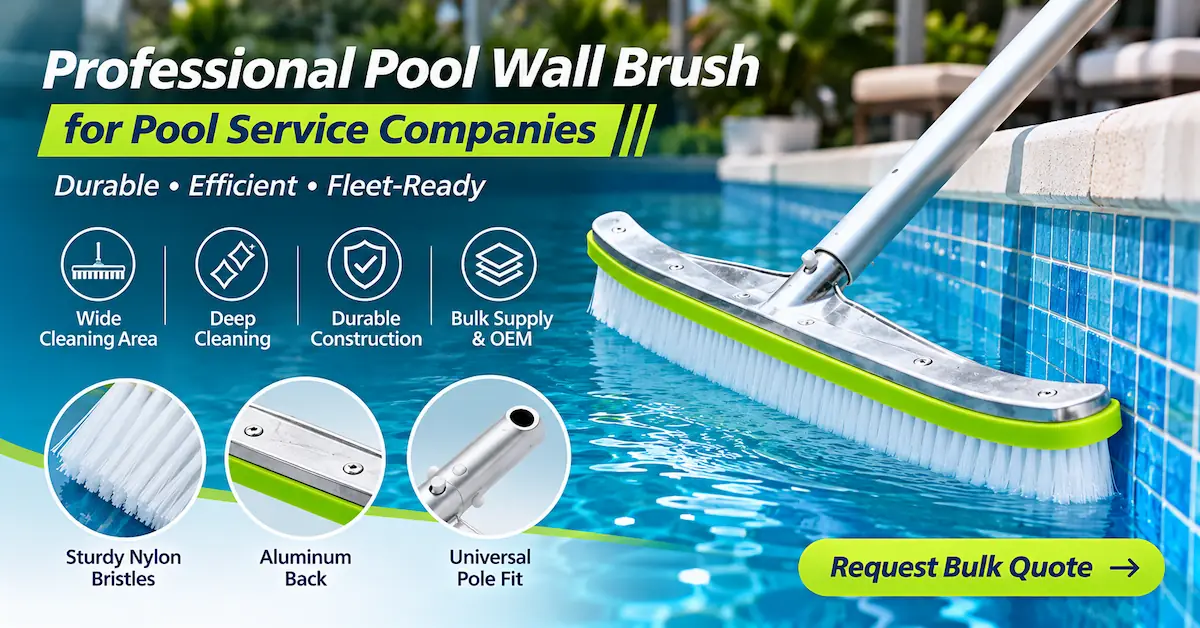
An 18-inch wall brush can be considered for general maintenance work.
The appropriate width depends on the technician's handling preferences, available pole, and pool geometry.
20-Inch Pool Wall Brushes
A 20-inch wall brush provides a wider cleaning head.
It may be useful for large, relatively open wall or floor areas where the head can maintain suitable contact.
However, its larger width does not automatically guarantee faster cleaning across every pool.
Curved and Round-Head Brushes
Curved or round-head designs can be evaluated for areas where a straight brush is difficult to position.
Potential applications include steps, corners, transitions, and selected curved surfaces.
The exact bristle arrangement and pole compatibility should be verified.
Operational Comparison
| Brush Configuration | Potential Use | Main Advantage | Limitation to Evaluate |
|---|---|---|---|
| 18-inch wall brush | General route maintenance | Balanced working width | May require more passes on large areas |
| 20-inch wall brush | Larger open pool surfaces | Wider cleaning coverage | Handling in confined areas |
| Curved-edge brush | Wall transitions and corners | Different contact geometry | May not replace a straight wall brush |
| Round-head brush | Selected corners and curved areas | Access to irregular shapes | Smaller effective contact area |
| Specialized heavy-duty brush | Finish-approved demanding tasks | Task-specific cleaning action | Potential surface incompatibility |
Purchasing takeaway: A professional service fleet usually benefits more from a limited set of complementary brush designs than from a large assortment of overlapping products.
4. What Technical Specifications Should Buyers Request Before Ordering?
When sourcing bulk pool brushes for pool service companies, buyers should request a written specification sheet for every selected product.
Descriptions such as "heavy duty," "professional," or "premium" are not precise enough for repeat procurement.
Pool Brush Technical Specification Checklist
| Specification | What Should Be Defined |
|---|---|
| Brush width | Nominal dimensions and agreed tolerance |
| Bristle material | Actual polymer or filament specification |
| Bristle stiffness | Approved construction or reference sample |
| Bristle length | Trim length and permitted variation |
| Bristle arrangement | Density, pattern, and coverage |
| Backing material | Plastic, aluminum, or other approved construction |
| Head geometry | Straight, curved, round, or specialized design |
| Connector | Socket dimensions and locking mechanism |
| Pole compatibility | Approved pole interface |
| Product weight | Agreed specification, where relevant |
| Assembly integrity | Required bristle and connector retention |
| Appearance | Color, finishing, and unacceptable defects |
| Packaging | Unit packing and master carton configuration |
Why Bristle Retention Matters
A brush can lose practical value if bristles detach prematurely.
Bristle retention depends on the material, tufting or attachment method, backing construction, and operating conditions.
Buyers should agree on an appropriate verification method and acceptance criteria.
Why Connector Design Matters
Professional technicians frequently attach and remove cleaning heads from telescopic poles.
A connection should remain secure during intended brushing and allow practical removal when required.
The connector should be evaluated using the actual poles used by the purchasing company.
A "universal" label alone is not sufficient evidence of compatibility.
Why Weight and Balance Matter
Brush weight and balance can influence handling, particularly when technicians use long telescopic poles.
A lightweight brush is not necessarily more durable, and a heavier brush is not automatically more effective.
The correct choice depends on the assembly and intended task.
5. Which BONNY Pool Brushes Are Suitable for Professional Sourcing Evaluation?
BONNY supplies swimming pool cleaning brushes and related accessories for international wholesale customers.
The company's Pool Accessories Catalogue includes different wall brush and specialty brush configurations that professional buyers can evaluate.
BONNY Product Comparison
| BONNY Product | Published Product Reference | Potential Service Application | Required Confirmation |
|---|---|---|---|
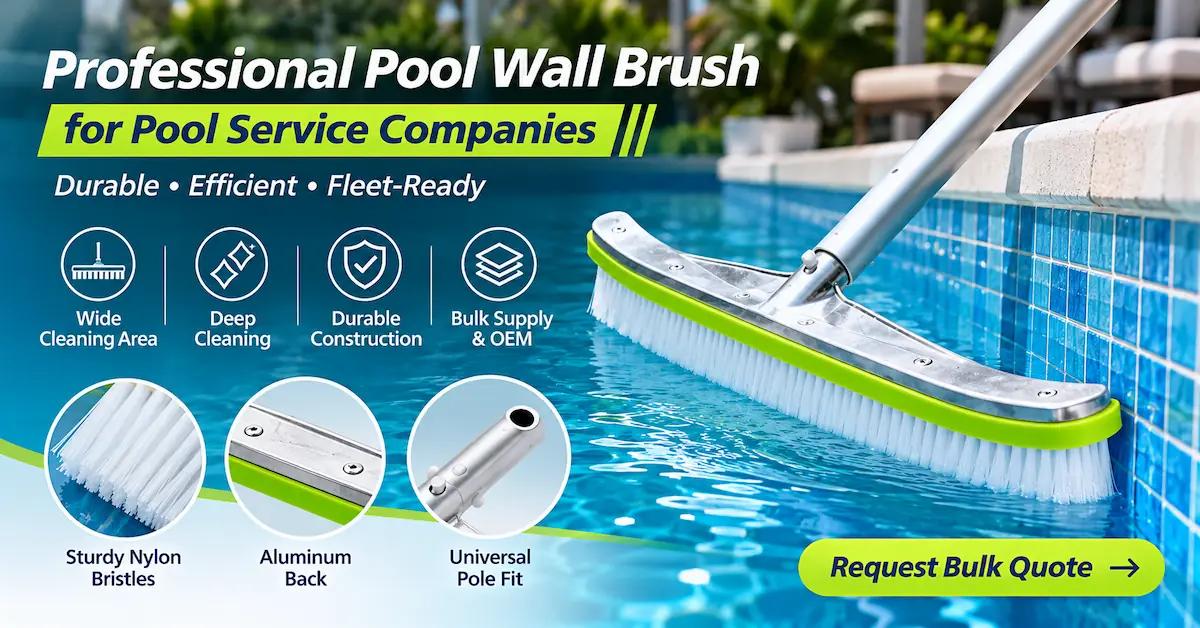
| 20-Inch Pool Wall Brush with Aluminum Handle | T614D / T614 appear on the product page | General pool wall and floor cleaning | Final model, construction, bristles, and pole fit |
| 18-Inch Deluxe Pool Brush with Aluminum Back | T854A / T854 appear on the product page | Standard route-maintenance brush | Final model, dimensions, and materials |
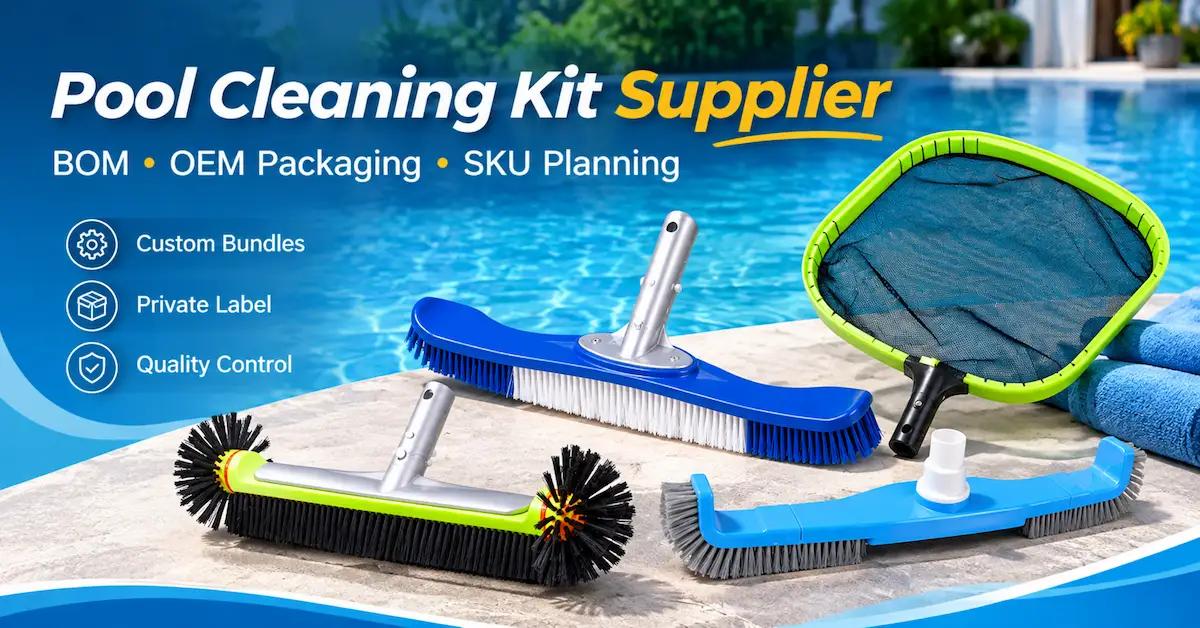
| 360-Degree Round Pool Wall Brush | WB081604 | Corners and curved cleaning areas | Head configuration and application suitability |
| 360 Pool Brush with Round Ends | WB0070 | Specialized corner and edge cleaning | Current availability and exact specifications |
| 2-in-1 Wall Cleaning and Suction Brush Head | Product-specific configuration | Selected combined cleaning tasks | Vacuum-system compatibility and intended use |
The table reflects published BONNY catalogue information. It does not claim that every item is appropriate for every surface or that all products are available for immediate bulk shipment.
20-Inch Pool Wall Brush
BONNY lists a 20-inch wall brush under the product page:
20-Inch Pool Wall Brush with Aluminum Handle
This product can be evaluated as a primary brush option for service companies handling larger pool surfaces.
The page displays the references T614D and T614 in different sections, so buyers should obtain a confirmed commercial model number before ordering.
18-Inch Deluxe Pool Brush
The official catalogue also includes:
18-Inch Deluxe Pool Brush with Aluminum Back
This model can be considered for general service applications where an 18-inch brush is preferred.
The listing contains both T854A and T854 references. Final material and variant details should be confirmed against the current technical specification.
360-Degree Round Pool Brush
BONNY lists a round-head cleaning brush under the model reference WB081604:
360-Degree Round Pool Wall Brush
This configuration is relevant when a service company requires a brush with different cleaning geometry.
The appropriate usage and compatibility should be established through sample evaluation.
Specialized Cleaning Brush
BONNY also lists a round-ended brush under reference WB0070.
At the time of review, its product page displayed an out-of-stock status.
Service companies interested in this design should confirm current availability or suitable alternatives before including it in a procurement plan.
How Many BONNY Brush Models Should a Service Company Select?
The answer depends on the company's pool portfolio.
An initial sourcing shortlist could consist of:
-
One primary wall brush size.
-
One alternative width for different pool geometries.
-
One specialty brush for curved areas and corners.
This is a suggested equipment strategy, not a preassembled BONNY service kit.
For additional information about brush categories, see BONNY's Guide to Pool Brush Types and Applications.
6. How Should Pool Service Companies Standardize Brushes Across Their Crews?
Standardization helps purchasing managers limit unnecessary variation.
However, the objective should not be to force every technician to use one brush for every pool.
A better approach is to create approved tool configurations for different service tasks.
Proposed Service Crew Equipment Structure
| Equipment Category | Purpose | Stocking Strategy |
|---|---|---|
| Primary wall brush | Routine maintenance | Standard issue for relevant technicians |
| Specialty corner brush | Steps and difficult geometry | Assigned to routes requiring it |
| Alternative surface brush | Pools with different finish requirements | Separate approved equipment |
| Spare brush | Replacement when a primary brush fails | Truck or central inventory |
| Replacement components | Applicable compatible parts | Stock only when supported and practical |
Why Standardize Pole Connections?
Technicians may carry telescopic poles for several cleaning tools.
Standardized and verified attachment interfaces can simplify equipment changes.
However, buyers should not assume that products from different manufacturers use identical clips or sockets.
Before approving a bulk order, verify the brush with the actual pole models used by the service team.
Assign Equipment by Route
A company servicing mainly fiberglass pools may require a different standard configuration from one operating primarily on plaster-finished residential pools.
Route managers can group customers by surface and cleaning requirements, then assign appropriate brushes.
Maintain a Backup Policy
A technician without a usable wall brush may be unable to complete a scheduled cleaning task properly.
A practical spare-parts policy helps reduce this risk.
The number of backup brushes should depend on historical failures, route schedules, and replenishment lead time.
7. How Can Pool Service Companies Calculate Bulk Brush Order Quantities?
Order quantity should be based on measurable operating needs rather than arbitrary purchasing targets.
A simple framework considers the initial equipment requirement, expected replacements, central safety stock, and supplier lead time.
Initial Stock Calculation
Initial brush requirement = Active service trucks × Approved brushes per truck + Central spare inventory
For example, assume a company operates 20 service trucks.
Each truck is assigned two approved brush types, and the company keeps five additional brushes in its warehouse.
The initial requirement would be:
20 × 2 + 5 = 45 brushes
This is an illustrative planning example, not a recommended fixed inventory level or a BONNY MOQ.
Replacement Demand
Replacement frequency depends on:
-
Number of completed service visits.
-
Pool surface conditions.
-
Brush material and construction.
-
Brushing intensity.
-
Storage and handling practices.
-
Actual defects and wear.
Instead of assuming that every brush lasts a fixed number of months, service companies should record replacement dates and reasons.
Reorder Point Formula
A practical inventory-planning formula is:
Reorder point = Average weekly brush usage × Replenishment lead time in weeks + Safety stock
For example, if observed replacement demand is five brushes per week, the confirmed replenishment period is six weeks, and safety stock is ten brushes:
Reorder point = 5 × 6 + 10 = 40 brushes
This is an illustrative model using assumed values.
Actual lead times, consumption, and safety stock must be determined by the buyer.
Why Record Replacement Reasons?
A broken connector and worn bristles are different failure mechanisms.
Recording these issues separately helps purchasing teams understand whether a problem relates to product quality, application, or handling.
8. How Should Service Companies Evaluate Brush Durability and Useful Life?
Professional buyers should measure actual operating life where possible.
Comparing brushes only by appearance or advertised durability can lead to poor purchasing decisions.
Service-Life Evaluation
A field evaluation can record:
-
Product model and batch.
-
Technician or service route.
-
Pool finishes cleaned.
-
Service visits completed.
-
Visible bristle wear.
-
Connector condition.
-
Handle and frame integrity.
-
Reason for replacement.
Suggested Sample Trial
A service company can issue representative samples to selected technicians.
The evaluation should include multiple pool types relevant to the company's actual operations.
Technicians can record handling, cleaning performance, attachment security, and visible wear over a defined period.
Compare Products Using Equivalent Conditions
Two brushes should not be compared as though they experienced identical wear if one was used mainly on smooth fiberglass surfaces and another on a more abrasive finish.
The trial should account for relevant differences in work conditions.
Cost Per Useful Service Visit
A practical economic metric is:
Brush cost per service visit = Landed brush cost ÷ Number of service visits completed before replacement
This helps buyers compare products according to observed usage.
It does not capture every element of labour productivity or surface-care quality, so it should be considered alongside technician feedback and cleaning performance.
Cost takeaway: A more expensive brush can be the better purchasing choice if it delivers demonstrably better value during its useful life. That conclusion must come from actual data rather than an assumed percentage improvement.
9. What Quality Tests Should a Wholesale Pool Brush Supplier Provide?
A professional wholesale purchase should define the characteristics that determine whether a brush is acceptable.
For pool service companies, the most important checks usually involve bristles, backing construction, connector compatibility, and overall assembly.
Recommended Pool Brush Quality Control Matrix
| Inspection Item | Suggested Verification | Potential Failure |
|---|---|---|
| Brush width | Measure against approved drawing | Incorrect size |
| Bristle material | Verify specified material | Wrong cleaning characteristics |
| Bristle length | Check agreed trim dimensions | Uneven cleaning |
| Bristle retention | Apply agreed retention method | Excessive shedding |
| Brush backing | Inspect structural integrity | Cracking or deformation |
| Aluminum components | Check approved construction and finish | Damage or unacceptable defects |
| Connector dimensions | Fit-test with approved pole | Incompatible attachment |
| Locking mechanism | Check engagement and removal | Accidental detachment |
| Assembly integrity | Inspect joints and fasteners | Loose components |
| Appearance | Compare with approved sample | Cosmetic inconsistency |
| Packaging | Verify protection and quantities | Shipping damage or short shipment |
Why Bristle Retention Testing Matters
Bristle shedding can reduce brush effectiveness and create maintenance inconvenience.
Buyers should discuss a suitable test method, sample size, and acceptance criteria with the supplier.
There is no universal bristle pull-force value that should be applied to every pool brush without regard to its design.
Why Connector Testing Matters
Pool service technicians may repeatedly apply force through long poles.
A connection should maintain appropriate engagement during its intended operation.
Buyers can ask for repeated attachment and removal checks, together with a practical field-use evaluation.
What About ISO 2859-1?
The ISO 2859-1:2026 acceptance sampling standard describes sampling schemes for inspection by attributes.
Buyers and suppliers may use an agreed sampling plan to evaluate defined production characteristics.
However, sampling does not replace product design verification, appropriate performance testing, or critical safety controls.
A manufacturer should not claim that a brush is ISO-certified simply because the buyer uses an ISO sampling framework.
Defect Classification
A purchasing specification can distinguish between:
Critical defects: Problems presenting unacceptable safety risks.
Major defects: Problems that prevent intended use or create unacceptable functional failure.
Minor defects: Cosmetic deviations within agreed limits.
The actual classification and acceptance criteria should be established before production.
10. What Manufacturing Capabilities Matter for Bulk Pool Brushes?
Manufacturing consistency influences product dimensions, bristle attachment, structural integrity, and repeat-order quality.
Different brush designs may require different processes.
Plastic Component Production
Plastic brush bodies and connectors may be manufactured using injection molding.
Buyers should confirm material specifications, dimensional tolerances, and acceptable molding defects.
Bristle Planting and Retention
Bristle-planting processes can influence tuft placement, attachment quality, and consistency.
A suitable process should be supported by agreed production controls and inspection requirements.
Metal Backing and Assembly
Some brush designs include aluminum backing components.
These require appropriate material selection, forming, finishing, and assembly.
Final Product Inspection
Finished brushes should be checked against approved samples, drawings, and packaging requirements.
BONNY Manufacturing Background
BONNY describes manufacturing capabilities including injection molding, bristle planting, product assembly, and engineering support.
These processes are relevant to selected products within its swimming pool accessory range.
The company also offers OEM and ODM services.
For a particular brush order, buyers should confirm which manufacturing processes apply to the selected model and which inspection procedures are included.
Learn More About BONNY Manufacturing
11. How Can Pool Service Companies Reduce Total Procurement Costs?
The lowest brush quotation does not necessarily provide the lowest operating cost.
A bulk sourcing decision should consider the complete financial effect of purchasing, using, and replacing the product.
Total Landed Cost
Total landed cost = Product cost + Packaging + Inspection + Freight + Insurance + Applicable import charges + Expected replacement costs
Depending on the project, customization and tooling may also need to be included.
Main Cost Drivers
| Cost Factor | Purchasing Implication |
|---|---|
| Bristle specification | Material and construction requirements |
| Brush width | Material consumption and carton size |
| Backing construction | Plastic or metal component costs |
| Connector design | Assembly and compatibility requirements |
| OEM branding | Custom marking or packaging |
| Order quantity | Production and purchasing arrangements |
| Inspection | Product acceptance requirements |
| Freight | Carton volume, weight and destination |
| Replacement frequency | Long-term procurement demand |
Wholesale Purchase vs Local Retail Replacement
Bulk purchasing may provide more predictable supply arrangements and allow companies to standardize equipment.
However, import freight, storage, working capital, and minimum order requirements should be considered.
The purchasing manager should compare the full landed cost with the cost of obtaining suitable products through local distribution.
Avoid Excessive Inventory
Large orders can create unnecessary stock if the selected design is later replaced or proves unsuitable.
A trial order or sample-based evaluation may be more appropriate before committing to a large recurring purchase.
12. OEM and Private-Label Pool Brushes for Service Companies
Not every service company needs customized branding.
For some buyers, purchasing established products under a consistent specification is sufficient.
For others, OEM customization can support equipment identification, franchise consistency, or resale through a branded distribution channel.
BONNY provides OEM and ODM support through its Engineering & Design Services.
Potential OEM Requirements
| Customization | Business Purpose | Verification Needed |
|---|---|---|
| Brush color | Fleet identification | Material and color approval |
| Logo | Brand recognition | Marking method and durability |
| Bristle configuration | Application-specific cleaning | Performance and retention testing |
| Head width | Route or customer requirements | Dimensional and functional review |
| Connector design | Fleet pole standardization | Mechanical compatibility |
| Packaging | Warehouse distribution | Carton protection and labeling |
| SKU labeling | Replenishment management | Accurate model identification |
| Custom construction | Differentiated product offering | Engineering and sample validation |
These are possible project requirements, not guaranteed options for every existing BONNY model.
OEM vs ODM
OEM generally involves manufacturing according to an approved design or customizing an existing product.
ODM may involve developing a new brush structure, connector, material combination, or design concept.
Changes to bristles, backing, or connectors should be evaluated for their effect on performance.
Recommended OEM Approval Process
Step 1: Define the intended pool surfaces and cleaning tasks.
Step 2: Select existing products or describe the required modifications.
Step 3: Approve technical specifications and reference samples.
Step 4: Conduct practical service trials.
Step 5: Review branding, packaging, and identification.
Step 6: Establish inspection requirements and approved product revisions.
Step 7: Confirm quotation, MOQ, and delivery arrangements.
Step 8: Plan repeat-order and change-notification procedures.
13. How Should Pool Service Companies Manage Supplier Replenishment?
A dependable supply arrangement should support repeat orders without uncontrolled changes to product specifications.
Establish an Approved Product List
Each approved brush should have a model reference, technical specification, and intended application.
The list should identify which products may replace others and which require separate approval.
Maintain a Golden Sample
An approved reference sample provides a physical comparison for subsequent shipments.
It should be linked to the corresponding drawing or specification revision.
Track Purchase and Replacement Data
Useful records include:
-
Quantity received.
-
Quantity issued to technicians.
-
Quantity remaining in stock.
-
Replacement frequency.
-
Defect and return reasons.
-
Lead-time performance.
-
Product revision changes.
Plan Reorders Before Stock Is Exhausted
Purchasing managers should monitor inventory against observed usage and confirmed replenishment lead times.
Suppliers should be informed of expected demand where appropriate.
However, forecast sharing does not replace a confirmed commercial agreement.
Control Product Substitutions
A supplier should obtain approval before changing critical specifications such as bristle material, backing design, or connector dimensions.
A visually similar replacement may behave differently in use.
14. Why Consider BONNY for Wholesale Pool Brush Sourcing?
Ningbo Bonny E-Home Co., Ltd., established in 1998, develops and manufactures swimming pool cleaning equipment and accessories for international customers.
Its official product catalogue includes wall brushes, curved and round-head designs, and other maintenance accessories.
Product Selection
BONNY provides multiple brush configurations that purchasing managers can evaluate for different service applications.
The appropriate model should be selected according to pool finish, brush geometry, attachment requirements, and the buyer's operating needs.
Manufacturing and Engineering
The company describes manufacturing capabilities including plastic molding, bristle planting, and product assembly.
For a specific model, buyers should confirm material and process details before approving the technical specification.
OEM and ODM Services
BONNY offers product customization, branding, packaging, and development support.
Service companies and distributors can discuss existing products or project-specific requirements.
International B2B Cooperation
BONNY works with overseas customers on product sourcing, sampling, customization, and export orders.
Prices, MOQ, delivery schedules, and available inspection documents should be confirmed for the actual order.
What Should Buyers Request?
A useful supplier evaluation should include:
-
Current product catalogue and technical specifications.
-
Representative sample availability.
-
Bristle and backing material information.
-
Pole compatibility requirements.
-
Agreed inspection criteria.
-
Packaging and carton quantities.
-
OEM options, if required.
-
Replenishment and change-management arrangements.
-
Updated wholesale quotation and production schedule.
Explore BONNY Pool Brushes and Accessories
15. Bulk Pool Brush RFQ Checklist for Pool Service Companies
A detailed request for quotation helps the supplier understand your actual equipment needs.
Recommended RFQ Template
| RFQ Item | Information to Provide |
|---|---|
| Buyer type | Pool service company, franchise, distributor, or contractor |
| Number of technicians | Active service personnel |
| Service coverage | Number and types of pools serviced |
| Pool surfaces | Plaster, fiberglass, vinyl, tile, or other finishes |
| Required brush types | Primary wall brush and specialty brushes |
| Preferred dimensions | Brush widths and head geometries |
| Bristle requirements | Material and approved stiffness |
| Pole compatibility | Existing pole specifications |
| Estimated order volume | Initial quantity and expected reorders |
| OEM requirements | Branding, colors, packaging, or custom designs |
| Quality inspection | Sample tests and acceptance criteria |
| Packaging | Unit packing and master carton requirements |
| Destination | Country and delivery location |
| Commercial terms | Price, MOQ, Incoterms, and proposed schedule |
Request Wholesale Pool Brush Pricing From BONNY
For an accurate quotation, provide BONNY with your preferred brush models, pool-surface requirements, service fleet size, estimated purchasing quantity, and destination country.
If your service company already uses a particular telescopic pole, include the relevant dimensions or a sample reference.
BONNY can review available products, confirm sample options, and discuss OEM customization or repeat-order arrangements.
Contact BONNY for Bulk Pool Brush Specifications, Samples and Wholesale Quotations
Frequently Asked Questions About Bulk Pool Brushes for Pool Service Companies
1. What are the best pool brushes for professional pool service companies?
The best choice depends on the surfaces being cleaned, the company's service routes, and the available telescopic poles. Professional buyers should evaluate a primary wall brush and appropriate specialty brushes against their actual operating requirements.
2. Is an 18-inch or 20-inch pool brush better for commercial cleaning?
An 18-inch brush may offer practical handling for general service, while a 20-inch brush provides wider coverage on suitable surfaces. Actual efficiency depends on geometry, handling, technician technique, and pool conditions.
3. Can nylon pool brushes be used on fiberglass and vinyl pools?
Suitable non-metallic brushes are commonly considered for these surfaces, but compatibility should be verified against the pool-finish manufacturer's instructions. Different nylon bristle constructions can have different stiffness.
4. How many pool brushes should a service company order in bulk?
Calculate the number required for active technicians, approved specialty applications, and replacement stock. Use observed wear rates and confirmed supplier lead times to estimate future order quantities.
5. How often should professional pool brushes be replaced?
Replacement should be based on actual wear, structural integrity, connector condition, and cleaning performance. There is no universal service-life interval appropriate for every brush and operating environment.
6. What should I inspect when receiving wholesale pool brushes?
Check product dimensions, bristle condition, retention, backing integrity, connector compatibility, packaging, SKU identification, and shipment quantities against the approved specification.
7. Can BONNY supply bulk pool brushes to maintenance companies?
BONNY supplies swimming pool cleaning equipment and accessories and works with international B2B customers. Specific brush availability, wholesale quantities, prices, and delivery arrangements should be confirmed directly.
8. Does BONNY offer OEM or private-label pool brushes?
BONNY offers OEM and ODM services, including product customization, branding, and packaging. Available customization options should be confirmed for the selected brush model.
9. Is buying pool brushes directly from China cheaper than purchasing locally?
It depends on unit pricing, order quantity, freight, inspection, storage, import charges, and actual replacement performance. Compare total landed cost rather than assuming an overseas quotation provides the lowest overall cost.
10. What should I include in a bulk pool brush quotation request?
Provide the brush types, pool surfaces, preferred widths, bristle requirements, pole compatibility, expected quantities, destination country, OEM needs, packaging requirements, and anticipated reorder frequency.
Conclusion
Sourcing bulk pool brushes for pool service companies requires a structured purchasing strategy focused on equipment standardization, surface compatibility, product durability, and repeat-order reliability.
For professional pool maintenance businesses, the best wholesale brush program is not simply the cheapest available product or the largest possible order.
It is a controlled selection of appropriate brush designs that technicians can use safely and effectively across their assigned service routes.
By approving technical specifications, evaluating real operating performance, monitoring replacement demand, and establishing supplier quality requirements, purchasing managers can make more informed equipment decisions.
A dependable procurement system should also account for landed cost, inventory availability, pole compatibility, and controlled product changes.
BONNY, operated by Ningbo Bonny E-Home Co., Ltd., offers a range of swimming pool brushes and cleaning accessories alongside OEM and ODM services for overseas business customers.
Whether you manage a regional pool maintenance company, operate multiple service crews, or distribute professional pool cleaning equipment, BONNY can review your requirements and discuss suitable wholesale brush options.