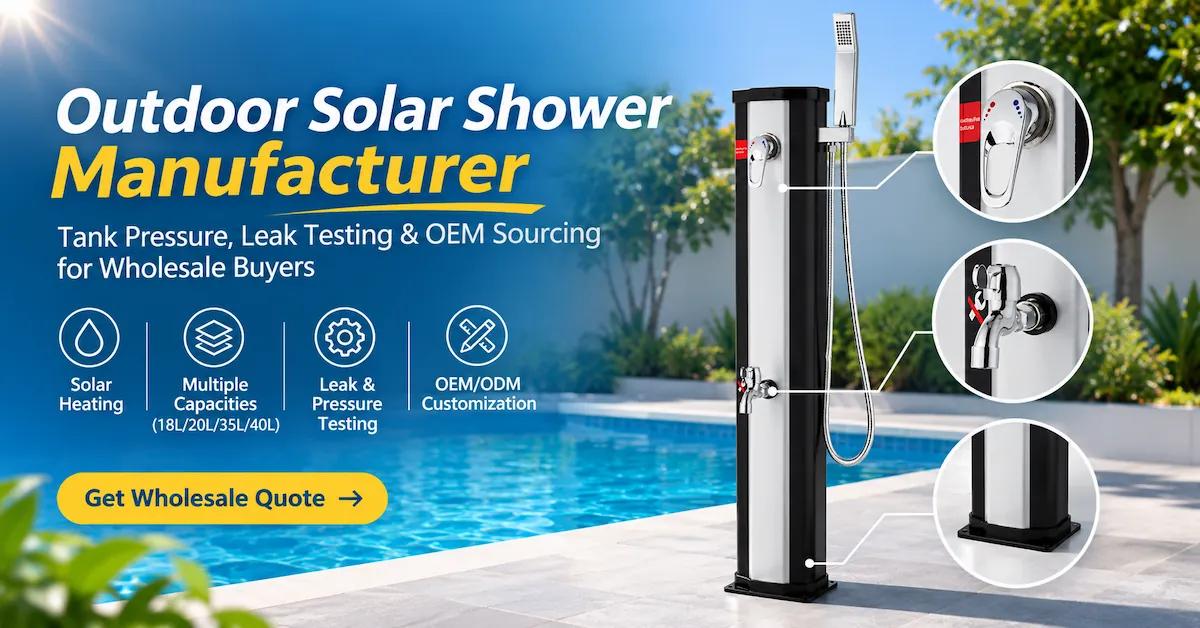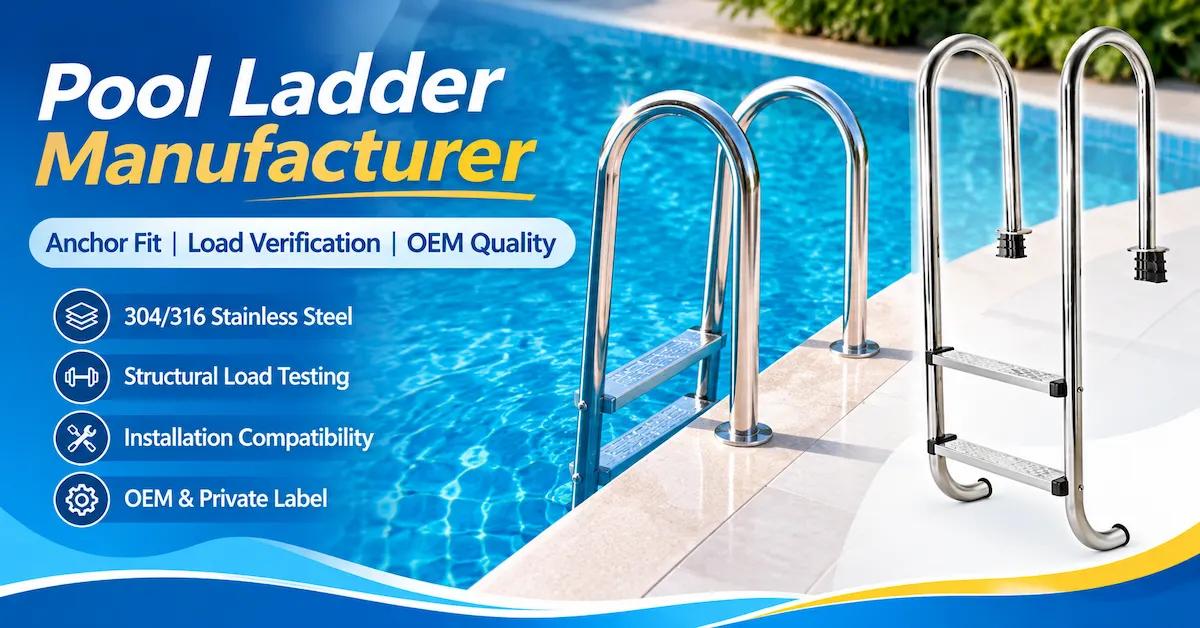

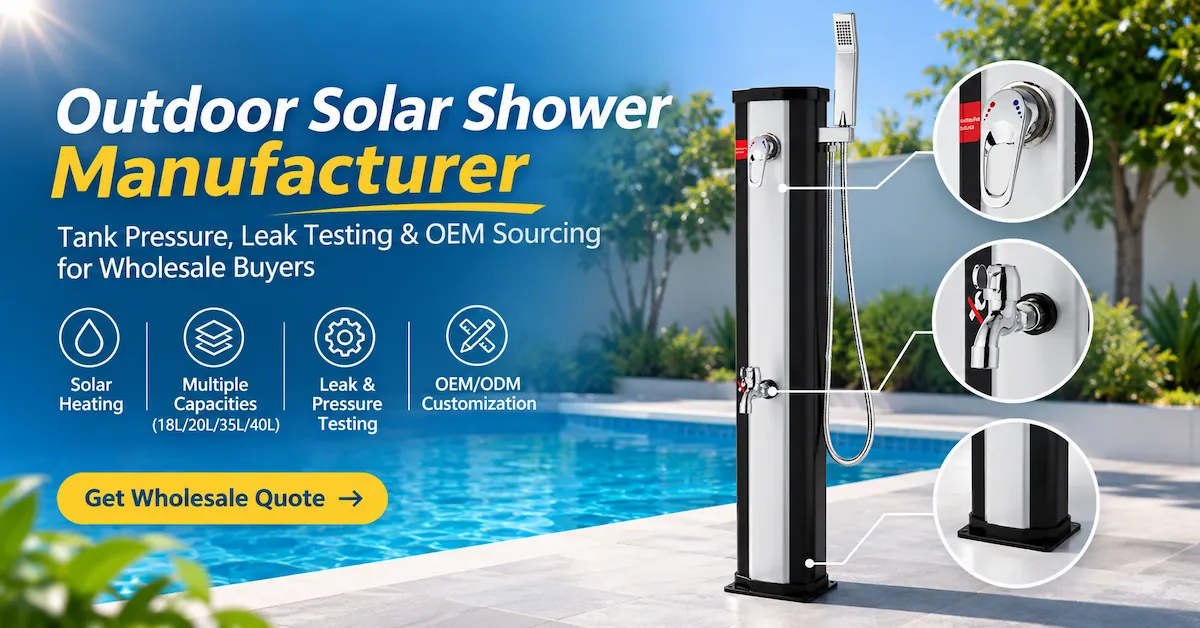
Quick Answer: A reliable outdoor solar shower manufacturer should provide confirmed tank-capacity specifications, water-pressure limits, material information, plumbing connection drawings, leak-test procedures, mounting instructions, and OEM quality requirements. Before wholesale purchasing, importers should verify representative samples for water tightness, valve operation, solar heat-up behavior, installation stability, and drainage. Solar heating performance varies with sunlight and ambient conditions; a solar shower does not automatically provide constant-temperature or scald-protected water.
Outdoor solar showers are used around swimming pools, residential gardens, holiday properties, outdoor leisure areas, and selected recreational facilities.
Unlike conventional electrically heated showers, many solar shower columns use sunlight absorbed by their bodies to warm stored water.
This can provide convenient warm-water rinsing without a dedicated electrical heating element.
However, successful B2B sourcing involves much more than selecting an attractive shower column.
A product may have a suitable capacity but be incompatible with the destination market's water pressure.
Another may look durable but develop leaks around its hose connector, control valve, showerhead joint, or tank body.
Improper mounting, poor drainage, and uncontrolled water temperatures can create additional problems.
For overseas wholesalers and private-label brands, these issues may result in complaints, replacement shipments, installation difficulties, and inconsistent customer experiences.
This guide explains how to evaluate technical specifications, manufacturing quality, and OEM supply arrangements before committing to bulk orders.
Key Takeaways for B2B Solar Shower Buyers
-
Tank capacity is not the same as usable warm-water output. Flow rate, incoming water temperature, sunlight, and mixing affect actual shower duration.
-
Pressure compatibility is critical. The water supply must remain within the selected product's approved operating limits.
-
Leak testing should cover the complete assembly. Tanks, valves, fittings, connectors, and showerheads all require attention.
-
Outdoor durability depends on materials and design. UV exposure, thermal cycling, corrosion, and winter conditions can influence service life.
-
Installation must match the site. Base dimensions, anchors, water connections, and drainage should be reviewed before shipping.
-
OEM quality requires specification control. Approved samples, component drawings, inspection records, and packaging requirements help maintain consistency across repeat orders.
1. What Should Buyers Verify When Choosing an Outdoor Solar Shower Manufacturer?
A professional solar shower purchasing specification should define the intended environment and the product's required functions.
For example, a shower intended for occasional private garden use may have different requirements from equipment used frequently at a resort or outdoor recreation facility.
Outdoor Solar Shower Technical Specification Checklist
| Specification | What Buyers Should Confirm | Main Purchasing Risk |
|---|---|---|
| Tank capacity | Nominal and usable water volume | Incorrect performance expectations |
| Heating method | Passive solar heating or another defined system | Misleading heating claims |
| Material | Tank body, structural housing and fitting materials | Premature degradation |
| Water pressure | Approved operating and maximum pressure | Leaks or structural damage |
| Water connection | Thread, hose fitting or connector dimensions | Installation incompatibility |
| Temperature control | Actual valve and mixing configuration | Unexpected hot-water delivery |
| Showerhead | Flow rate, dimensions and operating range | Unsuitable rinsing performance |
| Foot-wash outlet | Availability and control mechanism | Incorrect product configuration |
| Base structure | Dimensions, fixing points and hardware | Installation instability |
| Drainage | Approved emptying and winter-storage procedure | Freeze damage |
| Product documentation | Drawings, instructions and relevant test evidence | Installation and safety problems |
| OEM services | Colors, branding, packaging and design options | Uncontrolled customization |
Procurement takeaway: Buyers should request a model-specific specification sheet before comparing quotations.
2. How Does an Outdoor Solar Shower Actually Heat Water?
Many outdoor solar shower columns use passive solar thermal heating.
Sunlight reaches the shower body, where absorbed energy warms the structure and the water stored inside it.
Unlike a photovoltaic system, this arrangement does not necessarily involve a solar panel, electrical conversion, a battery, or an electric heating element.
The exact construction depends on the selected model.
What Affects Solar Heating Performance?
The main variables include:
-
Sunlight intensity and duration.
-
Outdoor air temperature.
-
Wind conditions.
-
Tank color and surface characteristics.
-
Stored water volume.
-
Incoming water temperature.
-
Heat loss through the shower body.
-
Water use and replenishment.
A manufacturer should not promise a fixed heat-up time without defining suitable test conditions.
Does a Larger Tank Produce Hotter Water?
Not necessarily.
A larger tank can store more water, but that does not guarantee a higher temperature.
The temperature reached depends on available solar energy, heat absorption, thermal losses, and the volume of water being heated.
Two products with different tank sizes can provide different amounts of warm water under the same weather conditions.
Can an Outdoor Solar Shower Maintain a Constant Temperature?
A passive solar shower does not automatically maintain a fixed water temperature.
Some shower designs include a manual mixing valve that allows users to combine water from different paths.
However, a manual mixing valve is not equivalent to a certified thermostatic temperature-control device.
Any thermostatic function should be verified for the specific model.
Engineering takeaway: Evaluate solar heating performance separately from temperature-control capability.
For a general introduction to solar shower applications, see BONNY's Solar Shower Column Guide.
3. How Should Buyers Choose Between 18L, 20L, 35L and 40L Outdoor Showers?
Tank capacity is one of the first specifications buyers compare.
However, the correct capacity depends on expected usage, site conditions, available water pressure, and the intended customer.
BONNY's Outdoor Products Catalogue includes outdoor shower products described with 18L, 20L, 35L and 40L capacities.
The published product titles are useful for identifying configurations to discuss, but final specifications should be confirmed before ordering.
Solar Shower Capacity Comparison
| Catalogue Capacity | Product Configuration Appearing in BONNY's Range | Potential Buyer Application | Main Verification |
|---|---|---|---|
| 18L | Free-standing solar-heated pool shower | Compact residential outdoor installations | Capacity, mounting and water connections |
| 20L | Outdoor garden and pool solar shower configurations | Garden retailers and residential pool suppliers | Tank material, pressure and valve arrangement |
| 35L | Larger solar shower column configurations | Buyers seeking greater water storage | Usable volume, dimensions and heat-up performance |
| 40L | Large-capacity aluminum outdoor shower column | Outdoor shower distributors | Confirm heating method, material and intended application |
These are catalogue-described configurations, not verified performance tiers. The 40L listing should not be assumed to use passive solar heating without confirmation.
Is a 20L Solar Shower Suitable for Residential Pools?
A 20L configuration may be worth evaluating for residential garden and poolside applications.
However, the useful number of rinses cannot be determined from nominal tank capacity alone.
Flow rate, mixing behavior, water temperature, and duration of use all influence actual consumption.
When Should Buyers Consider 35L?
A 35L unit may be appropriate where greater stored volume is desired.
Before selecting it, buyers should consider the larger overall structure, mounting requirements, carton dimensions, and total weight when filled.
More stored water can also mean more water must be drained or managed during periods of non-use.
Does Higher Capacity Mean Better Commercial Value?
Not automatically.
Larger products may require additional materials, packaging space, and handling.
The best configuration balances the customer's intended use with technical and commercial requirements.
4. Which Materials Are Suitable for Outdoor Solar Shower Columns?
Outdoor solar showers may incorporate plastic reservoirs, metal housings, valves, connectors, and other components.
Materials should be assessed according to their actual function.
PVC and Other Plastic Components
Some solar shower products use PVC or other polymer materials in their bodies and internal components.
Important considerations include material grade, compatibility with water, outdoor exposure, structural requirements, and thermal behavior.
The presence of PVC or ABS in a product description does not automatically establish its suitability for every operating temperature or pressure.
ABS Components
ABS may be used for selected molded housings or fittings.
Its performance depends on the specified grade, manufacturing conditions, and intended environment.
Aluminum Shower Columns
Aluminum can offer different structural and appearance characteristics.
Buyers should confirm the actual alloy, finishing system, water-contact components, and corrosion requirements.
Stainless Steel Components
Stainless steel may be used in selected outdoor shower structures or fittings.
The exact grade and finishing process influence suitability.
Material selection should reflect the intended environment, particularly for coastal installations and locations exposed to cleaning chemicals.
Material Evaluation Table
| Material Category | Potential Application | Recommended Buyer Verification |
|---|---|---|
| PVC | Selected tank or body components | Grade, water-contact suitability and temperature limits |
| ABS | Molded housings and fittings | Grade, impact performance and outdoor suitability |
| Aluminum | Structural column or housing | Alloy, coating, joints and corrosion resistance |
| Stainless steel | Structural and water-contact components | Grade, finishing and environmental compatibility |
| Elastomeric seals | Valves and pipe joints | Temperature, pressure and aging compatibility |
| Copper-alloy or other metal fittings | Selected plumbing components | Material identification and water-contact requirements |
Why Is UV Resistance Important?
Outdoor shower bodies are exposed to sunlight over extended periods.
Depending on material formulation, UV exposure may contribute to discoloration, brittleness, surface changes, or reduced mechanical performance.
Buyers should request appropriate evidence for any claimed UV resistance.
Avoid treating phrases such as "all-weather," "heavy duty," or "UV-proof" as verified specifications without supporting information.
5. How Do Water Pressure and Plumbing Connections Affect Reliability?
Water-pressure compatibility is one of the most important technical factors in outdoor shower procurement.
Different installations may use garden hoses, permanent plumbing, pressure regulators, or other supply arrangements.
A solar shower should only be connected in accordance with its approved installation instructions.
Operating Pressure vs Maximum Pressure
The operating pressure range describes the conditions for normal use.
The maximum permitted pressure identifies an upper limit that should not be exceeded.
These values are not interchangeable.
A product may require a minimum supply pressure for satisfactory flow while also having an upper pressure limit for its components.
Important Plumbing Interfaces
Buyers should verify:
-
Water inlet dimensions.
-
Connector type and thread specification.
-
Hose or pipe compatibility.
-
Control valve configuration.
-
Showerhead connection.
-
Foot-wash outlet connections, if included.
-
Required pressure regulation.
-
Applicable backflow-prevention arrangements.
-
Drainage and winterization instructions.
Descriptions such as "standard garden hose connection" may not establish compatibility with every destination market.
What Happens if Supply Pressure Is Too High?
Excessive pressure may contribute to leakage, component stress, or damage.
Buyers should confirm whether pressure regulation is required for the intended installation.
Never infer a universal permitted pressure from a similar-looking shower.
Does a Solar Shower Require Electricity?
Many passive solar shower columns heat stored water using direct sunlight and do not need electricity for heating.
However, a water supply and suitable pressure may still be required.
Products incorporating pumps, electrical heaters, or control systems must be evaluated separately.
Engineering takeaway: The buyer should approve the actual connection and pressure specifications before retail packaging or project installation.
6. What Leak Tests Should an Outdoor Solar Shower Manufacturer Perform?
Leak resistance is a critical requirement because a solar shower contains multiple water-contact components.
Water leakage can occur at threaded connectors, control valves, seals, tank joints, showerhead fittings, and other interfaces.
The appropriate verification method depends on the product design and permitted pressure.
Recommended Leak-Test Locations
| Test Location | Potential Failure | Suggested Verification |
|---|---|---|
| Tank body | Cracking or material defects | Visual inspection and suitable pressure/leak evaluation |
| Tank joints | Water seepage | Joint integrity test |
| Water inlet | Incorrect seal or fitting | Connection leak test |
| Mixing valve | Leakage or malfunction | Functional operation test |
| Showerhead connection | Loose fitting | Assembly and leak test |
| Foot-wash outlet | Valve or seal leakage | Outlet operation and leakage check |
| Internal piping | Poor joints or damaged tubing | Appropriate water-circuit test |
| Drain connection | Incomplete sealing | Drain closure and leakage inspection |
What Should a Pressure Test Record Include?
An appropriate test record should identify:
-
Product model and revision.
-
Test medium.
-
Applied pressure.
-
Test duration.
-
Product configuration.
-
Operating conditions.
-
Acceptance criteria.
-
Observed result.
-
Inspection date and traceability information.
Test values should be established according to the product specification and appropriate engineering requirements.
A high pressure-test value does not automatically establish that the product is safe under every real-world installation condition.
Should Buyers Test Only the Water Tank?
No.
A complete shower assembly includes several components that can develop leaks independently.
A suitable validation plan should cover the finished water path and critical interfaces.
Does Passing One Sample Test Guarantee Every Shipment?
No.
Sample testing establishes evidence for the tested configuration.
Bulk production also requires controlled components, consistent assembly, appropriate process checks, and defined inspection procedures.
Procurement recommendation: Include leak testing and critical connection checks in the product approval and production quality agreement.
7. How Can Buyers Evaluate Solar Heating and Temperature-Control Performance?
Heating performance should be evaluated under documented conditions rather than relying on an isolated maximum-temperature claim.
Recommended Solar Heating Evaluation
A buyer can ask for a controlled sample assessment covering:
Initial conditions: Record starting water temperature, volume, and ambient conditions.
Sun exposure: Record relevant exposure duration and weather conditions.
Temperature measurements: Measure water temperature using an appropriate method.
Water delivery: Evaluate the temperature and flow behavior during actual discharge.
Repeatability: Compare results under reasonably comparable conditions.
Why Maximum Temperature Requires Caution
Water inside a solar shower can become very hot after extended exposure to strong sunlight.
This creates a potential scalding hazard.
Appropriate user instructions should explain how to check the discharge temperature and use the controls safely.
Do not claim that the shower is anti-scald or temperature-limited unless the specific configuration has suitable supporting evidence.
Solar Heating Evaluation Checklist
| Evaluation | Buyer Question |
|---|---|
| Heating method | How does the selected model absorb solar energy? |
| Test conditions | Under what sunlight and temperature conditions was it evaluated? |
| Water temperature | How is outlet temperature measured? |
| Temperature control | Manual mixing or verified thermostatic control? |
| Flow performance | What is the specified flow rate under defined pressure? |
| User safety | What warnings and instructions are supplied? |
| Repeated use | How does incoming water affect the next shower? |
For commercial projects, a suitable hot-water system should be selected according to the facility's operating requirements.
A passive solar shower should not be assumed to provide the same temperature control as an engineered central hot-water installation.
8. Installation, Drainage and Water Hygiene: What Should Importers Check?
Outdoor shower performance depends partly on the installation location.
A suitable product still requires a suitable mounting surface, water supply, drainage arrangement, and maintenance plan.
Mounting Stability
Freestanding shower columns may use base plates or other anchoring systems.
Buyers should obtain drawings showing:
-
Overall dimensions.
-
Base dimensions.
-
Fixing-point positions.
-
Required fasteners.
-
Mounting-surface requirements.
-
Water inlet location.
-
Drainage or winterization arrangement.
The product's mounting system should be evaluated for the intended site.
Terms such as "portable" or "freestanding" do not necessarily mean the product can be used safely without secure fixing.
Winter Drainage
Water remaining inside a shower can expand when it freezes, potentially damaging the tank, valves, fittings, or connections.
Buyers supplying colder markets should confirm whether the unit can be completely drained and how it should be stored or protected.
Do not describe a product as frost-proof without model-specific evidence.
Water Stagnation and Hygiene
Water remaining unused in a shower can create hygiene concerns.
The CDC identifies warm water, stagnation, biofilm, and inadequate disinfectant control as factors associated with Legionella growth in water systems.
A shower may generate aerosols, making water-management practices particularly relevant.
For resorts, hotels, recreational facilities, and other commercial sites, the installation should be assessed under the facility's applicable water hygiene and maintenance procedures.
A passive solar shower should not be assumed to satisfy commercial water-temperature or hygiene controls merely because its water can become hot in sunlight.
Buyer Requirements
Request product-specific cleaning, flushing, drainage, and maintenance instructions.
Also confirm the applicable requirements for connection to the destination market's water supply, including any necessary backflow prevention and water-contact material documentation.
Installation takeaway: A safe installation depends on both product design and site-specific plumbing and maintenance decisions.
9. BONNY Outdoor Solar Shower Products: Which Options Should Buyers Evaluate?
Ningbo Bonny E-Home Co., Ltd. offers outdoor pool and garden products, including several solar shower column configurations.
The company's official catalogue provides a starting point for comparing capacities, body designs, and potential applications.
BONNY Outdoor Shower Product Comparison
| Published Product Description | Listed Category Feature | Main Sourcing Consideration |
|---|---|---|
| BN 18L Free-standing Outdoor Solar Heated Pool Shower | 18L solar shower configuration | Capacity, materials, base and water connection |
| BONNY 20L Small Size Outdoor Garden Pool Portable Solar Shower | 20L outdoor solar shower | Actual material, dimensions and water pressure |
| BONNY Customized Black 20L Freestanding PVC Solar Shower | 20L two-section design | Section connections, seals and assembly |
| BONNY Blue 20L Freestanding PVC Solar Shower | 20L blue two-section configuration | Color consistency, fittings and packaging |
| BONNY High Capacity 35L Outdoor Solar Shower | 35L large-capacity product | Heating behavior, dimensions and stability |
| BONNY 35L Solar Outdoor Garden Shower Column | 35L outdoor configuration | Material verification and installation |
| 40L Large-Capacity Aluminum Outdoor Shower Column | 40L outdoor shower column | Confirm whether this model is solar-heated |
| BONNY Outdoor Shower with Thermostatic Faucet | Thermostatic function appears in the product title | Verify actual control design and supporting performance evidence |
This table reflects published catalogue descriptions. It does not establish verified pressure ratings, heating times, exact material grades, or confirmed product availability.
What Should Buyers Request From BONNY?
Before ordering, request the current catalogue sheet for the selected model.
It should identify the complete product dimensions, water-circuit design, actual materials, inlet specification, pressure limits, tank capacity, temperature-control features, mounting hardware, and available documentation.
If a published product title differs from the current technical sheet, the approved specification should govern the order.
Explore BONNY Outdoor Solar Shower Products
10. How Does Manufacturing Quality Affect Outdoor Solar Shower Performance?
A reliable outdoor solar shower depends on consistent materials, components, and assembly.
The relevant manufacturing processes vary according to the selected product.
Plastic Component Manufacturing
For products incorporating molded plastic parts, manufacturers should control material grade, component dimensions, appearance, and critical mating surfaces.
Metal Components and Surface Finishing
Metal housings, mounting plates, and fittings should meet the required structural and finishing specifications.
Coatings and other finishes should be selected for the intended outdoor environment.
Water-Circuit Assembly
Valves, seals, connectors, and internal tubing should be assembled according to approved requirements.
Incorrect sealing or incompatible parts may create leakage even when the main tank is correctly manufactured.
Final Product Verification
The complete assembly should be inspected for function, leakage, appearance, and packaging accuracy.
BONNY Manufacturing Background
BONNY was established in 1998 and describes manufacturing capabilities including injection molding, blow molding, extrusion, assembly, and product development.
These capabilities support the company's broader pool equipment business.
For solar shower procurement, buyers should confirm which production stages are performed in-house and which components or processes involve external suppliers.
The company can discuss OEM and ODM project requirements through its Engineering & Design service.
11. What Quality Control Plan Should Wholesale Solar Shower Buyers Require?
Wholesale buyers should establish inspection criteria before approving production.
Quality assurance should address both product-specific technical performance and shipment consistency.
Recommended Solar Shower QC Matrix
| Inspection Item | Recommended Check | Risk Controlled |
|---|---|---|
| Body material | Verify approved material specification | Material substitution |
| Tank capacity | Confirm nominal and specified volume | Product mismatch |
| Product dimensions | Compare with approved drawing | Installation or packaging errors |
| Water circuit | Inspect connections and joints | Leakage |
| Valve operation | Verify specified functionality | Incorrect control behavior |
| Showerhead | Check assembly and intended flow | Poor operation |
| Mounting base | Verify dimensions and hardware | Installation problems |
| Surface appearance | Inspect against approved sample | Retail quality issues |
| Product labeling | Confirm specifications and warnings | Customer confusion |
| Packaging | Verify protection and components | Transit damage |
Factory Sample Approval
A representative sample should be evaluated against the approved specification.
Where relevant, the sample should be assessed for:
-
Connection compatibility.
-
Water leakage.
-
Valve operation.
-
Solar heating behavior.
-
Safe temperature handling.
-
Mounting and structural stability.
-
Drainage.
-
Packaging protection.
Batch Inspection and ISO 2859-1
ISO 2859-1:2026 provides sampling schemes indexed by acceptance quality limit for inspection by attributes.
It may support an agreed incoming or pre-shipment sampling plan.
However, statistical acceptance sampling does not establish long-term reliability or replace necessary product-specific safety and performance tests.
Buyers should define critical defects, functional acceptance requirements, and inspection responsibilities separately.
12. OEM and Private-Label Outdoor Solar Shower Manufacturing
OEM and ODM services allow distributors and brand owners to develop products tailored to their markets.
BONNY describes OEM/ODM support for product design, material choices, color customization, private labeling, and packaging.
Common OEM Customization Requirements
| Customization | Purpose | Engineering Consideration |
|---|---|---|
| Logo and branding | Private-label sales | Suitable marking method |
| Body color | Product differentiation | Approved color and material formulation |
| Tank capacity | Target application | Structural and heating implications |
| Showerhead | User preference | Flow and connector compatibility |
| Water fittings | Regional installation | Correct threads, seals and pressure |
| Foot-wash outlet | Added function | Additional joints and leakage risk |
| Mounting base | Site compatibility | Stability and fixing requirements |
| Packaging | Retail or wholesale distribution | Product protection and carton dimensions |
| Product instructions | Market readiness | Installation, hygiene and safety information |
Not every customization is necessarily available for every existing BONNY model.
OEM vs ODM Solar Showers
OEM typically involves production or customization according to an approved specification.
ODM may require a new structure, tank design, water circuit, prototype, or development process.
Changes to tank geometry, pressure-bearing components, or plumbing connections may require additional technical verification.
Recommended OEM Development Workflow
Step 1 — Define the market. Identify the target customer, climate, water supply, and intended installation.
Step 2 — Select a reference configuration. Review suitable BONNY outdoor shower models.
Step 3 — Confirm technical requirements. Establish capacity, materials, pressure, valve design, and mounting.
Step 4 — Develop or customize samples. Evaluate any required changes.
Step 5 — Validate the product. Review leak resistance, functions, heating behavior, and safety information.
Step 6 — Approve artwork and packaging. Confirm branding, instructions, and product identification.
Step 7 — Establish production controls. Agree on inspection and change-management requirements.
Step 8 — Confirm commercial arrangements. Finalize MOQ, quotation, lead time, and shipment requirements.
Learn About BONNY OEM and ODM Manufacturing
13. What Determines Wholesale Outdoor Solar Shower Cost and Lead Time?
The price of an outdoor solar shower depends on its structure and commercial specifications.
A larger capacity does not always mean better value for the buyer's intended market.
Major Cost Factors
| Cost Driver | Potential Purchasing Impact |
|---|---|
| Tank capacity | Material use and product dimensions |
| Material grade | Component cost and suitability |
| Water control system | Valve and fitting requirements |
| Showerhead | Design and component selection |
| Foot-wash outlet | Additional plumbing and assembly |
| Structural base | Mounting components and packaging |
| OEM branding | Printing, color and artwork |
| Custom tooling | Development and amortization |
| Quality verification | Inspection and testing expenses |
| Carton dimensions | Storage and international freight |
Total Landed Cost
A useful purchasing framework is:
Total landed cost = Product cost + Tooling allocation + OEM customization + Packaging + Inspection + Freight + Insurance + Applicable import charges + Expected replacement costs
This is a general procurement model, not a BONNY quotation.
MOQ and Production Lead Time
MOQ depends on the model, order quantity, customization, materials, and packaging requirements.
New tooling or major structural changes may extend the project schedule.
Buyers should request confirmed quotation terms and production arrangements for the selected configuration.
Packaging and Freight
Tall shower columns can require considerable carton space.
A two-section design may have different packing requirements from an integrated column.
However, a disassembled configuration also introduces additional joints and assembly operations that require verification.
The best shipping configuration should balance freight cost, assembly quality, product protection, and customer convenience.
14. Common Procurement Risks and How to Prevent Them
Risk 1: Assuming All Solar Showers Heat Water Equally
Solution: Request heating evaluations under defined conditions rather than assuming capacity alone predicts performance.
Risk 2: Incorrect Water Pressure
Solution: Confirm the approved operating pressure and the destination market's supply arrangements.
Risk 3: Leakage at Valves and Fittings
Solution: Include complete water-circuit leak testing in the acceptance plan.
Risk 4: Unverified Thermostatic Claims
Solution: Confirm whether the selected model uses a manual mixer or a genuinely validated temperature-control system.
Risk 5: Installation Mismatch
Solution: Obtain base dimensions, fixing requirements, and connection drawings before ordering.
Risk 6: Inadequate Winterization
Solution: Verify drainage and storage instructions for markets where freezing conditions occur.
Risk 7: Uncontrolled OEM Changes
Solution: Maintain approved drawings, materials, samples, and revision records.
Risk 8: Incomplete User Instructions
Solution: Confirm that packaging and instructions explain suitable installation, temperature precautions, cleaning, drainage, and intended use.
15. Why Consider BONNY as an Outdoor Solar Shower Manufacturing Partner?
Ningbo Bonny E-Home Co., Ltd. is a Ningbo-based manufacturer and supplier of swimming pool equipment and accessories.
The company was established in 1998 and serves international business customers through product supply and OEM/ODM cooperation.
Outdoor Shower Product Range
BONNY's official catalogue displays several outdoor shower configurations, including solar-heated and other outdoor shower columns with different published capacities.
This allows buyers to begin evaluating products according to the required application.
Customization Support
BONNY describes private-label, material, color, packaging, and product-development services.
Buyers can discuss their technical and commercial requirements with its team.
Manufacturing and Engineering Resources
BONNY's published company information identifies factory operations, engineering resources, and several manufacturing processes.
The actual manufacturing and inspection arrangement for a selected solar shower should be confirmed during supplier qualification.
Export-Oriented Purchasing
The company works with overseas buyers on specifications, samples, manufacturing requirements, and shipment planning.
For outdoor solar shower projects, customers should obtain current specifications and product-specific supporting evidence before approving an order.
16. Outdoor Solar Shower Manufacturer RFQ Checklist
A detailed request for quotation helps suppliers evaluate the required configuration and prepare a more accurate commercial proposal.
| RFQ Item | Information to Provide |
|---|---|
| Product category | Outdoor solar shower column |
| Intended use | Residential pool, garden, resort or other defined application |
| Capacity | Preferred 18L, 20L, 35L or another confirmed configuration |
| Material | Required material or request for assessment |
| Water supply | Available pressure and connection arrangement |
| Heating requirements | Expected operating environment and performance expectations |
| Temperature control | Manual mixing or specified control requirements |
| Showerhead | Preferred size and flow requirements |
| Additional functions | Foot wash or other accessories |
| Installation | Base, fixing, connection and drainage requirements |
| OEM requirements | Logo, color, packaging or structural changes |
| Quality requirements | Leak tests, functional checks and relevant documents |
| Estimated quantity | Initial and expected repeat-order volume |
| Destination | Country and distribution channel |
| Commercial terms | MOQ, price, Incoterms and delivery schedule |
Request an OEM or Wholesale Solar Shower Quotation
For an efficient enquiry, send BONNY your target tank capacity, application, destination market, expected quantity, material preferences, and required customization.
If you already have a reference product or installation drawing, include it with your enquiry.
BONNY can review the requirements, discuss suitable catalogue options or product-development feasibility, and confirm the applicable commercial arrangements.
Contact BONNY for Outdoor Solar Shower Specifications, OEM Samples and Wholesale Pricing
Frequently Asked Questions About Outdoor Solar Shower Manufacturers
1. What should I look for in an outdoor solar shower manufacturer?
Evaluate the supplier's product range, material specifications, water-pressure compatibility, leak-test procedures, installation documentation, quality controls, and OEM capabilities. Request representative samples and model-specific specifications before bulk purchasing.
2. How does an outdoor solar shower heat water without electricity?
Many solar shower columns use passive solar heating. Sunlight warms the shower body and stored water without requiring an electrical heating element. The actual heating method should be confirmed for the selected design.
3. Is a 20L or 35L solar shower better for wholesale buyers?
Neither capacity is universally better. The decision depends on the target market, expected usage, available sunlight, water supply, installation requirements, packaging, and landed cost.
4. Can an outdoor solar shower provide constant hot water?
A passive solar shower cannot guarantee a constant hot-water temperature or unlimited heated-water supply. Performance varies with sunlight, water volume, and operating conditions.
5. What water-pressure requirements should buyers check?
Confirm the selected model's operating pressure range, maximum permitted pressure, inlet connections, and any required regulation. Do not assume one pressure specification applies to every solar shower design.
6. How can I verify that a solar shower is leak-resistant?
Request a documented test procedure covering the tank, fittings, valves, connections, and finished water circuit. Test conditions and acceptance criteria should correspond to the actual product.
7. Are solar shower columns suitable for winter use?
Some designs may be damaged if water freezes inside their bodies or fittings. Buyers should confirm the selected product's drainage, storage, and winterization requirements before recommending it for cold climates.
8. Can BONNY provide OEM or private-label outdoor solar showers?
BONNY publicly offers OEM and ODM services including branding, materials, colors, packaging, and product development. Specific customization options and availability must be confirmed for the selected shower model.
9. What quality inspections are important for wholesale solar showers?
Important checks include material verification, dimensional inspection, leakage, valve operation, water connection compatibility, mounting components, labeling, and packaging integrity. Additional testing may be required for the intended market.
10. How do I request an outdoor solar shower wholesale quotation?
Provide your preferred product configuration, tank capacity, intended application, water supply requirements, estimated quantity, destination country, OEM needs, and inspection expectations. A model reference or sample photograph can help clarify the project.
Conclusion
Choosing a reliable outdoor solar shower manufacturer requires a technical assessment of tank capacity, solar heating behavior, water-pressure compatibility, leak resistance, materials, installation design, and manufacturing consistency.
For pool equipment importers, distributors, and private-label brands, successful sourcing begins with clearly defined specifications and representative sample approval.
Tank capacity alone does not guarantee sufficient warm-water performance, and an attractive shower column is not necessarily suitable for every plumbing system or outdoor environment.
Buyers should evaluate the complete water circuit, confirm applicable installation and safety requirements, and establish suitable quality controls before approving bulk orders.
A structured OEM development process can further improve product consistency by controlling materials, components, packaging, and engineering changes.
BONNY, operated by Ningbo Bonny E-Home Co., Ltd., offers outdoor shower products and OEM/ODM services for international B2B customers.
Whether you are sourcing a standard outdoor solar shower, comparing 20L and 35L configurations, or developing a private-label garden and poolside shower range, BONNY can review your requirements and discuss suitable product options.