
TL;DR: A reliable floating chlorine dispenser manufacturer should help buyers verify tablet compatibility, adjustable opening design, lid retention, buoyancy, material specifications, and production consistency before wholesale orders. Adjustable openings influence water contact with the tablets but do not automatically maintain a precise chlorine concentration. Importers should validate representative samples, confirm the permitted chemical products, establish inspection requirements, and approve OEM specifications before production.
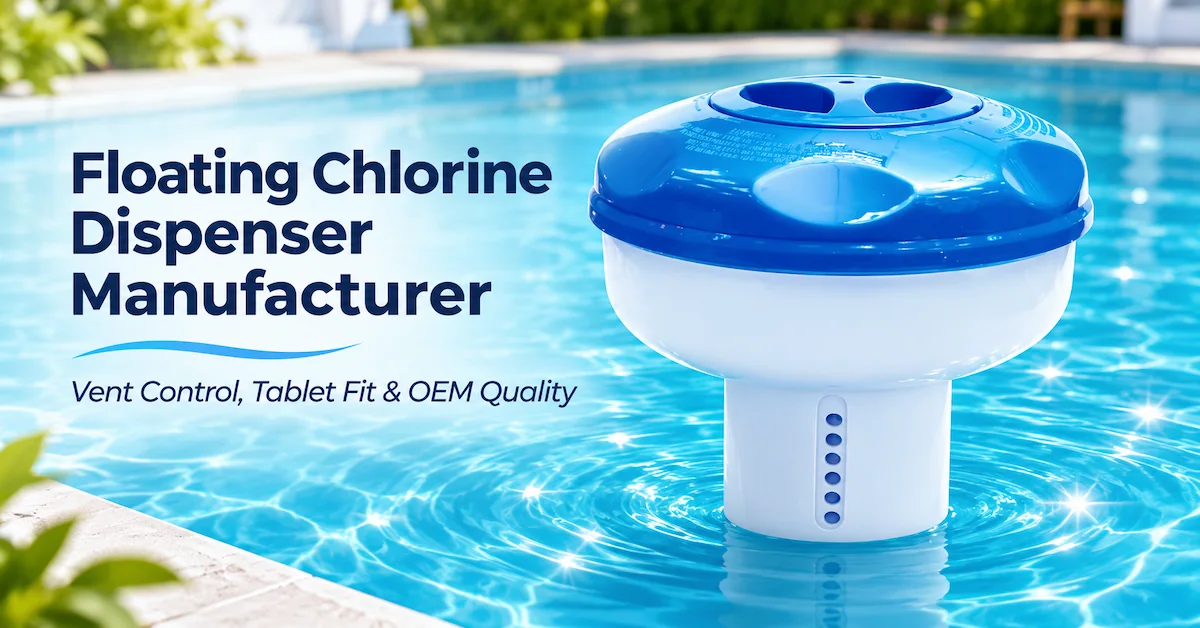
Floating chlorine dispensers are widely used as accessories in swimming pool maintenance. They hold compatible treatment tablets and allow water to contact them through openings in the dispenser body.
Although these products have relatively simple mechanical structures, their design can affect handling, tablet retention, floating behavior, and how readily water reaches the tablets.
For pool equipment importers, distributors, and private-label brands, purchasing risks include poorly fitting tablets, loose lids, cracked plastic, difficult-to-adjust openings, and inconsistent products between shipments.
This guide explains the technical factors that influence dispenser design, compares available configurations, and outlines how B2B buyers can qualify a manufacturer before placing bulk orders.
Quick Reference: What Should Buyers Verify Before Ordering Floating Chlorine Dispensers?
A professional purchasing specification should describe more than the dispenser's external dimensions.
| Technical Parameter | What Buyers Should Confirm | Purchasing Risk |
|---|---|---|
| Tablet compatibility | Permitted chemical formulation and tablet dimensions | Incorrect or unsafe chemical use |
| Tablet compartment | Internal diameter, height, capacity and loading access | Tablets not fitting or becoming trapped |
| Adjustable openings | Opening geometry, adjustment range and retention | Inconsistent or difficult adjustment |
| Lid structure | Closure type and secure engagement | Accidental opening or tablet release |
| Floating stability | Buoyancy and orientation under intended loading | Tipping or undesirable pool-surface contact |
| Body material | Polymer grade and construction | Cracking, degradation or deformation |
| Chemical compatibility | Suitability for the specific labeled chemical product | Material damage or unsafe use |
| Product identification | Model, instructions and warning labels | Incorrect application or customer confusion |
| OEM requirements | Color, branding, packaging and approved components | Inconsistent private-label production |
| Quality inspection | Sample approval and batch verification | Defective or inconsistent shipments |
Engineering takeaway: Tablet fit, adjustable opening behavior, lid security, and floating stability should be assessed as an integrated design. A dispenser that looks attractive may still require technical improvements before wholesale approval.
Key Takeaways for Importers and Private-Label Brands
A floating chlorine dispenser is a passive chemical holder, not a device that independently measures water chemistry or automatically adjusts sanitizer concentration.
Adjustable openings provide a way to change water exposure, but actual tablet dissolution depends on the chemical product, water conditions, and operating environment.
Lid security and product stability deserve particular attention because unintended tablet release can create chemical exposure and pool-surface risks.
Manufacturers should provide product-specific specifications rather than broad claims such as "precise dosing," "chlorine-proof," or "universal tablet compatibility."
For repeat orders, the most valuable quality controls are approved materials, consistent dimensions, secure assembly, suitable instructions, and documented changes to components.
1. How Does an Adjustable Floating Chlorine Dispenser Work?
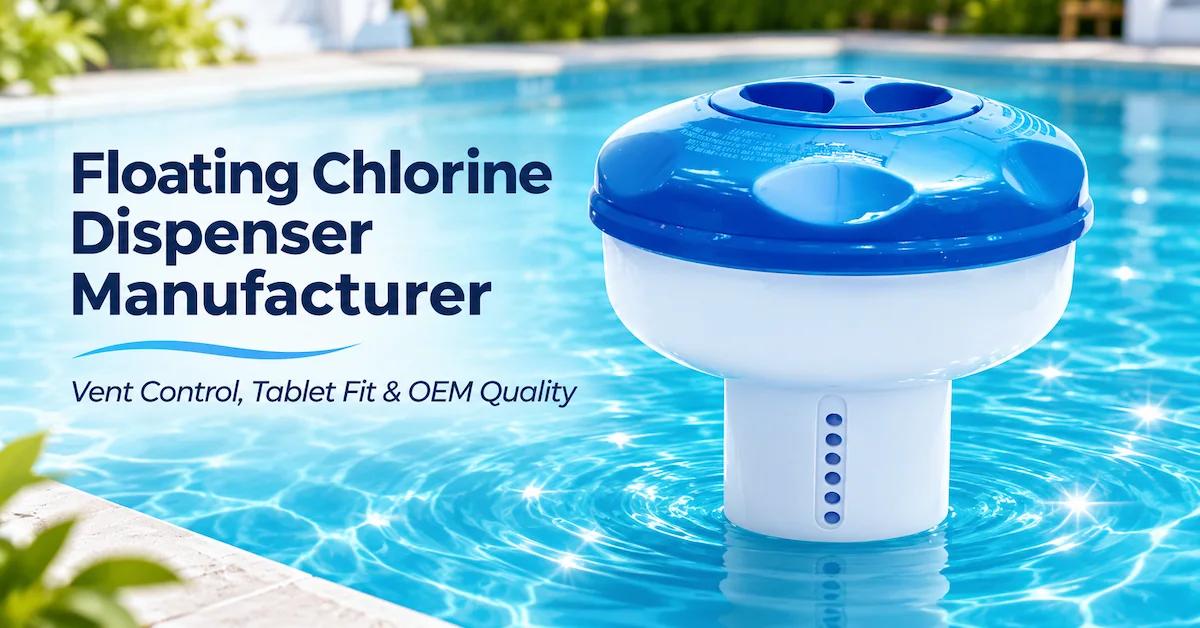
A typical floating dispenser contains a compartment for compatible chemical tablets, a buoyant body, and openings that allow pool water to contact the tablets.
Some designs incorporate an adjustable collar or rotating ring that changes the exposed opening area.
As water contacts the tablets, the chemical dissolves into the surrounding water.
Does a Larger Opening Always Release More Chlorine?
Increasing the exposed opening area may permit greater water exchange around the tablets, which can influence dissolution.
However, the relationship is not necessarily linear.
Actual dissolution depends on several factors, including tablet composition, water temperature, water movement, exposure time, and the amount of tablet surface available.
A collar positioned halfway between two settings should not automatically be interpreted as producing half the release rate.
A floating dispenser does not directly measure free chlorine, pH, or the concentration of sanitizer in the pool.
Operators must test water chemistry and follow the chemical product's label instructions and applicable operating requirements.
What Should Manufacturers Verify About Adjustable Openings?
The opening mechanism should operate consistently without excessive force or unintended movement.
Important considerations include opening geometry, ease of adjustment, resistance to jamming, and retention of the selected position.
| Design Feature | Function | Recommended Evaluation |
|---|---|---|
| Rotating adjustment ring | Changes opening exposure | Smooth rotation and secure positioning |
| Fixed opening | Allows water contact through a defined passage | Dimensions and obstruction inspection |
| Adjustable slots | Provide selectable exposure area | Opening consistency and mechanism integrity |
| Tablet chamber | Holds compatible tablets | Internal dimensions and loading clearance |
| Connection between sections | Maintains dispenser assembly | Fit and retention verification |
When comparing suppliers, buyers should request drawings or samples that show how the adjustment mechanism works.
For a new OEM design, opening dimensions and the intended operating characteristics should be established before tooling approval.
2. Why Is Chlorine Tablet Compatibility a Critical Design Requirement?
A dispenser's external size does not necessarily indicate which chemical tablets it can safely accommodate.
Products may be designed for different tablet diameters, compartment capacities, and chemical formulations.
1-Inch vs 3-Inch Tablet Dispensers
Small-tablet dispensers are often evaluated for compact swimming pool or spa accessory ranges.
Larger tablet compartments may be appropriate for other pool maintenance applications.
However, a dispenser designed for 3-inch tablets should not automatically be assumed suitable for every smaller tablet or treatment chemical.
The chemical label and dispenser's stated compatibility must agree.
Technical Comparison
| Design Type | Intended Product Category | Main Procurement Consideration |
|---|---|---|
| Compact tablet dispenser | Smaller, compatible tablet formats | Internal capacity and safe application |
| Standard pool floater | Defined larger tablet format | Compartment diameter and lid clearance |
| Larger-capacity dispenser | Higher tablet-holding capacity | Floating stability and loading conditions |
| Adjustable chemical floater | Defined compatible tablets and adjustable openings | Opening mechanism and user instructions |
| OEM customized floater | Buyer-defined product requirements | Engineering validation and chemical compatibility |
These are design categories for comparison, not claims that every configuration is currently available from BONNY.
Can Chlorine and Bromine Tablets Be Used Interchangeably?
Not automatically.
Different pool sanitizers may have incompatible chemical formulations. Never mix different pool chemical products in a dispenser, including different chlorine products or chlorine and bromine, and never assume a dispenser approved for one chemical is automatically suitable for another.
The CDC's Pool Chemical Safety guidance emphasizes following product labels, keeping incompatible chemicals separate, and preventing accidental mixing.
Buyers should require clear instructions identifying which chemical products are permitted for the selected dispenser.
Procurement recommendation: Confirm both physical tablet dimensions and the permitted chemical formulation. Mechanical fit alone does not establish safe compatibility.
3. How Do Lid Security and Buoyancy Affect Product Reliability?
Lid design is an important part of floating dispenser construction.
If a lid becomes loose or opens unintentionally, tablets may escape into the pool.
This can create chemical exposure concerns and potentially damage susceptible pool surfaces.
Twist-Lock and Threaded Closures
Depending on the design, a dispenser may use a twist-lock, threaded, or another closure mechanism.
Buyers should examine whether the lid closes securely, whether its engagement is easy to understand, and whether ordinary handling can cause unintended opening.
A locking lid should not be marketed as childproof or child-resistant unless the specific design has appropriate supporting evidence.
Floating Balance
A dispenser should maintain its intended orientation with the permitted tablet load.
Floating behavior can change as the tablets dissolve and the weight distribution changes.
Consequently, evaluating only an empty dispenser is insufficient.
Buyers may request floating tests in unloaded, partially loaded, and fully loaded conditions, using the permitted configuration.
Engineering Checks
| Component | Potential Problem | Suggested Verification |
|---|---|---|
| Lid | Accidental opening | Closure retention test |
| Lid engagement | Incomplete or difficult closing | Repeated operation check |
| Floating body | Unstable orientation | Representative loaded flotation test |
| Lower compartment | Unwanted contact with pool surfaces | Geometry and stability evaluation |
| Adjustment ring | Unintended setting changes | Functional operation check |
| Assembly joints | Separation or damage | Visual and mechanical inspection |
The appropriate acceptance criteria should be defined according to the product's actual intended use.
4. What Materials Should a Floating Chlorine Dispenser Manufacturer Use?
The material used for the dispenser body influences molding quality, durability, weight, and chemical compatibility.
Common polymer options in pool accessory manufacturing include polypropylene, polyethylene, and ABS.
Some designs may also incorporate other polymers or buoyancy-related components.
However, material names alone cannot establish that the finished product is suitable for prolonged contact with a particular chemical.
Polypropylene (PP)
Polypropylene can be used to manufacture molded chemical-dispenser components.
Its suitability depends on the actual grade, formulation, chemical exposure, temperature, and structural design.
Polyethylene (PE)
Polyethylene is another polymer used in floating equipment and containers.
Its properties vary according to the specific material grade and manufacturing method.
ABS
ABS offers different molding and structural characteristics and may be used in selected accessory components.
The buyer should confirm whether the particular material grade is suitable for the intended environment.
Material Selection Table
| Material | Potential Engineering Benefit | What Buyers Must Confirm |
|---|---|---|
| PP | Suitable for selected molded components | Grade, chemical compatibility and structural requirements |
| PE | Options for floating and molded designs | Material grade and environmental performance |
| ABS | Structural molding and appearance options | Compatibility with intended chemical and outdoor conditions |
| EVA | May be used in selected auxiliary or buoyancy components | Actual component function and formulation |
When evaluating environmental claims, buyers should ask for relevant product-specific evidence.
Terms such as "UV-resistant," "heavy duty," and "chemical-resistant" should be supported by defined material specifications or suitable testing.
Why Wall Thickness Matters
Wall thickness influences material consumption and mechanical performance.
A thicker wall is not automatically better because product durability also depends on geometry, rib design, material grade, molding quality, and loading.
Manufacturers should balance structural performance with practical product weight and cost.
5. BONNY Floating Chlorine Dispenser Products: Technical Sourcing Considerations
Ningbo Bonny E-Home Co., Ltd. is a Chinese manufacturer and supplier of swimming pool cleaning equipment and accessories.
BONNY's published product information includes floating chemical dispensers and other swimming pool maintenance products.
One product appearing in BONNY's public supplier listings is the T53 floating chlorine dispenser, described as a blue, approximately 9-inch dispenser for compatible 3-inch tablets.
However, available listings differ in their material descriptions, referring to PP or PP+EVA.
Consequently, buyers should obtain an updated specification directly from BONNY before publishing material claims or confirming an order.
T53 Product Specification Review
| Specification | Publicly Listed Information | Verification Required |
|---|---|---|
| Model | T53 | Current product availability |
| Product type | Floating chlorine dispenser | Exact operating instructions |
| Listed diameter | Approximately 9 inches | Final approved dimensions |
| Listed color | Blue | Available standard and OEM colors |
| Tablet format | 3-inch tablets in supplier listing | Permitted chemical type and capacity |
| Materials | PP or PP+EVA in different listings | Current bill of materials |
| Adjustment design | Requires model-specific confirmation | Opening structure and adjustment range |
| Lid structure | Requires model-specific confirmation | Closure mechanism and retention |
| MOQ | Varies between published supplier listings | Current quotation by quantity |
| Lead time | Requires updated confirmation | Actual production schedule |
The conflicting or incomplete details should be resolved before technical approval.
For further sourcing enquiries, buyers can start with the BONNY Product Catalogue and request the current floating-dispenser catalogue or model-specific specifications.
Which Dispenser Design Should Importers Choose?
For general residential pool retail, buyers may evaluate a dispenser designed around common, approved tablet formats with clear loading instructions.
For smaller spa-related applications, the intended water volume, chemical label, and operating requirements need special attention.
For private-label distributors, product differentiation may come from branding, packaging, materials, or a validated structural modification.
Commercial aquatic facilities require particular care: A household floating dispenser should not be presented as a substitute for required chemical feed equipment, water testing, or facility-specific operating controls. Buyers must verify applicable codes and whether this type of product is permitted for the intended use.
6. How Does Manufacturing Quality Affect Floating Chlorine Dispensers?
Product consistency begins with an approved specification.
BONNY's About Us page identifies manufacturing capabilities including injection molding, along with engineering and product-development resources.
Injection molding is relevant to many plastic floating-dispenser components, although the exact production process used for each model should be confirmed.
Product Design and Material Selection
The manufacturer first needs to define dimensions, materials, wall thickness, assembly structure, and intended operating conditions.
For chemical-dispensing products, material compatibility and permitted chemical use are particularly important.
Molded Component Production
Molded housings, lids, and adjustment components should meet agreed dimensional and appearance requirements.
Potential defects include poor fit, molding deformation, rough edges, and unacceptable dimensional variation.
Mechanical Assembly
Parts should fit together securely while remaining usable according to the product instructions.
The lid and adjustment mechanism require particular attention because their operation affects product handling and tablet retention.
Final Inspection
Finished products should be compared against approved samples and technical specifications.
An effective inspection system should distinguish between cosmetic defects and functional problems that could affect the product's intended use.
7. What Quality Tests Should Wholesale Buyers Request?
A professional floating chlorine dispenser manufacturer should be able to discuss how the selected product can be verified against the buyer's requirements.
The following is a recommended inspection framework, not a claim that BONNY has already completed every listed test.
| Inspection Item | Suggested Verification | Purchasing Risk |
|---|---|---|
| Tablet compartment | Measure against approved dimensions | Tablet incompatibility |
| Adjustment mechanism | Check operation and opening positions | Jamming or unintended movement |
| Lid retention | Agreed closure security test | Unintended tablet release |
| Floating stability | Test at representative permitted loads | Tipping or undesirable contact |
| Housing integrity | Visual and suitable mechanical checks | Cracking and assembly defects |
| Material consistency | Verify approved material specification | Uncontrolled substitutions |
| Chemical compatibility | Review applicable product or material evidence | Degradation under intended use |
| Appearance | Compare with approved reference | Retail quality problems |
| Labeling | Confirm correct instructions and warnings | Incorrect or unsafe use |
| Packaging | Check protection, barcode and carton markings | Shipping and distribution problems |
Sample Approval Process
Step 1 — Establish the specification. Confirm dimensions, materials, permitted tablet products, adjustment structure, and target applications.
Step 2 — Request representative samples. Samples should correspond to the proposed production configuration.
Step 3 — Verify mechanical functions. Check lid operation, adjustment movement, structural fit, and flotation under defined conditions.
Step 4 — Review chemical compatibility and instructions. Ensure the selected dispenser is intended for the specified treatment product and that the instructions communicate necessary precautions.
Step 5 — Approve packaging and branding. Confirm artwork, product identification, language, and warning information.
Step 6 — Establish inspection criteria. Agree on defect classification and production acceptance requirements.
Can ISO 2859-1 Be Used for Shipment Inspection?
ISO 2859-1:2026 provides an international framework for acceptance sampling by attributes.
It can support agreed inspection procedures for defined characteristics such as product appearance, dimensions, closure function, and packaging conformity.
However, statistical sampling does not automatically prove chemical compatibility or long-term performance.
Those requirements may need additional technical evidence or product-specific tests.
Pool Chemical Safety and User Instructions
The CDC's Pool Chemical Safety guidance emphasizes reading labels, using suitable protective equipment, preventing the mixing of incompatible chemicals, and keeping chemicals away from children and animals.
Retail packaging and user instructions should support safe and appropriate product use.
A dispenser supplier should not claim that an adjustable opening can independently guarantee safe sanitizer concentration.
8. OEM and Private-Label Floating Chlorine Dispenser Manufacturing
Private-label pool maintenance products allow distributors to build a recognizable brand and establish consistent retail presentation.
BONNY describes OEM and ODM capabilities including product design, material selection, color customization, private labeling, and packaging development.
Buyers can review these services through BONNY Engineering & Design.
Typical OEM Requirements
| Customization | Commercial Purpose | Technical Consideration |
|---|---|---|
| Product logo | Brand recognition | Placement and production method |
| Housing color | Distinctive retail identity | Approved color and material grade |
| Packaging | Channel-specific presentation | Instructions, labeling and carton design |
| Lid appearance | Product differentiation | Closure performance must remain acceptable |
| Tablet compartment | Compatibility with a defined format | Engineering and safety evaluation |
| Adjustment mechanism | Application-specific product design | Functional testing and tooling |
| Body geometry | Differentiated product range | Buoyancy and structural verification |
These are potential development requirements, not a guarantee that each option is available for every existing model.
OEM vs ODM
OEM generally involves manufacturing to agreed specifications or customizing an existing product.
ODM may involve developing a new concept, structure, prototype, or production design.
For example, applying a private-label logo is different from redesigning the chemical compartment or adjustment mechanism.
The latter requires additional engineering and validation.
Buyer recommendation: Finalize functional and safety-related specifications before approving large-scale branded packaging.
9. Floating Chlorine Dispenser Wholesale Cost, MOQ and Lead Time
Two dispensers may look similar while having different manufacturing costs.
Material grade, product dimensions, tooling complexity, assembly requirements, and packaging can all influence pricing.
Major Cost Factors
| Cost Driver | Purchasing Implication |
|---|---|
| Plastic material | Influences material cost and product specification |
| Body size | Affects resin consumption and packing dimensions |
| Adjustment design | Influences tooling and assembly |
| Lid mechanism | Adds components or functional requirements |
| Floating construction | Affects material and structural design |
| OEM branding | Requires customization and artwork approval |
| Retail packaging | Influences presentation and freight |
| Testing | Adds verification requirements |
| Order quantity | Influences production planning and price |
Total Landed Cost
For an accurate comparison, buyers should consider:
Total landed cost = Product cost + Tooling allocation + Customization + Packaging + Inspection + Freight + Insurance + Applicable import charges + Expected replacement costs.
This formula is a procurement framework, not a fixed BONNY quotation.
What About MOQ?
Minimum order quantities vary according to the product model, customization requirements, packaging, and production arrangements.
Buyers should request an updated, model-specific quotation.
How Long Does Manufacturing Take?
Lead time depends on production scheduling, material availability, quantity, sampling, and customization.
New tooling or structural modifications may require additional development stages.
All production and delivery schedules should be confirmed in writing before placing an order.
10. Common Procurement Risks and How to Avoid Them
Risk 1: Incorrect Tablet Compatibility
Problem: The selected tablets do not match the dispenser's approved dimensions or permitted chemical formulation.
Solution: Verify the exact tablet product, compartment dimensions, and instructions.
Risk 2: Overstated Dosing Precision
Problem: Buyers assume a ring setting guarantees a particular sanitizer concentration.
Solution: Describe the mechanism accurately and require water testing according to product labels and operating requirements.
Risk 3: Unsecured Lid
Problem: Tablets may escape if the closure opens unintentionally.
Solution: Confirm appropriate lid retention and clear operating instructions.
Risk 4: Inadequate Floating Stability
Problem: The dispenser does not maintain its intended orientation under representative conditions.
Solution: Evaluate samples with permitted loading configurations.
Risk 5: Unsupported Material Claims
Problem: Chemical or UV resistance is advertised without evidence.
Solution: Request material specifications and appropriate product-specific documentation.
Risk 6: Inconsistent OEM Production
Problem: Bulk products differ from the approved sample.
Solution: Maintain controlled drawings, materials, samples, and inspection requirements.
Risk 7: Incomplete Chemical Safety Information
Problem: Packaging fails to clarify approved chemical use or necessary precautions.
Solution: Review labeling and instructions before retail distribution.
11. Why Consider BONNY as a Floating Chlorine Dispenser Manufacturing Partner?
Founded in 1998, Ningbo Bonny E-Home Co., Ltd. develops and manufactures swimming pool cleaning equipment and accessories for international customers.
BONNY's published product information includes floating chemical dispensers, alongside other maintenance products.
Product Sourcing
Importers and distributors can discuss floating dispenser models, tablet compatibility, packaging, and procurement quantities with the company.
Available configurations and current specifications should be confirmed during the enquiry process.
Manufacturing Background
BONNY describes manufacturing capabilities relevant to plastic pool accessories, including injection molding and product assembly.
Buyers should request evidence applicable to the selected product rather than assume all models share identical materials or testing.
Engineering and Customization
The company offers OEM and ODM support for international business customers.
This enables discussions about branding, packaging, product appearance, and technically feasible modifications.
International Supply Cooperation
BONNY works with overseas buyers on product requirements, samples, manufacturing, and export orders.
Commercial terms are confirmed according to the selected product and purchasing project.
Explore BONNY Pool Equipment and Accessories
Learn More About BONNY Manufacturing
12. What Should Buyers Include in a Floating Chlorine Dispenser RFQ?
A well-prepared request for quotation helps manufacturers understand the actual purchasing requirements.
| RFQ Item | Information to Provide |
|---|---|
| Product type | Standard or adjustable floating dispenser |
| Reference model | T53 or another confirmed product |
| Tablet requirements | Exact permitted chemical product and tablet dimensions |
| Product size | Preferred diameter and compartment capacity |
| Material requirements | Body and component specifications |
| Lid structure | Required closure and retention characteristics |
| Adjustment mechanism | Opening design and operating requirements |
| Application | Residential pool or other permitted use |
| Order quantity | Estimated volume per SKU |
| OEM requirements | Logo, color, packaging or structural customization |
| Destination | Target country and sales channel |
| Inspection | Sample tests, documentation and acceptance criteria |
| Commercial terms | Pricing, MOQ, delivery conditions and schedule |
Request a Wholesale or OEM Quotation
For an efficient discussion, send BONNY your intended product configuration, tablet specification, estimated order quantity, destination market, and branding requirements.
The team can review suitable product options, confirm available specifications, and discuss sampling or development requirements.
Contact BONNY for Floating Chlorine Dispenser Specifications, OEM Samples and Wholesale Pricing
Frequently Asked Questions About Floating Chlorine Dispenser Manufacturers
1. What does a floating chlorine dispenser manufacturer produce?
A floating chlorine dispenser manufacturer produces mechanical pool accessories designed to hold compatible chemical tablets and allow controlled water exposure through specified openings. Product designs may vary in size, material, tablet capacity, and adjustment mechanism.
2. How do I choose a reliable floating chlorine dispenser manufacturer in China?
Compare product specifications, tablet compatibility, closure construction, floating stability, manufacturing capabilities, quality inspection requirements, and OEM services. Verify representative samples before approving bulk production.
3. Can adjustable chlorine dispensers maintain an exact chlorine concentration?
No. Adjustable openings influence water exposure, but they do not independently measure or precisely regulate the pool's chlorine concentration. Water chemistry must be tested and maintained according to applicable requirements.
4. What is the difference between 1-inch and 3-inch tablet dispensers?
The main difference is the tablet format and compartment design. Buyers must verify the exact product's permitted tablet size and chemical formulation rather than assume both formats are interchangeable.
5. Can I use bromine tablets in a floating chlorine dispenser?
Only if the specific dispenser and chemical product instructions permit the intended use. Never mix incompatible chemicals or different treatment products inside a dispenser.
6. What materials are commonly used in floating chlorine dispensers?
Common polymer options include polypropylene and polyethylene, while some designs may contain other materials. Actual chemical and environmental suitability depends on the material grade and finished product construction.
7. Can BONNY provide private-label floating chlorine dispensers?
BONNY provides company-level OEM and ODM services. Available branding, packaging, color, material, and structural options should be confirmed for the selected dispenser model.
8. What quality tests should importers request?
Important checks include tablet fit, lid retention, adjustment mechanism operation, floating stability, housing integrity, material verification, labeling, and packaging consistency. Additional tests should reflect the intended application.
9. What determines MOQ and production lead time?
MOQ and lead time depend on the model, order quantity, customization, tooling, packaging, and production schedule. Request current commercial terms for the actual purchasing project.
10. What information should I send to request a wholesale quotation?
Provide the target dispenser type, permitted tablet product, desired dimensions, material requirements, estimated order quantity, OEM needs, inspection expectations, and destination country.
Conclusion
Choosing a reliable floating chlorine dispenser manufacturer requires a technical evaluation of tablet compatibility, adjustable openings, lid security, floating stability, material selection, and production consistency.
For importers, distributors, and private-label brands, successful sourcing begins with clearly defined product requirements and representative sample approval.
Adjustable floating dispensers can provide a practical means of holding compatible pool treatment tablets, but they should never be marketed as substitutes for appropriate chemical handling, water testing, or required facility treatment controls.
BONNY, operated by Ningbo Bonny E-Home Co., Ltd., supplies swimming pool accessories and offers OEM/ODM manufacturing support for international B2B customers.
Whether you are sourcing standard floating dispensers, developing a private-label accessory range, or evaluating a customized product structure, BONNY can review your requirements and discuss suitable manufacturing options.