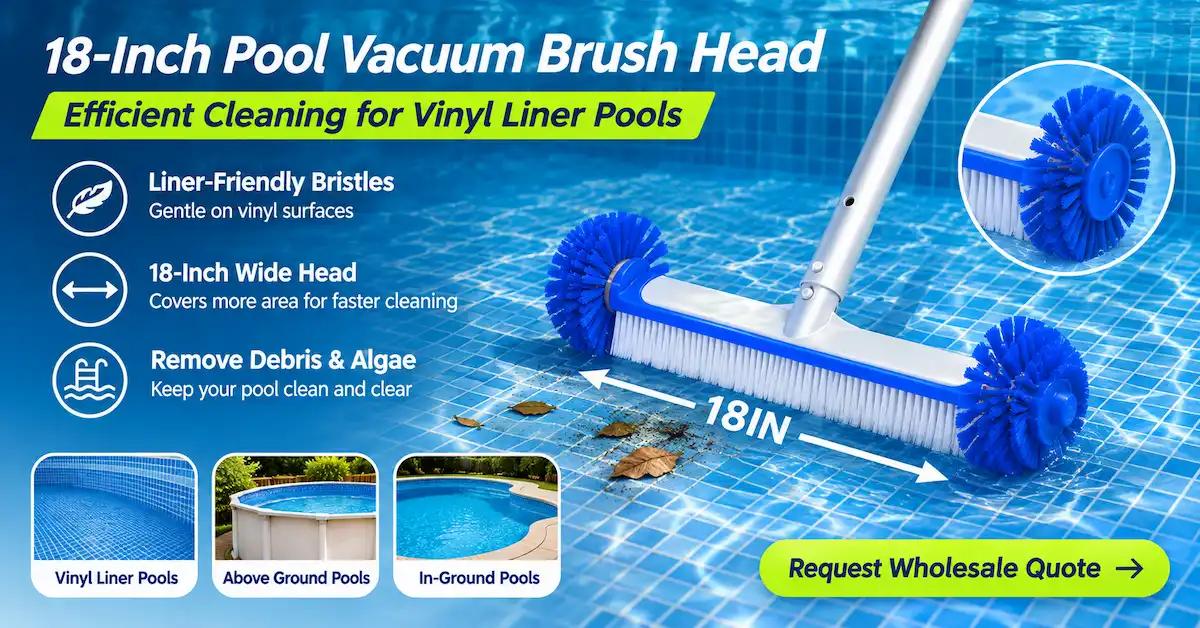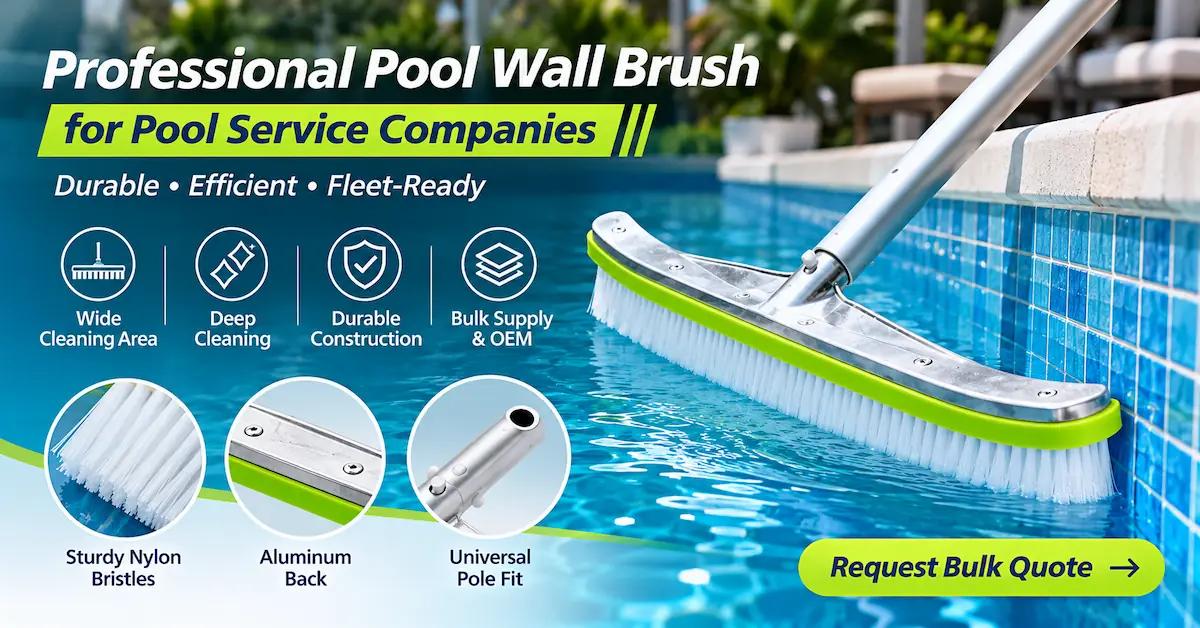

Quick Answer: When sourcing wholesale pool vacuum heads for vinyl liner pools, buyers should prioritize approved liner-contact materials, smooth protective edges, suitable suction behavior, compatible hose and pole connections, and documented quality controls. A flexible, brushed, or wheeled head is not automatically safe for every vinyl liner. Importers should verify the design against the liner manufacturer's guidance, test complete vacuum assemblies, and approve representative samples before placing bulk or OEM orders.
Vinyl-lined swimming pools require cleaning equipment that removes debris without creating unnecessary stress on the pool's interior surface.
For importers, distributors, pool maintenance companies, and private-label brands, this creates a specific sourcing challenge.
A vacuum head that performs well on concrete may not be suitable for a vinyl liner.
The risks include sharp or abrasive contact surfaces, excessive suction, poor movement across the liner, incompatible hose fittings, and inconsistent product quality.
These problems become more significant when hundreds of identical units are supplied to retailers or service teams.
A minor design issue that is overlooked during sampling can affect an entire shipment.
For that reason, wholesale purchasing should evaluate the complete relationship between the vacuum head, liner, hose, pole, and suction system.
This guide focuses on the technical and commercial requirements involved in sourcing vinyl-liner-compatible manual pool vacuum heads.
It also explains how to assess available products from BONNY, operated by Ningbo Bonny E-Home Co., Ltd., and establish a repeatable OEM procurement process.
Key Takeaways for Wholesale Buyers
-
Liner compatibility must be verified. A product marketed as flexible, wheeled, or heavy duty is not automatically suitable for vinyl.
-
Protective contact geometry matters. Inspect the underside, edges, fasteners, brushes, wheels, and any other parts that can touch the liner.
-
Excessive suction can damage a liner. Evaluate vacuum behavior using the intended equipment and follow the liner manufacturer's instructions.
-
Hose and pole interfaces require testing. Nominal compatibility claims should be confirmed using actual components.
-
Wholesale quality control should include functional checks. Visual inspection alone cannot establish safe liner contact or appropriate suction performance.
-
OEM modifications require revalidation. Changes to suction openings, brush materials, body shape, or wheels can affect performance.
-
Long-term cost matters more than the lowest quotation. Returns, replacement parts, damaged liners, and inventory issues can outweigh a small unit-price difference.
1. What Makes a Pool Vacuum Head Suitable for Vinyl Liner Pools?
A vinyl pool liner is a relatively flexible interior surface.
Unlike some rigid pool finishes, it can be vulnerable to punctures, tearing, abrasion, and localized deformation.
The suitability of a vacuum head therefore depends on its construction and operating behavior, not simply its cleaning width.
Important Design Characteristics
A suitable product should be evaluated for:
-
Smooth and protected contact surfaces.
-
Appropriate brush, wheel, roller, or guide construction.
-
Absence of exposed sharp fasteners or edges.
-
Suitable clearance between suction openings and the liner.
-
Controlled movement during operation.
-
Compatibility with the intended suction system.
-
Secure hose and pole connections.
-
Adequate structural integrity.
The specific combination depends on the vacuum head design and the liner manufacturer's requirements.
Why Protective Edges Matter
The perimeter of a vacuum head may contact the pool floor or wall during cleaning.
Exposed corners, damaged plastic, protruding screws, or abrasive components can create concentrated contact points.
These should be checked during sample approval.
A protective bumper or rounded edge may help reduce unwanted contact, but it must be evaluated as part of the finished assembly.
What Does the Liner Manufacturer Recommend?
Latham Pool's vinyl liner and fiberglass cleaning guide recommends appropriate soft nylon-bristle tools for gentle surface cleaning and emphasizes following the equipment manufacturer's instructions when vacuuming.
This supports an important purchasing principle:
Cleaning tools should be selected around the pool finish, not selected first and assumed compatible later.
For wholesale buyers, that means requesting specific compatibility information before marketing a vacuum head for vinyl-lined pools.
2. Why Is Excessive Suction a Risk for Vinyl Pool Liners?
A manual vacuum head uses an external suction source to draw water and debris through the cleaning head.
Its operating behavior depends on the vacuum head design, hose, filtration system, and flow conditions.
If the head seals too tightly against the liner, excessive localized suction can develop.
This may cause the head to become difficult to move or draw the liner toward the suction opening.
What Causes a Vacuum Head to Stick to the Liner?
Potential contributing factors include:
-
Excessive suction for the selected assembly.
-
Insufficient clearance around the suction inlet.
-
A contact surface that forms an unintended seal.
-
Incorrect equipment setup.
-
Inappropriate head geometry.
-
Poor adjustment or maintenance of the vacuum system.
The problem cannot always be solved by choosing a lighter or wider head.
The complete assembly should be evaluated.
Can More Suction Improve Cleaning?
Greater suction does not automatically produce a better result.
The objective is to remove debris while maintaining suitable movement and avoiding unacceptable liner stress.
If a vacuum head becomes immobilized or causes the liner to lift, operation should stop and the equipment setup should be reviewed according to the manufacturer's instructions.
Manufacturer Guidance on Vacuum Equipment
LOOP-LOC's vinyl swimming pool liner maintenance guidance advises owners to select maintenance equipment appropriate to their specific liners and consult a pool professional about safe vacuum options.
For wholesale procurement, this means a supplier should not make a universal "safe for all vinyl liners" claim without appropriate supporting evidence.
A Practical Supplier Question
Ask the manufacturer:
"What design features and test evidence support the use of this vacuum head on the vinyl liners and suction systems specified by our customers?"
This question is more useful than simply asking whether a product has strong suction.
3. Brush-Type, Wheeled and Flexible Vacuum Heads: Which Designs Should Buyers Compare?
Different vacuum head designs can provide different cleaning and movement characteristics.
However, no single design category guarantees vinyl compatibility.
Brush-Type Pool Vacuum Heads
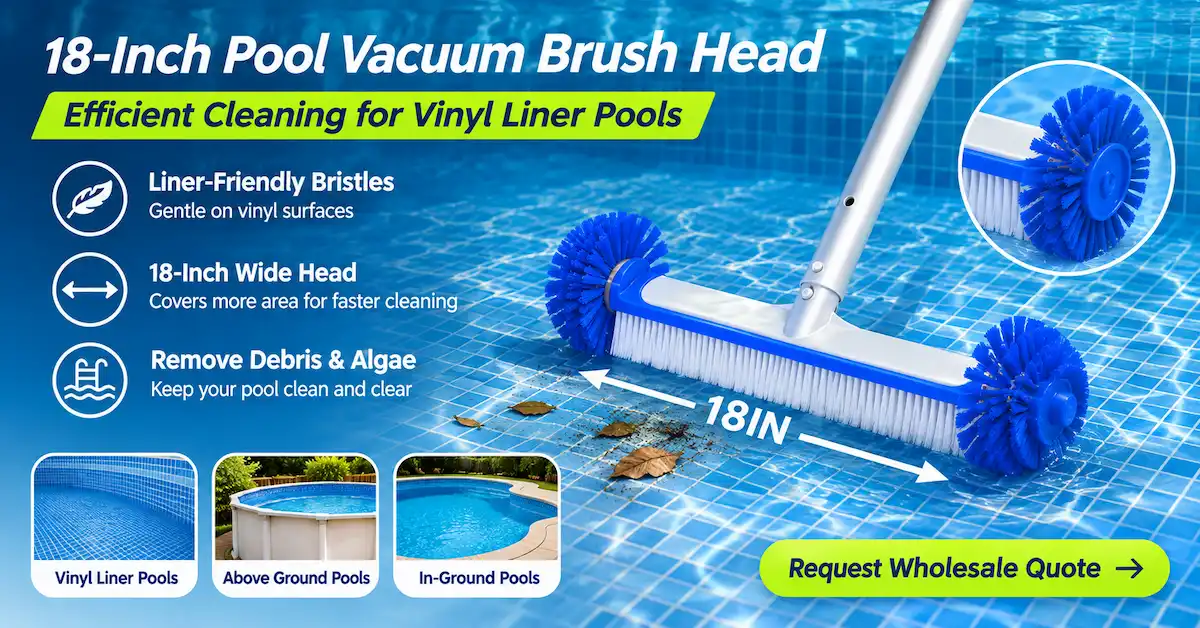
Brush-type vacuum heads incorporate bristles around or near the suction area.
Appropriate bristles may help manage the contact between the cleaning head and the pool surface.
Buyers should confirm the actual bristle material, stiffness, length, placement, and attachment quality.
Wheeled Vacuum Heads
Wheels or rollers can support the vacuum head and influence how it moves across the pool floor.
However, wheels must be appropriately designed, positioned, and maintained.
A wheel that becomes damaged, jams, or exposes a hard edge can create a different contact problem.
Furthermore, some flexible wheeled heads are designed primarily for concrete or other rigid pool finishes.
Their suitability for vinyl should never be assumed.
Flexible Vacuum Heads
Flexible heads can adapt to certain floor contours.
This may be useful for selected pool geometries, but flexibility does not establish liner compatibility by itself.
Buyers must consider the underside, wheel system, suction opening, and intended application.
Vinyl Pool Vacuum Head Design Comparison
| Design Type | Potential Benefit | What Buyers Must Verify | Purchasing Consideration |
|---|---|---|---|
| Soft-bristle vacuum head | Suitable contact and debris collection when appropriately designed | Bristle stiffness, attachment and liner compatibility | Candidate for liner-specific evaluation |
| Protective-bumper vacuum head | Separation of hard body edges from liner | Bumper coverage, material and retention | Evaluate contact protection |
| Wheeled vacuum head | Supports movement across a suitable surface | Wheel material, clearance, rotation and liner approval | Not automatically vinyl-safe |
| Flexible vacuum head | Adapts to selected contours | Bottom geometry, suction behavior and liner approval | Assess intended pool finish |
| Weighted vacuum head | Helps maintain a defined position during use | Weight distribution and suction behavior | Avoid assuming more weight is better |
| Curved or triangular head | Access to corners and shaped areas | Edges, brushes and suction layout | Useful for specific cleaning zones |
Engineering takeaway: Choose the design that has been evaluated for the intended liner and equipment configuration—not the design with the most features.
4. What Technical Specifications Should Wholesale Buyers Request?
A detailed technical specification helps prevent misunderstandings between importers and manufacturers.
For vinyl-lined pools, dimensions alone are insufficient.
The specification should also define contact materials, suction geometry, and compatibility requirements.
Pool Vacuum Head Technical Specification Checklist
| Parameter | Information to Confirm | Why It Matters |
|---|---|---|
| Head width | Actual dimensions and tolerance | Coverage and handling |
| Body material | Polymer or metal construction | Structural and contact performance |
| Contact surfaces | Materials and surface finish | Liner protection |
| Edge design | Rounded edges, bumper or other protection | Avoiding concentrated contact |
| Brush material | Filament material and stiffness | Suitable cleaning action |
| Wheel or roller design | Dimensions, material and positioning | Movement and surface clearance |
| Suction inlet | Geometry and opening dimensions | Flow and localized suction |
| Hose connection | Port dimensions and engagement | Vacuum-system compatibility |
| Pole attachment | Socket size and locking mechanism | Secure operation |
| Product weight | Approved specification | Handling and contact behavior |
| Assembly hardware | Fastener design and position | Avoiding exposed projections |
| Packaging | Product protection and labeling | Shipment quality |
| Intended application | Approved pool finishes | Correct product positioning |
Do All Vinyl Pool Vacuum Heads Need the Same Specifications?
No.
Above-ground and in-ground vinyl-lined pools can have different structures and maintenance arrangements.
The pool finish may be similar, but the required vacuum head can depend on water depth, floor geometry, hose connection, and filtration equipment.
A supplier should confirm the intended application rather than assume one configuration works for every pool.
5. How Should Buyers Verify Hose and Telescopic Pole Compatibility?
Connection compatibility is particularly important for wholesale distributors selling into different markets.
A vacuum head that does not connect correctly to the customer's equipment may be returned even if the cleaning head itself is otherwise acceptable.
Vacuum Hose Connections
Buyers should verify:
-
Hose connection diameter.
-
Actual dimensional tolerance.
-
Connection geometry.
-
Engagement depth.
-
Hose retention.
-
Suitability for the intended operating configuration.
Common pool equipment may use different hose sizes, so a description such as "standard hose fitting" should be supported by measurements.
Telescopic Pole Connections
A vacuum head may use a clip, button, pin, or another attachment mechanism.
The connection should remain secure during intended operation.
The buyer should also verify that the pole can be attached and removed without excessive force or damage.
Complete Assembly Testing
A practical sample evaluation should include:
Vacuum head + approved hose + telescopic pole + representative suction system + appropriate test surface.
Testing only the vacuum head's hose socket with a measuring tool does not establish complete operating compatibility.
Connection Quality Control
| Component | Verification | Potential Problem |
|---|---|---|
| Hose port | Fit with approved hose | Loose or incompatible connection |
| Hose retention | Appropriate operational check | Disconnection during cleaning |
| Pole socket | Actual pole fit | Incompatible attachment |
| Locking mechanism | Engagement and release | Accidental detachment |
| Suction opening | Functional behavior | Undesirable sealing or sticking |
| Complete assembly | Representative cleaning trial | Inconsistent operation |
Procurement recommendation: For private-label programs, define the actual hose and pole interface standards in the product specification.
6. Which BONNY Vacuum Heads Should Buyers Evaluate?
Ningbo Bonny E-Home Co., Ltd. manufactures and supplies swimming pool cleaning equipment and accessories for international markets.
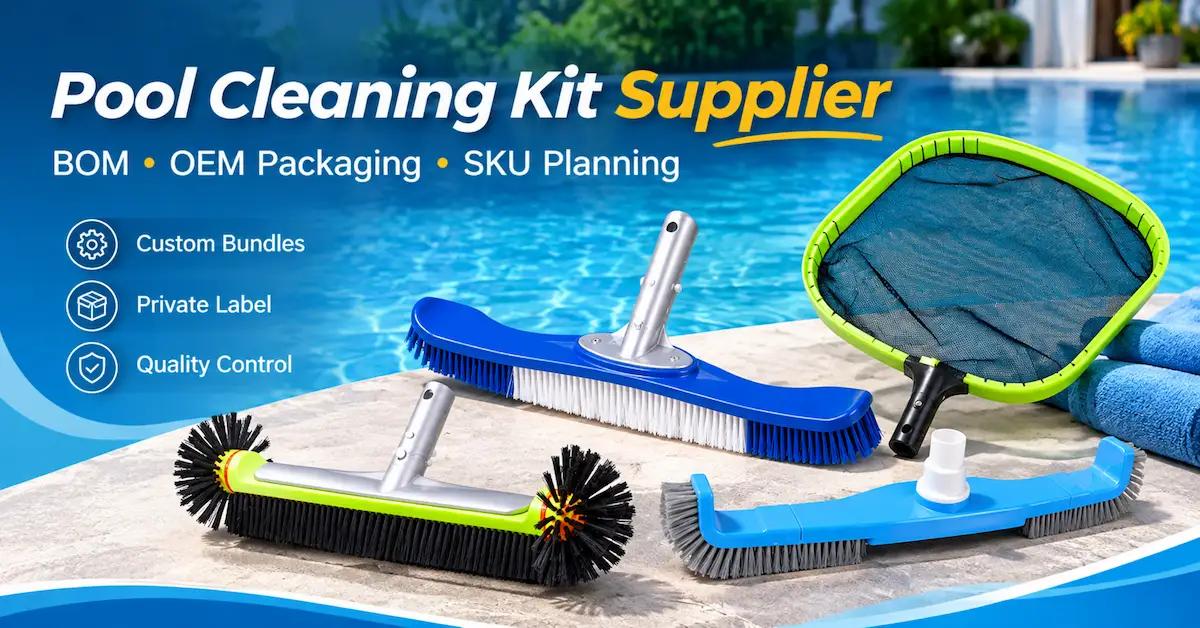
Its published Pool Accessories Catalogue includes manual vacuum heads and combined brush-and-suction cleaning products.
For buyers sourcing vinyl liner pool equipment, two product configurations are especially relevant for initial technical review.
BONNY 14-Inch Flexible Pool Vacuum Head
The catalogue lists:
Customized Pool Flexible Cleaning Aluminum 14 Inch Aluminum Clean Pool Vacuum Head for Swimming Pool
This product can be evaluated as a candidate where buyers require a flexible manual vacuum head.
However, the published product title alone does not establish that the unit is approved for vinyl liners.
Buyers should request confirmation of:
-
Actual head material and construction.
-
Underside and contact geometry.
-
Wheel or guide design, if applicable.
-
Suction inlet configuration.
-
Hose and pole interfaces.
-
Intended pool finishes.
-
Product-specific testing evidence.
In particular, confirm whether the selected configuration is intended for vinyl or primarily for rigid pool finishes.
BONNY Curved Suction Vacuum Brush Head
BONNY also lists:
Pool Vacuum Brush Head with Curved Brush
This combined cleaning-head design may be relevant to buyers evaluating integrated brushing and suction.
For vinyl applications, the buyer should verify bristle characteristics, hard-edge protection, vacuum behavior, and suitability for the intended liner.
The presence of bristles does not automatically prove liner compatibility.
BONNY Product Evaluation Table
| BONNY Catalogue Product | Published Design Description | What to Evaluate for Vinyl | Procurement Status |
|---|---|---|---|
| 14-Inch Flexible Pool Vacuum Head | Flexible manual vacuum-head configuration | Contact geometry, supports, suction, hose fit | Vinyl suitability requires confirmation |
| Curved Suction Vacuum Brush Head | Combined brush and vacuum configuration | Bristle contact, edge design and suction | Vinyl suitability requires confirmation |
| Other available manual vacuum heads | Subject to current catalogue | Intended finish, attachments and materials | Request updated model list |
This comparison identifies candidate products for review rather than certifying either model as vinyl-safe.
Why Should Buyers Request the Latest Catalogue?
Product specifications and available configurations can change.
Before issuing a purchase order, confirm the exact model number, technical drawing, bill of materials, packaging, and approved use.
This also helps prevent confusion between a catalogue photograph and the actual product delivered.
Explore BONNY Pool Vacuum Heads and Accessories
7. What Manufacturing Details Affect Liner-Safe Vacuum Head Performance?
Manufacturing consistency affects the quality of the complete vacuum head.
For liner-sensitive applications, particular attention should be given to edges, molded surfaces, bristle placement, and component alignment.
Plastic Molding Quality
Molded components should be inspected for defects that could affect structural integrity or surface contact.
Examples include:
-
Sharp flash or burrs.
-
Cracks.
-
Unacceptable deformation.
-
Poorly formed connection points.
-
Dimensional variation.
Brush and Contact Components
Where brushes are included, the approved bristle material and attachment method should be controlled.
The finished product should not have hard or exposed components in locations where the intended design requires softer contact.
Wheel and Roller Assembly
For wheeled designs, correct assembly and alignment are important.
Wheels should function as specified and not expose sharp components or other unacceptable contact points.
Hardware and Fasteners
Fasteners must remain properly secured and should not create unintended contact with the liner.
Finished Product Verification
The assembled product should be evaluated against its approved specifications.
This is especially important when multiple molded or purchased components interact.
BONNY Manufacturing Background
BONNY's About Us page describes manufacturing capabilities including injection molding, bristle planting, and product assembly.
These processes are relevant to the company's broader pool accessory range.
For a specific vinyl liner vacuum head project, buyers should confirm which processes and inspection procedures apply to the selected product.
8. What Tests Should Be Required Before Approving a Wholesale Order?
Sample approval should establish whether the product meets the buyer's agreed technical requirements.
For vinyl liner vacuum heads, a suitable test plan should examine both physical construction and functional behavior.
Recommended Sample Approval Tests
| Test Area | Suggested Evaluation | Main Purchasing Risk |
|---|---|---|
| Edge condition | Inspect all potential contact surfaces | Liner scratching or puncture |
| Contact material | Verify approved component specification | Unacceptable abrasion |
| Brush construction | Check material and attachment | Unsuitable bristles or shedding |
| Wheel operation | Inspect rotation and alignment | Dragging or hard contact |
| Suction behavior | Test representative operating conditions | Liner sticking or lifting |
| Hose compatibility | Test approved hose connections | Leakage or disconnection |
| Pole compatibility | Test engagement and handling | Loose attachment |
| Body integrity | Inspect joints and molded parts | Cracking or separation |
| Assembly completeness | Check parts and instructions | Missing accessories |
| Packaging | Verify protection and identification | Transit damage |
How Should Liner Contact Be Evaluated?
A representative test should use an appropriate liner material and equipment configuration.
The evaluation should follow the liner manufacturer's instructions and the applicable product requirements.
Where permitted, the buyer can compare movement, contact behavior, and visible surface effects under controlled conditions.
The test should not intentionally expose a production liner to excessive suction or damaging operating conditions.
Why Does Suction Testing Need the Complete System?
Vacuum performance is influenced by the connected equipment.
A head that works under one set of conditions may behave differently with another pump, hose, or suction arrangement.
The test record should therefore identify the relevant configuration and operating conditions.
What Should a Technical Test Report Contain?
A useful report identifies:
-
Product model and revision.
-
Tested components.
-
Relevant liner or test-surface specification.
-
Hose and pole configuration.
-
Suction-system conditions.
-
Test procedure.
-
Acceptance criteria.
-
Observations and results.
-
Test date and responsible organization.
Quality takeaway: Product approval requires relevant evidence. A catalogue label or unsupported "anti-scratch" claim is not a substitute for a defined test.
9. How Can ISO 2859-1 Support Bulk Pool Vacuum Head Inspection?
Once a design has been qualified, buyers must establish consistency across production orders.
Inspection should cover features that can be evaluated by defined acceptance criteria.
The ISO 2859-1:2026 standard for acceptance sampling by attributes provides an established framework for lot-by-lot sampling inspection.
It can be used as part of a buyer-supplier quality agreement.
Recommended Bulk Inspection Matrix
| Inspection Characteristic | Suggested Method | Risk Controlled |
|---|---|---|
| Head dimensions | Measurement | Product mismatch |
| Hose connection | Dimensional and fit check | Incompatibility |
| Pole attachment | Functional engagement check | Loose connection |
| Edge finishing | Visual and tactile inspection | Unacceptable sharpness |
| Brush retention | Agreed retention check | Detached bristles |
| Wheel assembly | Functional operation check | Poor movement |
| Body integrity | Visual and mechanical inspection | Cracking |
| Packaging | Comparison with approved sample | Shipment damage |
| SKU identification | Label verification | Incorrect product |
| Carton quantity | Count against purchase order | Short shipment |
Should Every Product Be Tested?
The appropriate inspection strategy depends on the characteristic and its potential consequences.
Sampling may be suitable for some routine production characteristics.
Critical safety-related characteristics may require additional controls, verification, or testing.
The inspection plan must be agreed before production.
Does ISO 2859-1 Mean the Product Is Certified?
No.
ISO 2859-1 describes statistical sampling procedures.
Using it for shipment inspection does not establish that a vacuum head is ISO-certified or approved for vinyl liners.
A manufacturer should only claim certification where appropriate evidence exists.
10. How Should Distributors Calculate Wholesale Cost and Return Risk?
Unit price is an important purchasing factor, but it does not represent the complete cost of supplying a vinyl liner pool vacuum head.
A low-cost product may create additional expense if its connector does not fit the target market or the product is returned due to unsuitable application claims.
Main Wholesale Cost Factors
| Cost Factor | Purchasing Impact |
|---|---|
| Body material | Manufacturing cost and product specifications |
| Contact protection | Components and assembly |
| Brush system | Material and attachment requirements |
| Wheels or rollers | Additional components and inspection |
| Head width | Material use and carton dimensions |
| Connection design | Tooling and compatibility |
| OEM branding | Color, marking and artwork |
| Packaging | Retail or bulk-shipment protection |
| Inspection | Technical and pre-shipment requirements |
| Freight | Carton size, weight and destination |
| Replacement obligations | Long-term financial exposure |
Calculate Total Landed Cost
A useful formula is:
Total landed cost = Product price + Tooling allocation + Packaging + Inspection + Freight + Insurance + Applicable import charges + Expected replacement costs
This is a procurement planning model, not a BONNY quotation.
Include Compatibility-Related Returns
Buyers should separately monitor returns caused by:
-
Wrong hose size.
-
Incorrect pole attachment.
-
Product damage.
-
Unsuitable pool-surface application.
-
Poor operating performance.
-
Incomplete packaging.
-
User instructions that do not match the product.
These records can improve future purchasing specifications.
Why Should Buyers Begin With Samples?
Before committing to a large quantity, the buyer can compare representative sample configurations using the intended liner and equipment conditions.
This helps identify compatibility problems before retail launch.
11. OEM and Private-Label Vinyl Pool Vacuum Head Manufacturing
Private-label products allow distributors and pool equipment brands to establish a consistent product range.
BONNY describes OEM and ODM capabilities including branding, product design, material selection, and packaging development.
Potential OEM Customization Requirements
| Requirement | Commercial Purpose | Technical Consideration |
|---|---|---|
| Brand logo | Product identification | Marking and placement |
| Body color | Brand differentiation | Approved material specification |
| Brush construction | Targeted cleaning application | Liner contact and retention |
| Protective edge design | Surface compatibility | Product validation |
| Hose port | Market-specific equipment fit | Connection verification |
| Pole connector | Fleet or retail compatibility | Assembly testing |
| Head geometry | Cleaning application | Contact and suction evaluation |
| Retail packaging | Distribution and presentation | Accurate application claims |
| Product instructions | Customer guidance | Clear operating limitations |
These are potential customization requirements, not confirmation that every option is available for every BONNY model.
OEM vs ODM
OEM commonly involves manufacturing to agreed specifications or customizing an existing product.
ODM may involve a new design, structural modification, tooling, or other engineering development.
A logo change generally presents a different validation challenge from changing the suction inlet or underside geometry.
Why OEM Changes Require Approval
For liner-sensitive equipment, modifying a contact surface or suction feature can change product behavior.
Consequently, the approved product revision should identify relevant components, materials, and dimensions.
Changes should be reviewed before production.
Recommended OEM Development Process
Step 1: Define the intended vinyl liner application and destination market.
Step 2: Identify suitable existing products or required modifications.
Step 3: Confirm technical specifications and connection interfaces.
Step 4: Obtain representative samples.
Step 5: Conduct appropriate liner compatibility and operating evaluations.
Step 6: Approve branding, packaging, and instructions.
Step 7: Establish production inspection requirements.
Step 8: Confirm MOQ, pricing, lead time, and repeat-order controls.
Learn About BONNY OEM and ODM Services
12. How Should Wholesale Buyers Manage MOQ, Lead Time and Reorders?
A reliable purchasing program should support both initial orders and future replenishment.
Minimum order quantities can vary according to the model, packaging, customization, and production arrangements.
Lead times depend on the selected configuration, order volume, material availability, and manufacturing schedule.
What Should Buyers Confirm?
Before issuing a purchase order, request:
-
Current model availability.
-
Final approved product specification.
-
Sample availability.
-
Applicable MOQ.
-
Packaging quantities.
-
Production and inspection arrangements.
-
Quoted lead time.
-
Delivery terms.
-
Replacement-part availability, where relevant.
-
Change-notification requirements.
Why Reorder Consistency Matters
A distributor may initially qualify a vacuum head using a particular hose connector and contact design.
If those features change without notice, previously approved compatibility evidence may no longer apply.
Buyers should therefore maintain an approved product reference and revision record.
Golden Sample and Technical Drawings
A golden sample provides a physical reference.
Technical drawings and component specifications provide additional control.
Both can help identify unacceptable deviations during future shipments.
Should Buyers Standardize One Model?
Standardization can reduce inventory complexity, but it should not override application requirements.
If customers use different liner types or vacuum systems, multiple approved models may be necessary.
The objective is a manageable selection of suitable products, not an unnecessarily broad catalogue or a single universal item.
13. Why Consider BONNY for Wholesale Pool Vacuum Head Sourcing?
Ningbo Bonny E-Home Co., Ltd., established in 1998 in Ningbo, China, manufactures swimming pool cleaning equipment and accessories for international customers.
Its product range includes pool brushes, skimmer nets, manual vacuum heads, and other swimming pool maintenance products.
Product Selection
BONNY's published catalogue includes flexible vacuum-head designs and combined brush-and-suction products.
These provide potential starting points for product evaluation.
Manufacturing and Engineering
The company describes manufacturing capabilities and support for product development and customization.
Project-specific material, assembly, and testing details should be confirmed for the selected model.
OEM and Private Label
BONNY offers OEM and ODM services for international business customers.
Buyers can discuss branding, packaging, component specifications, and technically feasible product modifications.
Commercial Cooperation
Importers and distributors can request product information, samples, quotations, and production arrangements according to their actual purchasing requirements.
What Should Buyers Confirm With BONNY?
Before approving a vinyl-specific product listing, obtain confirmation of:
-
Intended vinyl liner applications.
-
Relevant material and contact-surface specifications.
-
Hose and pole compatibility.
-
Operating and suction requirements.
-
Available test evidence.
-
Packaging and labeling.
-
MOQ and lead time.
-
OEM customization feasibility.
Important: A product appearing in BONNY's vacuum-head catalogue does not automatically mean that it is approved for every vinyl liner. Specific compatibility and performance claims should be verified.
View BONNY Pool Cleaning Products
14. What Should Buyers Include in a Vinyl Pool Vacuum Head RFQ?
A detailed request for quotation helps the supplier evaluate the actual application.
Recommended RFQ Checklist
| RFQ Item | Details to Provide |
|---|---|
| Product category | Manual pool vacuum head |
| Intended pool finish | Vinyl liner, with relevant manufacturer information |
| Target market | Destination country and sales channel |
| Pool application | Residential, above-ground, in-ground or professional service |
| Head design | Brush, wheeled, flexible or other approved concept |
| Contact requirements | Materials and liner protection expectations |
| Hose connection | Required dimensions and type |
| Pole attachment | Required connector dimensions |
| Suction arrangement | Relevant system information |
| Product dimensions | Preferred width and geometry |
| Testing | Required liner compatibility and functional checks |
| OEM customization | Logo, color, materials or packaging |
| Estimated quantity | Initial order and repeat demand |
| Inspection | Acceptance and documentation requirements |
| Commercial terms | MOQ, price, Incoterms and delivery schedule |
Request a Wholesale Quote From BONNY
To begin a sourcing project, provide BONNY with your intended vinyl liner application, preferred vacuum-head design, hose and pole requirements, estimated order quantity, and destination market.
If you have a reference product or approved sample, include its specifications with your enquiry.
BONNY can review available product configurations and discuss samples, OEM requirements, and commercial terms.
Contact BONNY for Vinyl Pool Vacuum Head Samples, OEM Specifications and Wholesale Pricing
Frequently Asked Questions About Wholesale Pool Vacuum Heads for Vinyl Liner Pools
1. What type of vacuum head is best for vinyl liner pools?
The best option is a vacuum head specifically approved for the intended liner and compatible with the pool's cleaning system. Buyers should evaluate smooth contact surfaces, appropriate brush or support construction, suction behavior, and the liner manufacturer's instructions.
2. Are flexible pool vacuum heads safe for vinyl liners?
Not automatically. Flexibility does not establish vinyl compatibility. Some flexible vacuum heads are intended primarily for concrete or other rigid pool finishes. Verify the exact model before purchasing.
3. Can a wheeled pool vacuum head damage a vinyl liner?
Potentially, yes. Suitability depends on wheel materials, geometry, clearances, the condition of the wheels, and suction-system behavior. A wheeled design should be evaluated for the specific liner.
4. Why does a pool vacuum head stick to a vinyl liner?
A vacuum head may stick when excessive localized suction or an unintended seal develops between the head and liner. Equipment setup, head geometry, and suction conditions can contribute. Stop operation and review the system if sticking occurs.
5. What hose sizes should importers verify?
Importers should confirm the actual hose diameter, connector geometry, engagement depth, and intended equipment requirements. Do not assume all vacuum heads and hoses use interchangeable fittings.
6. Can BONNY provide wholesale pool vacuum heads for vinyl liner applications?
BONNY supplies pool vacuum heads and other cleaning equipment. Buyers should request confirmation of which available configurations are suitable for the specific vinyl liner application before placing an order.
7. Does BONNY offer OEM and private-label pool vacuum heads?
BONNY offers OEM and ODM services including branding, packaging, and product customization. The available options and required validation should be discussed for the selected product.
8. What quality tests should be requested for vinyl pool vacuum heads?
Important checks include edge condition, contact materials, suction behavior, hose and pole compatibility, assembly integrity, and packaging. Tests should reflect the actual intended operating conditions.
9. What determines wholesale MOQ and production lead time?
MOQ and lead time depend on the product, order quantity, customization, packaging, materials, and production schedule. Buyers should request current model-specific quotations.
10. How can distributors reduce returns when purchasing vinyl pool vacuum heads?
Provide accurate application information, verify technical compatibility, approve samples, use clear product instructions, establish shipment inspections, and control changes between repeat orders.
Conclusion
Sourcing wholesale pool vacuum heads for vinyl liner pools requires a more specialized purchasing approach than selecting general-purpose swimming pool cleaning accessories.
The most important considerations are liner compatibility, controlled surface contact, appropriate suction behavior, hose and pole connections, manufacturing consistency, and reliable documentation.
A flexible or wheeled design may offer useful features, but these characteristics alone do not establish that a product is suitable for every vinyl liner.
For importers, distributors, and private-label brands, technical sample approval and clear purchasing specifications are essential steps before bulk production.
A supplier qualification process should also address OEM modifications, batch quality control, packaging, repeat-order consistency, and total landed cost.
BONNY, operated by Ningbo Bonny E-Home Co., Ltd., supplies manual pool vacuum heads and other swimming pool cleaning accessories alongside OEM and ODM manufacturing services.
Whether you are evaluating an existing vacuum-head configuration, developing a private-label product, or planning recurring wholesale orders, BONNY can review your technical requirements and discuss appropriate sourcing options.