

PRIVATE-LABEL SOURCING PLAYBOOK · Updated August 2026
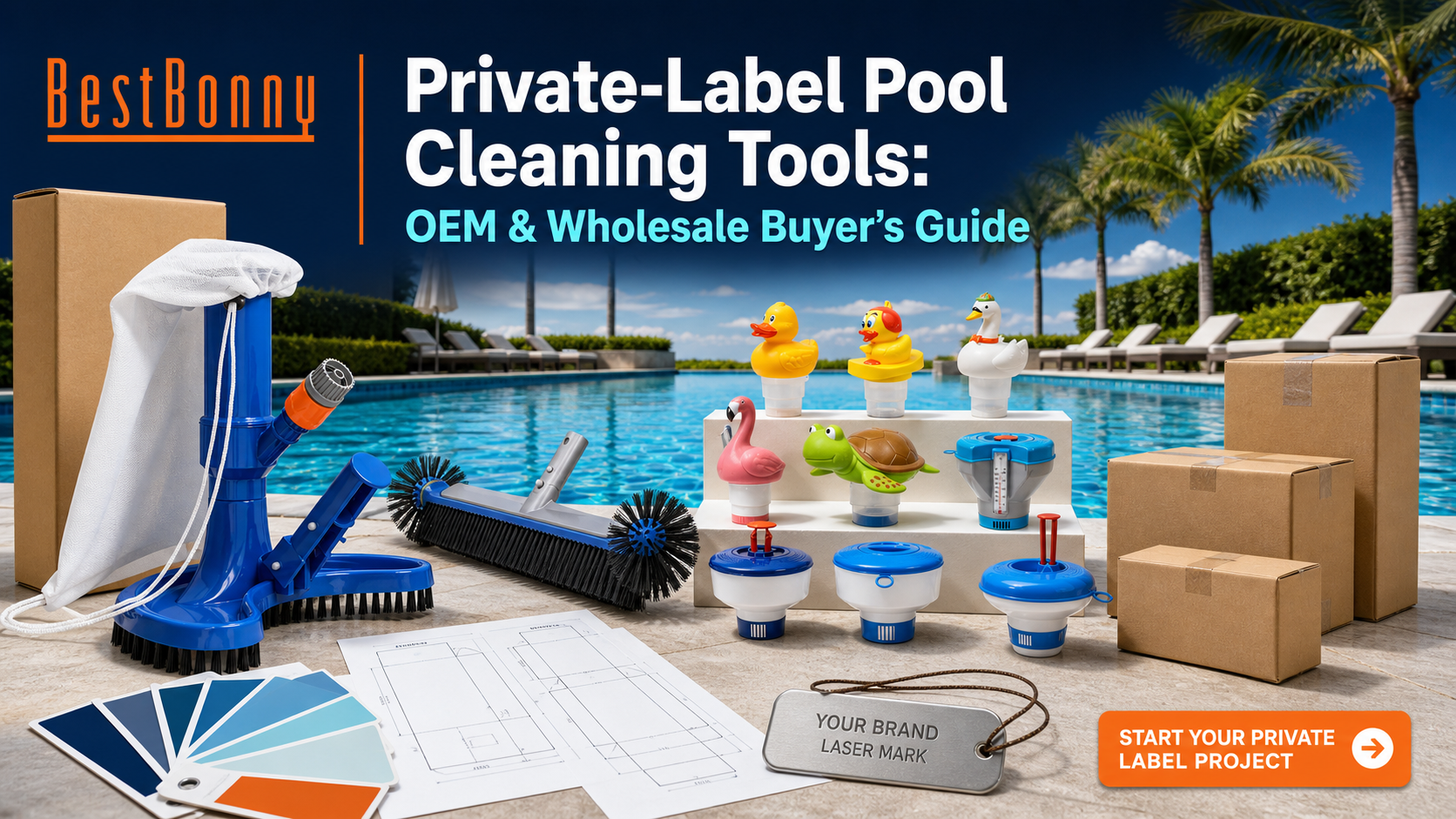
Private-Label Pool Cleaning Tools: The Complete OEM & Wholesale Buyer’s Guide
How retail brands, importers, distributors, and category managers can turn established pool tools into a controlled, differentiated, retail-ready range—without allowing speed to replace due diligence.
Direct answer: what is the safest way to launch private-label pool cleaning products?
Start with a small, compatible range built on production-proven platforms. Lock the product specification before artwork, validate real production samples, define packaging and compliance by destination market, and approve a written quality plan. Use a gated launch—brief, shortlist, engineering review, branded sample, pilot, inspection, and replenishment review. The winning supplier is the one that can document repeatability, not merely apply a logo quickly.
1. Private label is a business system, not a logo-printing service
The visible change in a private-label program may be a logo, color, and carton, but the commercial work reaches much further. A buyer takes responsibility for product selection, market fit, claims, packaging, traceability, compliance, forecasting, channel presentation, customer support, and warranty. The factory must translate those decisions into controlled materials, processes, artwork, packing, and records. If either side treats the project as “put our brand on this,” risks remain hidden until production or the first customer complaint.
A strong program begins with a product and channel strategy. Define the buyer who will choose the item, the user who will operate it, the pool surfaces and environments it must handle, the retail price architecture, the comparison set, the sales season, and the service promise.Decide whether your advantage is professional durability, easy compatibility, compact e-commerce packaging, value pricing, a coordinated color system, clearer instructions, or a complete cleaning solution. Differentiation should solve a buying or use problem, not merely create another SKU.
When evaluating private label pool cleaning products, ask the supplier to separate the standard platform from every proposed change. Standard platforms can shorten development because tooling and processes already exist. They are not automatically validated for your market, claims, packaging, or use case. Your controlled specification and current evidence still govern the order.
Private label is usually the fastest route when an existing product performs the required job and brand differentiation can come from assortment, color, packaging, instructions, content, and service. Choose ODM when the supplier must modify engineering or develop a differentiated function. Choose buyer-owned OEM when your organization controls a defined design. Write the model into the agreement because ownership, tooling, testing, exclusivity, price, and lead time change with it.
2. Write a launch brief that aligns commercial, engineering, and compliance teams
A one-page launch brief prevents different departments from buying different products.Include target countries, channel, consumer, use frequency, pool types, surfaces, climate, brand position, target retail price, gross-margin requirement, first-order and annual volume range, desired launch date, pack format, sustainability constraints, warranty, and required languages. Add competitor references for context, but describe what you want to improve rather than asking the factory to copy.
List non-negotiable product outcomes and unacceptable failures. A private-label brush may need a secure pole interface, surface-safe bristles, a backplate that resists corrosion, and a handle joint that survives professional use. A leaf rake may need fast drainage, a frame that remains stable with wet debris, and a bag that empties cleanly. A kit may need every adapter present, obvious assembly, and one instruction sheet that prevents misconnection. These are buyer outcomes; the supplier can then propose measurable specifications and tests.
Use three requirement columns: mandatory, target, and supplier proposal. Mandatory items protect safety, compatibility, brand, or regulation. Targets define preferred performance or commercial goals. Supplier-proposal fields invite manufacturing knowledge. This structure reduces defensive quoting and reveals where a supplier adds value.
3. Build a launch assortment around maintenance jobs
New brands often select products by photograph: one attractive brush, one skimmer, one vacuum head, and several novelty items. The result looks broad but may not work together.Build the range around jobs—surface debris, floor debris, wall and corner cleaning, chemical support, pole reach, and seasonal maintenance. Standardize connections and color logic. Give every SKU a role, target user, price position, and reason to remain in the range.
| Launch role | Example SKU | Core buyer promise | Private-label opportunity |
|---|---|---|---|
| Traffic driver | Wall brush | Fast, surface-appropriate cleaning | Width choice, bristle story, color, ergonomic instructions |
| Problem solver | Deep-bag leaf rake | Capture and unload heavy debris | Mesh, bag depth, frame, professional-use positioning |
| System anchor | Telescopic pole | Secure reach across compatible heads | Length architecture, lock, grip, attachment standard |
| Technical core | Vacuum head | Predictable contact and debris pickup | Weight, geometry, wheels or brushes, hose compatibility |
| Basket builder | Cleaning kit | One box with compatible essentials | BOM, instructions, packaging, replacement-part logic |
| Seasonal add-on | Floating dispenser | Convenient tablet containment and release control | Capacity, lid, vent, shape, warnings, color |
Begin with products that share materials, colors, packaging suppliers, and interfaces when this does not compromise performance. Shared architecture lowers development workload and supports mixed-container planning.It also makes content and merchandising clearer. A shopper understands a family of tools designed to work together.
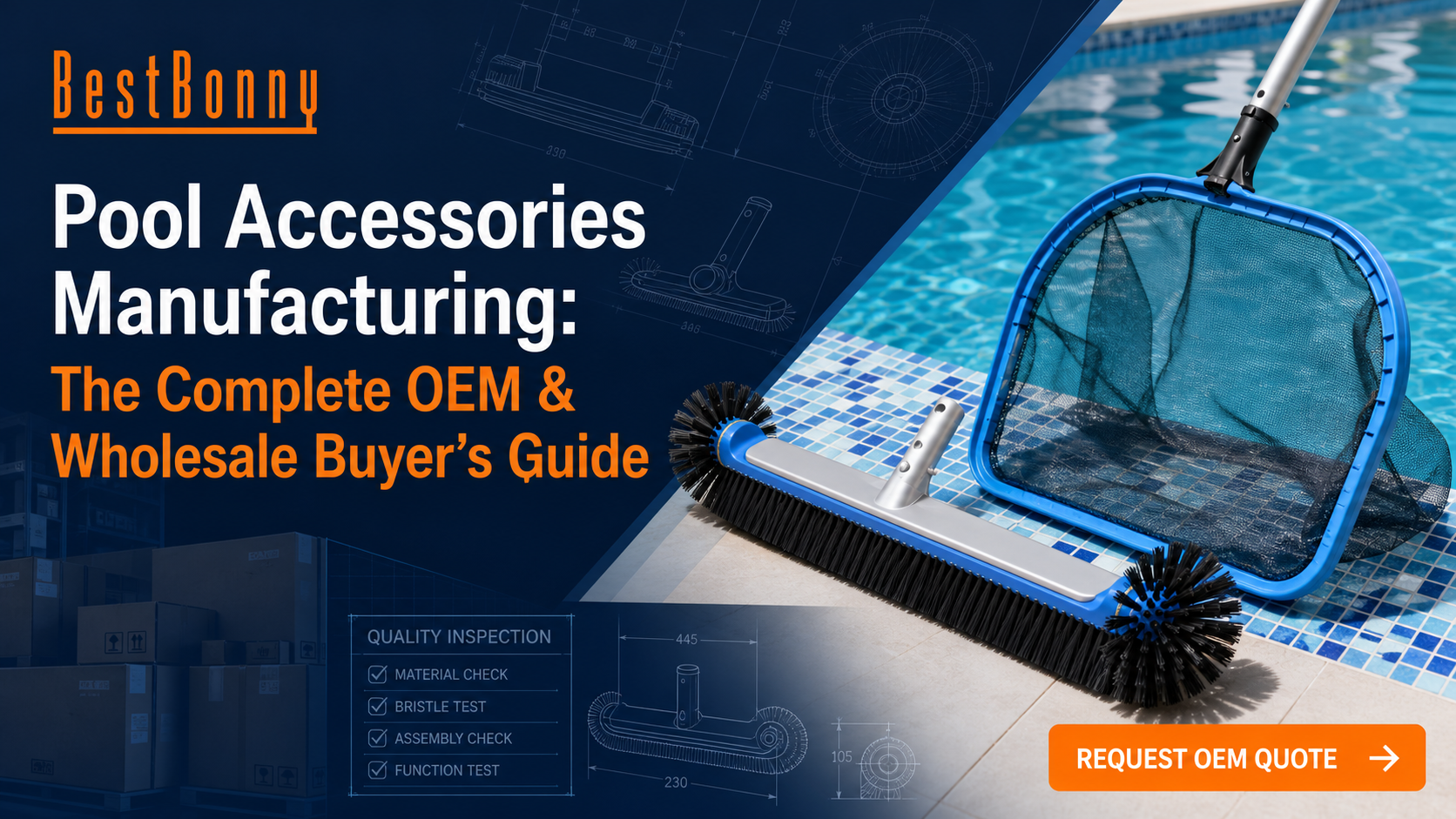
Review official product examples to frame engineering questions. A pool brush manufacturer discussion should cover bristle type, planting, backplate, surface suitability, corner reach, and pole fit. A pool skimmer net manufacturer discussion should cover mesh, depth, drainage, frame load, seam, and connector retention. A pool vacuum head manufacturer discussion should cover mass, contact, suction path, debris passage, hose fit, and repeated load at the pole connection.
4. Use a SKU scorecard before adding any item
Score each candidate on customer importance, differentiation, gross-margin potential, return risk, compliance complexity, packaging efficiency, MOQ exposure, seasonal demand, compatibility, content potential, and supplier process fit. Reject products with no clear role even if the unit price is attractive. Complexity consumes artwork, forecasting, quality, inventory, and customer-service capacity.
A practical gate is to require answers to six questions: Who buys it? Which problem does it solve? Why will they choose our version? What can fail? What evidence proves the promise? How will it be replenished profitably? If the team cannot answer in plain language, the SKU is not ready.
Use a provisional assortment for quotation and sampling, then reduce it. Samples reveal overlap, quality differences, packaging constraints, and weak interfaces. A disciplined buyer may evaluate twelve candidates, pilot seven, and launch five. Fewer strong SKUs create better product pages, training, inventory turns, and reviews than a rushed catalog of marginal variants.
5. Create a customization ladder
Customization should progress from low-risk, reversible changes to engineering changes. This makes cost, lead time, tooling, and validation visible.
- Documentation: label, instruction, warranty card, and language.
- Packaging: sticker, insert card, sleeve, color box, display, or e-commerce pack.
- Brand application: pad print, screen print, laser mark, molded mark, or approved label.
- Color and finish: standard color, matched color, surface texture, metal finish.
- Configuration: component combination, accessory, handle, mesh, bristle, or carton count.
- Component change: connector, lock, reinforcement, packaging insert, or replaceable part.
- New tooling or technology: unique geometry, mold, electronics, firmware, or system architecture.
For each step, request MOQ, one-time cost, lead time, affected tests, artwork requirements, production risk, and change-control implications. A custom color can affect resin batch, material purchasing, molding cleanup, color approval, UV behavior, and minimum quantity. A “small” logo change can alter the method, fixture, surface preparation, wear resistance, and position tolerance.
Keep a customization matrix by SKU. Record what is standard, optional without tooling, optional with setup, or new development. Record available print areas, artwork limits, color systems, packaging choices, and order combinations. The matrix becomes a sales tool for your own brand and a control tool for the factory.

6. Protect the product while differentiating the brand
Do not change a proven platform for cosmetic reasons without understanding performance. A darker resin may heat more in sunlight. A texture can complicate printing or cleaning. A new pigment or recycled-content rule can affect impact strength and color stability. A larger logo can cross a rib or curved surface. A thinner carton can improve cost but allow bristles or frames to deform.
Ask engineering to classify every proposed change as cosmetic, interface, material, structural, functional, safety, compliance, or packaging. Then define validation. Cosmetic changes may require visual approval and print adhesion.Material changes may require dimensional, mechanical, chemical, and weathering work. Interface changes require compatibility testing. Packaging changes require packed-product validation.
Avoid marketing claims that exceed the evidence. “Professional grade,” “chemical resistant,” “UV resistant,” “universal,” “safe for all surfaces,” and “lasts for years” need definitions and support. Strong private-label copy explains the intended use and relevant design choices without implying untested certainty.
7. Decide brand application by use environment
Logo method should follow material, surface, exposure, geometry, volume, and brand standard. Pad printing can suit curved or irregular parts but needs ink, pretreatment, adhesion, and wear controls. Screen printing can work on flatter areas. Laser marking can be durable on appropriate materials but appearance varies. Molded branding has high repeatability after tooling but is less flexible. Labels are fast but require adhesive and environmental validation.
Specify artwork revision, vector file, color, size, location, orientation, allowable position tolerance, surface preparation, curing, appearance, adhesion, abrasion, and chemical exposure as relevant. Approve the actual method on production-intent material. A digital mockup proves layout, not physical durability.
Place brand marks where they remain visible without interfering with grip, assembly, moving parts, warnings, or inspection. Consider how the product appears in shelf photography and use.Keep permanent product identity and traceability separate from promotional decoration.
8. Control color with more than a screen image
Digital color values are useful for design but insufficient for molded plastic, coated metal, printed ink, fabric, and cardboard. Establish a physical or instrument-based reference, substrate, finish, lighting, and acceptable difference. The same nominal color can look different across gloss plastic, matte carton, aluminum, nylon mesh, and printed paper. Decide whether the goal is exact match or a coordinated palette.
Approve color chips, then production-intent samples. Define how the factory handles natural material variation, pigment lot, regrind, and process conditions. Retain approved references at both sites and protect them from fading or contamination. For critical brand colors, use measurement and a controlled light cabinet; for less critical parts, a defined visual range may be sufficient.
Include color in change control. A pigment supplier, resin grade, finish, tool texture, ink, or print vendor change can alter appearance and performance. Do not let a purchasing substitution become an unapproved brand change.
9. Engineer packaging from channel backwards
A retail peg, shelf, distributor case, parcel network, and marketplace fulfillment system impose different constraints. Define the handling journey before selecting a box. Long poles, projecting handles, stiff bristles, mesh frames, and irregular kits need support that prevents bending, abrasion, puncture, and missing parts without producing unnecessary volume.
For e-commerce, protect against repeated handling, mixed orientation, drops, and labels placed by fulfillment partners. For physical retail, balance visibility, theft resistance, sustainability, and shelf efficiency. For wholesale, master-carton strength, identification, mixed-SKU logic, and pallet stability may matter more than a decorative retail surface.
Approve the packaging bill of materials: board grade and flute, dimensions, print method, coating, window, insert, bag, tie, tape, label, instruction, accessory pack, master carton, pallet, and corner protection. Define pack-out with photographs and steps. Test the packed product in the intended configuration and weight.

10. Make artwork approval a controlled technical process
Artwork errors can make an otherwise good production lot unsaleable. Maintain an artwork register showing SKU, country, language, barcode, dieline, file revision, approval date, and superseded versions. Require supplier acknowledgment and line clearance. Digital approval should be followed by physical print or production proof when color, legibility, barcode, coating, registration, or substrate matters.
Review product name, model, quantity, dimensions, claims, warnings, instructions, language, country of origin, importer or responsible economic operator, manufacturer identity where required, recycling information, date or lot code, barcode quiet zone, and channel-specific labels.Legal and compliance teams must review destination requirements; the factory should not be expected to define your legal position.
Use a barcode verifier rather than a phone camera for formal acceptance. Confirm that barcodes match the master data and remain readable on the actual print, curve, gloss, and packaging. Check human-readable numbers as well. A correctly printed wrong code is still wrong.
11. Write instructions for the first use and the first mistake
Good instructions reduce returns and protect the brand. Show assembly, compatible connections, intended surfaces, cleaning, storage, chemical precautions, inspection, and disposal as relevant. Use diagrams for orientation and connections. Put critical warnings where the user encounters the risk, not only in dense text.
Test instructions with people who did not write them. Give them the packed product and observe. Record where they hesitate, reverse a part, miss an adapter, apply excessive force, or misunderstand a claim. Revise the product or instruction—the best answer may be a poka-yoke feature, color cue, or preassembly rather than more words.
Coordinate website, carton, insert, and customer-service guidance. If the product page says a brush is suitable for every surface while the instruction excludes one, trust and safety suffer. Maintain one approved fact library by SKU so every channel uses the same current information.
12. Freeze a written specification before approving the branded sample
A beautiful branded sample can distract from missing technical control.Approve drawings, materials, colors, interfaces, dimensions, tolerances, functional tests, cosmetic standards, logo, packaging, labels, and traceability in writing. The sample then illustrates the specification rather than replacing it.
Identify critical-to-quality characteristics and inspection method. For a brush these may include pole fit, joint strength, bristle retention, backplate, width, and surface suitability. For a net: frame load, mesh, seam, bag depth, and connector. For a dispenser: material, tablet fit, lid, vent, buoyancy, and warnings. For a kit: exact BOM, compatibility, instruction, accessory count, and carton.
Sign and date retained control samples at buyer and factory. Label sample type and revision. Record all deviations and whether they are temporary. Never approve production with an unresolved note such as “color to be improved” or “packaging later.” Convert open items into objective conditions and a gate.
13.Use product-specific validation, not a generic factory checklist
| Product | Development checks | Routine production checks | Periodic or change-triggered checks |
|---|---|---|---|
| Brush | Surface matrix, fatigue, bristle pull, corrosion and UV plan | Dimensions, assembly, bristle appearance, pull sampling | Weathering, material confirmation, extended cycle |
| Skimmer net | Capture, drainage, frame load, connector pull, seam | Mesh, sewing, frame, fit, appearance | Abrasion, material, repeated load |
| Vacuum head | Floor contact, flow, debris passage, hose and pole fit | Weight, dimensions, assembly, connection, cosmetic | Fatigue, material, performance correlation |
| Dispenser | Capacity, lid, vent, float, ingress, material compatibility | Assembly, fit, float sample, markings, pack | Chemical/UV program and claim review |
| Pole | Bend/load, lock cycle, interface, corrosion, grip | Length, lock, straightness, finish, connector | Cycle, material certificate, corrosion |
| Kit | Full-system use test, BOM, missing-part prevention | Component count, fit, instruction, pack-out | Packaging distribution validation |
Methods must specify fixtures, conditions, cycles, forces, duration, sample selection, and acceptance. Record actual values where useful. A pass/fail box without raw data can hide drift. Align measurement methods between buyer, factory, and third-party inspector.
For lot acceptance, use a documented sampling plan appropriate to risk, such as one based on ISO 2859-1:2026. Define critical, major, and minor defects with product photographs and examples. Define what happens after rejection, including containment, sorting, rework, reinspection, cost, and schedule.
14. Treat a quality-system certificate as one input
A current quality-management certificate can support supplier qualification, but buyers must verify legal entity, site, scope, issue and expiry, and certification body. The current published ISO 9001:2015 standard is described by ISO as a quality-management framework; the new edition is in transition. See the official ISO 9001:2015 page.
More important, examine execution: drawing revision at the line, material lot records, first-piece approval, inspection frequency, calibrated equipment, nonconforming control, rework authorization, training, corrective action, and traceability. Ask for redacted examples from the same product family. A certificate does not approve your SKU, validate a marketing claim, or prevent an unauthorized change by itself.
15. Build compliance by SKU, market, and claim
Private-label owners need a market-access file for each SKU. Start with intended use, user, materials, electronics or batteries, chemical contact, packaging, claims, and destination. Then identify applicable laws, standards, tests, documentation, markings, warnings, languages, traceability, and responsible parties with qualified advisers.
In the European Union, review the European Commission’s product-safety information and product-specific legislation. Material chemical restrictions, packaging, electrical rules, batteries, radio functions, and waste obligations can depend on construction. In every market, use current official sources and expert review rather than a supplier’s generic “CE/RoHS/REACH available” statement.
Request documents that name the correct product and revision. Verify photos, model list, applicant, manufacturer, laboratory, method, result, date, and scope. Link each claim on the carton or product page to evidence. If the product or claim changes, perform a compliance impact review before approval.
A pool chlorine dispenser manufacturer should support product and material questions, but your brand must review intended-use wording, chemical warnings, tablet compatibility, and destination obligations. Do not market an adjustable floater as a precision dosing device unless the claim has been properly validated.
16. Expand due diligence for robotic and cordless products
A manual-tool program does not automatically qualify a supplier for electronics. When assessing a robotic pool cleaner OEM manufacturer, review hardware, motors, sealing, battery pack, cells, charger, PCB, firmware, navigation, sensors, app or cloud where present, cybersecurity, transport, reliability, repair, spares, warranty, and end-of-life support.
Define ownership of firmware, source code, app accounts, tooling, industrial design, test fixtures, and data. Define update and vulnerability response responsibilities. Review battery and transport documents at cell, pack, and finished-product level as applicable. Ensure regulatory review covers every target market and supplied accessory.
Reliability validation should represent use: charging cycles, run time, ingress, thermal conditions, debris, surfaces, slopes, retrieval, storage, and misuse. Track field failures by component and lot. A launch without repair parts, diagnostics, warranty triage, and firmware support can convert attractive gross margin into expensive returns.
17. Put traceability into the artwork and factory process
Define a lot-code format that connects finished goods to date, line or shift, material and component lots, inspection, and shipment. Decide where the code appears on product and packaging, how long it remains readable, and what records are retained. A code that only the factory understands can still work if decoding and response are controlled.
Run a trace exercise before launch. Select a finished unit and ask the factory to identify its production and material history. Then choose a material lot and identify affected finished shipments. Record time and gaps.Traceability is valuable only if it supports containment at useful speed.
For kits, trace both the kit lot and critical components. A missing or defective adapter may affect multiple kit SKUs. For private-label cartons, prevent mixing of customer brands through line clearance, separated storage, count reconciliation, and destruction or control of obsolete materials.
18. Require formal change notification
Once approved, the supplier must not change critical material, component source, color concentrate, mold, cavity, process, subcontractor, factory location, test, tooling, construction, artwork, or packaging without written approval. Define notice period, emergency process, required risk analysis, samples, validation, and inventory transition.
Classify change impact. An artwork spelling correction differs from a resin substitution. A second component source may need dimensional and functional comparison plus updated compliance evidence. A mold repair may need cavity study and pilot. An electronics change may need full regulatory and reliability review.
Changes can improve cost or resilience, so the process should enable them—not suppress disclosure. Suppliers hide changes when the approval path is slow or unclear. Set response times, named reviewers, and evidence expectations. Reward early notice and factual risk analysis.
19. Model MOQ by customization layer
Ask for separate minimums for standard product, custom color, printed product, label, instruction, color box, master carton, and mixed assortment. One MOQ number hides the real constraints.Printing may require hundreds while a color compound requires thousands. A carton supplier may impose a larger run than product assembly.
| Customization | Likely MOQ driver | Lower-risk launch option |
|---|---|---|
| Brand name | Print setup or label purchase | Durable label or standard print area |
| Custom color | Pigment/resin batch and molding cleanup | Existing color for pilot; match after validation |
| Retail carton | Board and print run | Standard carton plus branded sleeve or label |
| Unique configuration | Component suppliers and line efficiency | Use validated components and reduce variants |
| New mold | Tooling investment and process validation | Validate market on an existing platform first |
Negotiate the cause, not only the number. The buyer can accept standard colors, combine compatible SKUs, pay setup, commit annual volume with call-offs, or buy packaging inventory under agreed storage and obsolescence terms. Every solution transfers cost or risk; record who owns it.
20. Build a landed-cost model before choosing packaging or quantity
Unit price is one input. Add tooling, setup, samples, testing, inspection, packaging, artwork, freight, insurance, duty, broker, handling, pallet, storage, financing, scrap, defect sorting, returns, warranty, and obsolescence. Model at least first order and steady-state order. First-order costs are often distorted by tooling and small volume.
Normalize trade terms and named places under the official Incoterms® 2020 rules. Clarify what is included before comparing. Incoterms allocate specific delivery, risk, cost, and obligation points; they do not replace specifications, payment terms, title, warranty, or remedies.
Pool accessories are frequently volume-sensitive. Confirm packed carton dimensions and weight using production-intent packaging. Calculate cubic cost per sellable unit and compare configuration options. A slightly higher product cost may reduce carton volume, damage, assembly, or returns enough to improve total margin.
For pool cleaning kit wholesale, compare complete kit landed margin with component margin. Kits increase basket value and simplify the buying story but can carry more packaging volume, component MOQ, missing-part risk, and warranty complexity.
21. Design a price architecture, not one target cost
Create good-better-best or homeowner-professional tiers only where differences are meaningful and supportable. Use product architecture, materials, performance, pack, and service—not decorative claims alone. Keep enough shared components for purchasing leverage and compatibility while protecting each tier’s promise.
For example, an entry skimmer can use a shallow mesh and standard frame for light debris; a professional leaf rake can use deeper mesh, reinforced frame, stronger connector, and replacement support.A basic brush can focus on common surfaces; a professional brush can offer broader width or specialized bristles with explicit surface guidance. Test and describe the differences.
Give suppliers target cost ranges with commercial context, but do not force an impossible cost that invites silent material reduction. Ask for cost-down proposals with quantified specification impact. Approve value engineering through change control and validation.
22. Plan forecasting, production windows, and seasonality
Pool products can be seasonal, while production, packaging, and ocean freight have long and variable lead times. Build a demand plan by SKU, region, channel, and week or month. Identify long-lead components and the date when color, artwork, and quantity must freeze. Reserve capacity only after requirements are credible.
Ask the supplier to show lead-time components rather than one promise. Include material, molding, printing, packaging, assembly, testing, inspection, rework buffer, booking, and transport. Define the event that starts lead time. Confirm how holidays, peak season, and maintenance affect capacity.
Use a launch buffer that protects the retail date without creating excessive inventory. A smaller air shipment may support samples or launch displays, but it should not hide a broken mass-production schedule. Monitor artwork approval, packaging arrival, pilot results, production output, defect trend, inspection, booking, and departure as separate milestones.
23.Run a gated development and sample process
- Supplier shortlist: relevant process, product examples, commercial fit, quality evidence.
- Feasibility review: requirement questions, customization matrix, risks, DFM, timeline.
- Unbranded engineering sample: performance, material, interface, dimensions, failure review.
- Brand and color sample: physical logo, color, finish, identification, durability.
- Packaging proof: dieline, text, barcode, color, fit, pack-out.
- Pilot run: intended materials, equipment, operators, controls, tests, traceability.
- Pre-production approval: signed specification, control samples, artwork, quality plan.
- Mass production: first-piece, in-process control, functional tests, packing verification.
- Final inspection and shipment: lot acceptance, documents, loading evidence, retention sample.
- Launch review: returns, complaints, sell-through, content questions, replenishment changes.
Each gate should state required inputs, approval authority, open issues, and permission to proceed. Do not compress gates by treating a handmade sample as pre-production. If a launch date forces overlap, document the commercial risk and decision owner.

24.Evaluate the manufacturer’s real private-label operating model
A credible pool accessories manufacturer should connect sales, engineering, quality, production, artwork, packaging, logistics, and after-sales. Ask who owns each handoff. A fast sales reply is not enough if technical decisions have no named owner.
Request a redacted workflow for a similar private-label project: brief, feasibility, drawing, sample, artwork, pilot, approval, production, inspection, shipment, and change control. Ask to see examples of controlled specifications, packaging approvals, test records, traceability, and corrective actions. Verify that current documents apply to the manufacturing entity and product family.
Use a structured sample day. Put candidate products side by side and score materials, assembly, interfaces, ergonomics, performance, cosmetic consistency, pack, instruction, and supplier evidence. Photograph differences. The image above reflects the right mindset: compare complete sample stations, not isolated glamour photos.
25. How to choose a pool accessories supplier for private label
Anyone searching how to choose pool accessories supplier should prioritize evidence that the supplier can repeat the approved product and protect the brand. Score relevant manufacturing fit, DFM quality, specification discipline, artwork control, packaging engineering, compliance support, quality records, traceability, change notification, capacity, total cost, and corrective-action behavior.
| Question | Strong evidence | Weak answer |
|---|---|---|
| Can you make this construction? | Process map, equipment, same-family records and samples | Large catalog or marketplace listing |
| Can you control our brand? | Artwork register, proofs, line clearance, retained samples | “Send logo; we can print” |
| Can you repeat quality? | Control plan, actual data, traceability, defect actions | Certificate image without product records |
| Can you support our market? | SKU-specific current documents and open compliance questions | “All certificates available” |
| Can you meet launch? | Dependency-based plan, capacity calculation, named owners | One lead-time number with no start condition |
| Can you improve? | Root-cause examples, controlled cost-down, change approval | Blame, hidden substitutions, repeated defects |
26. Include poles, kits, and interfaces in the brand system
Accessory heads generate repeat purchases only when the connection system is predictable. If your range includes a pole, define diameter, button, thread, adapter, allowable play, load, and corrosion. A conversation with a telescopic pool pole manufacturer should focus on alloy, wall thickness, extension, lock cycle, bending, grip, and exact attachment dimensions.The linked product is an adjacent pole-engineering reference; the final pool application must be specified and validated separately.
Test every head with every approved pole and adapter. Publish a compatibility chart using exact models and dimensions. A kit should include only components that have been system-tested together. Control the BOM and use packing checks or fixtures to prevent missing parts.
Design replacement logic. Can users buy a bag, adapter, hose connector, brush head, or pole separately? Are spare parts coded and packaged? Professional buyers value serviceability, and spare parts can reduce returns and create repeat revenue.
27. Launch content should answer buyer objections honestly
Product pages and distributor materials should explain dimensions, materials, interfaces, intended surfaces, use, care, packaging, and what is included. Use original photographs, close-ups, diagrams, comparison tables, and test explanations. Avoid copied supplier boilerplate and claims unsupported by your file.
For B2B conversion, add downloadable or request-based resources: specification sheet, carton data, customization matrix, MOQ tiers, sample process, compliance pack summary, and RFQ form. Ask for market, channel, annual volume, target SKU, packaging, and launch date so the enquiry is qualified. Do not ask only “How can we help?”
Google’s people-first content guidance emphasizes original value, substantial answers, clear authorship, and trust. Its generative-AI optimization guidance says foundational SEO and valuable non-commodity content remain central. A long article earns attention only if it reduces the reader’s work; word count alone is not a ranking factor.
28. Create a fact library before scaling SEO and GEO content
Maintain one approved source for company and product facts: legal entity, factory locations, processes, equipment, capacity method, quality certificates, social audits, markets, customer references approved for use, product specifications, test methods, compliance documents, lead-time ranges, MOQ rules, warranty, contact details, and publication expiry dates.
Assign an owner and evidence link to each fact. Mark statements as approved, conditional, confidential, expired, or prohibited. Website pages currently can develop inconsistent numbers when old copy is reused. A fact library prevents one article saying fifteen years and another twenty-five, or one page using a sample MOQ as if it applied to every product.
For every blog, record primary keyword, buyer intent, original evidence, internal links, authoritative sources, author or reviewer, update date, CTA, and performance. Content operations then support sales enablement and quality, not only traffic.
29. Private-label RFQ checklist
- Brand, destination markets, channels, intended users, and launch objective.
- Candidate SKU list, target product references, use cases, and unacceptable failures.
- First order, annual forecast, seasonal pattern, reorder quantity, and target launch.
- Mandatory, target, and supplier-proposal requirements.
- Materials, colors, surfaces, interfaces, dimensions, tolerances, and performance tests.
- Customization ladder by SKU: logo, color, configuration, component, and tooling.
- Artwork method, position, size, color, adhesion, abrasion, and approval process.
- Retail pack, insert, master carton, pallet, barcode, warnings, and languages.
- Market-access matrix and required current documents by SKU.
- Sample stages, production representativeness, quantity, cost, timing, and approval gates.
- Tooling ownership, life, maintenance, storage, transfer, exclusivity, and IP.
- Quality plan, CTQs, inspection, defect classification, AQL, and retained records.
- Traceability format, complaint process, warranty data, spare parts, and corrective action.
- Change notification, prohibited substitutions, notice period, and validation.
- Price tiers, currency, validity, setup, packaging, named Incoterms place, and payment.
- Carton dimensions, weight, loading estimate, capacity, lead-time dependencies, and deviations.
Require a line-by-line compliance and deviation response. “Yes, can do” is not enough. Ask the supplier to identify assumptions, alternatives, risks, and information needed. The best quotation may contain more questions because the team understands what must be controlled.
30.Questions to ask during a private-label supplier call
- Which proposed SKUs are produced on your normal lines today?
- Which changes can use existing tooling, and which require new tooling?
- What creates the MOQ for product, color, print, and carton?
- Show how artwork revisions and obsolete packaging are controlled.
- Show the specification and inspection records for a similar construction.
- What are the three most common field failures and their controls?
- Which operations or components are subcontracted?
- How are materials identified, approved, and traced?
- Which tests run during development, each lot, and periodically?
- How do you prevent missing components in kits?
- How will you notify us before a material, supplier, process, or tool change?
- Who owns technical, artwork, quality, production, and shipment decisions?
- What is the critical path to our launch date?
- Which of our requirements would you change to reduce risk or total cost?
31. Frequently asked questions
How quickly can a private-label pool cleaning range launch?
Timing depends on platform selection, customization, samples, testing, artwork, packaging, compliance, production, inspection, and transport. A simple label on a proven stock platform is faster than custom color, carton, configuration, or tooling. Use a dependency-based schedule rather than one marketing number.
What is the difference between private label and OEM?
Private label usually applies a buyer’s brand to an existing platform with defined customization.OEM commonly means manufacturing to a buyer-controlled design. Actual ownership and responsibility vary, so define design, tooling, IP, testing, and change rights in the contract.
Can I begin with a low MOQ?
Often, if you accept standard product, color, and simpler packaging. Custom pigment, print, carton, or component suppliers may create higher minimums. Ask for MOQ by layer and negotiate the cause.
Should I order a custom color in the first run?
Only if the brand benefit justifies material, approval, MOQ, and schedule risk. A standard or existing color can validate demand faster. If color is central to the brand, define physical references and production validation early.
How do I prevent my logo from wearing off?
Select the method for the material and environment, then define pretreatment, ink or process, curing, adhesion, abrasion, chemical exposure, and acceptance. Approve production-intent samples and monitor routine production.
Can a cleaning kit use products from several suppliers?
Yes, but one party must own system compatibility, BOM control, packing, traceability, and complaint resolution. Consolidation can add logistics and coordination risk. Test the complete kit, not just components.
Do manual tools need compliance documents?
They may. Requirements depend on market, materials, intended use, claims, packaging, and channel. General product safety, chemical restrictions, labeling, traceability, and packaging obligations may apply. Obtain qualified current advice.
Does a quality certificate guarantee every shipment?
No.It can indicate a management system within a scope. Your specification, process controls, tests, inspection, traceability, change control, and remedies govern the product and order.
When should I consider a robotic private-label product?
After your organization can support electronics, batteries, software where applicable, compliance, spares, repair, diagnostics, warranty, and field data. Robotics can create value but requires a substantially stronger lifecycle system.
How do I create a high-quality B2B enquiry?
State market, channel, product or use case, annual and first-order volume, customization, packaging, compliance, target date, and open technical questions. Attach your specification or reference and ask for a deviation list, sample plan, and evidence pack.
32.A practical 90-day launch sequence
| Period | Primary work | Decision gate |
|---|---|---|
| Days 1–15 | Brief, market and SKU scorecard, supplier shortlist, initial RFQ | Approve platforms for samples |
| Days 16–30 | Engineering samples, interface tests, risk review, compliance matrix | Approve technical direction |
| Days 31–45 | Color, logo, packaging design, instruction, cost normalization | Approve branded sample and artwork proof |
| Days 46–60 | Pilot preparation, test methods, quality plan, traceability, production pack | Authorize pilot |
| Days 61–75 | Pilot, testing, packaging validation, corrective actions, pre-production sample | Authorize mass production |
| Days 76–90 | Production monitoring, inspection, content finalization, logistics readiness | Release shipment if all criteria pass |
This sequence is a planning example, not a promise. New tooling, repeated sample iterations, laboratory queues, electronics, complex packaging, peak season, or market approvals can require more time. Accelerate by clarifying requirements and decisions, not by skipping validation.
33. Final buyer perspective
A good private-label program makes the customer experience simple because the operating system behind it is disciplined. The range is coherent. Connections fit. Claims are supported. Instructions prevent mistakes. Packaging protects the product.Lots are traceable. Changes are controlled. The supplier can show what happened, and the brand can respond when the market teaches something new.
Do not ask a factory only whether it can add your logo. Ask whether it can protect the approved specification, evidence, artwork, timing, and reputation across repeat orders. Do not ask only for the cheapest price. Ask for the lowest controlled total cost at the quality and service level your customer expects.
Bonny presents OEM, ODM, private-label, engineering, and pool-accessory capabilities on its official site. Use those pages and product examples to begin a technical conversation, then request current product-specific documents. This distinction—marketing discovery followed by documented verification—is how professional buyers reduce risk and how credible suppliers earn long-term business.
Bring your private-label brief to an engineering conversation
Send your target market, product shortlist, first order, annual volume, brand color, packaging format, compliance needs, and launch date. Request platform options, customization limits, sample stages, current evidence, MOQ by layer, and a quotation with all assumptions and deviations listed.
Start Your Private-Label Project