
Quick Answer: The best pool leaf net for commercial pools depends on the facility's debris volume, cleaning frequency, staff workload, and existing telescopic poles. Shallow nets are practical for routine surface skimming, while appropriately designed deep-bag leaf rakes can handle larger leaf accumulations. Commercial buyers should compare collection efficiency, loaded handling, frame durability, net attachment, and replacement costs before selecting equipment for multiple facilities or wholesale orders.
Commercial swimming pools require consistent cleaning to maintain a suitable operating environment and attractive water appearance.
Hotels, resorts, community pools, aquatic centers, and pool maintenance contractors may face very different debris conditions.
An outdoor resort pool surrounded by trees may accumulate large amounts of leaves after wind or rain. An indoor aquatic facility may require more frequent removal of small floating debris. A maintenance contractor servicing multiple properties must also consider equipment portability and replacement availability.
These differences affect which leaf nets provide practical value.
For B2B buyers, the challenge is not simply finding a stronger net. It is selecting tools that suit actual operating conditions, establishing consistent staff procedures, and controlling recurring purchasing costs.
This article focuses on commercial pool cleaning operations and procurement planning, rather than general skimmer-net manufacturing specifications.
For an in-depth explanation of mesh aperture, frame construction, and supplier qualification, see BONNY's Pool Skimmer Net Supplier: Mesh Quality and Bulk Order Guide.
Key Takeaways for Commercial Pool Operators and Wholesale Buyers
A commercial pool leaf net should be selected according to the amount and type of debris collected during normal facility operations.
Shallow nets and deep-bag leaf rakes serve different purposes. Maintaining both may be more effective than requiring one design to handle every situation.
Cleaning efficiency should be measured through actual collection trials, including handling, emptying, and equipment changes—not only the width of the net.
Commercial buyers should standardize compatible pole connections and document the approved tool configurations used by maintenance teams.
A bulk purchasing plan should account for tool replacement frequency, facility inventory, supplier lead time, and total landed cost.
1. Why Is Leaf Removal Important for Commercial Swimming Pools?
Leaves, insects, pollen, and other organic materials can accumulate in swimming pools through wind, surrounding vegetation, and normal facility use.
If they remain in the water, some debris may sink or become trapped in skimmer baskets and other collection systems.
Manual surface skimming is a practical way for maintenance staff to remove visible floating debris.
How Does Debris Affect Pool Maintenance?
Organic debris adds to the workload of the pool's filtration and water-treatment systems.
The US Centers for Disease Control and Prevention's healthy swimming guidance explains that filtration removes debris, including leaves, and that debris can consume disinfectant needed for effective pool sanitation.
For commercial operators, this reinforces the value of removing unnecessary organic material as part of routine maintenance.
However, a manual pool leaf net does not replace filtration, disinfectant control, water testing, or other required operational procedures.
Why Commercial Facilities Have Different Needs
| Commercial Pool Type | Common Debris Situation | Operational Priority |
|---|---|---|
| Outdoor hotel pool | Leaves and insects from landscaping | Consistent appearance and convenient daily cleaning |
| Resort pool | Windblown leaves and seasonal debris | Effective collection and tool availability |
| Community swimming pool | Mixed floating debris | Predictable maintenance procedures |
| Aquatic center | Debris requiring routine removal | Efficient staff equipment management |
| Outdoor training pool | Leaves and windblown material | Suitable collection and storage |
| Pool maintenance contractor | Different debris conditions across client sites | Portable, standardized equipment |
Facility-specific cleaning requirements, operating schedules, and applicable local health rules must always take priority.
2. Shallow Skimmer Net vs Deep-Bag Leaf Rake: Which Is Better?
Commercial buyers should evaluate both designs.
The right choice depends on the actual cleaning task.
Shallow Pool Skimmer Nets
A shallow net has a relatively flat collection area.
It is commonly used for removing light floating debris from the water surface.
This configuration can be practical for routine cleaning when debris accumulation is limited.
However, its relatively shallow collection area may require frequent emptying when leaves are abundant.
Deep-Bag Pool Leaf Rakes
A deep-bag leaf rake provides a larger collection pocket.
This may be useful when a pool accumulates substantial amounts of leaves.
The design should be evaluated under representative loaded conditions because collecting more debris can increase weight and handling effort.
Commercial Pool Leaf Net Comparison
| Evaluation | Shallow Skimmer Net | Deep-Bag Leaf Rake |
|---|---|---|
| Main application | Routine surface skimming | Larger debris accumulation |
| Leaf capacity | Relatively limited | Greater potential collection volume |
| Emptying frequency | Depends on debris volume | May be less frequent for heavy leaf collection |
| Handling | Often convenient for light debris | Depends on bag construction and loaded weight |
| Frame requirements | Suitable strength for intended use | Must support expected loaded conditions |
| Storage | Generally compact | May require additional packing or storage space |
| Commercial application | Daily surface cleaning | Leaf-heavy outdoor pools |
| Purchasing priority | Maneuverability and repeatability | Loaded performance and durability |
Neither design is universally superior.
Recommendation: Commercial buyers should evaluate a shallow net for routine surface cleaning and a deep-bag design for facilities experiencing heavier leaf accumulation.
The two designs should be treated as complementary equipment rather than identical alternatives.
3. How Should Commercial Pools Select Nets Based on Debris Load?
The best purchasing decision begins with understanding actual debris conditions.
Rather than defining every commercial pool as requiring a heavy-duty leaf rake, facility managers can classify maintenance tasks by debris intensity.
Low Debris Load
Indoor pools or sheltered outdoor facilities may collect relatively small amounts of floating debris.
A shallow skimmer net may offer adequate collection capacity with convenient handling.
Moderate Debris Load
Pools near landscaping may experience regular leaf accumulation.
A wider collection opening or an appropriately designed deep-bag rake may be worth evaluating.
The decision should consider the frequency of emptying and the effort required during normal cleaning.
High Debris Load
Outdoor pools surrounded by trees may accumulate substantial debris after wind, storms, or seasonal leaf fall.
A deep-bag leaf rake can be evaluated for greater collection capacity.
However, higher debris loads also increase the importance of frame strength, net attachment, and safe handling.
Debris-Based Equipment Selection
| Debris Condition | Equipment to Evaluate | Main Purchasing Question |
|---|---|---|
| Occasional floating leaves | Shallow net | Is it easy to maneuver and empty? |
| Regular moderate leaf accumulation | Shallow or deep-bag net | Which is more efficient during real use? |
| Heavy seasonal leaves | Suitable deep-bag leaf rake | Can the frame and mesh support the load? |
| Fine floating debris | Appropriate fine-mesh net | Does retention justify additional water resistance? |
| Mixed debris across facilities | Two complementary net designs | Can crews standardize equipment without losing flexibility? |
This approach supports better purchasing decisions than selecting equipment based solely on product descriptions.
4. How Can Facility Managers Measure Leaf Net Cleaning Efficiency?
Commercial pool cleaning efficiency should be evaluated through repeatable tasks.
A wider net may collect more material during a single pass, but the overall cleaning time also depends on handling, water resistance, emptying, and access to the pool.
Four Practical Performance Measures
Collection time: Record the time required to remove a defined amount of floating debris from a representative area.
Emptying frequency: Record how often staff need to empty the net during the task.
Handling performance: Ask operators to assess weight, maneuverability, and usability when the net contains debris.
Tool condition: Inspect the mesh, frame, and connector after repeated use.
A Simple Commercial Cleaning Trial
A purchasing manager can compare two suitable net designs under reasonably similar operating conditions.
For example, staff can record the total time needed to complete a defined surface-cleaning task and the number of times each net must be emptied.
The comparison should use similar debris conditions and account for operator differences.
A single trial is not enough to establish universal performance, but repeated observations can support an informed purchasing decision.
Useful Operational Metrics
| Metric | How to Record It | Procurement Value |
|---|---|---|
| Cleaning time | Minutes per defined task | Helps evaluate staff efficiency |
| Net emptying | Number of emptying events | Indicates practical capacity |
| Tool replacement | Number of nets replaced | Supports replacement planning |
| Connector failures | Recorded incidents | Identifies compatibility or quality problems |
| Mesh damage | Tears and attachment defects | Indicates potential durability issues |
| Staff feedback | Structured evaluation | Identifies handling problems |
Operational takeaway: Measure the complete cleaning task rather than assuming a larger net automatically reduces labor time.
5. What Technical Specifications Matter for Commercial Pool Leaf Nets?
Before purchasing a pool leaf net for commercial pools, buyers should confirm its important construction and interface specifications.
Commercial-use frequency makes repeatable product quality particularly valuable.
Technical Purchasing Checklist
| Specification | Buyer Requirement |
|---|---|
| Net type | Shallow skimmer or deep-bag rake |
| Frame width | Approved dimensions |
| Net depth | Suitable for expected debris volume |
| Mesh material | Confirmed material and grade |
| Mesh opening | Appropriate debris retention |
| Frame material | Approved construction |
| Frame rigidity | Suitable for representative loading |
| Net attachment | Secure connection to the frame |
| Pole socket | Compatible dimensions |
| Locking mechanism | Reliable engagement |
| Product weight | Suitable for handling |
| Packaging | Protection and correct quantity |
Why Mesh Material Matters
Nylon and other polymer meshes may be used in pool cleaning equipment.
Their performance depends on the actual material grade, filament construction, opening size, and attachment method.
A material description alone does not establish durability.
Why Frame Strength Matters
When a net contains wet leaves, the frame and connection experience additional loading.
If the frame bends excessively or the net attachment fails, the tool may become unsuitable for continued use.
The manufacturer and buyer should agree on appropriate sample evaluation conditions.
Why Pole Compatibility Matters
Commercial maintenance teams often use telescopic poles with multiple cleaning accessories.
The leaf net should fit the approved poles and remain securely attached during intended operation.
Descriptions such as "universal fitting" should be verified through physical testing.
6. How Should Commercial Facilities Standardize Cleaning Equipment?
Large facilities and maintenance contractors can benefit from standardizing a limited number of approved leaf-net configurations.
Standardization can simplify staff training, inventory management, and replenishment.
However, it should not eliminate equipment needed for different debris conditions.
Example: Commercial Pool Cleaning Equipment Plan
| Equipment Category | Purpose | Stocking Approach |
|---|---|---|
| Primary shallow skimmer | Routine surface cleaning | Standard maintenance equipment |
| Deep-bag leaf rake | Heavy leaf accumulation | Available for appropriate facilities |
| Compatible telescopic pole | Extended reach | Confirm shared connections |
| Spare leaf net | Replacement after damage | Central or facility storage |
| Additional specialty net | Fine debris or restricted spaces | Stock where required |
This is an illustrative equipment plan, not a preassembled BONNY product kit.
Facility-Level vs Contractor-Level Purchasing
An individual hotel may purchase equipment based on its specific pool environment.
A maintenance contractor serving multiple facilities should consider how many different net configurations its technicians actually need.
Where practical, standardizing connectors and product dimensions can reduce avoidable variation.
However, each approved net should remain suitable for its intended cleaning task.
7. How Many Pool Leaf Nets Should Commercial Buyers Purchase?
Bulk purchasing quantities should be determined by operating requirements rather than arbitrary minimum stock targets.
A facility should consider the number of maintenance teams, equipment assigned per team, expected replacements, and supplier replenishment time.
Initial Equipment Requirement
A simple planning formula is:
Initial quantity = Active cleaning teams × Nets per team + Central spare inventory
For example, a hypothetical pool maintenance contractor may operate six cleaning teams.
If each team requires two approved nets and the warehouse maintains four spare units:
6 × 2 + 4 = 16 nets
This example illustrates inventory planning. It is not a recommended fixed stock level or a BONNY minimum order quantity.
Reorder Point
A separate calculation can help determine when new stock should be purchased.
Reorder point = Average weekly net consumption × Replenishment lead time in weeks + Safety stock
The actual values should be based on recorded replacement demand and confirmed supplier terms.
What Causes Leaf Nets to Be Replaced?
Replacement may be necessary due to torn mesh, frame damage, worn attachments, connector failures, or unacceptable deterioration.
A purchasing team should record the reason for each replacement.
This helps distinguish normal wear from potential product quality problems.
8. Which BONNY Products Should Commercial Buyers Evaluate?
Ningbo Bonny E-Home Co., Ltd., established in 1998, manufactures and supplies swimming pool cleaning equipment and accessories for international customers.
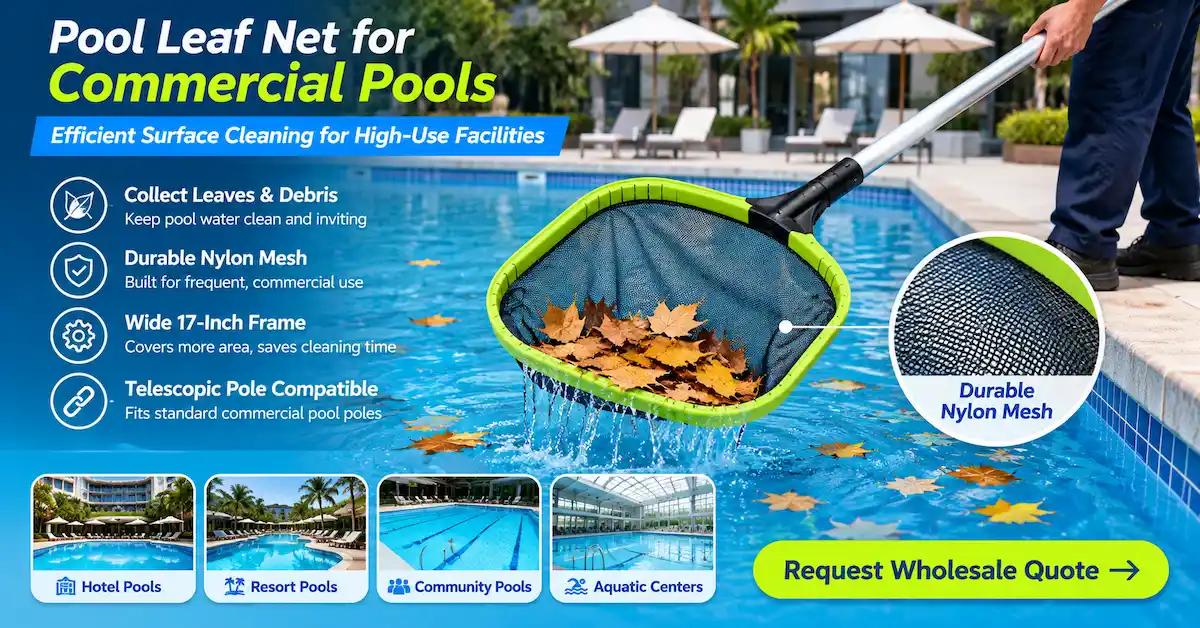
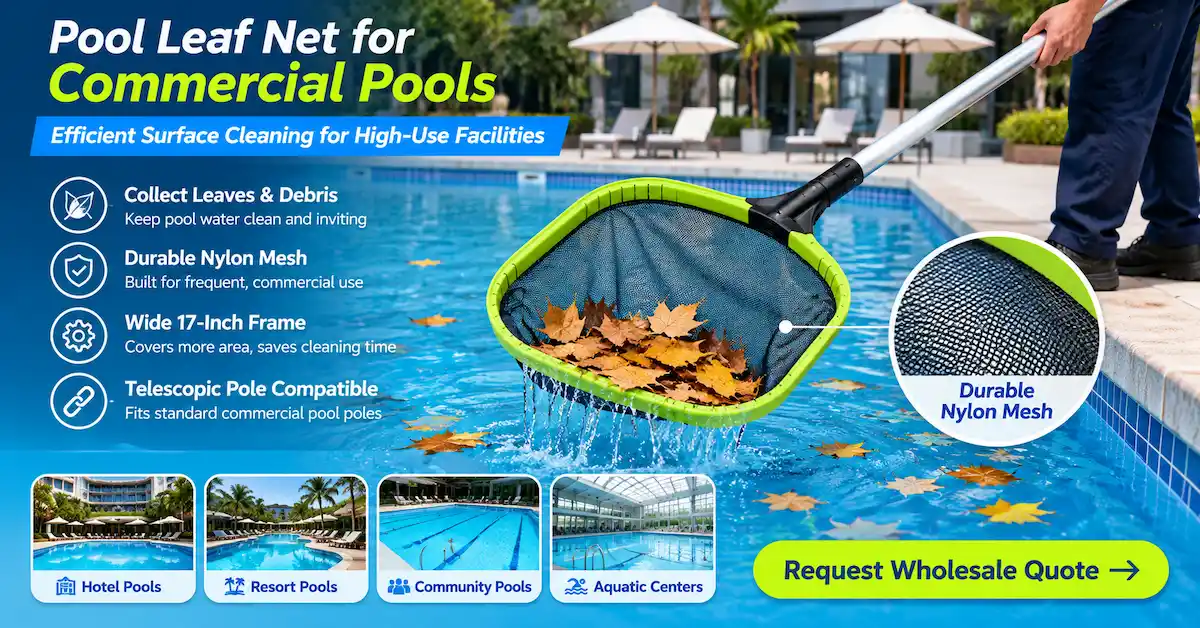
BONNY's published product catalogue includes a 17-inch nylon shallow-mesh pool skimmer net, which provides a relevant starting point for commercial surface-cleaning evaluations.
BONNY 17-Inch Swimming Pool Skimmer Net
Published product name: 17 Inch Swimming Cleaning Pool Net Water Skimmer Net Durable Nylon Shallow Mesh Leaf Rake Tool.
The product is listed in BONNY's pool accessory range.
Its published description identifies a 17-inch shallow-mesh net with nylon mesh.
This product can be evaluated for routine commercial pool surface cleaning.
Buyers should confirm actual frame dimensions, pole connection, mesh construction, product weight, and durability requirements before ordering.
View BONNY 17-Inch Pool Skimmer Net
What About Deep-Bag Leaf Rakes?
BONNY's existing blog content discusses deep-bag leaf rakes as a category.
However, that does not establish the current availability or specifications of a particular deep-bag model.
Commercial buyers requiring deep-bag nets should ask BONNY to confirm available designs, catalogue references, and customization feasibility.
BONNY Product Evaluation
| Product Configuration | Published Status | Recommended Purchasing Approach |
|---|---|---|
| 17-inch nylon shallow skimmer net | Listed in BONNY's catalogue | Request specifications and representative samples |
| Deep-bag leaf rake | Discussed in BONNY content | Confirm current model availability |
| Custom commercial leaf net | Potential OEM/ODM project | Submit technical requirements for feasibility review |
Explore BONNY Pool Accessories
Important: A product described as a swimming pool skimmer net is not automatically verified for every commercial facility. Buyers should confirm the actual operating requirements and product specifications.
9. How Should Buyers Inspect Wholesale Pool Leaf Nets?
Commercial buyers should establish inspection requirements before approving large orders.
A quality plan should evaluate the net, frame, connection, packaging, and finished assembly.
Recommended Quality Control Matrix
| Inspection Item | Suggested Check | Potential Problem |
|---|---|---|
| Mesh material | Verify approved specification | Material substitution |
| Mesh construction | Visual and dimensional inspection | Incorrect openings or defects |
| Net attachment | Agreed retention evaluation | Mesh separation |
| Frame dimensions | Measurement | Product inconsistency |
| Frame integrity | Representative functional loading | Excessive bending or damage |
| Pole connection | Actual fit test | Loose attachment |
| Surface finish | Edge and appearance inspection | Unacceptable projections |
| Packaging | Carton and product protection | Transport damage |
| Product identification | Model and quantity verification | Incorrect shipment |
How Does ISO 2859-1 Support Bulk Inspection?
The ISO 2859-1:2026 standard for acceptance sampling by attributes provides a statistical framework for lot-by-lot inspection.
Importers can use an agreed sampling plan to evaluate defined product characteristics.
However, acceptance sampling does not replace appropriate product testing or guarantee that every unit is defect-free.
Using the standard also does not mean a specific leaf net has obtained ISO product certification.
Golden Sample Approval
A golden sample should reflect the approved product configuration.
It should be supported by the relevant dimensions, materials, connection requirements, and packaging specifications.
This provides a reference for repeat production orders.
10. What Determines Commercial Pool Leaf Net Wholesale Costs?
Unit price is only one part of the purchasing decision.
Commercial buyers should also consider product replacement, packaging, inspection, freight, and inventory holding costs.
Total Landed Cost
A useful purchasing formula is:
Total landed cost = Product price + Packaging + Inspection + Freight + Insurance + Applicable import charges + Expected replacement costs
Cost Per Cleaning Task
Facility managers can also measure equipment costs against actual use.
Equipment cost per cleaning task = Landed unit cost ÷ Completed cleaning tasks before replacement
This metric should be calculated from real operating data.
It does not capture every labor or maintenance expense, but it can help buyers compare products beyond initial price.
Procurement Cost Considerations
| Factor | Impact |
|---|---|
| Net size | Material and packaging requirements |
| Mesh construction | Manufacturing and durability considerations |
| Frame design | Material and structural requirements |
| Net depth | Collection volume and packing dimensions |
| Pole connection | Compatibility and replacement risk |
| OEM branding | Customization cost |
| Order volume | Production and purchasing arrangements |
| Replacement frequency | Long-term equipment cost |
A more expensive net may provide better value if it performs reliably for more cleaning tasks, but this should be demonstrated through actual service data.
11. OEM and Private-Label Commercial Pool Leaf Nets
Commercial pool equipment distributors may require consistent branding, packaging, colors, or product specifications.
BONNY describes OEM and ODM capabilities for swimming pool cleaning equipment and accessories.
Potential Customization Options
| Requirement | Commercial Benefit | Verification Needed |
|---|---|---|
| Frame color | Brand identity | Approved material and color |
| Logo | Private-label positioning | Marking method |
| Net dimensions | Application-specific selection | Engineering feasibility |
| Mesh configuration | Debris collection requirements | Performance testing |
| Pole connection | Equipment standardization | Compatibility |
| Packaging | Wholesale distribution | Product protection |
| SKU labeling | Inventory management | Accurate product identification |
Not all customization options are necessarily available for every existing model.
OEM vs ODM
OEM: Manufacturing or modifying an existing product according to approved specifications.
ODM: Developing a new or substantially modified product that may require engineering, prototyping, tooling, and additional validation.
For a commercial pool leaf net, a new frame geometry or connection mechanism should be reviewed for structural and functional suitability before mass production.
Learn About BONNY Engineering & Design
12. How Should Commercial Buyers Qualify a Pool Leaf Net Supplier?
Supplier qualification should connect product performance with reliable purchasing arrangements.
A practical process begins by defining the facility's debris conditions and intended use.
The buyer should then request relevant product specifications and evaluate representative samples.
Sample trials can compare collection capacity, handling, connector security, and product condition after repeated use.
Following successful sample evaluation, the buyer and supplier should agree on packaging, inspection procedures, MOQ, production schedule, and product identification.
For repeat orders, important changes to materials, frame geometry, mesh construction, or pole connections should require appropriate notification and approval.
What Makes BONNY Relevant to Commercial Buyers?
BONNY offers a swimming pool accessory product range, manufacturing resources, and OEM/ODM services for international B2B customers.
Its published manufacturing capabilities include plastic molding, bristle planting, and other processes used across its pool equipment business.
For a specific leaf-net order, buyers should confirm the actual manufacturing arrangements, materials, inspection methods, and available documentation.
No unverified production capacity, replacement-life guarantee, MOQ, or delivery period should be assumed.
13. What Should Be Included in a Commercial Pool Leaf Net RFQ?
A clear request for quotation helps suppliers evaluate the requirements accurately.
| RFQ Item | Information to Provide |
|---|---|
| Buyer type | Hotel, resort, aquatic facility, contractor, or distributor |
| Pool environment | Indoor, outdoor, landscaped, or another defined application |
| Debris type | Leaves, insects, mixed floating debris |
| Cleaning frequency | Routine schedule and seasonal requirements |
| Net configuration | Shallow, deep-bag, or both |
| Dimensions | Preferred frame size and net depth |
| Mesh specification | Material and required retention characteristics |
| Pole interface | Existing pole connection details |
| Estimated order quantity | Initial purchase and anticipated replenishment |
| OEM requirements | Logo, colors, packaging, or design modifications |
| Quality requirements | Sample tests and inspection criteria |
| Destination market | Country and distribution channel |
| Commercial requirements | MOQ, price, delivery terms, and schedule |
Request Commercial Pool Leaf Net Wholesale Pricing
For an efficient enquiry, provide BONNY with your intended application, debris conditions, preferred net configuration, required quantity, and destination market.
If you operate multiple facilities or service routes, include your expected replenishment needs.
BONNY can review available products, sample options, and technically feasible OEM requirements.
Contact BONNY for Commercial Pool Leaf Net Specifications, Samples and Wholesale Quotations
Frequently Asked Questions About Pool Leaf Nets for Commercial Pools
1. What is the best pool leaf net for commercial pools?
The best option depends on debris volume, cleaning frequency, staff requirements, and existing equipment. Shallow nets are useful for routine surface cleaning, while appropriately designed deep-bag rakes can be evaluated for heavier leaf accumulation.
2. Should hotels use shallow or deep pool skimmer nets?
Hotels may benefit from a shallow net for daily cleaning and a deep-bag leaf rake when landscaping or seasonal conditions create heavier debris loads.
3. Can a commercial pool leaf net replace the filtration system?
No. Manual leaf nets supplement pool maintenance but do not replace filtration, disinfection, water testing, or other required operational systems.
4. How can a pool operator measure leaf net efficiency?
Record cleaning time, emptying frequency, debris conditions, handling, and tool condition during representative cleaning trials. Compare products under reasonably similar conditions.
5. Are nylon mesh pool nets suitable for commercial use?
They can be suitable depending on the material grade, mesh construction, frame attachment, and operating conditions. Buyers should verify the complete product rather than relying on the word "nylon."
6. How many leaf nets should a commercial pool facility stock?
Inventory depends on the number of cleaning teams, approved net types, replacement demand, and supplier lead time. A facility-specific stock calculation is more reliable than a universal quantity.
7. Are all commercial pool leaf nets compatible with telescopic poles?
No. Pole socket dimensions and locking mechanisms may vary. Buyers should test the net with their actual telescopic poles before ordering.
8. Can BONNY provide wholesale pool leaf nets?
BONNY lists a 17-inch shallow-mesh pool skimmer net and supplies swimming pool cleaning accessories to international business customers. Product availability and commercial terms should be confirmed directly.
9. Does BONNY offer OEM pool leaf net customization?
BONNY provides company-level OEM and ODM services. Specific customization options for a selected leaf net should be evaluated and confirmed before ordering.
10. What information is required for a wholesale commercial pool leaf net quotation?
Provide the target application, debris conditions, preferred design, dimensions, mesh requirements, pole compatibility, expected quantity, packaging needs, destination market, and inspection expectations.
Conclusion
Choosing the right pool leaf net for commercial pools requires an understanding of real maintenance conditions, debris loads, staff requirements, and long-term equipment costs.
For hotels, resorts, aquatic centers, pool maintenance contractors, and wholesale distributors, the most effective purchasing strategy is not necessarily selecting the largest or most expensive net.
It is choosing equipment that matches the required cleaning tasks, performs reliably during representative use, and can be replenished consistently.
Shallow skimmer nets and deep-bag leaf rakes can serve complementary roles in commercial pool maintenance.
Standardized pole connections, approved technical specifications, structured sample trials, and quality inspections help buyers make more dependable procurement decisions.
BONNY, operated by Ningbo Bonny E-Home Co., Ltd., supplies swimming pool cleaning equipment and accessories and offers OEM/ODM support for international business customers.
Whether you are purchasing nets for a hotel maintenance team, establishing a multi-facility cleaning program, or developing a wholesale pool equipment range, BONNY can review your requirements and discuss appropriate product options.
Contact BONNY to Discuss Commercial Pool Leaf Nets, OEM Customization, Samples and Wholesale Pricing