
A pool skimmer net supplier should be evaluated on measurable product specifications, not only price, appearance, or claims of durability. For B2B importers, distributors, and private-label brands, the most important purchasing risks include unsuitable mesh aperture, weak net-to-frame attachment, frame deformation, incompatible telescopic pole fittings, and inconsistent specifications between production batches.
TL;DR: A reliable pool skimmer net supplier should help buyers define mesh material and opening size, validate frame and connection strength, approve samples, and establish repeatable quality requirements before mass production. Shallow nets are generally suitable for routine surface debris collection, while deep-bag nets are useful when higher debris capacity is needed. Neither option is universally superior; the correct choice depends on the intended application.
This guide provides a technical comparison, supplier qualification method, inspection framework, and purchasing decision process for wholesale pool skimmer nets.
How Do Pool Skimmer Net Specifications Compare?
The first step in wholesale sourcing is to identify the characteristics that determine whether a net will perform its intended function.
The table below summarizes the most important engineering and purchasing considerations.
| Technical Factor | Shallow Skimmer Net | Deep-Bag Leaf Rake | Buyer Decision Rule |
|---|---|---|---|
| Net depth | Relatively shallow | Deeper collection pocket | Select according to debris volume and emptying frequency |
| Debris retention | Depends on mesh aperture | Depends on aperture and bag geometry | Specify target debris sizes rather than relying on product names |
| Mesh construction | Often lightweight | May require additional support under heavy loading | Verify material, attachment and suitable load conditions |
| Water resistance | Depends on mesh area and aperture | Depends on mesh, bag shape and loading | Compare handling during representative cleaning trials |
| Frame requirements | Must maintain opening geometry | Must support additional debris loads | Evaluate frame rigidity and connection strength |
| Cleaning application | Routine floating debris | Leaf-heavy pools and larger debris accumulation | Match the net to the maintenance environment |
| Wholesale considerations | Storage, handling and retail presentation | Packaging volume, construction and durability | Compare total landed cost, not just unit price |
Engineering takeaway: Mesh design, frame construction, and operating conditions should be evaluated as one system. Selecting only the frame width or mesh type leaves important performance risks unresolved.
Key Takeaways for B2B Buyers
-
Mesh aperture determines particle retention: Smaller openings can retain smaller debris but may increase drag during movement through water.
-
Frame strength and net attachment must be evaluated together: A strong frame does not compensate for weak stitching or net retention.
-
Pole compatibility is a critical interface requirement: A net with good mesh construction may still be unsuitable if the connector does not fit the buyer's telescopic poles.
-
Sample approval should establish a repeatable specification: Future shipments need the same approved materials, dimensions and assembly characteristics.
-
OEM customization should follow technical validation: Branding and packaging should be finalized after confirming the underlying product design.
Why Is Mesh Aperture Critical to Pool Skimmer Net Performance?
Mesh aperture refers to the opening size within the netting structure. It influences which debris particles can be captured and how water passes through the net during cleaning.
For wholesalers, an inaccurate mesh specification can create a mismatch between customer expectations and actual product performance.
Fine-Mesh Retention vs Water Resistance
A smaller mesh opening can retain smaller leaves, insects, and other debris when the opening is sufficiently small relative to the particles.
However, reducing mesh aperture can increase resistance as water moves through the net, depending on the overall mesh construction.
This creates a trade-off between debris retention and handling.
For routine residential cleaning, a lightweight shallow net with suitable aperture may be sufficient.
For professional services handling heavy leaf accumulation, collection capacity and handling under load may become more important.
Technical recommendation: Ask the manufacturer to provide actual aperture dimensions and a material specification. Terms such as "ultra-fine mesh" or "premium nylon" are not substitutes for measurable requirements.
Filament Thickness and Mesh Construction
Mesh performance also depends on filament characteristics.
Two nets with similar opening sizes can differ in flexibility, mechanical strength, and resistance to snagging because of differences in filament size and construction.
Important variables include:
-
Mesh material and grade.
-
Filament size and construction.
-
Aperture dimensions.
-
Net depth and shape.
-
Reinforcement and edge finishing.
-
Attachment method at the frame.
A supplier should be able to clarify which characteristics are standard and which can be modified for an OEM project.
Mesh Material Selection
Nylon, polyester, and polypropylene are possible materials for pool cleaning nets.
Each can have different material properties, but the performance of a finished skimmer net depends on the selected grade and complete product construction.
| Material | Relevant Characteristics | What Buyers Should Verify |
|---|---|---|
| Nylon | Flexible filament options and varied mesh constructions | Filament grade, strength, opening size and environmental suitability |
| Polyester | Alternative filament and textile constructions | Attachment, flexibility and resistance under intended conditions |
| Polypropylene | Lightweight polymer options for selected applications | Material grade, construction and dimensional stability |
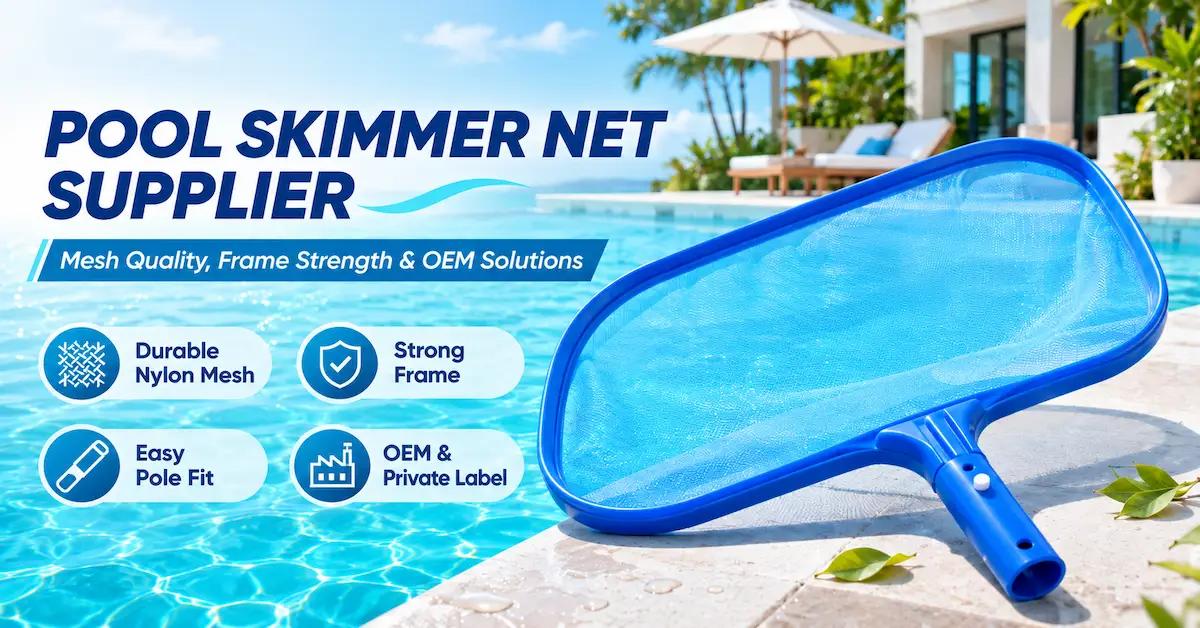
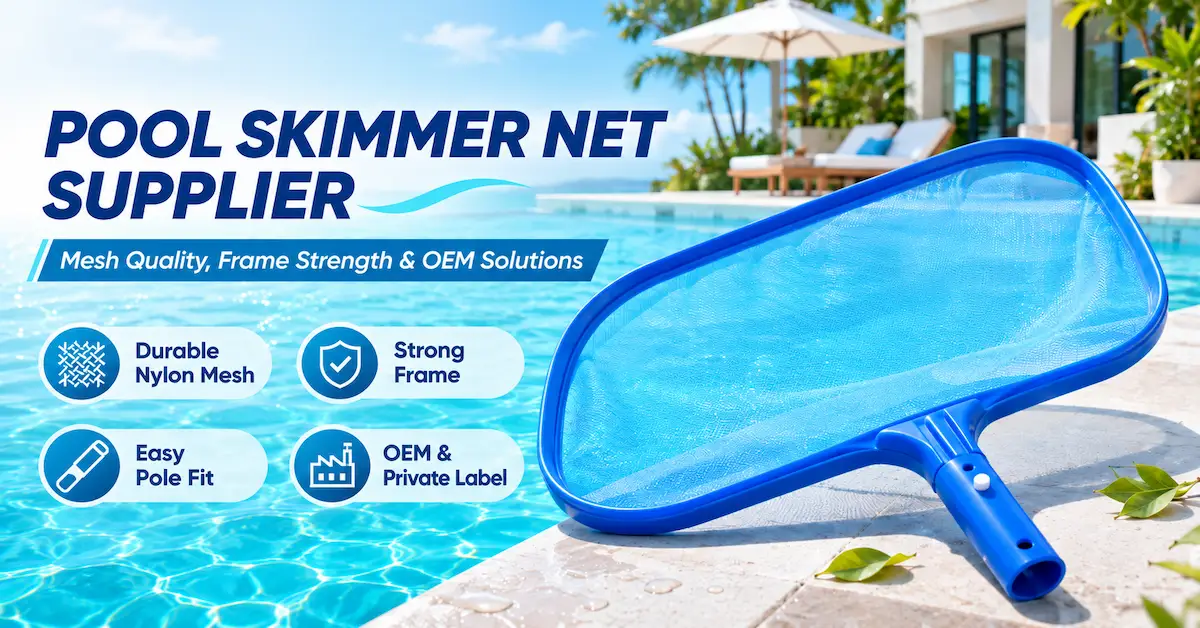
BONNY's catalogue includes a 17-inch shallow pool skimmer net listed with nylon mesh, providing a starting point for buyers evaluating standard shallow-net designs.
The published product name does not establish a precise mesh aperture, tensile strength, or UV-resistance rating.
Explore BONNY Pool Skimmer Nets and Accessories
How Do Frame Geometry and Attachment Strength Affect Durability?
Mesh specifications alone cannot establish whether a pool skimmer net is appropriate for repeated use.
The supporting frame, edge finishing, net connection and telescopic pole socket all contribute to the overall design.
Frame Rigidity and Deflection
The frame maintains the net opening during cleaning.
If it deforms excessively under the intended load, the operator may find it difficult to collect debris consistently.
Frame behavior depends on material, cross-sectional shape, reinforcement, opening dimensions, and loading conditions.
For plastic frames, important variables include wall thickness, rib geometry, molding quality and material selection.
For metal-reinforced designs, buyers should also examine attachment points and the suitability of the chosen materials for pool environments.
A reinforced frame is not automatically better for every application. Greater rigidity may add weight and cost without providing meaningful value for lightweight surface cleaning.
Net-to-Frame Attachment
The interface between the mesh and frame is a common point of concern in product qualification.
A net may have adequate mesh strength but fail when the connection separates under loading.
Buyers should consider:
-
Uniformity of stitching or binding.
-
Secure attachment around the frame perimeter.
-
Reinforcement at high-stress locations.
-
Absence of exposed sharp edges.
-
Resistance to separation during representative use.
An inspection plan should define acceptable attachment quality rather than relying solely on visual impressions.
Handle Socket and Telescopic Pole Connection
Pool skimmer net heads are commonly attached to telescopic poles, but connection arrangements are not necessarily universal.
Important variables include socket dimensions, locking position, connector material and retention.
Buyer rule: Test the proposed skimmer head with the actual poles sold in your market.
If the connector is critical, define its dimensions and fit requirements on the approved drawing.
Frame and Connection Inspection Matrix
| Component | Potential Failure | Suggested Verification |
|---|---|---|
| Frame body | Cracking or excessive bending | Material and dimensional inspection; agreed loading trial |
| Mesh perimeter | Tearing or separation | Attachment inspection and agreed retention test |
| Frame rim | Rough edges or unwanted projections | Visual and handling inspection |
| Pole socket | Loose or incompatible fit | Physical compatibility test |
| Locking connection | Unintended detachment | Repeated attachment and functional checks |
| Finished assembly | Inconsistent geometry | Approved sample and drawing comparison |
The exact test conditions and acceptance limits should be agreed between buyer and supplier before production.
Which Skimmer Net Design Is Best for Different Pool Applications?
A useful product comparison should focus on customer applications rather than presenting every design as universally suitable.
Residential Pools With Light Surface Debris
For routine removal of floating insects and leaves, a shallow skimmer net may be an appropriate starting point.
Important considerations include ease of handling, mesh retention and pole compatibility.
A deeper net is not necessarily required when debris volumes are low.
Outdoor Pools Surrounded by Trees
Pools near trees may accumulate larger amounts of leaves, particularly after wind or storms.
A deep-bag leaf rake may offer more practical collection capacity in these conditions.
However, the frame and mesh attachment must be suitable for the expected loaded weight.
Hotels and Professional Pool Maintenance
Professional maintenance teams may use skimmer nets frequently across multiple sites.
Their purchasing priorities often include predictable dimensions, secure pole connections, practical handling and repeat-order availability.
A standardized range of shallow and deep-bag designs can address different tasks without requiring a single product to perform every function.
Compact Pools and Spas
Smaller pools and spas may benefit from compact net designs that can reach restricted spaces.
For these applications, frame geometry and ease of maneuvering may be more important than maximum collection capacity.
Application Selection Table
| Application | Preferred Design to Evaluate | Main Technical Priority |
|---|---|---|
| Daily residential surface cleaning | Shallow net | Handling and suitable mesh aperture |
| Seasonal leaf accumulation | Deep-bag rake | Collection volume and attachment strength |
| Fine floating debris | Fine-mesh configuration | Particle retention and water resistance |
| Frequent professional maintenance | Suitable reinforced design | Repeatable construction and connector fit |
| Small pools and spas | Compact net | Maneuverability |
| Private-label retail range | Defined combination of models | Product differentiation and packaging |
Selection principle: Choose the simplest design that meets the actual cleaning requirement. Additional features should provide a clear operational or commercial benefit.
How Can Buyers Specify Pool Skimmer Net Quality Before Manufacturing?
Many purchasing disputes result from requirements that were never defined precisely.
Descriptions such as "heavy duty," "fine mesh," and "universal fit" leave room for different interpretations.
A technical specification should eliminate these uncertainties.
Core Product Specification Sheet
| Specification | Required Information |
|---|---|
| Product category | Shallow skimmer net or deep-bag leaf rake |
| Frame geometry | Shape and nominal dimensions |
| Frame material | Specified plastic or metal construction |
| Mesh material | Material type and agreed grade |
| Mesh aperture | Defined opening-size requirement |
| Net depth | Nominal depth and permitted variation |
| Attachment | Net-to-frame construction requirement |
| Pole interface | Dimensions and locking arrangement |
| Color | Approved color reference |
| Packaging | Retail or bulk packaging specification |
| Product identification | Model number and specification revision |
| Inspection | Approved tests and acceptance criteria |
Buyers should identify which dimensions or characteristics are critical to function and agree on suitable tolerances.
Not every dimension requires an unusually tight tolerance.
Over-specifying noncritical features can increase manufacturing cost without improving the customer's experience.
Establish a Golden Sample
A golden sample is a mutually approved product reference used to verify future production.
It should be supported by written specifications and photographs.
The sample should demonstrate the agreed mesh, frame, connection, color and packaging configuration.
A physical sample without documentation may not be sufficient to control subsequent orders.
How Should Quality Control Work From Sampling to Mass Production?
Quality control should verify that finished products conform to the approved design.
A useful system combines pre-production qualification, in-process checks and final shipment inspection.
Stage 1: Pre-Production Verification
Before production, confirm:
-
Product specification revision.
-
Approved materials and components.
-
Representative samples.
-
Critical interface dimensions.
-
Packaging and artwork.
-
Inspection and acceptance requirements.
Any unresolved specification should be clarified before bulk production begins.
Stage 2: In-Process Quality Checks
For appropriate product designs, checks may include molded-frame dimensions, net attachment, connector construction and appearance.
The buyer should ask the supplier to explain which process checks apply to the quoted model.
The existence of factory inspection equipment does not automatically establish that a specific skimmer net has passed every possible test.
Stage 3: Final Inspection
Final inspection should compare production samples against the approved specification.
| Quality Characteristic | Suggested Inspection | Expected Evidence |
|---|---|---|
| Mesh construction | Material and visual inspection | Agreed material specification and sample record |
| Frame dimensions | Measurement | Inspection results |
| Net attachment | Agreed functional or retention check | Acceptance record |
| Pole compatibility | Fit test | Confirmed mating-pole reference |
| Overall appearance | Visual inspection | Defect classification |
| Packaging | Artwork and carton inspection | Approved packaging sample |
| Lot identification | Product and carton verification | Traceability records |
For lot-by-lot acceptance inspection, buyers may use a sampling plan based on ISO 2859-1:2026, which covers sampling procedures for inspection by attributes.
The standard provides a framework for sampling and acceptance decisions. It does not automatically prove that any particular product or shipment meets a defined quality level.
Stage 4: Repeat-Order Change Control
A successful first shipment does not remove the need for controls on subsequent orders.
Changes to mesh suppliers, material grades, frame designs, pole sockets or packaging may affect product consistency.
A suitable purchasing agreement should define which changes require advance notification and written approval.
Technical takeaway: Repeatability is established by documented specifications, inspection records and change control—not simply by receiving one acceptable sample.
What Is the Fastest Way to Qualify a Pool Skimmer Net Supplier?
For an importer evaluating several suppliers, a clear decision process is more useful than collecting large numbers of generic quotations.
The following five-step workflow helps organize supplier qualification.
Step 1: Define the Application
Identify the intended customer, pool environment, debris type and frequency of use.
Decision: Is the primary requirement light surface cleaning, heavy leaf collection, fine-particle retention or frequent professional maintenance?
Step 2: Select a Suitable Net Design
Choose a shallow net, deep-bag design or another configuration based on the application.
Decision: Does the proposed geometry meet the expected debris volume and handling requirements?
Step 3: Confirm Critical Specifications
Request mesh material, aperture size, frame dimensions, attachment construction and pole-fitting details.
Decision: Can the supplier provide sufficient information to verify the product?
Step 4: Test Representative Samples
Perform practical collection, loading, attachment and compatibility checks.
Decision: Does the sample meet the agreed functional requirements?
Step 5: Approve Commercial and Production Requirements
Confirm packaging, branding, MOQ, quotation scope, inspection plan and delivery conditions.
Decision: Can the supplier reproduce the approved product under commercially acceptable terms?
A supplier that cannot clarify critical product specifications should not be approved solely because its price is attractive.
Practical Purchasing Scenario: Selecting Nets for a Professional Service Range
Consider a hypothetical distributor that supplies swimming pool maintenance companies serving residential properties and outdoor commercial facilities.
The distributor needs to select two skimmer net categories.
Procurement Challenge
Its customers encounter different debris conditions. Some require lightweight daily skimming; others need to collect larger volumes of leaves.
Purchasing one generic net design may fail to meet both applications.
Technical Evaluation
The distributor identifies the main differences:
-
Required debris-holding capacity.
-
Mesh aperture and material.
-
Frame rigidity under expected loading.
-
Pole connector compatibility.
-
Ease of emptying and cleaning.
-
Packaging and replacement requirements.
Recommended Sourcing Approach
The distributor could evaluate a shallow skimmer net for routine surface cleaning and a deep-bag leaf rake for leaf-heavy conditions.
Both designs should undergo sample approval against the same brand-level quality criteria, with application-specific requirements documented separately.
Expected Procurement Value
This approach provides clearer product positioning, avoids unnecessary SKU overlap and creates more transparent customer expectations.
The scenario illustrates a recommended decision method; it is not presented as an actual BONNY customer project or a measured performance result.
How Do OEM and ODM Services Support Pool Skimmer Net Brands?
For private-label distributors, manufacturing customization can help create a consistent product assortment.
However, technical and commercial requirements should be confirmed before approving branded production.
Ningbo Bonny E-Home Co., Ltd. describes OEM and ODM services covering branding, materials, colors, packaging and product development.
Its Engineering & Design page outlines available project-development support.
OEM and ODM Comparison
| Project Requirement | OEM Approach | ODM Approach |
|---|---|---|
| Starting point | Existing product or buyer-defined specification | New product concept |
| Main objective | Branding or defined customization | Design development |
| Typical buyer input | Product specification, logo, packaging requirements | Application brief, functional goals, design expectations |
| Engineering involvement | Depends on requested modifications | May require structural design and prototyping |
| Tooling requirements | Project-dependent | Project-dependent |
| Sample approval | Required before production | Required after development and validation |
Common Customization Areas
Buyers may discuss frame color, logo placement, packaging artwork, mesh configuration, dimensions and pole connectors.
Not every modification is necessarily available on every product.
For example, changing packaging artwork is different from creating a new molded frame or modifying a locking mechanism.
The latter may require engineering work, tooling and additional testing.
Buyer recommendation: Approve functional specifications first, then confirm cosmetic and branding requirements.
Discuss OEM/ODM Pool Accessory Development With BONNY
How Does Product Specification Affect Wholesale Cost?
The lowest unit price may not represent the lowest overall purchasing cost.
Wholesale skimmer net costs depend on materials, structure, production quantities and commercial arrangements.
| Cost Driver | Why It Matters | Buyer Action |
|---|---|---|
| Mesh material and construction | Affects material consumption and manufacturing requirements | Define the exact specification |
| Frame design | Influences material and tooling requirements | Evaluate necessary strength and geometry |
| Net depth | Changes material use and packaging needs | Match depth to intended application |
| Pole connector | May require different components or tooling | Standardize where appropriate |
| Branding | Adds artwork and production requirements | Approve branding scope early |
| Packaging | Affects protection, presentation and freight volume | Compare carton dimensions and packing options |
| Inspection | Adds quality-assurance activity | Specify critical checks |
| Order quantity | Influences production planning and pricing | Request quotations by SKU and volume |
Consider Total Landed Cost
A more complete purchasing comparison should include:
Product price + packaging + tooling allocation + inspection + freight + insurance + applicable import charges + expected replacement costs.
This is a sourcing framework, not an actual BONNY price quotation.
MOQ and Lead Time
Minimum order quantities and production schedules depend on the selected product and customization requirements.
Standard products, customized packaging and new-tooling projects may have different commercial conditions.
Buyers should request written confirmation of MOQ, sample availability, pricing and estimated schedules for each project.
Why Consider BONNY as a Pool Skimmer Net Supplier?
Founded in 1998, Ningbo Bonny E-Home Co., Ltd. develops and manufactures pool cleaning equipment and accessories for international business customers.
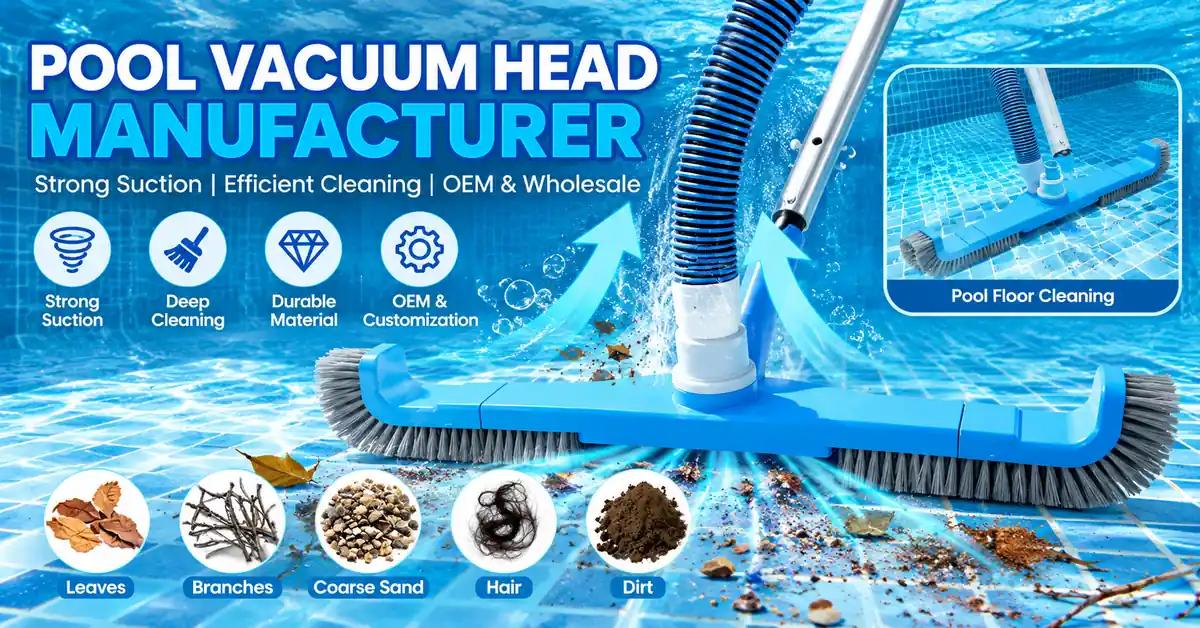
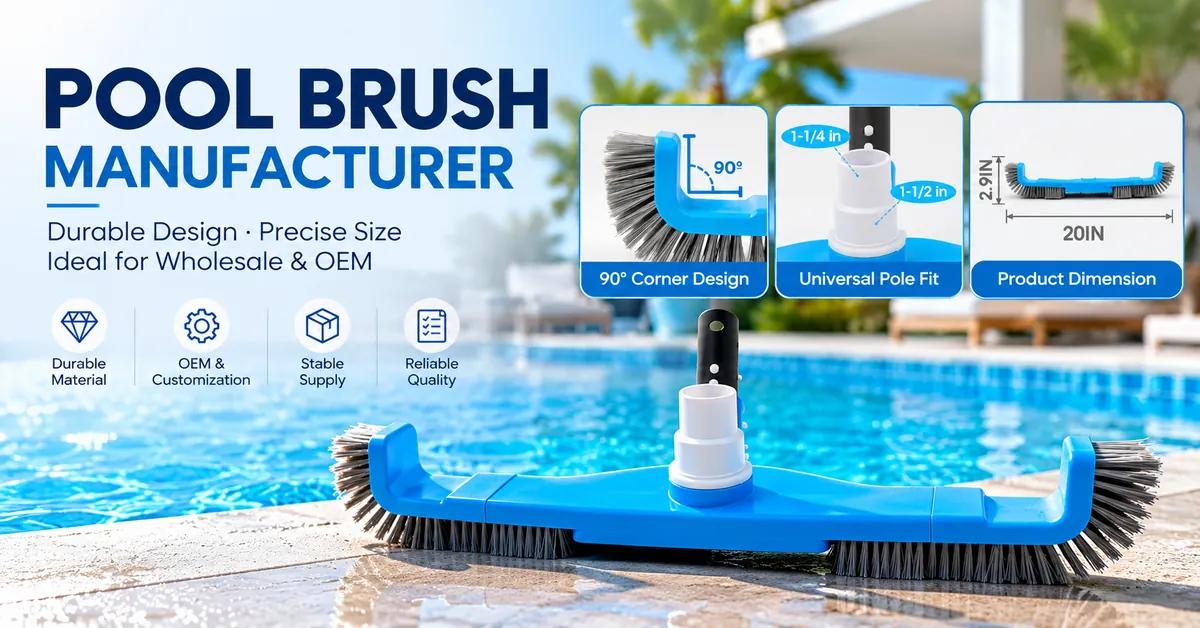
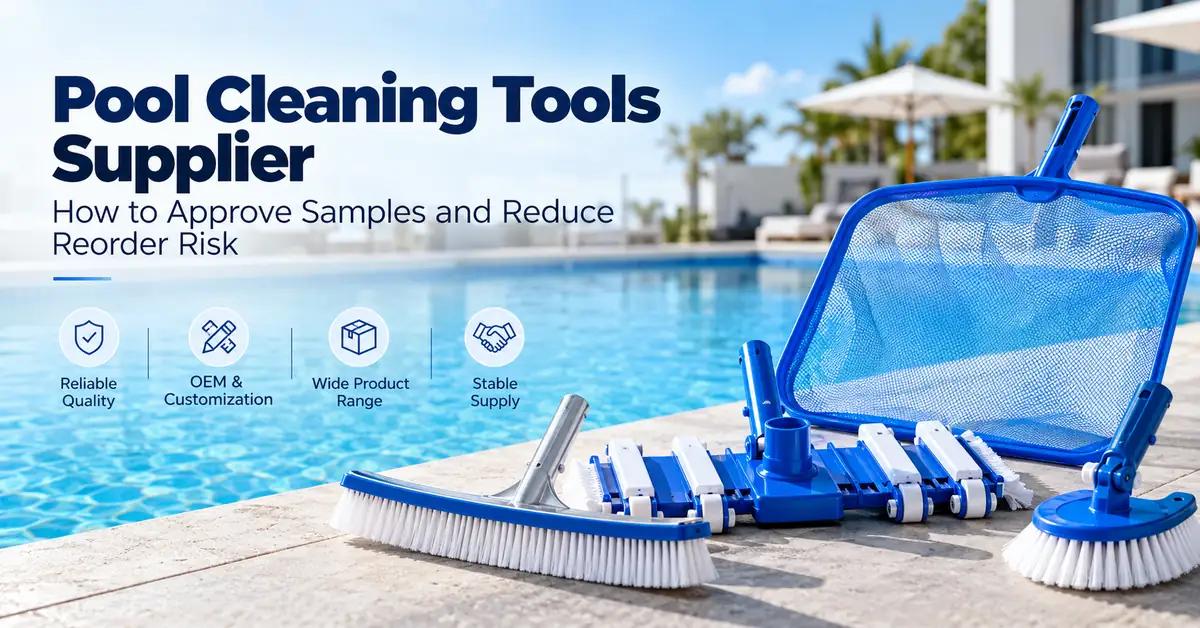
The company's Pool Accessories catalogue includes a 17-inch nylon shallow skimmer net, alongside other cleaning accessories such as pool brushes and vacuum heads.
This product range is relevant to importers and distributors building a coordinated pool maintenance assortment.
Product Sourcing
BONNY provides existing pool accessory products that buyers can evaluate for wholesale supply.
The appropriate selection depends on confirmed models, technical specifications and sample availability.
Engineering and Customization
BONNY offers OEM and ODM support for buyers considering branded packaging, material options, color changes or product development.
The scope of each project should be established before quoting.
Manufacturing Background
The company's About Us page identifies established manufacturing operations and engineering resources.
Supplier approval should nevertheless rely on the actual product's specifications, representative samples and relevant quality documents.
Export-Oriented Cooperation
International buyers can contact BONNY to discuss target markets, product configurations, estimated quantities, packaging and shipment requirements.
For a first enquiry, submitting detailed specifications will help the supplier identify suitable options.
Explore BONNY Pool Cleaning Accessories
What Should You Include in a Wholesale Skimmer Net RFQ?
A well-prepared request for quotation reduces misunderstandings and helps suppliers compare requirements consistently.
| RFQ Field | Information Required |
|---|---|
| Product type | Shallow net, deep-bag leaf rake or another design |
| Target application | Residential, commercial, hotel, resort or professional maintenance |
| Frame dimensions | Preferred width, length and shape |
| Mesh specification | Material, aperture and desired net depth |
| Frame construction | Material, reinforcement and attachment requirements |
| Pole connection | Dimensions and locking mechanism |
| Order volume | Estimated quantity per SKU |
| Customization | Logo, color, packaging or structural modification |
| Packaging | Unit packaging, carton quantity, barcode and language |
| Destination | Import country and requested delivery terms |
| Quality requirements | Sample evaluation and inspection expectations |
| Documentation | Drawings, specifications and relevant supporting records |
For a customized project, include reference photographs, product drawings or a sample where available.
For standard products, provide the intended market and cleaning applications.
Ready to evaluate a wholesale pool skimmer net supplier?
BONNY can discuss product selection, engineering feasibility, OEM requirements and quotation details based on your purchasing brief.
Request Pool Skimmer Net Samples and Wholesale Pricing From BONNY
Frequently Asked Questions
1. What should I look for in a pool skimmer net supplier?
Evaluate mesh material, opening size, frame construction, net attachment, pole compatibility, sample quality, manufacturing consistency and commercial terms. A reliable supplier should be able to clarify product-specific requirements before bulk production.
2. What is the difference between a shallow pool skimmer net and a deep-bag leaf rake?
Shallow skimmer nets are commonly used for routine surface debris collection. Deep-bag leaf rakes provide greater collection capacity for leaf-heavy conditions. The better choice depends on debris volume, handling requirements and maintenance frequency.
3. Does a smaller mesh aperture always provide better cleaning?
No. Smaller openings can retain smaller particles, but they may also increase resistance when moving the net through water. The appropriate aperture depends on the target debris and complete net construction.
4. Is nylon suitable for commercial pool skimmer nets?
Nylon can be suitable for various skimmer net designs. Actual performance depends on filament grade, mesh geometry, attachment method and operating conditions. Buyers should request material specifications and representative samples.
5. How can buyers verify frame strength?
Frame strength can be evaluated using dimensional inspection, representative loading tests and functional trials. Test conditions and acceptance criteria should be defined according to the intended use.
6. Are all pool skimmer nets compatible with telescopic poles?
No. Connection dimensions and locking mechanisms vary. Buyers should confirm the actual pole interface and test compatibility before approving a product.
7. Can BONNY offer private-label pool skimmer nets?
BONNY describes OEM and private-label manufacturing services, including branding, packaging, material and color options. Specific customization availability should be confirmed for the chosen skimmer net design.
8. What inspection standard can be used for wholesale skimmer net shipments?
ISO 2859-1:2026 provides a framework for acceptance sampling by attributes. Buyers and suppliers can agree on a suitable inspection plan, defect classifications and acceptance requirements for the actual order.
9. What determines MOQ and production lead time?
MOQ and lead time depend on product design, materials, customization, quantity, tooling and production scheduling. They should be confirmed for each SKU or project rather than assumed to be fixed.
10. What information should I send to request a skimmer net quotation?
Provide the net design, dimensions, mesh requirements, target debris, pole connection, expected order quantity, branding needs, packaging preferences, destination market and any required inspection documents.
Conclusion
Choosing a reliable pool skimmer net supplier requires a technical purchasing approach that considers mesh aperture, material construction, frame rigidity, net attachment, telescopic pole compatibility and manufacturing consistency.
For importers, wholesalers and private-label brands, the strongest sourcing decisions begin with clearly defined applications, measurable product specifications and representative sample approval.
Shallow skimmer nets, deep-bag leaf rakes and fine-mesh configurations each offer advantages for particular cleaning tasks. The objective is not to find one product that claims to do everything, but to develop an assortment suited to the needs of the target market.
BONNY, operated by Ningbo Bonny E-Home Co., Ltd., supplies swimming pool cleaning accessories and provides OEM/ODM support for international B2B customers.
Whether you are evaluating standard shallow skimmer nets, expanding a wholesale cleaning-tool range or planning private-label products, BONNY can review your technical and commercial requirements.