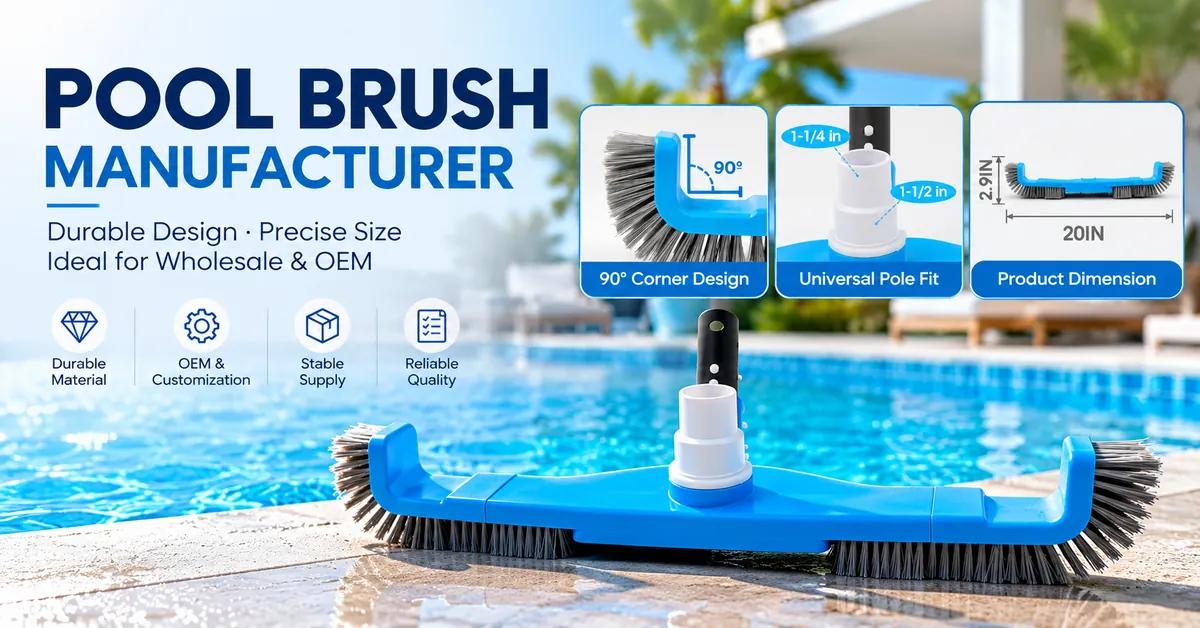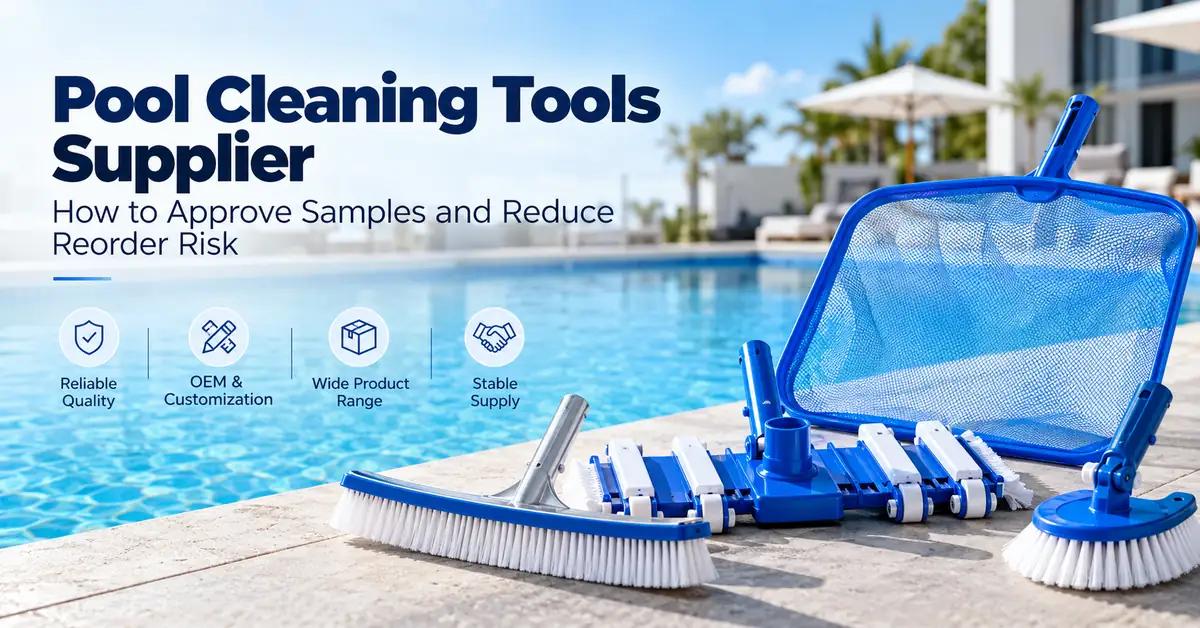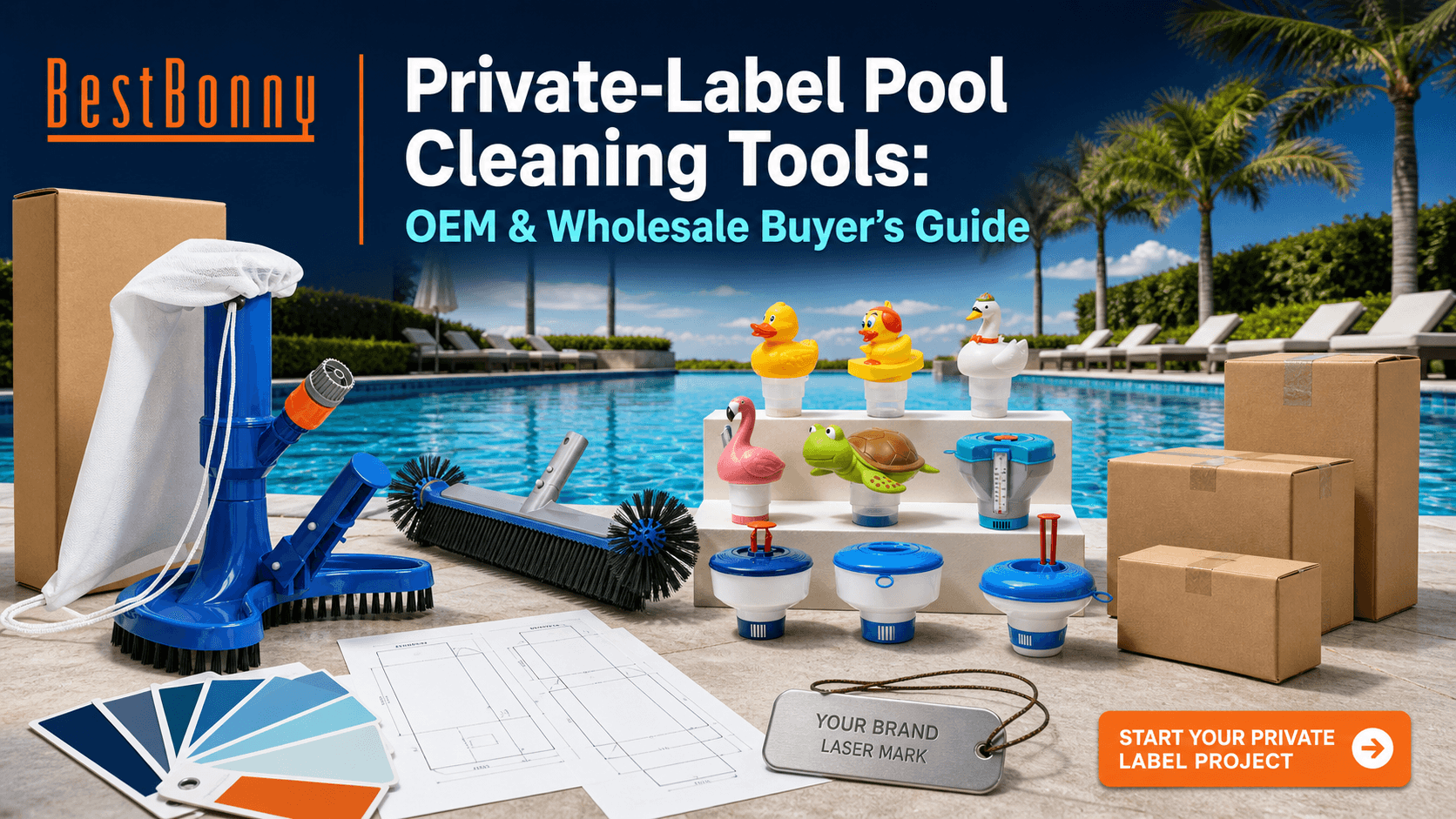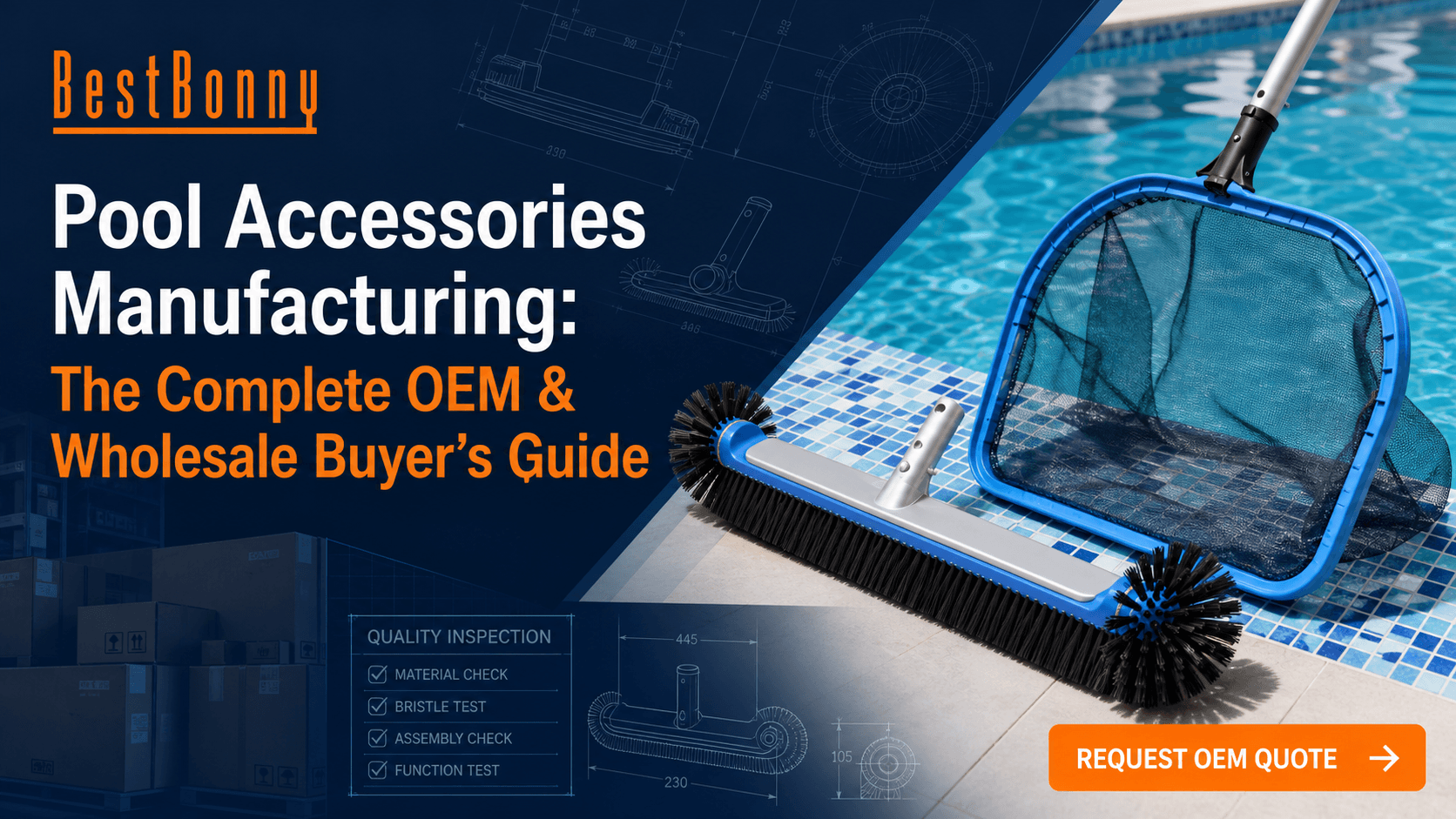

A reliable pool brush manufacturer should offer more than a competitive price. For importers, swimming pool equipment distributors, and private-label brands, the real purchasing value comes from selecting appropriate bristle materials, durable brush structures, compatible pole connections, and consistent specifications across bulk orders.
Pool brushes may appear simple, but differences in bristle stiffness, backing construction, head width, edge design, and manufacturing quality can significantly affect cleaning performance and customer satisfaction.
The key to successful wholesale sourcing is to match each brush design to its intended pool surface, establish measurable product specifications, and verify those requirements before mass production.
This guide explains how professional B2B buyers can evaluate pool brush construction, compare available designs, and develop practical OEM purchasing requirements.
1. What Should B2B Buyers Look for in a Pool Brush Manufacturer?
A qualified pool brush manufacturer should understand both product construction and the commercial requirements of wholesale distribution.
The most important evaluation factors include:
-
Material selection: Bristle type, backing material, and component durability.
-
Product compatibility: Suitable pool surfaces, telescopic pole fittings, and cleaning applications.
-
Manufacturing capability: Plastic molding, bristle planting, component assembly, and customization.
-
Quality consistency: Repeatable dimensions, secure bristle attachment, and reliable assembly.
-
OEM/ODM support: Custom colors, branding, packaging, and product development where available.
-
Supply coordination: Clear quotations, samples, MOQ requirements, and delivery arrangements.
These factors are particularly important for buyers building their own pool maintenance brands or supplying products to retailers and professional cleaning companies.
A supplier offering several brush designs can also help distributors establish a more targeted product assortment for residential, commercial, and specialized pool maintenance applications.
2. Understanding Pool Brush Materials and Their Applications
Material selection is one of the most important decisions in wholesale pool brush sourcing.
Different pool finishes require different cleaning methods. A brush suitable for unfinished concrete may be inappropriate for delicate vinyl liners or fiberglass surfaces.
Nylon Bristles: A Versatile Option for Routine Cleaning
Nylon bristles are commonly used in swimming pool wall brushes because they offer a balance of flexibility and cleaning action.
Depending on the specific bristle grade and construction, nylon brushes may be suitable for routine maintenance of various pool finishes.
Key evaluation factors include bristle diameter, flexibility, density, length, and attachment strength.
Buyers should request confirmation of compatibility with the intended pool finish rather than assuming every nylon brush is safe for every surface.
Stainless Steel Bristles: Specialized Cleaning Applications
Stainless steel bristles are more aggressive and may be appropriate for certain hard, compatible pool surfaces where stubborn deposits require additional mechanical action.
However, metal-bristle brushes are generally inappropriate for vinyl liners, fiberglass, painted surfaces, or other finishes susceptible to scratching.
Their suitability should be checked against the pool finish manufacturer's maintenance instructions.
Mixed Bristles: Balancing Cleaning Characteristics
Some pool brush designs combine different bristle materials or stiffness levels.
These configurations may be considered for specific cleaning requirements, but performance depends on the complete brush design rather than material names alone.
Pool Brush Material Comparison
| Bristle Material | Typical Application | Main Advantage | Important Limitation |
|---|---|---|---|
| Nylon | Routine pool wall and floor cleaning | Flexible, versatile cleaning characteristics | Stiffness and finish compatibility vary |
| Stainless steel | Selected hard-surface cleaning applications | More aggressive scrubbing action | May damage delicate or coated finishes |
| Mixed bristles | Specialized cleaning requirements | Combines different bristle characteristics | Must be validated for the intended surface |
| Polypropylene bristles | Certain general-purpose brush designs | Material and stiffness options for different applications | Suitability depends on grade and construction |
B2B purchasing recommendation: Always request the actual bristle material specification, not simply a description such as "premium bristles" or "heavy-duty brush."
3. Why Brush Backing and Frame Construction Matter
The backing structure determines how the brush head supports its bristles and transfers cleaning force from the telescopic pole.
Poorly designed connections or inconsistent molding may create problems even when the bristle material itself is appropriate.
Aluminum-Back Pool Brushes
Aluminum-backed brushes are a common choice for wide pool wall cleaning tools.
The aluminum component provides structural support, while the overall brush construction determines weight, handling, and resistance to deformation.
For wholesale procurement, important checks include:
-
Aluminum thickness and surface finish.
-
Attachment between the backing and brush body.
-
Edge smoothness.
-
Pole connector strength.
-
Resistance to loosening during repeated use.
Aluminum should not automatically be described as corrosion-proof. Actual durability depends on alloy selection, finishing, and service conditions.
Plastic-Back Pool Brushes
Plastic-backed brushes can provide flexible design options, particularly for curved, rounded, or specialized cleaning heads.
Common engineering plastics may include polypropylene or ABS, depending on the product.
Their performance depends on material grade, wall thickness, reinforcement, and molding quality.
For outdoor applications, buyers should also ask whether weathering or UV-resistance testing is available for the selected material.
Technical Specification Checklist
| Component | Specification to Confirm | Why It Matters |
|---|---|---|
| Brush head | Width, profile, dimensions | Cleaning coverage and product differentiation |
| Bristles | Material, length, stiffness, density | Cleaning action and surface compatibility |
| Backing | Plastic or aluminum construction | Structural support and handling |
| Connector | Material, dimensions, locking arrangement | Telescopic pole compatibility |
| Edges | Shape, finish, exposed corners | Reduced risk of surface damage |
| Assembly | Bristle retention and connector security | Long-term functional reliability |
| Packaging | Unit protection, carton quantity, labeling | Retail readiness and shipping efficiency |
A technical specification sheet should clearly identify these requirements before the supplier and buyer approve the final product.
4. Comparing BONNY Pool Brush Designs for Different Markets
Ningbo Bonny E-Home Co., Ltd. offers several pool brush designs within its Pool Accessories product range.
The available catalogue includes standard wall brushes, wider cleaning heads, rounded brush designs, and combination cleaning products.
Different designs address different cleaning tasks and distribution requirements.
BONNY Pool Brush Design Comparison
| Product Design | Published Product Feature | Potential Application | Main Buying Consideration |
|---|---|---|---|
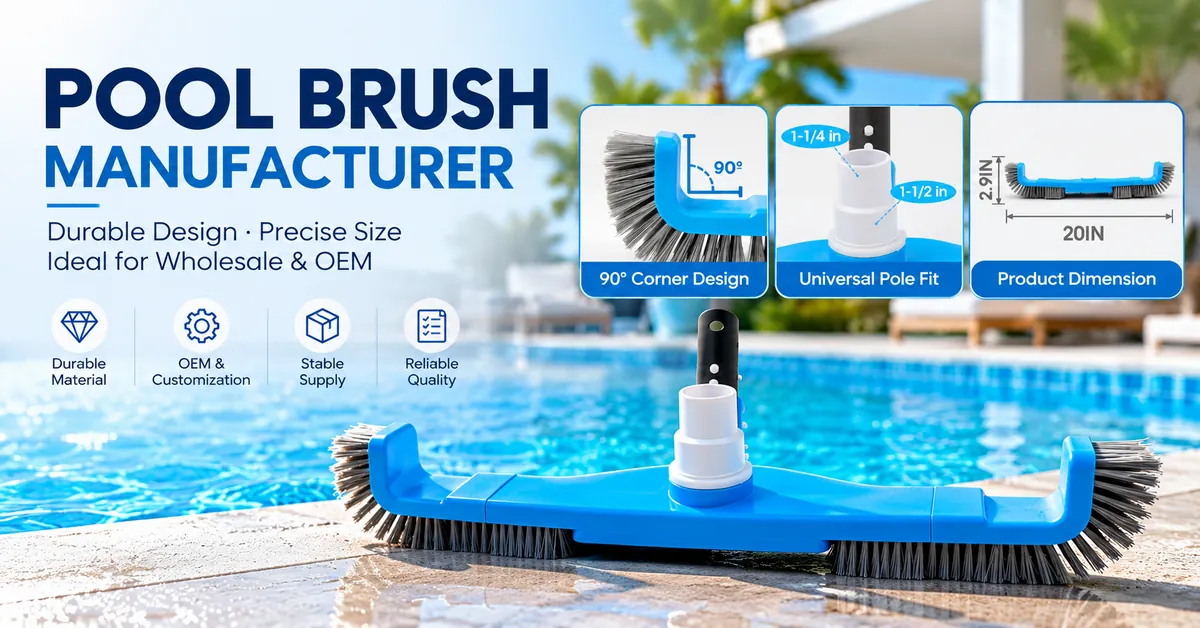
| 20-inch wall brush | Wide cleaning head with aluminum-related construction | Larger pool walls and floors | Confirm bristle grade, backing, and fitting dimensions |
| 18-inch deluxe pool brush | 18-inch head with aluminum-back design | Routine residential and professional maintenance | Confirm exact model and material specifications |
| 360-degree round pool brush | Round cleaning design with nylon bristles | Curved surfaces, corners, and steps | Check rotation mechanism, edge contact, and surface compatibility |
| 2-in-1 vacuum brush head | Combined brush and suction-head concept | Selected manual vacuum cleaning tasks | Verify hose and pole connections |
| Corner and curved-end brushes | Specialized head geometry | Steps, corners, and restricted spaces | Evaluate reach, handling, and cleaning contact |
The table summarizes product types presented in BONNY's catalogue. Exact model numbers, material grades, performance claims, and specifications should be confirmed against the latest product documentation.
Which Brush Design Should Buyers Choose?
For general wholesale distribution: An 18-inch wall brush can be a practical product to evaluate when customers need a conventional cleaning format.
For larger pool maintenance applications: A 20-inch brush may offer wider coverage, although actual cleaning efficiency depends on the brush design and operating conditions.
For specialized cleaning markets: Rounded and multi-angle brushes may help address steps, curved surfaces, and corners that are difficult to reach with flat brush heads.
For professional maintenance suppliers: A complementary range of standard and specialized brush designs may serve a broader set of cleaning tasks than a single universal product.
The right assortment depends on your target market rather than simply choosing the largest number of SKUs.
For more information about different brush designs, see BONNY's guide to pool brush types and applications.
5. How Does the Pool Brush Manufacturing Process Affect Quality?
Manufacturing methods influence the structural consistency, bristle attachment, finish, and functionality of a pool brush.
BONNY's company profile identifies manufacturing capabilities including injection molding and bristle planting, both relevant to pool brush production.
Step 1: Product and Material Specification
Manufacturing begins with confirming the brush design, dimensions, material requirements, and intended application.
For customized products, the buyer should provide drawings, reference samples, or a technical brief.
Step 2: Plastic Component Molding
Injection molding can be used to manufacture suitable plastic brush bodies, connectors, and other components.
Important engineering considerations include dimensional accuracy, wall thickness, material consistency, and visible molding defects.
Step 3: Bristle Planting
Bristle planting secures the cleaning filaments within the brush body.
Important variables include the number of bristle bundles, placement pattern, insertion depth, and attachment method.
A good design should provide appropriate brushing contact while minimizing unwanted filament shedding.
Step 4: Backing and Connector Assembly
Depending on the design, assembly may include an aluminum backing, handle socket, fastening components, and pole-attachment system.
Connectors should be checked for secure engagement and compatibility with the intended telescopic pole.
Step 5: Product Inspection and Packaging
Finished products should be assessed against agreed specifications before packing.
For a wholesale purchase, buyers should request clear inspection criteria covering dimensions, appearance, assembly, packaging, and functional characteristics.
The important distinction is that a supplier's available manufacturing processes do not automatically prove that every model has passed a particular durability or performance test.
6. What Quality Control Tests Should Wholesale Buyers Request?
Quality control is especially important when brushes will be sold under a distributor's own brand.
A product that looks satisfactory in a photograph may still have inconsistent fittings, poorly secured bristles, or assembly defects.
Buyers should consider the following inspection framework.
| Quality Check | Suggested Verification | Purchasing Value |
|---|---|---|
| Bristle retention | Agreed pull or retention test method | Identifies potential filament attachment problems |
| Connector fit | Physical test with specified telescopic poles | Helps prevent fitting-related returns |
| Dimensional consistency | Measurements against approved drawings | Supports repeat-order consistency |
| Edge safety | Visual and handling inspection | Identifies unwanted sharp or rough edges |
| Assembly strength | Agreed functional loading or repeated-use test | Evaluates connector and backing integrity |
| Appearance | Color, surface finish, molding defects | Supports retail presentation |
| Packaging | Carton markings, barcode, packaging integrity | Reduces receiving and distribution errors |
Specific methods and acceptance limits should be documented before production.
For incoming or final inspection, buyers can consider ISO 2859-1:2026, which describes acceptance sampling procedures for inspection by attributes.
The International Organization for Standardization also identifies process management and evidence-based decisions as important quality management principles.
These references provide a quality assurance framework; they do not establish that any particular BONNY pool brush has been certified or tested to those requirements.
Where product certification or market-specific documentation is required, buyers should request evidence for the exact SKU and intended destination.
7. OEM and Private Label Pool Brush Manufacturing
Private-label pool brushes allow distributors and retailers to establish a recognizable product range rather than relying entirely on generic products.
BONNY offers OEM and ODM support, including branding, packaging, material and color customization, and engineering development services.
Its Engineering & Design team can be contacted to discuss the feasibility of individual projects.
Typical OEM Customization Options
| Customization | Commercial Purpose | What Buyers Should Confirm |
|---|---|---|
| Product color | Match brand identity | Color reference, material and production feasibility |
| Private label | Improve brand recognition | Logo artwork and application method |
| Custom packaging | Support retail and e-commerce sales | Box design, labels, barcode and dimensions |
| Bristle configuration | Address specific cleaning applications | Material, stiffness, pattern and testing |
| Brush dimensions | Differentiate product assortment | Tooling needs, structural feasibility and MOQ |
| Product design | Develop distinctive product features | Prototype approval, tooling and development costs |
OEM vs ODM: Which Approach Is Better?
OEM manufacturing generally suits buyers who have an established product specification or want to customize an existing design.
ODM development is more appropriate when buyers require structural changes or a new product concept that needs engineering evaluation.
A customized logo or packaging format is usually a different project from developing a completely new brush head.
For an efficient quotation, identify which modifications are essential and which can remain standard.
8. Understanding Wholesale Pool Brush Pricing and MOQ
When comparing quotes from different pool brush manufacturers, buyers should evaluate product specifications and total sourcing costs—not only the quoted unit price.
The main pricing variables include:
-
Bristle material and configuration.
-
Brush width and backing construction.
-
Connector and fastening components.
-
Order quantity.
-
Tooling or development requirements.
-
Branding and packaging complexity.
-
Inspection, shipping, and delivery terms.
For example, two 18-inch brushes may have different costs because one uses a reinforced backing, different bristle materials, or a more complex assembly.
A lower initial quotation does not necessarily mean a better purchasing outcome if the product creates compatibility issues or customer returns.
What About Minimum Order Quantity?
There is no universal MOQ for all pool brush designs.
Existing standard products, customized colors, private-label packaging, and new tooling projects may require different purchasing quantities.
The most useful approach is to request a quotation based on your specific SKUs and estimated volumes.
What About Production Lead Time?
Lead time depends on product availability, order quantity, customization requirements, material procurement, and production scheduling.
For OEM projects, sampling and approval can add development stages before bulk production.
Buyers should request written confirmation of sample timing, production schedule, inspection arrangements, and shipping terms.
9. How to Reduce Procurement Risks Before Placing a Bulk Order
A structured supplier qualification process can prevent avoidable problems in large orders.
Risk 1: Incorrect Bristle Selection
Choosing unsuitable bristle stiffness may cause poor cleaning results or surface damage.
Recommended action: Match the brush to the intended finish and request sample testing before confirming suitability.
Risk 2: Incompatible Pole Connections
Different telescopic pole systems may use different attachment arrangements.
Recommended action: Request connector dimensions and test physical samples with your target pole systems.
Risk 3: Weak Bristle Attachment
Loose or poorly secured bristles can affect product usability and customer satisfaction.
Recommended action: Establish an agreed bristle retention inspection method.
Risk 4: Unapproved Product Changes
A repeated order may become inconsistent if components, materials, or packaging change without approval.
Recommended action: Maintain an approved product specification and reference sample for each SKU.
Risk 5: Incomplete OEM Requirements
Unclear branding, material, or packaging instructions may cause delays and additional expenses.
Recommended action: Finalize drawings, artwork, material requirements, and sample acceptance criteria before bulk production.
For wholesale customers, the best risk management strategy is clear communication supported by documented specifications.
10. Why Consider BONNY as Your Pool Brush Manufacturing Partner?
Founded in 1998, Ningbo Bonny E-Home Co., Ltd. is a China-based manufacturer of swimming pool cleaning equipment and accessories.
Its product offering includes pool wall brushes, specialized cleaning brush heads, vacuum heads, and other pool maintenance accessories.
BONNY also describes engineering, product development, OEM manufacturing, and private-label support for international business partners.
Manufacturing-Related Capabilities
Product development support: Buyers can discuss standard product selection or potential customized designs.
Relevant manufacturing processes: The company identifies injection molding and bristle planting among its manufacturing capabilities.
Product assortment: Different brush head styles are available for buyers serving different maintenance applications.
OEM/ODM services: Branding, materials, colors, packaging, and development projects can be evaluated individually.
International sourcing support: BONNY works with overseas business customers on product requirements and export orders.
These capabilities make BONNY worth evaluating for wholesale and customized pool brush procurement. However, buyers should always confirm product-specific specifications, samples, inspection requirements, pricing, and delivery arrangements.
Explore BONNY Pool Brushes and Cleaning Accessories
Discuss Your OEM/ODM Pool Brush Project
11. How to Request an Accurate Pool Brush Manufacturing Quotation
A clear RFQ helps manufacturers identify suitable products and prepare more meaningful quotations.
Include the following information:
| RFQ Information | Example |
|---|---|
| Product category | Pool wall brush or round corner brush |
| Preferred width | 18-inch or 20-inch design |
| Pool application | Residential, commercial, vinyl-lined, concrete, or tiled pool |
| Bristle requirements | Preferred material and stiffness |
| Frame requirements | Plastic or aluminum-backed design |
| Connector | Dimensions and type of telescopic pole |
| Order quantity | Estimated quantity per SKU |
| Branding | Standard BONNY product or private-label requirements |
| Packaging | Bulk packing, retail box, or customized packaging |
| Destination market | Country and delivery requirements |
| Quality documentation | Any specific inspection or test report requests |
If you are not sure which brush design suits your market, explain your customer applications and existing product range.
Ready to source wholesale or custom pool brushes?
Request a Pool Brush Quotation from BONNY
BONNY can review your product requirements and discuss available designs, customization possibilities, and the next steps for your purchasing project.
Frequently Asked Questions About Pool Brush Manufacturers
1. What does a pool brush manufacturer do?
A pool brush manufacturer develops or produces cleaning brush products for swimming pools. Manufacturing may involve plastic component molding, bristle planting, assembly, and packaging. Some suppliers also support OEM branding and custom product development.
2. How do I choose a reliable pool brush manufacturer in China?
Evaluate product specifications, available manufacturing processes, sample quality, technical communication, customization capabilities, and inspection arrangements. Request documentation and compare suppliers against the same purchasing requirements.
3. What bristle materials are commonly used in pool brushes?
Common options include nylon, polypropylene, stainless steel, and mixed-bristle configurations. The appropriate selection depends on the pool finish, cleaning task, and the brush manufacturer's specific design.
4. Can I use a stainless steel pool brush on a vinyl pool liner?
Stainless steel bristles are generally inappropriate for vinyl liners because their aggressive cleaning action can damage sensitive surfaces. Use a brush specifically approved for the liner material and follow the pool finish manufacturer's guidance.
5. What is the difference between an aluminum-back and plastic-back pool brush?
An aluminum backing provides structural support and is common in wider brush designs. Plastic-backed brushes offer different molding and shape options. Actual durability depends on material grade, geometry, assembly quality, and operating conditions.
6. Can BONNY manufacture private-label pool brushes?
BONNY offers OEM and private-label services, including branding and packaging customization. Specific color, material, structural, and design modifications depend on the selected product and engineering feasibility.
7. What is the minimum order quantity for wholesale pool brushes?
MOQ varies by model and customization requirements. Standard products, custom packaging, and new tooling projects can have different minimum quantities. Contact the manufacturer with your target SKU and estimated volume.
8. How can I verify pool brush quality before bulk purchasing?
Request representative samples and assess bristle retention, connector compatibility, dimensions, assembly strength, edge finishing, and packaging. Agree on inspection criteria and document the approved specifications.
9. How long does custom pool brush production take?
Production timing depends on design complexity, tooling, sampling, material availability, quantity, and packaging requirements. Ask the supplier to confirm the timeline for your specific order rather than relying on a general lead-time estimate.
10. What should I provide when requesting OEM pool brush samples?
Share the target brush design, dimensions, intended pool finish, bristle requirements, branding details, packaging preferences, estimated order quantity, and destination market. Drawings or reference photographs can help clarify the project.
Conclusion
Choosing the right pool brush manufacturer requires a clear understanding of bristle materials, backing construction, cleaning applications, manufacturing processes, and wholesale purchasing requirements.
For B2B importers and private-label brands, successful sourcing depends on selecting appropriate product designs, verifying sample quality, confirming technical specifications, and establishing clear production and inspection expectations.
Rather than choosing products based solely on appearance or price, buyers should evaluate the complete relationship between product performance, material selection, customization requirements, and long-term supply consistency.
BONNY provides pool cleaning brush products and OEM/ODM manufacturing support for international buyers seeking standard or customized pool maintenance accessories.
Whether you are developing a private-label pool brush range, expanding your wholesale catalogue, or comparing product designs for professional maintenance applications, BONNY can discuss suitable options based on your requirements.
Contact BONNY to Request Pool Brush Samples, Specifications, and a Wholesale Quotation