
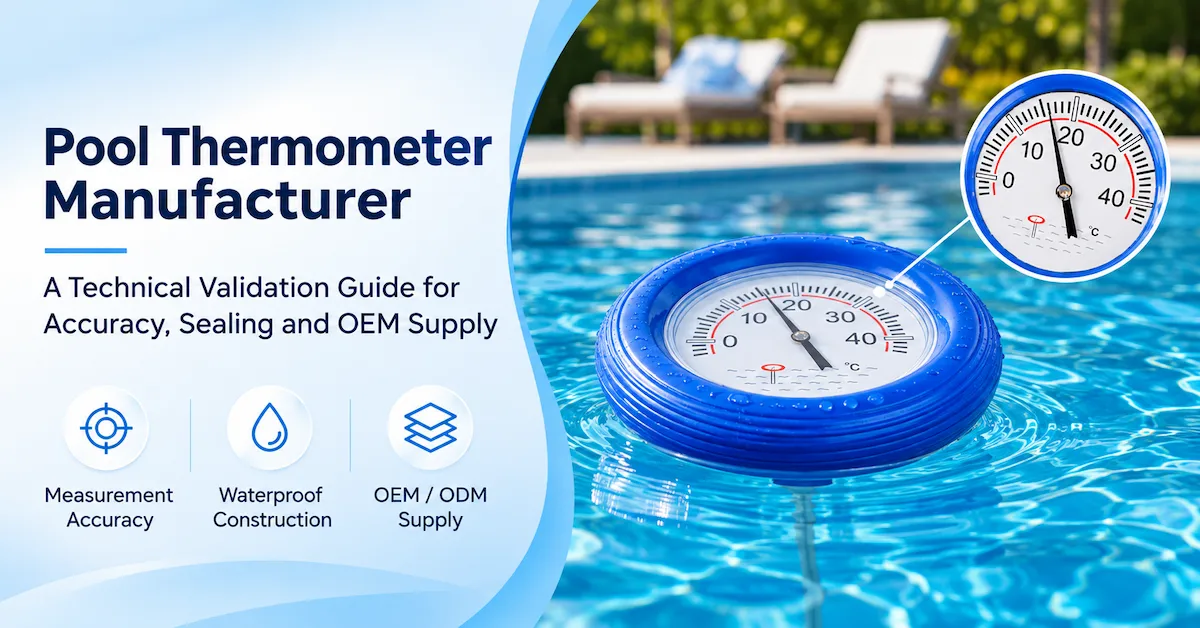
TL;DR: A reliable pool thermometer manufacturer should provide verifiable temperature-measurement specifications, an enclosure suitable for the intended water exposure, consistent sensor performance, and a documented sample-approval process. Importers should distinguish display resolution from measurement accuracy, verify waterproof claims for the exact product, and control critical components before approving OEM or wholesale production.
Pool thermometers may appear to be straightforward accessories, but measurement errors and moisture-related failures can create purchasing problems for international distributors. A product with an attractive digital display may still have an unspecified accuracy tolerance, inadequate sealing, or inconsistent performance between production batches.
For pool equipment importers and private-label brands, the challenge is therefore not simply finding a supplier with an appealing catalogue. It is identifying a product that meets measurable technical requirements and can be reproduced consistently.
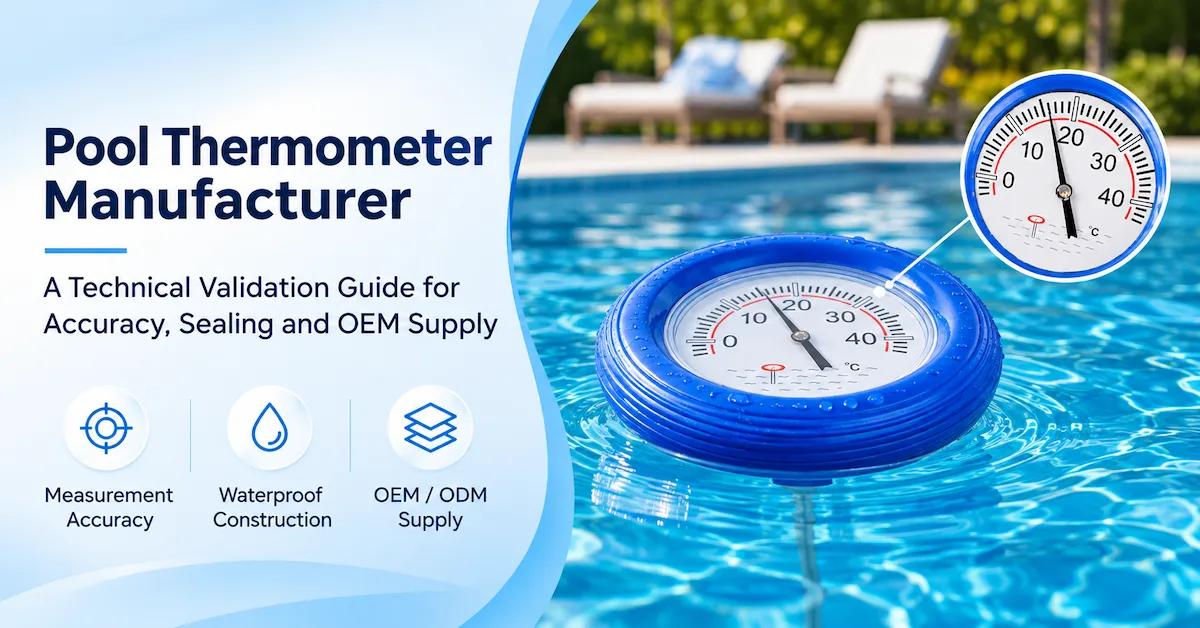
This guide examines the engineering considerations behind thermometer accuracy, waterproof construction, sensor placement, manufacturing quality, and OEM sourcing, using BONNY's published floating digital thermometer as a product reference.
Quick Reference: Pool Thermometer Technical Specifications and Supplier Requirements
A thermometer should be evaluated against the requirements of its intended application.
The following matrix identifies the technical information B2B buyers should request before approving a product.
| Technical Parameter | What Buyers Should Verify | Main Procurement Risk |
|---|---|---|
| Measurement accuracy | Defined permissible measurement error | Incorrect temperature readings |
| Display resolution | Smallest displayed temperature increment | Confusing display detail with accuracy |
| Measurement range | Minimum and maximum specified temperatures | Use outside the product's intended range |
| Sensor construction | Sensing arrangement and location | Unrepresentative or inconsistent readings |
| Response time | Defined stabilization or response behavior | Unreliable readings during temperature changes |
| Waterproof protection | Enclosure design and applicable test evidence | Water ingress and electronic failure |
| Housing material | Specified polymer and relevant material properties | Cracking, weathering, or mechanical problems |
| Power supply | Battery arrangement and operating conditions | Premature loss of functionality |
| Display readability | Digit size, contrast, temperature units | Poor user experience |
| Production quality | Approved sample, inspection plan, change control | Variations between batches |
Technical takeaway: A detailed-looking temperature display is not proof of accurate measurement. Buyers need evidence of actual thermometer performance under defined conditions.
Key Takeaways
-
Accuracy and resolution are different. A thermometer displaying 0.1°C increments is not necessarily accurate within ±0.1°C.
-
Waterproof performance needs product-specific evidence. A general waterproof claim does not establish suitability for continuous floating use.
-
Sensor placement affects temperature readings. Water depth, circulation, sunlight, and stabilization conditions influence measurement comparisons.
-
A representative sample is essential. Buyers should test temperature readings, display function, housing integrity, and floating stability.
-
OEM customization must preserve functionality. Changes to housing, seals, sensors, or power components may require additional engineering verification.
-
Repeatable quality is more valuable than one successful demonstration. Approved specifications and controlled components help maintain consistency across wholesale orders.
Why Trust This Technical Sourcing Guide?
This article separates publicly available product information from established measurement principles and recommended purchasing practices.
Three types of evidence form the basis of the analysis.
1. Official BONNY product information
Ningbo Bonny E-Home Co., Ltd. publishes a floating digital pool thermometer in its Pool Accessories catalogue.
Its product page identifies model T389 and lists PVC as a material. However, the available information does not establish a verified measurement-accuracy tolerance, waterproof rating, or battery-life specification.
2. Temperature-measurement principles
The U.S. National Institute of Standards and Technology (NIST) provides guidance on thermometer verification, measurement traceability, and the distinction between resolution and accuracy.
These principles support the recommended comparison-testing methods discussed below.
3. Manufacturing inspection principles
ISO 2859-1:2026 describes acceptance sampling procedures for inspection by attributes. This provides a framework for evaluating defined shipment characteristics but does not replace technical performance testing.
The procedures in this guide are proposed buyer qualification methods. They are not presented as completed BONNY tests or certified product results.
What Is the Difference Between Thermometer Accuracy, Resolution and Repeatability?
Measurement terminology can be confusing when comparing pool thermometers.
Three important terms should be considered separately.
Measurement Accuracy
Accuracy describes how close a thermometer's indication is to an accepted reference value.
For a purchasing specification, manufacturers commonly express permissible error as a temperature tolerance.
The buyer should request the tolerance applicable to the intended measurement range.
Display Resolution
Resolution describes the smallest change that can be displayed.
A thermometer showing temperatures in 0.1°C increments has a display resolution of 0.1°C.
However, that does not establish its actual measurement accuracy.
A product can display highly detailed numbers while still having a larger measurement error.
Measurement Repeatability
Repeatability describes the consistency of readings under the same measurement conditions.
A thermometer may show a stable reading but consistently differ from the reference temperature.
Conversely, an instrument can occasionally produce a close reading while exhibiting unacceptable variation between repeated measurements.
These characteristics should be evaluated independently.
Comparison of Measurement Characteristics
| Characteristic | Engineering Meaning | Required Buyer Evidence |
|---|---|---|
| Accuracy | Closeness to reference temperature | Defined tolerance and comparison results |
| Resolution | Smallest displayed increment | Display specification |
| Repeatability | Consistency under repeated conditions | Repeat measurement records |
| Response time | Behavior after a temperature change | Defined response test |
| Measurement range | Specified usable temperature range | Product specification |
| Measurement traceability | Documented relationship of a measurement result to a reference | Appropriate calibration and uncertainty records |
How Is Temperature Error Calculated?
The indicated temperature error can be expressed as:
Indicated error = Thermometer reading − Reference temperature
For example, suppose a reference thermometer reads 30.0°C while the product sample displays 30.6°C.
The indicated difference is:
30.6°C − 30.0°C = +0.6°C
This is an illustrative calculation, not a BONNY test result.
Whether the sample passes depends on the buyer's approved tolerance, the uncertainty of the reference measurement, and the test conditions.
Engineering recommendation: Do not accept a claimed accuracy value unless its measurement range and verification conditions are clearly defined.
How Should a Pool Thermometer Manufacturer Verify Temperature Accuracy?
A practical temperature-verification process should compare the product against a suitable reference instrument.
The objective is to determine whether the proposed thermometer meets the intended purchasing specification.
Step 1: Establish the Application Range
Define the temperatures relevant to the target market.
A thermometer intended for a residential swimming pool may have different operating requirements from one intended for a heated spa.
The application should determine the testing range.
Step 2: Use an Appropriate Reference Thermometer
Select a reference instrument with suitable measurement performance and documented calibration or verification status.
The reference should have a sufficiently understood uncertainty for the intended acceptance decision.
NIST guidance emphasizes that measurement traceability depends on documented comparisons and uncertainties rather than the instrument's appearance or brand.
Step 3: Prepare Stable Measurement Conditions
Use a controlled water environment where temperature can be compared consistently.
Place the reference sensor near the thermometer's effective measurement location where practical.
Avoid introducing large temperature differences through direct sunlight, uneven water mixing, or inappropriate sensor positioning.
Follow the product's intended immersion and operating instructions.
Step 4: Compare Multiple Temperatures
Where the product specification permits, evaluate readings at more than one temperature.
For illustration, a purchasing team might select test points around 20°C, 30°C, and 38°C if they fall within the manufacturer's specified operating range.
These example temperatures are not claimed BONNY specifications or universal requirements.
Step 5: Allow Sufficient Stabilization
Record readings only after the product and reference have had sufficient time to respond to the test conditions.
A device that has just moved between different temperature environments may not immediately indicate the new water temperature.
Step 6: Record and Evaluate the Results
Use a documented test sheet.
| Test Record | Reference Measurement | Product Reading | Evaluation |
|---|---|---|---|
| Low-range point | Record measured value | Record displayed value | Compare with agreed tolerance |
| Mid-range point | Record measured value | Record displayed value | Compare with agreed tolerance |
| High-range point | Record measured value | Record displayed value | Compare with agreed tolerance |
| Repeat measurement | Repeat at a selected condition | Record repeated reading | Evaluate consistency |
No product should be declared compliant until the results have been compared against approved acceptance criteria.
Why Is One Temperature Check Insufficient for Some Applications?
A single-point check can be appropriate for certain limited-use verification tasks.
However, it may not reveal differences in measurement behavior across a wider operating range.
When the thermometer is marketed for multiple water-temperature environments, a multi-point evaluation may provide a more suitable assessment.
The number of test points should depend on the actual product specification and purchasing risk.
Why Do Floating Digital Pool Thermometers Develop Waterproofing Problems?
Waterproof construction is important because floating thermometers operate in humid, splash-prone or water-contact environments.
The housing protects electronic components from conditions that could interfere with their operation.
Potential water-ingress locations depend on the design but may include housing joints, display windows, battery covers and sensor penetrations.
Battery Compartment Sealing
If a thermometer uses a replaceable battery, the compartment must be designed for the intended operating environment.
A removable cover creates an interface that requires appropriate sealing and assembly.
Buyers should evaluate whether the closure remains secure after permitted battery replacement.
Display Window Construction
The display window must maintain readability while protecting internal electronics.
Poor attachment or sealing may allow moisture accumulation.
Condensation inside an electronic housing can indicate a problem requiring investigation.
However, buyers should not assume that every visible change in appearance is caused by the same failure mechanism.
Sensor Interface
The temperature sensor must interact appropriately with the measured environment.
Depending on its construction, a sensor may be positioned within or attached to the housing.
Any opening or transition associated with the sensing element should be considered during enclosure design.
Does an IP Rating Guarantee Continuous Waterproof Operation?
Not necessarily.
IEC 60529 defines an ingress protection classification system for electrical enclosures.
However, a claimed IP rating must be interpreted according to the actual test conditions and product configuration.
For instance, an IPX7 classification is associated with defined temporary-immersion conditions. It should not automatically be interpreted as permission for unlimited continuous underwater use.
For floating pool thermometers, buyers should confirm whether the product is intended for continuous water contact, temporary exposure, or another defined operating condition.
Waterproof Quality Checklist
| Design Area | Recommended Verification | Main Failure Concern |
|---|---|---|
| Housing joint | Seal and assembly inspection | Moisture penetration |
| Display window | Connection integrity | Condensation and display problems |
| Battery compartment | Closure and sealing verification | Water reaching electronics |
| Sensor interface | Construction and seal assessment | Sensor-related water ingress |
| Floating behavior | Representative operating test | Unstable position |
| Electrical functionality | Checks before and after specified exposure | Functional failure |
| Reassembly | Inspection after permitted servicing | Loss of sealing integrity |
Buyer recommendation: Require test evidence for the exact product configuration. A generic waterproof statement is insufficient for evaluating an electronic pool thermometer.
How Do Sensor Placement and Pool Conditions Influence Temperature Readings?
A floating thermometer typically measures temperature near the sensing element rather than calculating the average temperature of an entire swimming pool.
This distinction matters when users compare readings from different instruments.
Water Temperature Variation
Pool water may not be perfectly uniform.
Temperature can vary with depth, sunlight exposure, circulation and heating conditions.
Consequently, two correctly functioning thermometers can display different values if they measure water in different locations.
Direct Sunlight
Solar heating may affect the exposed housing and surrounding water.
Depending on construction, this can influence the indicated temperature.
Buyers should evaluate whether the intended operating instructions provide sufficient guidance on placement.
Water Circulation
Water near an inlet, heating return or other circulation feature may differ in temperature from water elsewhere in the pool.
When testing two thermometers, measurement positions should be comparable.
Floating Stability
A floating thermometer should maintain the intended orientation during normal operation.
If the sensing element is placed incorrectly because the product tilts or floats irregularly, the resulting reading may not represent the expected measurement location.
Operating Environment Comparison
| Environment | Main Measurement Consideration | Recommended Buyer Check |
|---|---|---|
| Residential outdoor pool | Sunlight and variable conditions | Placement instructions and representative trial |
| Heated swimming pool | Localized temperature differences | Measurement location and stabilization |
| Indoor pool | Routine water-temperature monitoring | Readability and measurement consistency |
| Spa or hot tub | Potentially higher temperatures | Specified operating range and material suitability |
| Retail consumer market | Ease of understanding | Display clarity and instructions |
A consumer floating thermometer should not automatically replace a required calibrated monitoring instrument or safety-control system.
The appropriate measuring equipment depends on the intended application and applicable operating requirements.
How Do Digital, Analog and Wireless Pool Thermometers Compare?
Different thermometer designs serve different customer needs.
A B2B distributor should select products according to market demand rather than assuming the most feature-rich option is always the best.
| Selection Factor | Analog Thermometer | Floating Digital Thermometer | Wireless Thermometer System |
|---|---|---|---|
| Reading method | Graduated scale | Electronic display | Sensor with compatible remote-reading arrangement |
| Power requirements | Often battery-free | Depends on electronic design | Depends on sensor and communication system |
| Key benefit | Simpler operation | Convenient numerical display | Potential remote access |
| Main technical risk | Scale interpretation and sensing mechanism | Electronics and enclosure protection | Communication and additional electronics |
| Main quality requirement | Scale and mechanical construction | Measurement verification and sealing | Measurement, sealing and transmission verification |
| Buyer priority | Basic maintenance accessories | Residential and retail product ranges | Selected smart pool applications |
Which Type Is Best for Wholesale Buyers?
For price-sensitive accessory ranges, simple thermometer designs may provide an appropriate starting point.
For customers who prefer digital readings, a floating digital thermometer may be worth evaluating.
For a remote-monitoring product line, buyers should verify the actual wireless communication function, compatible receiver and operating requirements.
A product title that includes the word "wireless" should not be treated as proof of a specific transmission protocol, distance, or application feature.
BONNY T389 Floating Digital Pool Thermometer: Product and Procurement Analysis
BONNY's published catalogue includes the T389 floating digital pool thermometer.
This product is relevant to wholesale importers and pool accessory distributors evaluating digital temperature-measuring products.
View the BONNY T389 Floating Digital Pool Thermometer
Published Product Information
| Attribute | Published Listing | Procurement Consideration |
|---|---|---|
| Brand | BONNY | Confirm product identification |
| Model | T389 | Use this model in the RFQ |
| Product description | Floating digital pool thermometer | Confirm actual functions |
| Listed material | PVC | Confirm which components use PVC |
| Wireless wording | Included in product title | Verify communication capability |
| Listed MOQ | 500 pieces | Confirm current quotation terms |
| Listed delivery time | 35 days | Confirm actual order schedule |
| Accuracy | Not established by the available specification | Request measurement data |
| Waterproof rating | Not established by the available specification | Request relevant test evidence |
| Battery performance | Not established by the available specification | Request battery specifications |
The product page's general FAQ gives broader MOQ and delivery guidance that differs from the product-specific figures.
Therefore, the listed 500-piece MOQ and 35-day delivery period should be treated as catalogue information rather than firm commitments for a new order.
What Should Buyers Confirm Before Ordering T389?
An importer should request a complete product specification covering:
-
Temperature measurement range.
-
Accuracy tolerance and display resolution.
-
Celsius and Fahrenheit functionality.
-
Sensor construction and location.
-
Power supply and battery arrangements.
-
Intended immersion or water-exposure conditions.
-
Applicable environmental test evidence.
-
Display and housing details.
-
OEM customization possibilities.
-
Packaging and labeling.
These details help determine whether the product is suitable for the intended distribution market.
Who Should Evaluate This Product?
The T389 is a potential sourcing option for distributors selling pool maintenance accessories.
Its suitability for particular residential, spa or commercial applications should be determined through confirmed technical documentation and sample testing.
How Should a Manufacturer Control Quality Across Production Batches?
Consistent production requires more than approving a single functional sample.
For digital thermometers, manufacturing consistency may depend on the sensor, electronic assembly, housing, seals and power system.
Incoming Component Control
The quality plan should identify critical materials and components.
Where applicable, these may include temperature sensors, display modules, battery contacts, sealing components and molded housing parts.
Buyers should agree on specifications for components that could materially affect product performance.
Assembly Verification
Suitable checks may include housing assembly, seals, electrical connections, display function and product appearance.
Different thermometer designs require different inspection procedures.
Functional Verification
The manufacturer and buyer should agree on the measurement verification needed for the selected product.
A final display-function check alone does not establish temperature accuracy.
Final Inspection
Final inspection should compare the completed product against approved documentation.
| Inspection Item | Recommended Evidence |
|---|---|
| Model identification | Confirmed SKU and product revision |
| Display operation | Function check record |
| Measurement performance | Agreed reference comparison |
| Housing integrity | Visual and assembly inspection |
| Waterproof verification | Applicable product-specific evidence |
| Battery arrangement | Correct component and closure checks |
| Cosmetic quality | Approved appearance reference |
| Packaging | Artwork, labeling and carton inspection |
| Batch traceability | Production or lot identification |
How Can ISO 2859-1:2026 Support Bulk Inspection?
ISO 2859-1:2026 provides sampling schemes for inspection by attributes.
A buyer and supplier can use an agreed sampling approach to evaluate defined characteristics, such as product appearance, packaging conformity and certain functional pass/fail checks.
However, a statistical inspection plan cannot substitute for technically appropriate accuracy verification.
Measurement performance may require its own test method and supporting records.
Engineering takeaway: Quality control should combine product-specific testing with suitable production and shipment inspection procedures.
Practical Sourcing Scenario: Qualifying a Private-Label Pool Thermometer
Consider a hypothetical distributor preparing to launch a private-label pool thermometer range.
The company sells accessories for residential swimming pools and wants a product with a clear digital display.
It is comparing several suppliers.
The Purchasing Challenge
The suppliers offer products with similar appearances, but their quotations do not provide the same technical information.
One quotation specifies display resolution without measurement accuracy.
Another claims waterproof performance without identifying the test method.
A third offers a lower unit price but does not specify critical electronic components.
The distributor cannot make a meaningful comparison using prices alone.
Step 1: Establish Technical Requirements
The buyer defines:
-
Intended water-temperature range.
-
Required measurement tolerance.
-
Display format.
-
Environmental exposure conditions.
-
Battery requirements.
-
Packaging and branding needs.
Step 2: Request Comparable Samples
Samples are evaluated using consistent conditions.
The distributor records measurement differences, display behavior, housing quality and operating suitability.
Step 3: Review the Evidence
The buyer compares the actual product results against the approved requirements.
Any supplier claim that cannot be verified remains an open qualification item.
Step 4: Approve the Product Specification
Once an acceptable sample is identified, the distributor approves the product configuration, artwork, packaging and inspection requirements.
Step 5: Control Repeat Orders
Future shipments must conform to the approved product specification.
Any critical sensor, housing or sealing change requires appropriate review.
Expected Procurement Value
This method helps the buyer make decisions based on documented evidence rather than marketing descriptions.
It also creates a foundation for consistent product branding and future replenishment.
This is an illustrative procurement scenario, not a documented BONNY customer case or a claim of measured cost savings.
How Can OEM and ODM Services Improve Pool Thermometer Product Development?
Private-label distribution requires coordination between product performance and brand identity.
Ningbo Bonny E-Home Co., Ltd. describes OEM and ODM support covering product customization, packaging and engineering development.
Buyers can explore these capabilities through BONNY Engineering & Design.
OEM vs ODM
| Requirement | OEM | ODM |
|---|---|---|
| Starting point | Existing product or customer-defined specification | New or substantially modified product concept |
| Typical objective | Branding and controlled customization | Product design and development |
| Buyer input | Logo, appearance, packaging and technical requirements | Functional brief, design objectives and specifications |
| Engineering involvement | Depends on the modification | Usually greater development involvement |
| Prototype approval | Required where applicable | Required after development |
| Tooling | Depends on the project | May require new tooling |
Common Customization Requirements
For a pool thermometer project, buyers may discuss product color, logo placement, packaging, instructions and display preferences.
Changes to the sensor, electronics, battery configuration or housing structure require additional engineering consideration.
Not every customization option is necessarily available for the existing T389 model.
Recommended Development Workflow
-
Define intended customers and application conditions.
-
Identify a standard product or proposed custom design.
-
Establish technical and environmental requirements.
-
Review customization feasibility.
-
Request and evaluate samples.
-
Approve final specifications and packaging.
-
Confirm quality checks and commercial terms.
-
Proceed with the agreed production arrangement.
Buyer recommendation: Finalize the technical requirements before approving large quantities of branded packaging.
How Do Accuracy Requirements and OEM Features Affect Wholesale Cost?
The lowest thermometer price may not provide the best overall purchasing value.
Additional technical or branding requirements can affect manufacturing and sourcing costs.
| Cost Driver | Procurement Implication |
|---|---|
| Sensor specification | Different measurement requirements may affect component selection |
| Measurement verification | Testing requirements can influence inspection effort |
| Housing and sealing | Construction and environmental protection may affect cost |
| Display configuration | Size and functionality influence design |
| Battery arrangement | Affects components and packaging |
| Wireless capability | Additional functions may require electronics and validation |
| OEM packaging | Artwork, printing and packaging requirements |
| Custom tooling | Potential nonrecurring development expense |
| Order quantity | Influences production planning and pricing |
| Freight | Depends on packing configuration and destination |
Total Landed Cost
For a meaningful supplier comparison, calculate:
Total landed cost = Product cost + Customization + Tooling allocation + Inspection + Packaging + Freight + Insurance + Applicable import charges + Expected replacement costs.
This is a procurement framework, not an actual BONNY price calculation.
MOQ and Lead Time
The T389 product page currently publishes indicative MOQ and lead-time information.
However, final commercial terms depend on the selected configuration, order quantity, branding and production schedule.
Buyers should request written confirmation before placing an order.
Why Consider BONNY as a Pool Thermometer Manufacturing Partner?
Founded in 1998, Ningbo Bonny E-Home Co., Ltd. is a China-based manufacturer and supplier of swimming pool cleaning equipment and accessories.
BONNY's product range includes a floating digital pool thermometer along with pool brushes, skimmer nets, vacuum heads and related maintenance products.
This makes its catalogue relevant to importers seeking complementary pool accessory categories.
Product Sourcing
Buyers can evaluate the existing T389 model and discuss suitable configurations based on their market requirements.
Engineering and Customization
BONNY describes product engineering, packaging and OEM/ODM services for international customers.
Project-specific capabilities should be confirmed before final approval.
Manufacturing Background
The company identifies manufacturing processes such as injection molding and product assembly within its broader operations.
This does not establish that every electronic thermometer component is produced in-house.
Export-Oriented Cooperation
International distributors can discuss product specifications, samples, order volumes, packaging and delivery requirements.
Explore BONNY Pool Accessories
Pool Thermometer Supplier Selection: A Practical RFQ Checklist
A structured request for quotation helps suppliers provide more comparable information.
| RFQ Item | Information to Provide |
|---|---|
| Product model | T389 or another requested configuration |
| Target market | Destination country and sales channel |
| Application | Swimming pool, spa or other defined use |
| Measurement range | Required operating temperatures |
| Accuracy | Required permissible error |
| Display | Preferred units and format |
| Waterproofing | Intended water exposure and documentation needs |
| Power | Battery requirements |
| Quantity | Estimated volume per SKU |
| OEM requirements | Logo, color, packaging and instructions |
| Testing | Sample verification and inspection criteria |
| Commercial terms | Pricing, MOQ, shipping terms and schedule |
Request a Technical and Commercial Quotation
For a more useful response, include your proposed application, measurement requirements, order volume and customization preferences.
BONNY can review its available product options and discuss the next steps for sampling or project development.
Contact BONNY for Pool Thermometer Specifications, OEM Samples and Wholesale Pricing
Frequently Asked Questions
1. How should importers evaluate a pool thermometer manufacturer?
Buyers should evaluate actual measurement specifications, waterproof construction, representative samples, component quality, inspection procedures, OEM capabilities and commercial terms. An attractive digital display alone is not sufficient evidence of product quality.
2. What is the difference between display resolution and accuracy?
Resolution is the smallest temperature increment shown. Accuracy concerns how close the indicated temperature is to the reference value. A display with 0.1°C increments does not automatically have ±0.1°C accuracy.
3. How can I verify digital pool thermometer accuracy?
Compare representative samples against an appropriate reference thermometer under controlled conditions. Define test points, stabilization requirements and acceptance tolerances before conducting the evaluation.
4. Are floating digital pool thermometers completely waterproof?
Not necessarily. Waterproof performance depends on the enclosure, seals, battery arrangement and actual test conditions. Buyers should confirm the product's intended water exposure and any applicable test evidence.
5. Can a floating digital thermometer be used in a hot tub?
Only if the specified measurement range and environmental limits support the intended spa temperatures and operating conditions. Buyers should verify the actual model requirements.
6. Does BONNY T389 include wireless remote monitoring?
The published product title uses the word "wireless," but the available specification does not establish the communication protocol, receiver compatibility or transmission features. These details should be confirmed with BONNY.
7. What material is listed for BONNY T389?
The product page lists PVC as a material. Buyers should confirm the materials used for individual components and request additional documentation where needed.
8. Can BONNY provide private-label pool thermometers?
BONNY offers company-level OEM and ODM services. Product-specific branding, display, housing and packaging options should be discussed with the engineering or sales team.
9. What quality checks are important for bulk thermometer orders?
Important checks include measurement performance, display operation, enclosure integrity, power components, product identification and packaging. Inspection methods should match the approved specification.
10. What information is needed to request wholesale pool thermometer pricing?
Provide the product model, target application, required accuracy, operating conditions, quantity, customization requirements, packaging preferences and destination country.
Conclusion
Choosing a reliable pool thermometer manufacturer requires more than comparing digital features or wholesale prices.
For importers, distributors and private-label brands, the most important sourcing considerations include measurement accuracy, sensor behavior, waterproof construction, component consistency and clearly defined quality requirements.
A structured technical evaluation—covering reference measurements, environmental verification, sample approval and repeat-order controls—helps reduce uncertainty before bulk purchasing.
Different thermometer technologies offer different advantages, but the correct product should always be selected according to the intended application and supported specifications.
BONNY, operated by Ningbo Bonny E-Home Co., Ltd., offers swimming pool accessories including the T389 floating digital thermometer, alongside engineering and OEM/ODM support for international business customers.
Whether you are evaluating standard digital pool thermometers, preparing private-label packaging or developing customized product requirements, BONNY can review your purchasing brief and discuss available solutions.