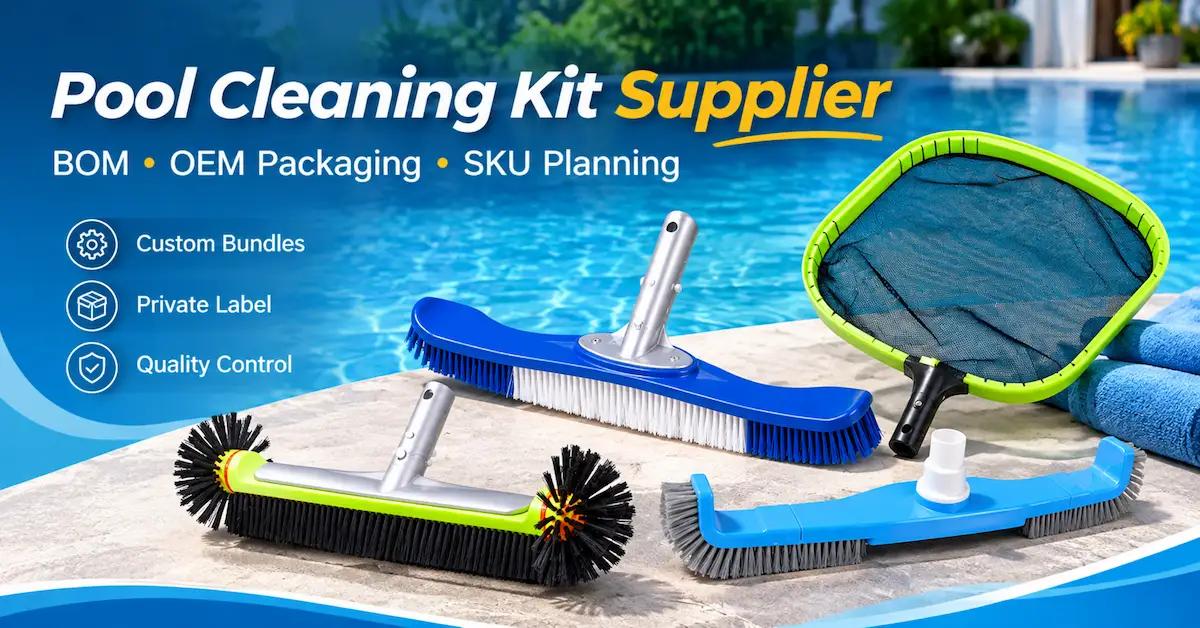

TL;DR: A reliable pool cleaning kit supplier should help B2B buyers manage component compatibility, bill of materials (BOM) accuracy, OEM packaging, quality inspection, and repeat-order consistency. Before ordering wholesale pool cleaning kits, importers should establish approved component specifications, assign kit-level SKUs, test complete sample bundles, and confirm assembly and replenishment arrangements.
For distributors and private-label pool equipment brands, selling several cleaning tools together can provide a convenient product offering. However, a successful commercial bundle requires more than putting a pool brush, skimmer net, and vacuum head into the same carton.
Each component must meet the intended application, connect correctly with related equipment, and remain consistent across repeat orders.
Packaging dimensions, SKU identification, replacement-part availability, and manufacturing changes also influence the final purchasing cost.
A bundle containing individually acceptable products can still fail if components do not fit, instructions are incomplete, or the delivered configuration differs from the approved sample.
This article focuses on the commercial and technical process of developing repeatable pool cleaning kit SKUs for wholesale distribution.
For a basic introduction to choosing the cleaning tools that belong in a maintenance kit, see BONNY's Guide to Building the Ideal Pool Cleaning Kit for Commercial Buyers.
Key Takeaways for B2B Pool Cleaning Kit Buyers
-
Control the complete product configuration. Each kit needs an approved BOM, component quantities, and a unique kit identifier.
-
Verify product compatibility before production. Brushes, skimmer nets, vacuum heads, poles, and hoses must match the intended application and connection systems.
-
Confirm packaging feasibility. Retail presentation, component protection, carton dimensions, and barcode requirements affect the total cost.
-
Inspect both components and finished kits. Individual product quality does not guarantee that an assembled bundle is complete.
-
Separate standard products from custom development. Logo and packaging customization differ from new product engineering.
-
Manage repeat orders through revision control. Changes to components, materials, connectors, or artwork should be documented and approved.
1. What Should a Wholesale Pool Cleaning Kit Supplier Actually Provide?
A professional pool cleaning kit supplier should support more than the sale of individual pool accessories.
For a defined purchasing project, the supplier may need to coordinate product selection, technical specifications, component sourcing, packaging, assembly, inspection, and shipping.
However, the scope of these services must be confirmed before placing an order.
Supplier Capability Checklist
| Supplier Capability | What B2B Buyers Should Verify | Commercial Benefit |
|---|---|---|
| Product range | Availability of the required cleaning tools | Fewer separate sourcing arrangements |
| Technical support | Component specifications and compatibility guidance | Reduced product mismatch |
| OEM customization | Branding, colors, labels and packaging | Consistent private-label presentation |
| Kit assembly | Whether complete bundles can be packed at origin | Simplified downstream fulfilment |
| Quality inspection | Component and finished-kit verification | Reduced shipping and receiving errors |
| Inventory coordination | Reorder and component availability arrangements | Better replenishment planning |
| Export support | Carton data, packaging and shipment documentation | More predictable international procurement |
The most important purchasing question is not simply whether a supplier sells brushes and nets.
It is whether the supplier can support the specific kit configuration and commercial delivery model required by your business.
Who Should Use This Sourcing Approach?
This framework is particularly relevant for:
-
Importers developing private-label pool maintenance products.
-
Wholesale distributors managing multiple accessory SKUs.
-
Retail chains introducing branded cleaning kits.
-
E-commerce brands that require consistent product packaging.
-
Pool maintenance companies purchasing standardized equipment.
-
Regional distributors coordinating recurring supply programs.
2. How Should Buyers Structure Pool Cleaning Kit SKUs?
The first step is to define the finished product as a distinct commercial item.
A kit should have a clear identity, approved contents, target application, and packaging specification.
Different kit configurations may require separate SKUs even when they share several components.
Three Practical B2B Kit Configurations
| Proposed Configuration | Core Components to Evaluate | Target Customer | Commercial Purpose |
|---|---|---|---|
| Residential Surface-Care Bundle | Skimmer net + suitable wall brush | Retail and private-label pool brands | Straightforward maintenance accessory package |
| Manual Floor-Cleaning Bundle | Vacuum head + confirmed compatible equipment | Pool equipment distributors | Support manual pool-floor cleaning |
| Professional Maintenance Bundle | Wall brush + corner brush + skimmer net + vacuum head | Pool service companies | Standardized cleaning-tool assortment |
These are illustrative sourcing configurations, not confirmation that BONNY currently sells each combination as a preassembled kit.
Telescopic poles, vacuum hoses, adapters, and other components should only be included when their availability and compatibility have been confirmed.
Why Separate Kit SKUs Matter
Consider a distributor offering a residential surface-care bundle and a professional maintenance bundle.
Both may contain the same skimmer net, but the professional version may require a different wall brush or an additional vacuum head.
If both configurations use the same product identification, inventory and fulfilment errors become more likely.
Each finished kit should therefore have an approved SKU.
For illustration:
-
PK-SUR-01: Residential Surface-Care Bundle.
-
PK-VAC-02: Manual Vacuum Accessory Bundle.
-
PK-PRO-03: Professional Maintenance Bundle.
These are example buyer-assigned identifiers, not BONNY product model numbers.
Component SKU vs Finished-Kit SKU
A component SKU identifies an individual product, such as a skimmer net or wall brush.
A kit SKU identifies the complete saleable configuration.
If components are also sold individually, separate identification supports purchasing, inventory control, replacement orders, and traceability.
For fixed retail bundles using GS1 identifiers, buyers should follow the applicable GTIN allocation rules. A change to the composition of a predefined bundle may require a new GTIN.
Procurement recommendation: Establish the kit identification system before artwork approval and bulk packaging production.
3. How to Build a Controlled Bill of Materials for Pool Cleaning Kits
A bill of materials (BOM) defines the individual items and quantities required for one finished kit.
For wholesale pool cleaning kits, a BOM should include products, accessories, packaging materials, labels, and instruction documents.
It becomes the primary reference for quoting, assembly, inspection, and replenishment.
Example: Residential Surface-Care Kit BOM
| BOM Code | Component | Technical Requirement | Quantity |
|---|---|---|---|
| C-001 | Pool skimmer net | Approved frame, mesh and connector specification | 1 |
| C-002 | Pool wall brush | Approved brush width, bristle type and connector | 1 |
| C-003 | Telescopic pole | Approved dimensions and compatibility, if included | Optional |
| P-001 | Retail packaging | Approved box or packaging configuration | 1 |
| P-002 | Protective insert | Material and dimensions if required | As specified |
| D-001 | Product instructions | Approved language and product information | 1 |
| L-001 | Product label | Approved SKU, barcode and market information | 1 |
This BOM is an illustrative procurement template. It does not establish that BONNY currently offers this exact assembled kit or all optional components.
What Information Must a BOM Include?
A professional BOM should identify:
-
Finished-kit SKU and revision.
-
Component model numbers.
-
Required quantities.
-
Approved materials and specifications.
-
Packaging components.
-
Labels and instructions.
-
Approved alternatives, where permitted.
-
Inspection requirements.
-
Revision and approval records.
A BOM should be sufficiently detailed that the same configuration can be reproduced for a future order.
Why BOM Revision Control Matters
Suppose a distributor approves a bundle containing an 18-inch pool brush.
Before the next shipment, the brush is replaced with a 20-inch design.
Although both products belong to the same category, the change affects the finished kit.
It may influence carton dimensions, handling, price, customer expectations, and product identification.
Therefore, the supplier should obtain approval before making such substitutions.
A controlled BOM helps prevent inconsistencies between approved samples and future shipments.
4. How Can Buyers Verify Compatibility Across Multiple Pool Cleaning Tools?
Compatibility should be tested before a kit is approved for bulk production.
This is especially important when a bundle contains products with mechanical interfaces.
Telescopic Pole Compatibility
A skimmer net and pool wall brush may use similar attachment concepts, but their connection details can vary.
Buyers should verify actual socket dimensions, locking systems, and attachment security.
Do not assume all cleaning heads fit every telescopic pole.
Vacuum Head and Hose Compatibility
A manual pool vacuum head must connect to the correct hose and suction system.
Important factors include connection dimensions, engagement depth, operating conditions, and the intended pool finish.
A vacuum head sold without a hose should not be described as a complete vacuum system.
Pool Surface Compatibility
A brush suitable for one pool surface may be inappropriate for another.
Bristle stiffness, backing geometry, edges, and vacuum-head contact materials should suit the intended pool finish.
Component Compatibility Matrix
| Component | Compatibility Requirement | Verification Method |
|---|---|---|
| Skimmer net | Approved telescopic pole | Physical fit and retention test |
| Wall brush | Pole connection and pool finish | Attachment and surface suitability review |
| Vacuum head | Pole, hose and intended suction system | Complete assembly and functional test |
| Vacuum hose, if supplied | Head port and suction equipment | Dimensional and operating compatibility check |
| Corner brush | Pool surface and cleaning geometry | Representative cleaning trial |
| Packaging | Complete approved component set | Physical pack-out test |
Why Compatibility Testing Should Be Documented
A successful sample test is useful only when the tested components can be identified.
Record the specific model and revision of each component used during approval.
If a connector changes in a later shipment, the original compatibility test may no longer represent the new configuration.
Engineering takeaway: The approved kit is a system of defined components. Changing one critical component can affect the performance of the entire bundle.
5. Which BONNY Products Are Relevant to Custom Pool Cleaning Kits?
Ningbo Bonny E-Home Co., Ltd. develops and manufactures swimming pool cleaning equipment and accessories for international markets.
Its published product catalogue contains several products that buyers can evaluate as potential kit components.
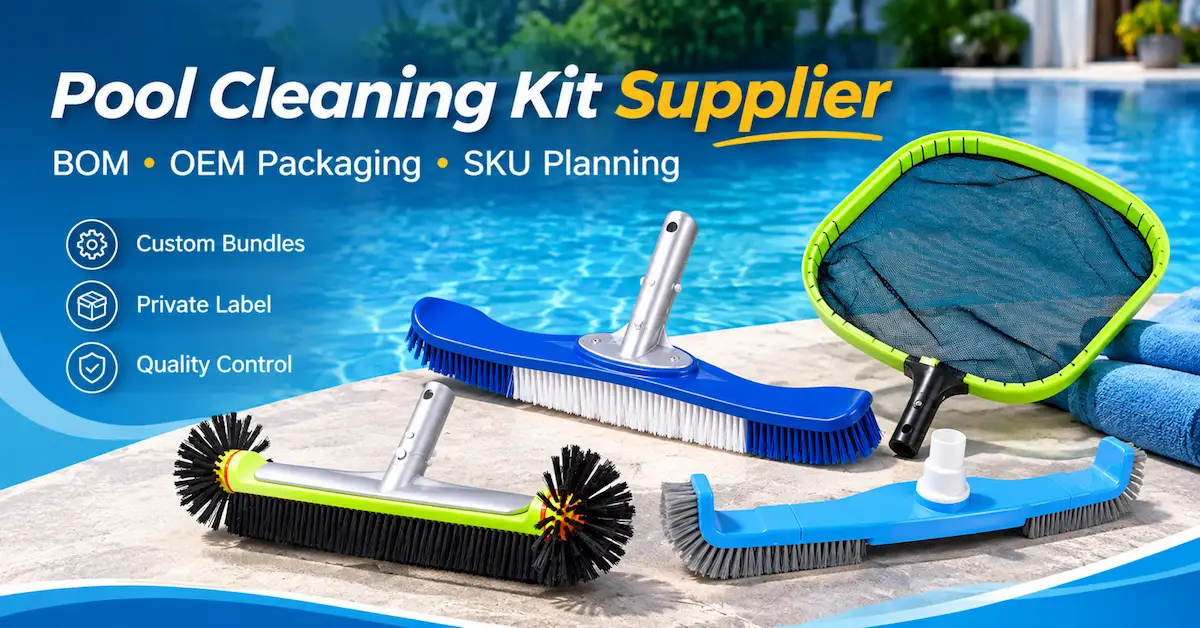
The BONNY Pool Accessories catalogue includes pool wall brushes, skimmer nets, manual vacuum heads, and specialized cleaning brushes.
Representative BONNY Products for Kit Development
| Product | Published Catalogue Feature | Possible Bundle Application |
|---|---|---|
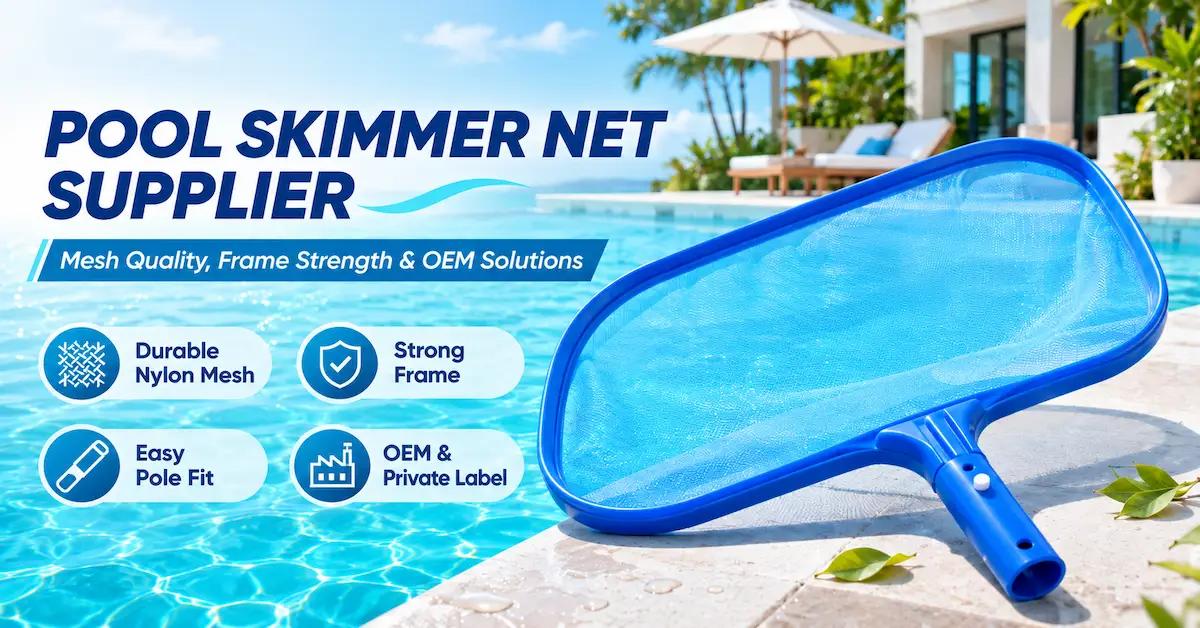
| 17-inch pool skimmer net | Nylon shallow-mesh design | Residential surface-care bundle |
| 18-inch deluxe pool brush | Aluminum-back wall brush | General maintenance kit |
| 20-inch pool wall brush | Wider brush-head format | Professional cleaning assortment |
| 360-degree round pool brush | Rounded cleaning-head design | Specialized corner-cleaning kit |
| 14-inch flexible vacuum head | Flexible manual vacuum-head design | Manual vacuum accessory bundle |
| 20-inch suction vacuum brush head | Combined brushing and suction design | Selected floor-cleaning configurations |
The table identifies product types appearing in BONNY's catalogue. The technical specifications and suitability of individual models should be verified during project qualification.
What Has Been Confirmed About BONNY?
BONNY publicly presents an existing pool accessory product range and OEM/ODM support for international customers.
Its engineering services include private labeling, packaging customization, material and color selection, and product development.
What Still Needs Confirmation?
Buyers should confirm whether BONNY can supply their proposed combination as:
-
Individually packed accessories.
-
A combined bulk carton.
-
A completed retail-ready kit.
-
A custom-designed branded bundle.
The availability of individual products does not automatically confirm finished-kit assembly services or a specific MOQ.
These should be established during the quotation process.
Explore BONNY Pool Cleaning Products
6. OEM Packaging: What Should Be Verified Before Bulk Production?
Packaging can significantly influence the commercial viability of a pool cleaning kit.
Unlike a single small accessory, a kit may contain products with different dimensions, shapes, and protective requirements.
For example, a wide brush head may be difficult to pack alongside a rigid vacuum head without increasing carton size.
A skimmer net may also require protection against abrasion or snagging.
Compare Three Packaging Models
| Packaging Model | Main Advantage | Main Cost or Operational Concern |
|---|---|---|
| Retail-ready assembled kit | Convenient for direct retail distribution | Packaging development, assembly and carton size |
| Bulk-packed component bundle | Suitable for commercial and wholesale buyers | Receiving and sorting requirements |
| Individually packed accessories | Flexible replenishment and local assembly | Additional warehouse handling and kitting work |
Retail-Ready Packaging Requirements
A retail-ready kit may require:
-
Printed product box.
-
Internal component protection.
-
Correct component list.
-
Product photographs matching the actual contents.
-
Instructions and usage information.
-
Barcode and SKU identification.
-
Applicable market-specific labeling.
The product images and claims on the packaging must accurately describe the supplied contents.
For example, a box should not show a telescopic pole as an included component if the kit contains only the brush and skimmer head.
Packaging Protection
Different tools require different protection.
Wall brushes: Bristles should not be permanently distorted by unsuitable packing pressure.
Skimmer nets: Mesh should be protected from sharp edges, snagging, and unnecessary compression.
Vacuum heads: Connectors and structural components should be secured against impact and movement.
Poles or hoses, if included: Their length, diameter, and packing arrangement must be considered when selecting carton dimensions.
Packaging Approval Checklist
| Inspection Area | Required Verification |
|---|---|
| Box dimensions | Complete approved kit fits correctly |
| Component protection | No unacceptable contact or deformation |
| Packaging artwork | Matches approved product configuration |
| Barcode | Correct finished-kit identification |
| Instructions | Complete and suitable for the destination market |
| Carton markings | Correct SKU, quantity and destination information |
| Transport protection | Packaging withstands agreed handling and shipping conditions |
Where appropriate, buyers may specify packaging performance tests that represent the planned distribution environment.
The exact procedure should be agreed before production.
7. How Do OEM and ODM Requirements Affect Kit Development?
Private-label kits allow buyers to create a coordinated brand experience across multiple products.
However, different types of customization have different technical and commercial requirements.
BONNY describes OEM and ODM support through its Engineering & Design service.
Standard OEM Bundle
An OEM project may use existing cleaning accessories with approved brand colors, logos, instructions, and packaging.
This approach may require less product-development work than creating new cleaning-head structures.
Custom ODM Bundle
An ODM project may involve new connector designs, modified accessory structures, or an entirely new product configuration.
Such work may require engineering evaluation, prototyping, tooling, and product testing.
OEM vs ODM Comparison
| Purchasing Requirement | OEM | ODM |
|---|---|---|
| Starting point | Existing product or buyer-defined specification | New or modified product concept |
| Main objective | Branding and specification control | Design and product development |
| Typical customization | Logo, color, packaging, approved components | Structure, connections, new product features |
| Tooling | Depends on requirements | May require additional tooling |
| Sample approval | Required for selected configuration | Required after development |
| Commercial complexity | Project-dependent | Often involves additional development stages |
Recommended Project Workflow
Step 1 — Define the finished-kit SKU. Establish the target customer and intended application.
Step 2 — Select components. Identify suitable products and confirm technical compatibility.
Step 3 — Approve the BOM. Confirm component quantities, specifications, and revisions.
Step 4 — Develop OEM packaging. Review branding, instructions, artwork, and physical component arrangement.
Step 5 — Test the complete sample kit. Verify functionality, completeness, and packaging protection.
Step 6 — Confirm commercial terms. Agree on production or assembly scope, MOQ, pricing, inspection, and delivery.
Step 7 — Authorize production. Use the approved BOM, samples, and artwork as the production reference.
Step 8 — Establish reorder controls. Define change notifications and replenishment arrangements.
Buyer recommendation: Approve the technical configuration before finalizing large quantities of printed packaging.
8. How Should Buyers Inspect Complete Pool Cleaning Kits?
Pool cleaning kit quality control should operate at two levels.
The first is component quality.
The second is kit completeness and correct assembly.
A kit may contain products that individually pass inspection while still failing as a finished commercial item.
Component-Level Quality Checks
| Component | Suggested Inspection | Main Risk |
|---|---|---|
| Pool wall brush | Dimensions, bristles, connector and edges | Poor fit or unsuitable construction |
| Skimmer net | Mesh integrity, frame and attachment | Torn mesh or weak connection |
| Vacuum head | Connection geometry and assembly | Incompatibility or function problems |
| Telescopic pole, if included | Locking function and fit | Loose attachment |
| Vacuum hose, if included | Connection dimensions and integrity | Incompatible suction assembly |
Kit-Level Quality Checks
The finished bundle should be inspected for:
-
Correct component models and quantities.
-
Approved specifications and revisions.
-
Required accessories and instructions.
-
Correct packaging configuration.
-
Accurate barcode and SKU labels.
-
Visible damage or missing parts.
-
Correct carton quantities and markings.
-
Shipment identification and documentation.
How Can ISO 2859-1 Support Shipment Inspection?
ISO 2859-1:2026 provides an international framework for acceptance sampling by attributes.
An agreed sampling plan may help evaluate defined defect categories and production-lot acceptance.
However, sampling alone does not guarantee that every kit contains every required component.
Buyers may need additional complete-pack verification procedures where missing items would have significant commercial consequences.
Golden Sample and BOM Control
A golden sample should represent the approved finished kit.
It should be supported by the controlled BOM, product specifications, and approved packaging artwork.
This reference helps buyers evaluate whether later shipments match the intended configuration.
Quality takeaway: Component inspection protects individual product performance, while finished-kit inspection protects commercial completeness and consistency.
9. How Should Buyers Compare Wholesale Kit Costs?
When sourcing a multi-component kit, the quoted price should be evaluated alongside packaging, assembly, inspection, freight, and inventory requirements.
Buying several tools together does not automatically reduce the total purchasing cost.
Total Landed Cost Per Kit
A practical calculation is:
Total landed cost per kit = Component costs + Packaging + Assembly + Tooling allocation + Inspection + Freight + Insurance + Applicable import charges + Expected replacement costs
This is a purchasing framework, not a BONNY quotation.
Compare Preassembled Kits and Separate Components
| Cost Factor | Preassembled Kit | Separate Component Purchasing |
|---|---|---|
| Product costs | Combined product quotation | Individual component quotations |
| Assembly | Potentially completed before shipping | Completed by destination warehouse if required |
| Packaging | Finished retail or bulk-kit packaging | Individual or bulk component packaging |
| Inventory | Finished-kit stock | Component stock |
| Order flexibility | Defined finished configurations | Greater flexibility for local kit assembly |
| Replenishment | Reorder complete kit | Reorder individual components |
| Freight | Depends on finished-kit dimensions | Depends on component packing arrangement |
Which Model Is More Suitable?
Preassembled kits may be appropriate for distributors seeking a finished retail product.
Separate component purchasing may be preferable for companies that already operate their own fulfilment or kitting facilities.
There is no universally cheaper model.
The most suitable option depends on the buyer's product range, labour costs, distribution structure, and expected order volume.
MOQ and Production Scheduling
A pool cleaning kit may contain several products with different production or sourcing requirements.
Consequently, the final kit MOQ may be influenced by the individual components, packaging quantities, and assembly arrangement.
Buyers should request a quotation for the complete configuration rather than assuming the MOQ of one product applies to the entire kit.
10. How Can Distributors Manage Replenishment and Repeat Orders?
Repeat-order management is a major reason to establish a controlled BOM.
A distributor may initially sell hundreds of kits successfully, but later face supply problems if one component becomes unavailable or changes specification.
Maintain Approved Component References
Every critical component should have a model number and approved technical specification.
If the supplier proposes an alternative component, the buyer should assess compatibility, packaging fit, appearance, and performance before approval.
Track Component Availability
A complete kit can only be supplied when all required components are available.
For example, a buyer may have adequate stock of skimmer nets and brushes but insufficient vacuum heads.
The kit's actual available quantity is constrained by the component with the lowest available quantity relative to its required amount per kit.
Plan Replacement Components
Some customers may need replacement nets or brushes without purchasing another complete kit.
Distributors should consider whether individual replacement SKUs are commercially useful.
Any replacement component must match the approved kit's relevant interfaces and specifications.
Monitor Returns and Complaints
Useful product feedback includes missing components, damaged packaging, incompatible connections, weak brush attachment, and mesh defects.
These records help identify whether an issue originates in component design, assembly, packaging, or customer application.
Establish Change Notification Requirements
A repeat-order agreement should identify which changes require approval.
These may include component materials, connection dimensions, approved suppliers, packaging artwork, and finished-kit configuration.
The purpose is to prevent uncontrolled substitutions while allowing agreed product improvements.
11. Common Mistakes When Purchasing Wholesale Pool Cleaning Kits
Mistake 1: Purchasing Accessories Without a Controlled BOM
Risk: Delivered contents differ between orders.
Solution: Approve a complete BOM and revision before production.
Mistake 2: Assuming Components Are Universally Compatible
Risk: Tools do not fit the supplied pole, hose, or intended equipment.
Solution: Verify complete component assemblies using representative samples.
Mistake 3: Designing Packaging Before Confirming Components
Risk: The finished kit does not fit the printed box or requires costly changes.
Solution: Approve component dimensions before final packaging artwork.
Mistake 4: Ignoring Finished-Kit Inspection
Risk: Individually acceptable products are shipped in incomplete bundles.
Solution: Establish component-level and kit-level acceptance checks.
Mistake 5: Using the Same SKU for Different Kit Configurations
Risk: Inventory, barcodes, and reorder specifications become inconsistent.
Solution: Assign clear identifiers and follow applicable product-identification rules.
Mistake 6: Assuming All OEM Services Are Included
Risk: Unanticipated tooling, packaging, assembly, or development costs.
Solution: Confirm the project scope and commercial responsibilities in writing.
Mistake 7: Reordering Without Checking Product Revisions
Risk: Replacement products no longer match the original kit.
Solution: Maintain approved specifications and a formal change-approval process.
12. Why Consider BONNY for Pool Cleaning Kit Component Sourcing?
Founded in 1998, Ningbo Bonny E-Home Co., Ltd. is a Chinese manufacturer and supplier of swimming pool cleaning equipment and accessories for international markets.
BONNY's product catalogue includes the manual cleaning tools that buyers commonly evaluate when planning pool maintenance bundles.
Relevant Product Categories
Buyers can explore pool wall brushes, skimmer nets, vacuum heads, and specialized cleaning accessories.
These product categories may provide a starting point for developing an OEM kit configuration.
Engineering and OEM/ODM Support
BONNY describes product development, material and color customization, private-label branding, and packaging services.
These capabilities can support discussions about component specifications and branded product requirements.
Manufacturing Background
The company identifies manufacturing processes including injection molding and bristle planting.
Buyers should confirm which processes apply to their selected components and how completed kit assembly would be handled.
International Sourcing
BONNY works with overseas distributors, retailers, and brand owners on product requirements, sampling, manufacturing, and export orders.
Important: BONNY's published individual product range and customization services do not automatically establish that a proposed kit is available as a stock item or that every kitting service is included. Complete-kit assembly, mixed-SKU packing, MOQ, and delivery schedules should be confirmed with BONNY for each project.
Explore BONNY Pool Cleaning Accessories
Learn About BONNY Manufacturing and OEM Services
13. What Should Buyers Include in a Pool Cleaning Kit RFQ?
A detailed request for quotation helps the supplier determine whether the proposed configuration is feasible.
| RFQ Field | Information to Provide |
|---|---|
| Target application | Residential, retail, professional maintenance or another defined market |
| Finished-kit SKU | Buyer-assigned identifier or proposed configuration name |
| Component list | Required product categories and model references |
| BOM quantities | Number of each component per kit |
| Technical specifications | Materials, dimensions and compatibility requirements |
| Packaging model | Preassembled retail kit, bulk bundle or separate components |
| Branding | Logo, colors, artwork and labeling |
| Estimated volume | Number of kits and expected replenishment requirements |
| Destination market | Country and distribution channel |
| Quality requirements | Approved samples and inspection criteria |
| Commercial scope | Assembly, packaging, tooling, quotation and delivery terms |
| Reorder controls | Component availability and change-approval expectations |
Request a Pool Cleaning Kit Sourcing Quotation
BONNY can review existing pool cleaning accessories, branding requirements, packaging options, and project feasibility.
For an efficient enquiry, submit your proposed component list, target application, expected quantity, destination market, and preferred packaging model.
Contact BONNY for OEM Pool Cleaning Kit Components and Wholesale Pricing
Frequently Asked Questions About Pool Cleaning Kit Suppliers
1. What is the main role of a pool cleaning kit supplier?
A pool cleaning kit supplier provides or coordinates cleaning accessories for a defined product bundle. Depending on the confirmed supply arrangement, the supplier may also support branding, packaging, assembly, inspection, and shipping.
2. What is the difference between a pool cleaning kit supplier and a pool accessories manufacturer?
A pool accessories manufacturer focuses on producing individual tools or components. A kit supplier may also coordinate component selection, compatibility, packaging, and complete-bundle requirements. Some businesses provide both functions, depending on their capabilities.
3. What is a BOM for a pool cleaning kit?
A bill of materials lists all components required for one finished kit, including product quantities, specifications, packaging, labels, and instructions. It supports consistent production and repeat purchasing.
4. Can BONNY supply custom OEM pool cleaning kits?
BONNY offers OEM/ODM and product customization services. Buyers should confirm whether the proposed component combination, complete-kit assembly, and packaging arrangement are available for their particular project.
5. Are pool cleaning kit components universally compatible?
No. Brush heads, skimmer nets, poles, vacuum heads, and hoses may use different connections. Buyers should verify actual dimensions and test the selected components together.
6. How should private-label brands manage pool cleaning kit SKUs?
Assign a clear identifier to each finished-kit configuration and maintain an approved BOM. Track critical component specifications and follow applicable barcode or GTIN rules where required.
7. Is preassembled kit sourcing cheaper than ordering separate components?
Not necessarily. Compare product costs, packaging, assembly, inspection, freight, storage, and fulfilment costs. The best option depends on the buyer's distribution and inventory model.
8. What quality checks are important for wholesale pool cleaning kits?
Verify component quality, interface compatibility, correct BOM quantities, packaging protection, labeling, and finished-kit completeness. Inspection methods should be agreed before production.
9. What determines MOQ and production lead time?
MOQ and lead time depend on the selected components, customization, packaging, assembly requirements, order quantity, and production schedule. Obtain a complete-kit quotation for the proposed configuration.
10. What should I send when requesting a pool cleaning kit quotation?
Provide the target market, required accessories, estimated quantities, technical specifications, packaging preferences, branding requirements, destination country, and expected reorder needs.
Conclusion
Choosing a reliable pool cleaning kit supplier requires a structured approach to component sourcing, technical compatibility, BOM management, OEM packaging, quality inspection, and inventory replenishment.
For importers, wholesale distributors, and private-label brands, the most effective purchasing strategy is to develop a clearly defined kit configuration that can be approved, reproduced, and managed across multiple orders.
A successful wholesale bundle should provide practical customer value without introducing unnecessary components, incompatible fittings, or avoidable packaging costs.
Controlled bills of materials, representative sample approval, complete-kit inspection, and documented change management help reduce procurement uncertainty and support long-term product consistency.
BONNY, operated by Ningbo Bonny E-Home Co., Ltd., supplies swimming pool cleaning accessories and provides OEM/ODM services for international B2B customers.
Whether you are planning a residential surface-care bundle, developing a private-label pool maintenance range, or sourcing components for professional cleaning kits, BONNY can review your requirements and discuss suitable product and customization options.