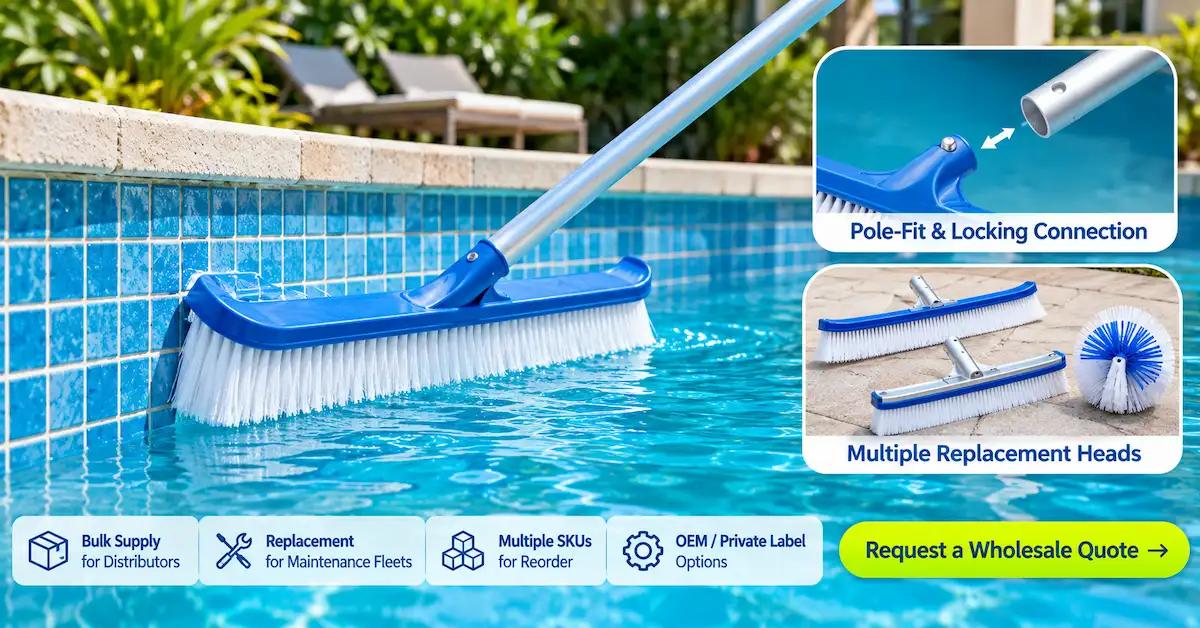

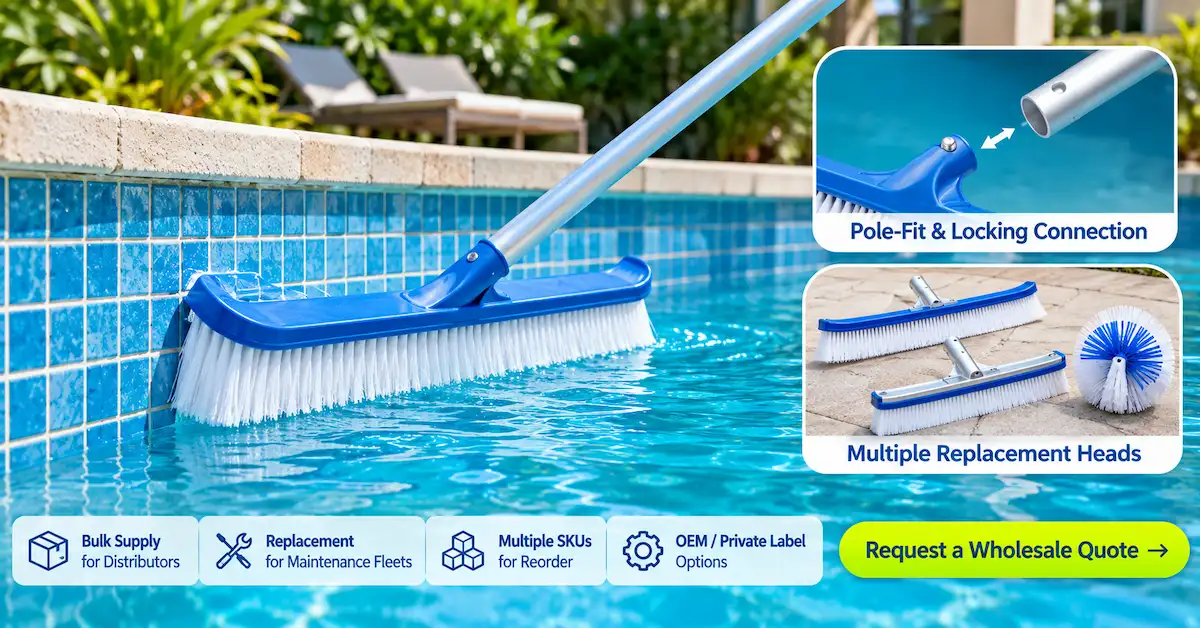
Quick Answer: Buyers sourcing pool brush replacement heads wholesale should verify the actual pole-to-head interface, locking clip geometry, brush dimensions, and approved replacement SKU before ordering. A replacement head should fit the existing pole securely, suit the intended pool surface, and match the buyer's product identification requirements. Sample installation trials, controlled substitution records, and batch inspections help prevent incompatible replacements and repeat-order errors.
Pool maintenance companies and equipment distributors often need to replace worn or damaged brush heads without replacing an entire cleaning tool assembly.
For businesses managing hundreds of tools, replacement-head availability is an important purchasing consideration.
However, replacement brushes that look similar are not necessarily interchangeable.
A 20-inch brush may have a different connection structure from another 20-inch product. Two brush heads may use similar locking clips but have different insertion depths, hole positions, or connector dimensions.
Even when the head attaches to the pole, the connection may not remain secure during repeated brushing.
For professional buyers, these issues can lead to customer complaints, returns, unnecessary equipment replacement, and unpredictable inventory demand.
This guide focuses on replacement-head purchasing, mechanical fit verification, substitute-model approval, and recurring wholesale supply.
It does not repeat the broader material-selection and pool brush manufacturing topics covered in BONNY's existing technical articles.
Key Takeaways for Wholesale Replacement-Head Buyers
-
Match the actual connection dimensions, not only the advertised brush width or nominal pole size.
-
Identify what is included: a complete replacement brush head may be supplied with or without a locking clip or other attachment components.
-
Approve substitutes individually. Similar-looking brush models should not automatically be treated as interchangeable.
-
Test the complete assembly. The actual pole, brush head, and locking mechanism should be evaluated together.
-
Maintain separate replacement SKUs. The customer's existing equipment reference and the supplier's product number should both be recorded.
-
Control repeat-order changes. Connector geometry, bristle construction, and packaging should remain consistent with the approved specification.
-
Confirm commercial availability. A manufacturer selling complete pool brushes does not necessarily offer every component as a separately stocked replacement part.
1. Why Do Buyers Purchase Replacement Pool Brush Heads in Bulk?
Replacement-head purchasing allows a distributor or maintenance company to evaluate whether existing telescopic poles can remain in service when the cleaning head becomes worn or damaged.
This can be useful when the pole is still functional and the brush connection is designed to permit head replacement.
Common Wholesale Purchasing Scenarios
| Buyer Type | Purchasing Requirement | Main Procurement Risk |
|---|---|---|
| Pool equipment distributor | Maintain an assortment of compatible replacement heads | Incorrect SKU matching |
| Pool maintenance company | Replace worn brush heads across service routes | Loose pole connections |
| Service franchise | Standardize replacement components across locations | Supplier substitutions |
| Private-label brand | Supply replacement products under its own brand | Product identification inconsistency |
| Pool equipment retailer | Offer replacements for previously sold equipment | Customer returns caused by incompatibility |
| Maintenance contractor | Replenish approved tools without unnecessary full-tool replacement | Availability and lead-time uncertainty |
Replacement Head vs Complete Pool Brush
A buyer should distinguish between three purchasing categories:
Complete brush head: The brush body, backing, bristles, and integrated connection components required by its design.
Brush head with separate connector components: A replacement product that may require specific clips, buttons, or other parts.
Individual replacement hardware: A clip or other service component supplied independently, if available.
These are not necessarily interchangeable commercial products.
The supplier should confirm whether the quoted item includes everything required to connect it to the intended pole.
Buyer recommendation: Define the delivered product's contents before comparing wholesale prices.
2. What Should Buyers Measure Before Ordering Pool Brush Replacement Heads Wholesale?
The most reliable starting point is a dimensional comparison between the existing telescopic pole and the proposed replacement head.
Measurements should reflect the actual connection design.
Some pool cleaning attachments use a male connector inserted into a hollow pole, while other mechanical arrangements may differ.
Critical Pole-Fit Measurements
| Measurement Code | Dimension or Feature | How to Verify |
|---|---|---|
| P1 | Inside diameter of the pole end | Measure the mating opening |
| H1 | Outside diameter of the brush-head connector | Measure the part entering the pole |
| P2 | Usable pole insertion depth | Measure the available internal engagement |
| H2 | Brush-head connector insertion length | Measure the intended mating section |
| P3 | Locking-hole diameter or shape | Check the actual opening |
| H3 | Locking-button diameter or profile | Measure the corresponding engagement feature |
| P4 | Hole-center distance from the pole end | Measure the axial position |
| H4 | Button-center distance from the connector reference face | Measure the corresponding axial position |
| P5 | Number and angular arrangement of locking holes | Identify connection orientation |
| H5 | Clip-button arrangement | Compare with pole holes |
| P6 | Pole wall thickness and end condition | Inspect for deformation or damage |
| H6 | Connector material and construction | Confirm the approved design |
These measurements are an RFQ template, not universal BONNY product specifications.
Why Nominal Pole Size Is Not Enough
Two poles with the same nominal size may have different actual internal dimensions, wall thicknesses, locking-hole positions, or connection arrangements.
A replacement-head supplier should therefore request actual measurements or representative physical samples where compatibility is uncertain.
Recommended Measuring Tools
Digital calipers can be used for accessible dimensions.
Depth gauges or appropriate measuring tools may help determine insertion depth and hole position.
For more complex connectors, a drawing, reference sample, or suitable inspection fixture can improve consistency.
Pole-Fit Measurement Form
| RFQ Field | Existing Pole | Proposed Replacement Head |
|---|---|---|
| Brand or reference | Buyer to complete | Supplier to complete |
| Model number | Buyer to complete | Supplier to complete |
| Mating diameter | Measured value | Measured value |
| Engagement length | Measured value | Measured value |
| Locking-hole position | Measured value | Corresponding button position |
| Locking configuration | Hole number and orientation | Button number and orientation |
| Material | If known | Supplier specification |
| Drawing revision | If available | Required |
| Fit result | Reference assembly | Pass / Fail / Pending |
Engineering takeaway: A compatible replacement depends on the complete interface geometry, not merely one diameter measurement.
3. How Should Buyers Verify Pool Brush Locking Clips and Pole Connections?
Locking clips and spring-button mechanisms help retain cleaning heads on compatible poles.
Their geometry and operating behavior should be considered part of the replacement-head specification.
What Can Cause an Incorrect Fit?
Common issues include:
-
Connector diameter mismatch.
-
Incorrect locking-hole position.
-
Inadequate insertion depth.
-
Button misalignment.
-
Damaged or weakened clips.
-
Deformed pole openings.
-
Different connection systems.
-
Excessive looseness after assembly.
A replacement can appear correctly attached while still having unacceptable movement during use.
Functional Pole-Fit Test
Step 1 — Inspect the components. Check both the pole and replacement head for deformation, burrs, cracks, or damaged locking components.
Step 2 — Assemble the components. Confirm that the connector engages without inappropriate force or modification.
Step 3 — Check locking engagement. Verify the button or retention feature reaches its intended position.
Step 4 — Inspect movement. Assess unwanted looseness or rotation according to agreed criteria.
Step 5 — Conduct a representative use trial. Test the assembly under suitable brushing conditions.
Step 6 — Repeat attachment and removal. Confirm that the locking mechanism remains functional after an agreed number of operations.
Functional Acceptance Matrix
| Test | Acceptance Principle |
|---|---|
| Initial insertion | Connects correctly without damage |
| Locking engagement | Retention feature engages as designed |
| Axial retention | Does not separate under agreed loading conditions |
| Rotational movement | Remains within approved functional requirements |
| Attachment removal | Can be removed using the intended method |
| Repeated operation | Maintains acceptable function |
| Field-use compatibility | Performs satisfactorily during representative cleaning |
Test loads, cycle counts, and acceptance limits should be established for the selected product.
There is no justified universal locking-force value that automatically applies to every pool brush connector.
Can Buyers Source Locking Clips Separately?
Potentially, but this depends on the manufacturer and specific design.
A pool brush pole connector supplier may provide clips as separate parts, integrated components, or as part of a complete replacement head.
Buyers should confirm the available supply arrangement.
Important: BONNY's published catalogue confirms several pool brush products, but it does not establish that every locking clip or connector is available as an independently sold replacement SKU.
4. How Can Buyers Approve Substitute Pool Brush Models?
Substitution is a common concern in replacement-parts procurement.
An importer may need to replace a discontinued brush head with a newer or alternative product.
However, an alternative model should not be approved based solely on visual similarity.
Replacement SKU Compatibility Matrix
| Evaluation | Existing SKU | Candidate SKU | Acceptance Requirement |
|---|---|---|---|
| Product category | Wall brush | Wall brush | Same intended task |
| Head width | Approved value | Confirmed value | Meets buyer requirement |
| Head geometry | Approved shape | Confirmed shape | Suitable for intended use |
| Bristle material | Approved specification | Confirmed specification | Compatible with intended pool finish |
| Pole mating dimensions | Recorded measurements | Measured values | Fits approved interface |
| Locking clip arrangement | Existing design | Candidate design | Secure engagement |
| Connection retention | Existing performance requirement | Tested result | Passes agreed test |
| Product identification | Original SKU | New supplier SKU | Cross-reference approved |
| Packaging | Current format | Proposed format | Suitable for distribution |
| Replacement status | Existing product | Candidate product | Approved or rejected |
Three Replacement Decisions
Direct replacement: A candidate is approved to replace the existing product for its defined application.
Conditional replacement: The candidate is suitable only with a specified pole, adapter, or additional component.
Not interchangeable: The candidate cannot replace the existing product within the buyer's defined requirements.
These classifications should be recorded in the purchasing system.
Why Width Alone Is Not a Substitute Criterion
An 18-inch brush and a 20-inch brush may serve similar cleaning tasks, but they are not automatically interchangeable commercial items.
A different width can influence handling, packaging, product presentation, and customer expectations.
Likewise, similar pole connectors do not establish equivalent bristle characteristics.
Example Alternative-SKU Approval Record
| Original SKU | Proposed Alternative | Fit Test | Application Review | Decision |
|---|---|---|---|---|
| Buyer SKU A | Supplier SKU X | Pass | Pass | Approved replacement |
| Buyer SKU A | Supplier SKU Y | Pass | Pending | Hold |
| Buyer SKU B | Supplier SKU Z | Fail | Pass | Reject |
Illustrative examples only. These are not actual BONNY substitute-model approvals.
5. Which BONNY Pool Brush Models Can Be Evaluated for Replacement Orders?
Ningbo Bonny E-Home Co., Ltd. supplies swimming pool cleaning brushes and other pool accessories for international business customers.
Its catalogue includes several brush-head formats suitable for initial procurement review.
However, buyers should confirm whether a particular model can be purchased as a head-only replacement, what attachment parts are included, and which existing poles it fits.
BONNY Product Comparison
| BONNY Product | Published Reference | Relevant Purchasing Application | Information to Confirm |
|---|---|---|---|
| 20-Inch Pool Wall Brush | T614D / T614 appear on the page | Wider replacement brush-head assortment | Exact SKU and connector dimensions |
| 18-Inch Deluxe Pool Brush | T854A / T854 appear on the page | Standard replacement brush category | Model identification and locking interface |
| 360-Degree Round Pool Brush | WB081604 | Specialty replacement head for corners and curved areas | Clip geometry and pole compatibility |
| Round-End Corner Brush | WB0070 | Specialized accessory assortment | Current availability and connector details |
Published model references should not be treated as proof of interchangeability.
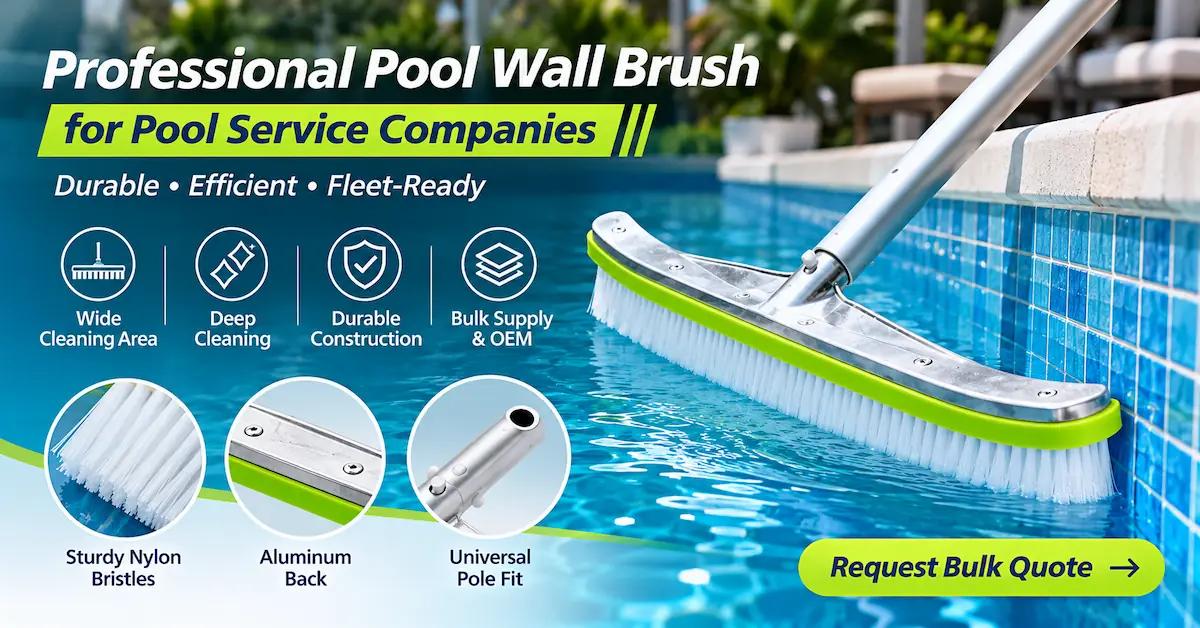
20-Inch Pool Wall Brush
BONNY lists a 20-inch wall brush with an aluminum-handle description.
The product page identifies T614D in one location and T614 in its specifications.
Buyers should confirm the current SKU and whether these identifiers refer to variants, revisions, or another product-data distinction.
View BONNY 20-Inch Pool Wall Brush
18-Inch Deluxe Pool Brush
BONNY's 18-inch deluxe brush provides another candidate for wholesale replacement-head sourcing.
Its page contains T854A and T854 references that require confirmation before ordering.
View BONNY 18-Inch Deluxe Pool Brush
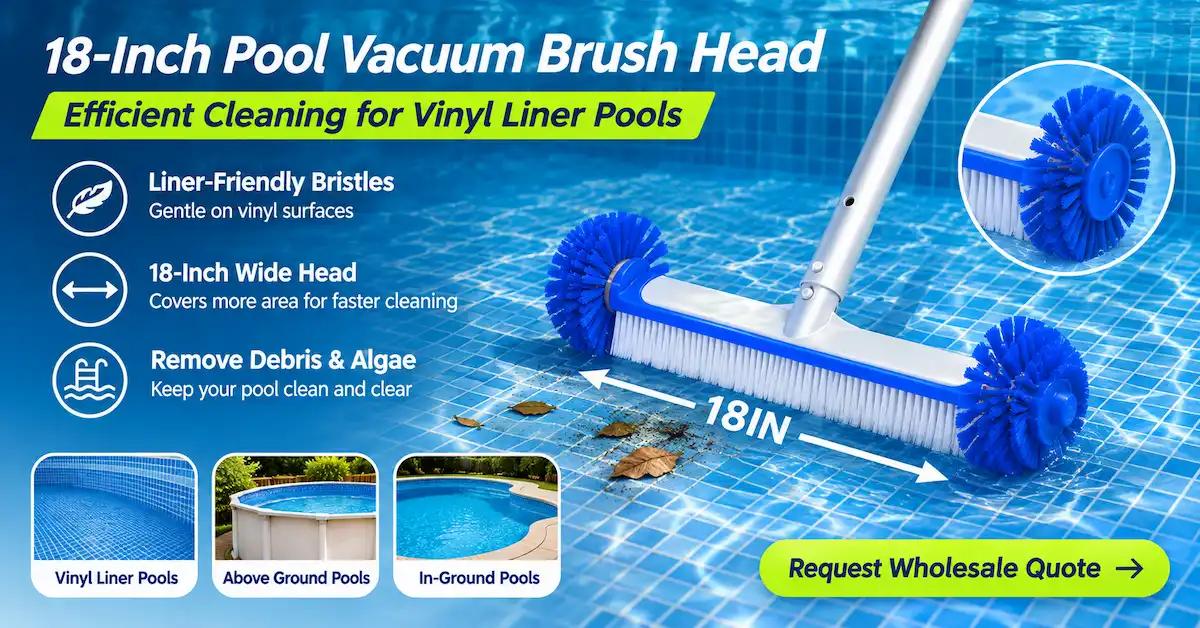
360-Degree Round Pool Brush
The WB081604 round-head design is relevant to buyers requiring replacement brushes for curved cleaning areas or specialized maintenance tasks.
Its exact connector arrangement and compatibility should be established through physical testing.
View BONNY 360-Degree Round Pool Brush
What About Separate Replacement Connectors?
The existing catalogue confirms complete cleaning brush products.
Independent availability of clips, adapter components, or connector-only SKUs should be discussed directly with BONNY.
Explore BONNY Pool Cleaning Accessories
6. How Should Buyers Test Replacement Brush Samples Before Bulk Approval?
Sample approval should use the actual equipment configuration operated by the buyer's customers or maintenance teams.
A dimensional comparison can identify obvious mismatches, but a complete assembly trial is still valuable.
Recommended Sample Approval Sequence
-
Identify the original pole and brush reference.
-
Record connection dimensions.
-
Select candidate replacement-head models.
-
Measure the candidate connector.
-
Check locking-clip engagement.
-
Conduct a physical assembly test.
-
Evaluate representative brushing performance.
-
Check bristle suitability for the intended pool finish.
-
Approve packaging and product identification.
-
Record the final replacement decision.
Sample Sign-Off Checklist
| Approval Item | Evidence | Status |
|---|---|---|
| Original pole identified | Model, photograph or sample | Pending |
| Replacement SKU identified | Supplier reference | Pending |
| Connection drawing | Dimensions and tolerances | Pending |
| Locking clip | Type and engagement test | Pending |
| Functional trial | Approved field-use evaluation | Pending |
| Bristle specification | Material and construction | Pending |
| Pool-surface suitability | Application review | Pending |
| Packaging contents | Confirmed head and accessories | Pending |
| Label and SKU | Approved identification | Pending |
| Golden sample | Retained reference | Pending |
The completed checklist should identify the product revision and approval date.
A supplier should not change the agreed connector geometry without notifying the buyer where such a change affects compatibility.
7. What Quality Inspections Matter for Bulk Pool Brush Heads?
Once a replacement SKU has been approved, the next priority is manufacturing consistency.
The supplied products should continue to match the approved dimensions and functional requirements.
Recommended Bulk QC Matrix
| Inspection Item | Suggested Verification | Purchasing Risk |
|---|---|---|
| Connector diameter | Dimensional check | Incorrect pole fit |
| Connector engagement length | Measurement | Incomplete attachment |
| Locking button position | Dimensional check | Button cannot engage |
| Clip function | Assembly trial | Loose or failed retention |
| Brush head dimensions | Measurement | Wrong product supplied |
| Bristle construction | Approved specification check | Incorrect cleaning characteristics |
| Backing integrity | Visual and functional check | Structural defects |
| Assembly integrity | Agreed inspection procedure | Component separation |
| Packaging contents | Count and identification | Missing parts |
| Carton labels | SKU and revision verification | Incorrect replenishment |
What Is the Role of ISO 2859-1?
ISO 2859-1:2026 provides acceptance-sampling schemes indexed by acceptance quality limit for inspection by attributes.
Buyers and suppliers can use a suitable agreed sampling plan for defined pass/fail characteristics, such as incorrect labels, damaged components, or connections that fail an established go/no-go fixture.
However, the standard does not establish universal pool brush connector dimensions, locking-force requirements, or product certification.
Critical compatibility checks may need additional verification beyond routine sampling.
Why Retain a Golden Sample?
A golden sample provides a reference for subsequent orders.
For replacement-head purchasing, the sample should correspond to the approved connector geometry and commercial product configuration.
The reference should be supported by controlled technical specifications.
8. How Should Distributors Manage Replacement SKUs and Repeat Orders?
Replacement parts require careful inventory management because the intended customers may continue using equipment purchased years earlier.
A supplier's current catalogue number may not match the distributor's original product identification.
A cross-reference system helps connect these records.
Recommended Replacement SKU Database
| Database Field | Purpose |
|---|---|
| Original customer SKU | Identifies the existing product |
| Original supplier model | Records the prior source |
| Approved replacement SKU | Identifies the substitute |
| Compatibility status | Direct, conditional or not interchangeable |
| Approved pole models | Records verified interfaces |
| Brush dimensions | Confirms commercial specification |
| Product revision | Controls changes |
| Packaging quantity | Supports purchasing and warehouse operations |
| Reorder status | Active, discontinued or pending approval |
| Supplier lead time | Supports replenishment planning |
Internal SKU vs Retail GTIN
An internal SKU is generally used within a business for inventory and order management.
A GTIN is a standardized trade-item identifier used in relevant supply-chain and retail systems.
These should not be treated as identical.
The GS1 GTIN Management guidance explains that new products need distinct identifiers and that certain changes to existing products may require a new GTIN.
For a replacement brush head, the brand owner should assess whether the new item or changed product characteristics require a different GTIN under applicable GS1 rules.
Not every small manufacturing revision automatically requires a new retail barcode.
How Can Buyers Avoid Reorder Errors?
Maintain a clear link between the approved sample, the supplier's SKU, the distributor's SKU, and the actual connection specification.
If a model is discontinued, do not automatically substitute the nearest-looking product.
Instead, use the approved replacement matrix.
Recommended Replenishment Process
Stage 1: Review demand and identify active replacement SKUs.
Stage 2: Confirm current supplier availability.
Stage 3: Verify there have been no unapproved design changes.
Stage 4: Issue the order using approved model and revision references.
Stage 5: Inspect incoming products.
Stage 6: Record any changes, returns, or compatibility complaints.
Operational takeaway: A reliable replacement-head supply program depends on accurate product identification as much as manufacturing quality.
9. What Materials and Manufacturing Details Affect Replacement Compatibility?
For replacement-head sourcing, material and manufacturing details matter when they influence fit, intended use, or repeatability.
Molded Connector Components
Plastic connector dimensions may be affected by material selection, mold design, and production consistency.
Any changes affecting the mating interface should be reviewed against the approved drawings.
Metal Backing and Handle Components
Some pool brushes use aluminum backing or handle components.
These should be inspected for relevant geometry, assembly integrity, and surface condition.
Locking Components
Where spring clips or buttons are used, their material and construction can affect engagement and repeated operation.
Buyers should specify the complete approved connector assembly rather than only the visible button.
Bristle Construction
Bristle characteristics should match the intended cleaning application.
However, this article's primary purpose is replacement compatibility, not a general comparison of brush materials or tuft-retention technologies.
For buyers evaluating bristle manufacturing in greater detail, BONNY's other pool brush sourcing guides provide a separate technical reference.
10. How Do Replacement-Head Costs Compare With Complete Tool Replacement?
Replacing an entire telescopic pole and brush assembly may be unnecessary when only the head is worn.
However, this depends on whether the pole is in acceptable condition and a compatible replacement head is available.
Replacement Purchasing Cost Factors
| Cost Factor | Replacement Head | Complete Tool Assembly |
|---|---|---|
| Brush head | Required | Required |
| Telescopic pole | Not required if existing pole is suitable | May be included |
| Connector hardware | Depends on supplied configuration | Depends on design |
| Installation or assembly | Possible | Depends on product |
| Freight | Product-specific | Product-specific |
| Compatibility testing | Important | Still necessary |
| Storage | Replacement SKU inventory | Complete-tool inventory |
| Packaging | Head-only or retail replacement pack | Full product pack |
Total Landed Cost Per Accepted Replacement Head
A useful purchasing model is:
Landed cost per accepted head = (Product cost + Packaging + Inspection + Freight + Insurance + Applicable import charges + Rework or replacement costs) ÷ Accepted units
This formula helps buyers compare suppliers without ignoring quality-related expenses.
MOQ and Lead Time
Minimum order quantities, prices, and production schedules depend on the actual product and commercial requirements.
A head-only order may have a different arrangement from an order for complete brushes.
Buyers should confirm current terms rather than assuming that the MOQ for a complete product also applies to replacement components.
11. Can BONNY Support OEM Replacement Brush Head Programs?
BONNY, operated by Ningbo Bonny E-Home Co., Ltd., develops and manufactures swimming pool cleaning equipment and accessories for international customers.
Its official information identifies manufacturing capabilities including injection molding, bristle planting, and product assembly.
The company also describes OEM and ODM services covering product development, materials, colors, branding, and packaging.
These capabilities are relevant to discussions about customized brush-head designs.
However, project-specific manufacturing feasibility must be confirmed.
Potential OEM Replacement-Head Requirements
| Customization | Business Value | Verification Needed |
|---|---|---|
| Connector dimensions | Existing pole compatibility | Engineering and functional approval |
| Locking clip design | Replacement fit | Retention and operation tests |
| Brush head width | Assortment requirements | Dimensional and use validation |
| Bristle configuration | Intended pool finish | Application and construction review |
| Product color | Private-label identity | Approved material and color |
| Retail packaging | Replacement-part merchandising | Accurate contents and labels |
| SKU identification | Repeat-order management | Cross-reference accuracy |
| Replacement component supply | Service and repair support | Actual availability and commercial terms |
OEM vs Standard Replacement Supply
A standard replacement order uses an existing product that meets the buyer's approved specifications.
An OEM project may require branding, packaging, or a modified connector.
A custom connector can require engineering development and new sample approval.
Learn About BONNY Engineering and OEM Services
12. Wholesale Replacement Pool Brush Head RFQ Checklist
An effective RFQ should identify both the replacement item and the equipment it must fit.
Recommended RFQ Template
| RFQ Field | Information to Provide |
|---|---|
| Buyer type | Distributor, maintenance fleet, retailer or OEM brand |
| Required product | Complete replacement brush head |
| Original product reference | Existing SKU, model or reference photo |
| Original pole | Brand, model and available drawing |
| Pole mating dimensions | Inside/outside dimensions as appropriate |
| Locking system | Hole location, clip type and button arrangement |
| Required brush width | Target dimensions |
| Bristle specification | Intended pool surface and material requirement |
| Head-only supply | Confirm whether pole is excluded |
| Included hardware | Clip, buttons or other specified parts |
| Substitute model | Current or proposed alternative SKU |
| Sample requirements | Quantity and fit-test expectations |
| Quality requirements | Inspection and acceptance criteria |
| Packaging | Bulk or retail replacement packaging |
| Estimated order quantity | Initial and expected repeat volume |
| Destination country | Import market |
| Commercial terms | Quotation, MOQ, lead time and delivery terms |
Request Replacement Pool Brush Head Pricing
For the most accurate quotation, send BONNY a photograph or drawing of the original brush head and pole connection.
Include the measured interface dimensions, required quantity, destination market, and whether the product will be sold as a private-label replacement.
BONNY can review available brush products, identify questions requiring clarification, and discuss the feasibility of a suitable replacement configuration.
Frequently Asked Questions About Pool Brush Replacement Heads Wholesale
1. Where can distributors source pool brush replacement heads wholesale?
Distributors can evaluate manufacturers and suppliers offering pool cleaning brushes, including BONNY. Before purchasing, confirm head-only availability, required connector components, product specifications, and replacement compatibility.
2. Are replacement pool brush heads compatible with all telescopic poles?
No. Pole diameters, connector geometry, button positions, and locking mechanisms can differ. Buyers should verify the actual connection dimensions and test the proposed replacement head.
3. What measurements are required to replace a pool brush head?
Measure the relevant pole and connector diameters, engagement depth, locking-hole positions, button geometry, and other mating features. The exact measurements depend on the attachment design.
4. Can I replace an 18-inch pool brush with a 20-inch head?
Possibly, but only after confirming connection compatibility, intended application, handling requirements, and commercial suitability. Different widths should not automatically be treated as equivalent SKUs.
5. Do wholesale replacement brush heads include locking clips?
That depends on the product and supplier. Buyers should request a clear list of included components before ordering.
6. Can BONNY supply replacement brush heads without telescopic poles?
BONNY lists complete pool brush products. Whether a specific model is available as a head-only replacement, with or without separate locking hardware, must be confirmed directly.
7. What should be checked when approving an alternative replacement SKU?
Verify head dimensions, connector geometry, locking mechanism, bristle construction, pool-surface suitability, packaging, and product identification. Conduct a complete assembly trial.
8. How can importers reduce compatibility-related returns?
Maintain accurate dimensional specifications, approve representative samples, document replacement cross-references, use clear packaging information, and control supplier changes.
9. Does a new replacement brush head always require a new GTIN?
No. GTIN assignment depends on whether it is a new trade item or a change requiring new identification under applicable GS1 rules. The responsible brand owner should assess the specific case.
10. What should I include in a bulk replacement brush head RFQ?
Provide the original model, pole dimensions, locking mechanism, required brush specification, sample requirements, anticipated quantities, destination country, and packaging preferences.
Conclusion
Sourcing pool brush replacement heads wholesale requires careful control of connection dimensions, locking mechanisms, product identification, and repeat-order specifications.
For distributors, professional maintenance fleets, and private-label brands, the main purchasing risk is not simply selecting the wrong brush width.
It is approving replacement products that do not fit existing equipment or cannot be supplied consistently across future orders.
A dependable procurement process begins with accurate pole measurements, followed by representative sample testing, alternative-SKU approval, clear packaging specifications, and appropriate bulk quality inspection.
Maintaining controlled replacement references also helps buyers manage discontinued models, supplier changes, and customer returns.
BONNY, operated by Ningbo Bonny E-Home Co., Ltd., offers swimming pool brushes and OEM/ODM manufacturing support for international B2B customers.
Whether you are evaluating replacement wall brush heads, developing an approved substitute model, or planning recurring wholesale orders, BONNY can review your product requirements and discuss appropriate sourcing options.