
Quick Answer: A reliable nylon bristle pool brush OEM manufacturer should be able to define filament specifications, explain its bristle attachment process, and establish repeatable tuft-retention checks before bulk production. Buyers should approve the bristle material, tuft pattern, pull-test procedure, acceptance criteria, and complete brush sample. Factory approval should also cover production records, inspection methods, component changes, and shipment consistency.
For importers and private-label pool accessory brands, nylon pool brushes are often evaluated for routine swimming pool maintenance.
However, two brushes with similar appearances can perform differently during repeated cleaning.
One brush may retain its bristles throughout normal use, while another may begin shedding after repeated brushing.
This difference can be influenced by filament construction, tuft anchoring, backing material, manufacturing conditions, and product handling.
For wholesale buyers, bristle shedding can create product complaints, replacement costs, and uncertainty about future orders.
The purchasing challenge is therefore not simply finding an inexpensive nylon-bristle brush.
It is identifying a manufacturer that can produce the agreed construction consistently and provide appropriate evidence before shipping large quantities.
This guide focuses on bristle planting, tuft retention, sample approval, and OEM factory qualification, rather than providing another general comparison of pool brush materials.

Key Takeaways for OEM Buyers
-
Define filament material, dimensions, tuft construction, and attachment requirements before comparing quotations.
-
Ask the supplier to identify the actual bristle attachment method used for the selected product.
-
Establish a repeatable pull-test procedure rather than requesting an unsupported universal retention-force value.
-
Inspect the location and type of failures, not only the maximum recorded force.
-
Use approved samples and controlled specifications to manage repeat orders.
-
Combine process controls, functional testing, and appropriate shipment sampling.
-
Confirm whether a proposed OEM change affects bristle retention and requires renewed qualification.
1. What Should Buyers Specify When Sourcing OEM Nylon Pool Brushes?
A professional purchasing specification should describe the features that influence bristle performance and finished-product consistency.
The term nylon bristle is not sufficiently detailed on its own.
Different nylon formulations and filament geometries can produce different stiffness, flexibility, and wear characteristics.
OEM Pool Brush Technical Specification Checklist
| Specification | What Buyers Should Define | Quality Risk |
|---|---|---|
| Nylon filament type | Approved polymer formulation or grade | Material substitution |
| Filament diameter | Agreed diameter and tolerance | Unwanted stiffness variation |
| Filament length | Finished trim length | Uneven cleaning contact |
| Filament end finish | Approved tip condition | Surface scratching or inconsistent contact |
| Tuft density | Number and arrangement of planted tufts | Inconsistent brush coverage |
| Filaments per tuft | Approved construction range | Variable retention or stiffness |
| Attachment method | Specified tuft anchoring process | Premature shedding |
| Backing material | Approved polymer or structural construction | Weak tuft support |
| Head dimensions | Width, profile and tolerances | Product mismatch |
| Connector | Pole socket and locking geometry | Attachment problems |
| Packaging | Bristle protection and product identification | Deformation during transport |
The buyer should also identify the intended pool surfaces.
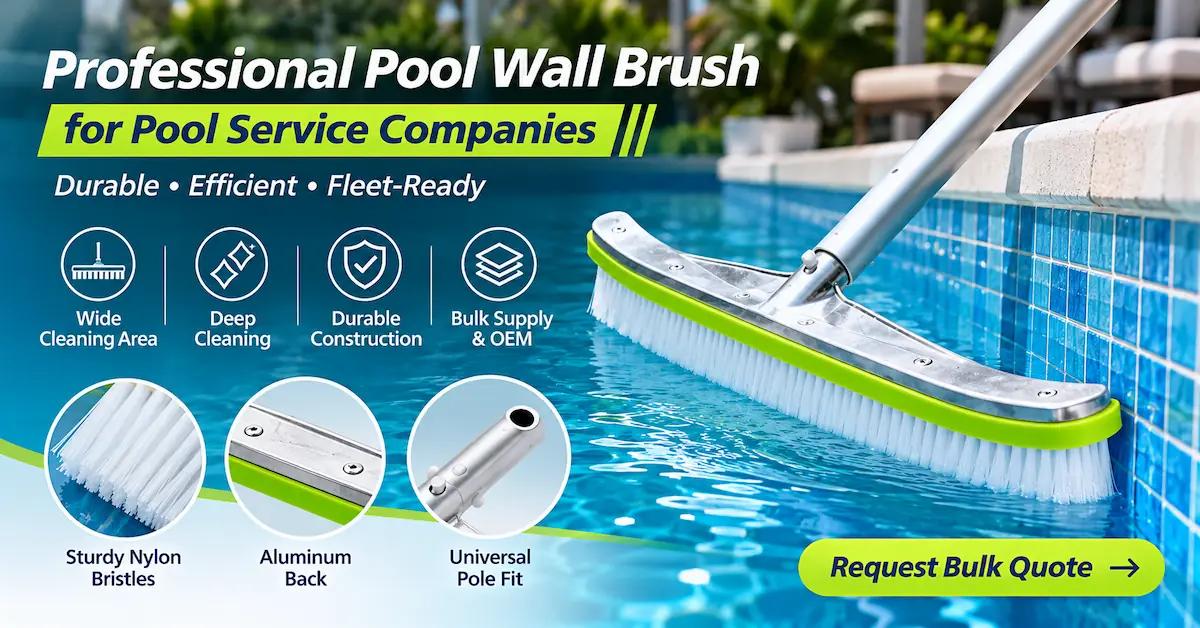
A custom bristle pool wall brush developed for one application should not automatically be marketed as suitable for all vinyl, fiberglass, plaster, or tiled pools.
Surface compatibility requires separate evaluation.
Which Buyers Need Detailed Bristle Specifications?
Detailed specifications are particularly valuable for pool accessory importers, OEM brand owners, distributors managing repeat orders, and quality managers responsible for supplier approval.
They are less necessary for occasional one-off retail purchases.
Procurement recommendation: Request a technical drawing and filament specification before approving the product appearance or packaging.
2. How Do Bristle Planting and Attachment Methods Affect Retention?
Bristle retention depends partly on how filaments are secured to the brush head.
The selected method should be verified with the manufacturer because different products may use different attachment systems.
Staple-Set Tufting
In some brush manufacturing processes, filament bundles are inserted into preformed holes and retained by an anchoring component.
The integrity of the attachment can depend on the tuft construction, hole dimensions, anchor, and backing material.
If these elements are not controlled, retention performance may vary between brushes.
Anchorless or Fusion-Based Attachment
Other brush constructions may use alternative attachment methods.
Depending on the product, these can involve different mechanical or thermal joining principles.
Their performance should be assessed using a method appropriate to the actual construction.
Important: These are general manufacturing approaches. BONNY publicly identifies bristle-planting capabilities, but buyers should confirm the exact attachment method used for each requested model.
Common Bristle Retention Failure Modes
| Failure Mode | Possible Contributing Factor | What Buyers Should Investigate |
|---|---|---|
| Individual filaments detach | Filament damage, inconsistent construction or attachment | Filament integrity and manufacturing conditions |
| Entire tuft pulls out | Insufficient anchoring or unsuitable tuft-hole geometry | Attachment structure and hole consistency |
| Backing cracks around tuft | Weak substrate or excessive localized stress | Material and backing design |
| Tufts become uneven | Inconsistent planting or trimming | Process settings and finished geometry |
| Tufts loosen after repeated use | Combined mechanical wear and attachment problems | Durability under representative use |
| Localized shedding in one area | Process variation or difficult head geometry | Planting consistency across brush locations |
A useful factory audit should distinguish these failure modes.
For example, complete tuft extraction is a different problem from gradual filament wear during normal service.
The corrective actions may also differ.
3. How Should Buyers Audit a Nylon Bristle Pool Brush OEM Manufacturer?
An OEM factory audit should focus on whether the supplier can repeatedly manufacture the approved brush construction.
A modern production facility is valuable, but equipment descriptions alone do not establish retention performance.
Five Factory Qualification Areas
1. Material control
Ask how filament materials, backing components, and approved alternatives are identified.
The supplier should be able to explain how material changes are reviewed.
2. Bristle planting process
Confirm the attachment method, equipment responsibilities, process-setting controls, and inspection points.
3. Testing capability
Ask whether appropriate retention-testing equipment and trained personnel are available.
Where testing is outsourced, confirm the laboratory and procedure.
4. Production traceability
Review how batches, product revisions, inspection records, and production dates are identified.
5. Corrective-action management
Ask how the manufacturer investigates failures and prevents recurrence.
OEM Factory Audit Checklist
| Audit Question | Evidence to Request |
|---|---|
| Is the filament specification controlled? | Material specification and incoming inspection records |
| Is the tuft attachment method documented? | Process description or approved work instruction |
| Are critical dimensions verified? | Relevant measurement records |
| Is the retention test repeatable? | Test procedure and sample report |
| Is testing equipment maintained? | Calibration or verification records |
| Are failed products investigated? | Nonconformance and corrective-action records |
| Are approved samples retained? | Golden sample identification |
| Are component changes controlled? | Revision and approval records |
The ISO 9001:2026 quality management standard provides an authoritative framework for process control, documented requirements, and continual improvement.
However, ISO 9001 is a management-system standard. It does not establish a universal minimum tuft pull-out force for swimming pool brushes.
A supplier's quality-system claims and actual certification status should be verified separately.
4. How Should OEM Buyers Conduct Pool Brush Tuft Retention Tests?
A pool brush tuft retention test evaluates the force required to detach a defined filament bundle or attachment from the brush body under controlled conditions.
Its purpose is to compare the tested construction against an agreed acceptance requirement.
A reliable test must be repeatable.
Step 1: Identify the Test Specimen
Record the model, sample revision, filament specification, and bristle attachment method.
The selected tufts should represent relevant areas of the brush.
These may include central sections, ends, corners, or regions with different tuft orientations.
Step 2: Secure the Brush Head
Use a suitable fixture to hold the brush body without introducing unintended deformation.
The fixture should allow the intended attachment to be evaluated without imposing an unrelated failure mechanism.
Step 3: Grip the Tuft
Grip the specified filament bundle using an appropriate fixture.
The gripping method should avoid cutting, slipping, or unnecessarily damaging the filaments.
The correct method depends on the brush construction.
Step 4: Apply a Controlled Pull
Apply the agreed loading method using suitable force-measuring equipment.
Important variables include pulling direction, loading rate, specimen conditioning, and the number of locations tested.
These must be established before comparing results.
Step 5: Record the Failure
Record the peak force, relevant displacement if measured, and failure mode.
An attachment failure, individual filament breakage, and fixture slip should not be treated as interchangeable outcomes.
Tuft Retention Test Plan
| Test Parameter | Recommended Requirement | Buyer Approval |
|---|---|---|
| Test identification | Product model and revision | Confirm before testing |
| Filament specification | Approved nylon formulation and construction | Required |
| Test locations | Defined positions across the brush | Agree location plan |
| Specimen quantity | Defined for design verification and production checks | Agree sample count |
| Conditioning | Agreed temperature, moisture and preparation | Document |
| Pulling direction | Consistent with the selected attachment geometry | Document |
| Loading rate | Fixed in the approved procedure | Document |
| Gripping method | Suitable for the tuft construction | Validate fixture |
| Force measurement | Appropriate calibrated or verified equipment | Record |
| Acceptance limit | Buyer-approved, design-specific criterion | Set before testing |
| Failure classification | Tuft extraction, filament breakage, substrate failure or invalid test | Record separately |
| Retest procedure | Defined treatment of invalid or failed results | Agree in advance |
Is There a Universal Minimum Pull Force?
There is no justified single pull-force value that should be applied to every pool brush without considering the specific construction and an applicable agreed method.
The buyer and manufacturer should define acceptance criteria using the product design, technical requirements, and suitable validation evidence.
Do not copy force thresholds from unrelated toothbrush standards or other brush categories and describe them as mandatory pool brush requirements.
Example Test Record Template
| Sample ID | Tuft Location | Peak Force (N) | Failure Mode | Acceptance Result |
|---|---|---|---|---|
| Sample A | Center | Record measured value | Record observation | Pass/Fail |
| Sample A | Left end | Record measured value | Record observation | Pass/Fail |
| Sample A | Right end | Record measured value | Record observation | Pass/Fail |
| Sample B | Center | Record measured value | Record observation | Pass/Fail |
| Sample B | Curved section | Record measured value | Record observation | Pass/Fail |
This is a proposed record format, not a BONNY test report.
Actual measured values and pass/fail decisions must come from testing the specified product.
5. Is a Pull Test Enough to Approve an OEM Pool Brush?
No.
A pull test evaluates a particular attachment-related property under defined conditions.
It does not independently prove that the finished brush is suitable for its intended operating environment.
Repeated Brushing Evaluation
A representative durability trial can help evaluate whether bristles become loose, deform, or shed during repeated use.
The test should use appropriate conditions and avoid damaging actual customer pool finishes.
Bristle Geometry and Trim Inspection
A brush may meet an attachment criterion while having unacceptable differences in filament length or arrangement.
These characteristics should be inspected separately.
Pole Connector Verification
The pole connection should be evaluated using approved pole dimensions and the intended locking mechanism.
Packaging Evaluation
Bristles should not be permanently deformed by packaging pressure.
The complete product should remain protected during transportation.
Design Verification Comparison
| Verification | Main Purpose | Can It Replace Pull Testing? |
|---|---|---|
| Tuft retention test | Evaluate attachment strength | No; this is the direct attachment check |
| Repeated brushing trial | Evaluate behavior under repeated use | No |
| Bristle length inspection | Verify geometry | No |
| Surface compatibility review | Evaluate the intended pool finish | No |
| Connector fit test | Verify pole engagement | No |
| Packaging evaluation | Identify transport-related damage | No |
Quality takeaway: OEM sample approval should combine relevant tests rather than rely on a single impressive measurement.
6. How Should Buyers Approve Pre-Production Samples?
A pre-production sample should represent the product that the manufacturer intends to supply in bulk.
The buyer should approve more than its appearance.
Pre-Production Sample Approval Checklist
| Approval Item | Required Evidence | Status |
|---|---|---|
| Product model | Confirmed SKU and revision | Pending approval |
| Bristle material | Agreed specification | Pending approval |
| Bristle construction | Filament length, diameter and tuft layout | Pending approval |
| Attachment method | Confirmed process | Pending approval |
| Retention test | Approved test results | Pending approval |
| Backing structure | Approved material and dimensions | Pending approval |
| Pole connector | Fit-test results | Pending approval |
| Surface suitability | Appropriate application evaluation | Pending approval |
| Packaging | Approved physical pack and artwork | Pending approval |
| Golden sample | Identified retained reference | Pending approval |
| Inspection plan | Agreed criteria and records | Pending approval |
| Commercial configuration | Final product contents and quotation | Pending approval |
Why Does Sample Revision Matter?
Suppose the manufacturer changes the nylon filament diameter after sample approval.
The revised brush may feel different during cleaning and may respond differently during retention or wear testing.
A change to tuft-hole geometry or anchoring components may also influence attachment.
Consequently, material and structural changes should be reviewed before production.
What Is a Golden Sample?
A golden sample is an approved physical reference retained for later comparison.
It should correspond to a controlled specification and identifiable product revision.
The buyer and manufacturer should agree on how the sample is stored, identified, and used during later inspections.
7. How Should Bulk Pool Brush Inspection Be Organized?
After the design is approved, the objective shifts from proving the concept to verifying manufacturing consistency.
Bulk inspection should cover critical materials, assembly features, and finished-product characteristics.
Recommended Production Inspection Matrix
| Inspection Stage | Main Check | Potential Risk |
|---|---|---|
| Incoming filaments | Approved material and dimensions | Material substitution |
| Backing components | Dimensions and hole quality | Weak tuft support |
| Bristle planting | Tuft position and assembly consistency | Retention variation |
| Bristle trimming | Finished length and appearance | Uneven cleaning |
| In-process testing | Approved retention verification | Attachment failures |
| Final assembly | Pole connector and structural integrity | Functional defects |
| Product appearance | Unacceptable damage and defects | Retail rejection |
| Packaging | Bristle protection and labeling | Shipping damage |
| Shipment inspection | Quantity, SKU and agreed attributes | Incorrect or defective shipment |
How Does ISO 2859-1:2026 Apply?
ISO 2859-1:2026 defines acceptance sampling schemes for inspection by attributes.
It can support agreed lot-by-lot inspection of characteristics such as visible defects, dimensions classified against tolerances, labeling, and other defined pass/fail conditions.
The relevant inspection level, AQL, sample selection method, and acceptance rules must be agreed.
The standard does not prescribe a pool brush tuft retention-force threshold.
A quantitative pull-test procedure may require a separate measurement-based sampling or verification plan.
Critical vs Major vs Minor Defects
Defect classification should be determined by the intended product and potential consequences.
An unacceptable safety hazard may be classified as critical.
Failure to meet a specified retention requirement may be major or critical according to the agreed risk assessment.
A minor cosmetic variation may be treated differently if it does not affect function.
The buyer should not leave defect classification unresolved until a shipment fails inspection.
8. Which BONNY Nylon Pool Brushes Can Buyers Evaluate for OEM Projects?
Ningbo Bonny E-Home Co., Ltd. offers swimming pool cleaning brushes and OEM/ODM services for international business customers.
Its official Pool Accessories Catalogue includes wall brushes and specialty cleaning heads.
Representative BONNY Product Options
| BONNY Product | Published Reference | OEM Evaluation Focus |
|---|---|---|
| 360-Degree Round Pool Wall Brush | WB081604 | Nylon bristles, curved tuft layout and retention |
| 20-Inch Wall Brush with Aluminum Handle | T614D / T614 appear on the page | Confirm filament grade, attachment and head construction |
| 18-Inch Deluxe Pool Brush with Aluminum Back | T854A / T854 appear on the page | Confirm bristle specifications, backing and assembly |
| 2-in-1 Pool Wall Cleaning and Suction Brush Head | Nylon bristles stated in product title | Combined brush construction and functional verification |
These are existing catalogue references, not confirmed OEM test results.
360-Degree Nylon Pool Wall Brush
BONNY's published product description identifies a nylon round-head pool brush.
This is a relevant candidate for buyers evaluating tuft patterns and attachment consistency across curved sections.
View BONNY 360-Degree Round Pool Brush
20-Inch Pool Wall Brush
BONNY lists a 20-inch wall brush with an aluminum-handle description.
The product page shows both T614D and T614 references.
Buyers should confirm the current model identification and exact filament material before specifying a nylon-bristle OEM variant.
View BONNY 20-Inch Pool Wall Brush
18-Inch Deluxe Pool Brush
The company's 18-inch deluxe brush listing includes an aluminum-back description and T854A/T854 references.
Buyers should confirm the actual bristle material, structure, and available customization options.
View BONNY 18-Inch Deluxe Pool Brush
Important: The catalogue demonstrates relevant product designs, but it does not establish that every listed variant has identical nylon filaments, tuft attachment methods, or retention-test results.
Those details should be confirmed through the technical enquiry process.
9. What Manufacturing Information Should Buyers Request From BONNY?
BONNY was founded in 1998 and describes manufacturing capabilities including injection molding, bristle planting, and product assembly.
These are relevant to pool cleaning brush production.
The company also supports international OEM and ODM projects.
However, buyers should not assume that every product uses the same production line or attachment technology.
Recommended Factory Approval Questions
Ask BONNY to clarify:
-
Which bristle attachment method is used for the selected brush.
-
Whether the requested nylon grade is available.
-
Which tuft dimensions and attachment parameters are controlled.
-
Whether a model-specific pull-test method can be agreed.
-
How production records and inspection results are maintained.
-
Whether sample changes require renewed approval.
-
Which OEM colors, packaging options, and custom designs are feasible.
-
How expected order volumes and production schedules will be confirmed.
Learn About BONNY Engineering and OEM Services
The purpose is to establish a product-specific supply agreement supported by verifiable documentation.
10. What Affects OEM Nylon Pool Brush Pricing, MOQ and Lead Time?
OEM pricing depends on the approved product design and purchasing requirements.
Major Cost Drivers
| Cost Driver | Commercial Impact |
|---|---|
| Nylon filament specification | Material and construction cost |
| Tuft density | Filament consumption and planting operations |
| Attachment method | Production and verification requirements |
| Brush head dimensions | Material use and packaging |
| Backing material | Structural component cost |
| Custom color or branding | OEM customization |
| Product testing | Sample and production verification |
| Retail packaging | Printing and material requirements |
| Order quantity | Manufacturing and commercial planning |
| Reorder consistency | Inventory and change-control requirements |
Total Landed Cost
A useful procurement model is:
Total landed cost = Product price + Tooling allocation + Customization + Inspection + Packaging + Freight + Insurance + Applicable import charges + Expected replacement costs.
A lower unit price may not deliver better value if the brush requires frequent replacement or generates customer complaints.
However, cost savings must be calculated from actual performance and purchasing data.
MOQ and Lead Time
MOQ and production schedules depend on the selected model, customization requirements, quantity, packaging, and manufacturing arrangements.
Buyers should request a current model-specific quotation.
No universal BONNY MOQ or lead-time commitment should be assumed.
11. OEM Pool Brush RFQ: What Should Importers Send the Factory?
A detailed request for quotation helps the manufacturer understand the intended product and required verification.
Recommended RFQ Checklist
| RFQ Item | Information to Provide |
|---|---|
| Product type | Nylon-bristle wall brush or specialty brush |
| Reference model | Existing BONNY model or customer drawing |
| Intended market | Country and distribution channel |
| Pool application | Relevant pool finishes and cleaning tasks |
| Brush dimensions | Width, head geometry and tolerance |
| Nylon filaments | Requested material and construction |
| Tuft pattern | Density, positions and trim length |
| Retention requirements | Agreed test method and acceptance criteria |
| Pole interface | Socket and locking dimensions |
| OEM requirements | Logo, colors, packaging or structural changes |
| Sample quantity | Required qualification samples |
| Inspection | Pre-production and bulk QC requirements |
| Estimated order | Initial quantity and forecast demand |
| Destination | Country and delivery terms |
| Commercial terms | Price, MOQ and proposed delivery schedule |
Request OEM Nylon Pool Brush Samples and Testing Information
Importers and private-label brands can share their drawings, reference products, bristle specifications, and inspection requirements with BONNY.
The team can review available product designs, customization feasibility, sample arrangements, and commercial terms.
Contact BONNY for Custom Nylon Pool Brush Specifications, Sample Approval and Wholesale Pricing
Frequently Asked Questions About Nylon Bristle Pool Brush OEM Manufacturers
1. How do I qualify a nylon bristle pool brush OEM manufacturer?
Review material control, tuft attachment processes, test procedures, production traceability, sample approval, and defect management. Request evidence relevant to the exact brush design rather than relying only on factory descriptions.
2. What causes nylon pool brush bristles to fall out?
Possible causes include weak tuft anchoring, inconsistent planting conditions, unsuitable backing geometry, material defects, and wear during use. The failure mode should be identified before selecting a corrective action.
3. What is a pool brush tuft retention test?
It is a controlled mechanical test used to evaluate the resistance of a tuft or attachment to removal under defined conditions. The procedure and acceptance criteria must match the product construction.
4. Is there a universal minimum bristle pull force for swimming pool brushes?
No universal value should be assumed without a relevant product-specific requirement. Buyers should agree on a validated method and acceptance limit appropriate to the selected brush.
5. Can a pull test guarantee that pool brush bristles will never shed?
No. A pull test evaluates a defined characteristic under specific conditions. Repeated use, materials, cleaning conditions, and other factors can also affect service performance.
6. What documents should I request before approving OEM production?
Request approved drawings, filament specifications, process information, sample test results, inspection criteria, product identification, and change-control arrangements.
7. Does ISO 2859-1 certify the quality of nylon pool brushes?
No. ISO 2859-1 provides acceptance sampling procedures for inspection by attributes. Using the standard does not mean that the finished product is ISO-certified or meets an unspecified tuft-retention requirement.
8. Can BONNY manufacture custom nylon pool brushes?
BONNY offers pool brush products and OEM/ODM services. Specific nylon grades, attachment methods, custom constructions, and testing requirements should be confirmed for each project.
9. What determines wholesale nylon pool brush MOQ and pricing?
MOQ and pricing depend on product design, filaments, dimensions, customization, packaging, production arrangements, and order quantities. Request current terms for the selected configuration.
10. What should I include in a nylon pool brush OEM quotation request?
Provide the intended application, reference model, filament requirements, tuft construction, retention-testing expectations, expected quantity, destination market, packaging, and approved inspection criteria.
Conclusion
Choosing a reliable nylon bristle pool brush OEM manufacturer requires more than evaluating appearance, catalogue specifications, or wholesale pricing.
For importers, private-label brands, and quality managers, the most important step is establishing whether the factory can manufacture the approved bristle attachment construction consistently.
A structured qualification process should include filament specifications, bristle planting assessment, appropriate tuft-retention testing, complete sample approval, and production inspection requirements.
Pull-test results are useful only when the measurement procedure, acceptance criteria, and failure classifications are clearly defined.
Controlled product revisions and supplier change-management procedures also help reduce uncertainty during repeat orders.
BONNY, operated by Ningbo Bonny E-Home Co., Ltd., supplies swimming pool cleaning brushes and offers OEM/ODM support for international business customers.
Whether you need an existing wall brush, a private-label nylon-bristle design, or a custom brush requiring additional sample verification, BONNY can review your technical requirements and discuss suitable manufacturing options.