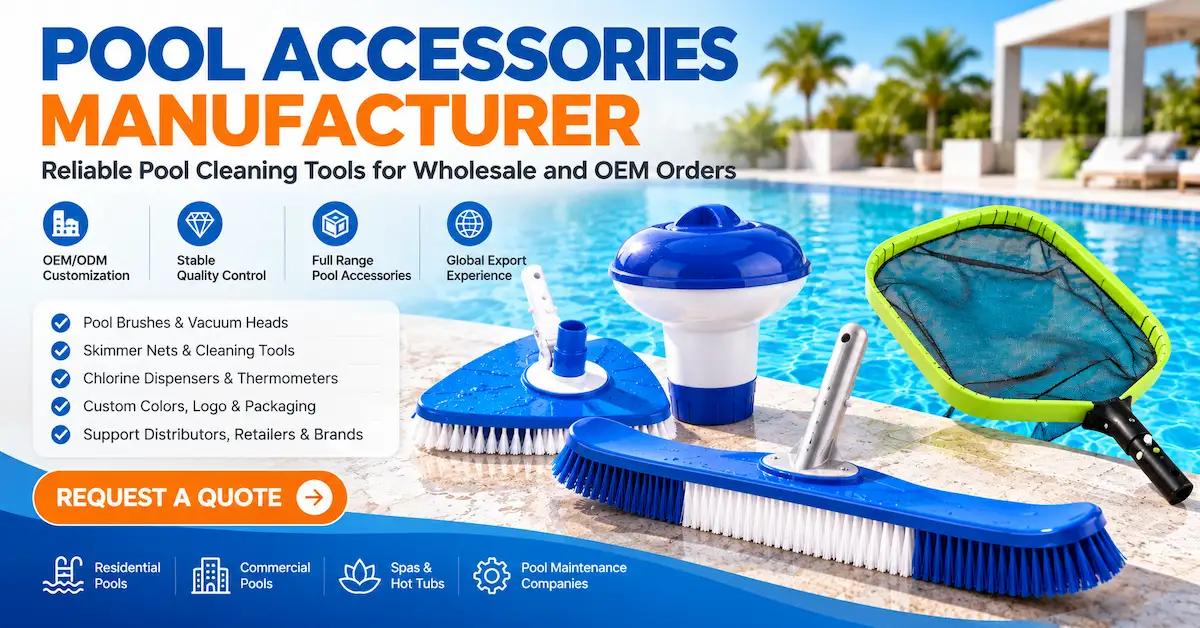

What Should B2B Buyers Look for in a Pool Accessories Manufacturer?
A reliable pool accessories manufacturer should do more than offer a broad catalog and competitive prices. For importers, distributors, and private-label brands, the right manufacturing partner must provide products that fit their target market, consistent production quality, clear customization options, and purchasing terms that support profitable resale.
The difficulty is that two pool cleaning tools can look almost identical in a product photograph while performing differently in actual use. A brush may lose bristles, a skimmer frame may bend under repeated loading, or a vacuum head may not connect properly to the poles and hoses already used by customers.
These issues often become visible only after a shipment reaches the destination market.
A practical sourcing process should therefore examine five areas:
-
Product range and application compatibility.
-
Materials, manufacturing processes, and construction quality.
-
Sample approval and production inspection.
-
OEM/ODM customization and commercial flexibility.
-
Total purchasing cost, delivery planning, and after-sales arrangements.
For buyers developing wholesale or private-label product lines, these criteria provide a stronger foundation than supplier price comparisons alone.
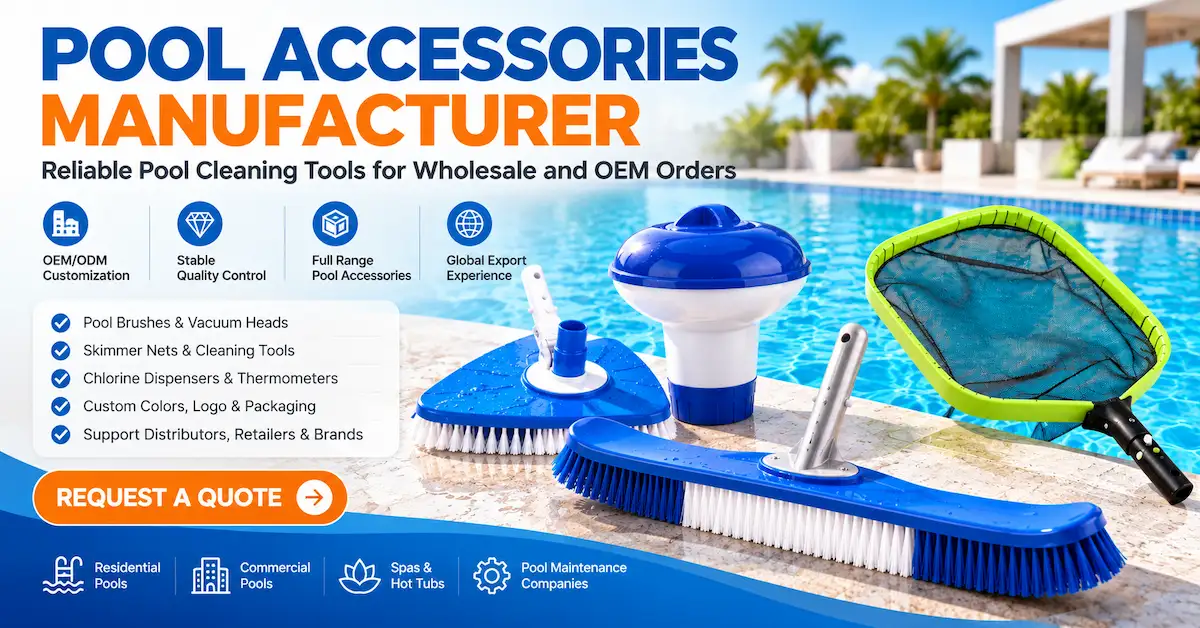
1. Identify the Pool Accessories Your Customers Actually Need
Before comparing manufacturers, decide which product categories will generate demand in your distribution channel.
A swimming pool equipment importer serving residential retailers may prioritize lightweight brushes, skimmer nets, and thermometers. A commercial maintenance distributor may need different vacuum head configurations, stronger tool connections, and products suitable for frequent use.
Buying across several categories makes sense when the products serve a clearly defined customer group. However, purchasing unrelated items simply to expand a catalog can increase inventory complexity without improving sales.
Core Pool Accessories for Wholesale Buyers
| Product category | Typical applications | Important purchasing considerations |
|---|---|---|
| Pool wall brushes | Cleaning walls, floors, steps, and waterlines | Brush width, bristle material, backing construction, surface compatibility |
| Pool vacuum heads | Removing settled debris from pool floors | Shape, hose connection, pole fitting, bottom contact, material |
| Pool skimmer nets | Collecting leaves, insects, and floating debris | Mesh size, frame strength, net depth, connection security |
| Pool thermometers | Monitoring swimming pool and spa water temperature | Reading range, accuracy, display, water resistance |
| Floating chlorine dispensers | Holding compatible pool treatment tablets | Material, tablet compatibility, capacity, adjustment mechanism |
| Pool cleaning kits | Residential retail and professional maintenance | Component compatibility, packaging, replacement availability |
Bonnywin's pool accessories collection includes wall brushes, vacuum cleaning heads, skimmer nets, and other pool maintenance products.
For an importer building an initial wholesale assortment, brushes, vacuum heads, and skimmer nets are practical categories to evaluate together. Customers frequently use these tools during the same maintenance routine, creating opportunities for complementary sales.
Which Products Deserve Priority?
The answer depends on the buyer's sales channel.
Pool retail distributors may prioritize products that are easy to display, explain, and replenish.
Pool service companies are more likely to examine durability, connection compatibility, cleaning coverage, and replacement frequency.
Private-label brands should consider whether a product offers meaningful differentiation through materials, design, packaging, or application-specific features.
The best starting assortment is not necessarily the largest. It is the range that matches a known customer requirement and can be supplied consistently.
2. Match Pool Accessories to Different Applications
One of the most common sourcing mistakes is assuming that a single accessory configuration will work equally well in every swimming pool.
Pool surface materials, water treatment methods, maintenance frequency, and debris conditions all affect product selection.
Pool Surface and Application Comparison
| Pool application | Recommended sourcing considerations | Potential problem to avoid |
|---|---|---|
| Vinyl liner pools | Soft-contact cleaning tools and smooth edges | Scratching or damaging the liner |
| Fiberglass pools | Non-abrasive brushes and suitable vacuum heads | Surface marks from inappropriate bristles |
| Concrete or plaster pools | Brush stiffness matched to the finish and maintenance task | Ineffective cleaning or excessive surface abrasion |
| Above-ground pools | Lightweight tools and compatible fittings | Unstable connections or unsuitable vacuum heads |
| Commercial pools | Durable construction and easy maintenance | Frequent replacement and operational interruptions |
| Spas and hot tubs | Compact designs and suitable temperature resistance | Poor access to corners or material deterioration |
These are general selection principles. Actual compatibility should be verified against the pool finish manufacturer's recommendations and the specific tool's construction.
Example: Choosing a Vacuum Head
A rigid vacuum head may be appropriate for some flat pool floors, while a flexible triangular design can be useful when cleaning corners and more difficult-to-reach areas.
Bonnywin lists a flexible triangular pool vacuum head designed for manual pool cleaning applications.
Before purchasing, buyers should confirm the head's dimensions, hose connection size, pole attachment, contact surfaces, and intended pool finish.
A label such as "universal" should not replace actual dimensional verification.
For commercial procurement, it may be useful to request two or three compatible models rather than selecting one design for every customer.
3. Evaluate Materials Before Comparing Unit Prices
Material selection influences the durability, weight, appearance, and manufacturing cost of swimming pool accessories.
For a wholesale buyer, understanding basic material differences is important because the cheapest formulation may not provide the best long-term value.
Common Materials Used in Pool Cleaning Accessories
| Material | Common applications | Important evaluation points |
|---|---|---|
| Polypropylene (PP) | Molded bodies, dispensers, selected cleaning components | Stiffness, impact resistance, chemical compatibility |
| ABS plastic | Selected housings and structural components | Impact performance, surface finish, weathering resistance |
| Nylon | Brush bristles and some net materials | Wear behavior, flexibility, bristle retention |
| Aluminum | Brush backings, frames, and selected structural parts | Weight, corrosion behavior, rigidity |
| Stainless steel | Selected hardware and metal components | Material grade, corrosion resistance, suitability for pool chemistry |
Materials should not be judged solely by their generic names.
Two polypropylene components, for example, may perform differently because of resin grade, wall thickness, molding conditions, geometry, and additives.
Similarly, nylon bristles differ in diameter, stiffness, density, and attachment methods.
Why Bristle Construction Matters
A pool brush may have an attractive aluminum backing and a comfortable pole connector, but poor bristle retention can shorten its useful life.
When evaluating a brush manufacturer, buyers should consider:
-
Bristle material and diameter.
-
Bristle arrangement and working width.
-
Retention strength under repeated use.
-
Backing construction and edge finishing.
-
Connection strength between the brush and pole.
-
Compatibility with the intended pool surface.
Bonnywin offers a 20-inch pool wall brush with an aluminum handle, providing a relevant product reference for evaluating larger cleaning brushes.
For OEM orders, the approved sample should establish the required appearance, dimensions, and functional characteristics. A production batch should then be checked against those agreed requirements.
4. Examine Manufacturing Processes and Technical Capabilities
A professional pool accessories manufacturer should be able to explain how its manufacturing processes affect the finished product.
For molded cleaning accessories, production quality depends on more than machine capacity. Mold design, material control, process stability, component assembly, and inspection all contribute to product consistency.
Injection Molding
Injection molding is commonly used to produce plastic components for pool cleaning tools.
Important variables include material selection, molding temperature, cooling behavior, wall thickness, and mold maintenance.
Inconsistent processing may contribute to visible defects, dimensional variations, warping, or weak areas.
Buyers should request representative samples and review critical dimensions where different components need to fit together.
Bristle Planting
Bristle planting is relevant to many pool brush constructions.
For wholesale procurement, bristle retention and consistent distribution are particularly important. Uneven planting may affect cleaning performance, while insufficient retention can lead to premature bristle loss.
Testing expectations should be agreed upon before production rather than introduced after a quality dispute.
Other Manufacturing Capabilities
Depending on the product design, manufacturing may also involve extrusion, blow molding, component assembly, and finishing operations.
According to its company profile, Ningbo Bonny E-Home Co., Ltd. was established in 1998 and identifies injection molding, bristle planting, blow molding, and extrusion among its manufacturing capabilities. The company also describes OEM/ODM development and in-house research activities.
For buyers evaluating Bonnywin, these capabilities provide a useful starting point for technical discussions. The manufacturing route, tooling arrangement, and available customization options should still be confirmed for each selected product.
5. Build a Quality Control Checklist Before Placing Bulk Orders
A supplier's statement that products are "high quality" does not tell a purchasing manager how to verify consistency.
A more useful approach is to create an inspection checklist linked to the approved product specification.
Quality control should address incoming materials, manufacturing, final assembly, packaging, and shipment preparation.
Recommended Pool Accessories QC Checklist
| Inspection area | What buyers should check | Why it matters |
|---|---|---|
| Material identification | Approved resin, metal, bristle, or mesh specification | Reduces unintended material changes |
| Critical dimensions | Brush width, fitting diameter, vacuum head connections | Supports product compatibility |
| Appearance | Flash, sharp edges, discoloration, visible defects | Reduces retail complaints |
| Assembly integrity | Loose fittings, poorly seated parts, unstable connections | Reduces functional failures |
| Bristle attachment | Retention and consistency against agreed criteria | Helps prevent premature brush failure |
| Net construction | Mesh attachment, seams, frame connection | Reduces tearing and separation |
| Functional testing | Product-specific use and operation checks | Confirms intended functionality |
| Packaging | Label accuracy, quantities, carton integrity | Reduces logistics and receiving problems |
This checklist is a recommended procurement framework, not a claim that every listed test is currently performed on every Bonnywin product.
Sample Approval Before Production
An effective sampling process should establish measurable requirements.
For example, a pool skimmer net sample review can include frame dimensions, net depth, mesh material, pole connection, appearance, and packaging.
Bonnywin lists a 17-inch nylon shallow-mesh pool skimmer net, which illustrates the type of product whose construction details should be documented before bulk production.
If possible, retain an approved physical sample along with a signed specification.
For repeat orders, this reference can help both parties identify changes in materials, construction, or appearance.
Certifications and Compliance
Manufacturers may provide factory audit reports, management system certificates, material declarations, or product-specific test reports.
These documents have different purposes.
A factory social compliance audit is not the same as a product safety certificate. Likewise, a general quality management system does not establish that every product meets the legal requirements of a particular destination market.
Importers should identify the applicable requirements for their product category and destination country, then request current documents showing the correct company, product scope, and relevant test or audit information.
Avoid assuming that every manual cleaning accessory requires the same compliance documentation as an electrical pool cleaner.
6. Evaluate OEM and Private-Label Customization
For importers and brand owners, OEM services can provide a way to build a differentiated product assortment rather than selling identical generic accessories.
However, customization should begin with a commercial objective.
Changing a product's color is useful only if the new appearance supports the brand's positioning or retail requirements.
Common OEM Customization Requirements
| Customization area | Buyer requirement | Items to confirm |
|---|---|---|
| Product color | Brand-matched appearance | Color reference, sample approval |
| Logo and branding | Private-label identity | Logo method, position, artwork |
| Packaging | Retail or e-commerce presentation | Packaging structure, dimensions, labeling |
| Product specifications | Selected dimensions or component configuration | Technical feasibility, tooling needs |
| Product assortment | Coordinated cleaning tool range | Model compatibility and order quantities |
| Carton markings | Warehouse and import identification | Barcodes, carton labels, destination requirements |
Bonnywin publicly describes OEM/ODM manufacturing support. Buyers interested in custom pool accessories can discuss their requirements through the company's contact page.
The precise customization scope must be confirmed for each product and order.
OEM Development Process
A practical private-label development project can follow this sequence:
Requirement brief → Technical review → Quotation → Sample production → Sample approval → Bulk manufacturing → Inspection → Shipment
This is a recommended workflow. Individual projects may require additional tooling development, packaging approvals, compliance testing, or sample revisions.
For modified or newly developed products, the purchasing agreement should clarify tooling ownership, design confidentiality, revision control, and responsibilities if specifications change.
These commercial details are particularly important when a brand intends to reorder the same product over multiple seasons.
7. Understand MOQ, Lead Time, and Order Planning
MOQ is one of the first questions importers ask a pool cleaning tools supplier.
However, minimum order quantities are not always identical across product categories.
A standard accessory made with existing tooling may have different order requirements from a newly developed item requiring custom materials or packaging.
For example, Bonnywin's published listing for its T53 floating chlorine dispenser provides the following reference details:
| Product information | Published listing |
|---|---|
| Model | T53 |
| Product | Floating chlorine dispenser |
| Material | PP |
| Diameter | 9 inches |
| MOQ | 504 pieces |
| Packing | 24 pieces per carton |
| Listed delivery time | 24–35 days |
These are model-specific published figures, not guaranteed current terms for all orders. Buyers should reconfirm availability, packaging, price, MOQ, and production schedules when requesting a quotation.
Planning Seasonal Purchases
Pool accessories often experience seasonal demand.
An importer preparing for peak sales should allow time for sample approval, production, export handling, transportation, customs processing, and local distribution.
It is useful to work backward from the required warehouse arrival date instead of focusing only on factory production time.
When negotiating with a pool accessories manufacturer, ask for separate estimates covering sampling, customization, production, and shipment readiness.
This creates a more realistic purchasing schedule and reduces the risk of receiving seasonal inventory too late.
8. Compare Total Landed Cost Instead of Factory Price Alone
The cheapest quoted product is not necessarily the most economical product to sell.
Consider two vacuum heads with similar dimensions. One has a slightly lower unit price but requires a larger carton, experiences more connection problems, or generates more returns.
The initial price advantage may disappear after freight and after-sales expenses are included.
A Practical Landed Cost Model
Landed Cost per Unit = Product Cost + Allocated Freight + Customs Duties + Import Fees + Other Applicable Logistics Costs
A broader commercial evaluation should also consider expected warranty expenses, damaged goods, warehouse handling, and inventory carrying costs.
| Cost factor | What to compare |
|---|---|
| Ex-factory product price | Price per model and quantity tier |
| Tooling or development charges | One-time and recurring costs |
| Retail packaging | Materials, printing, and assembly |
| Master cartons | Carton dimensions, protection, packing quantity |
| Freight | Shipment volume, weight, and shipping terms |
| Import costs | Duties, clearance, local handling |
| Quality-related expenses | Inspection, returns, replacements |
| Inventory costs | Seasonal storage and slow-moving stock |
For lightweight but bulky products such as certain skimmer nets and cleaning tools, carton volume can have a meaningful impact on shipping economics.
Request the packed dimensions and gross weight rather than relying solely on product weight.
A small packaging improvement may be valuable when multiplied across a large shipment, provided it does not compromise protection.
9. Evaluate Whether a Manufacturer Fits Your Distribution Model
Not every supplier is suitable for every buyer.
A high-volume importer may value consistent production, consolidated shipments, and stable specifications.
A growing private-label brand may place greater importance on sampling support, packaging flexibility, and manageable initial order quantities.
A professional pool maintenance distributor may prioritize functional compatibility and repeat availability.
Supplier Evaluation Matrix
The following scorecard is a suggested internal purchasing tool.
| Evaluation category | Suggested weight | What to investigate |
|---|---|---|
| Product range and compatibility | 20% | Availability of required models and specifications |
| Quality evidence | 25% | Samples, inspection criteria, documentation |
| OEM/ODM support | 15% | Customization feasibility and development process |
| Commercial terms | 15% | MOQ, pricing structure, payment terms |
| Delivery and logistics | 15% | Production planning, packing, export handling |
| Communication and support | 10% | Technical responses, issue handling, documentation |
Score each supplier using the same evidence standards.
A supplier should not receive a high quality score simply because its marketing materials contain certification logos. The relevant documentation and actual product samples should support the assessment.
This approach helps procurement teams compare offers consistently and explain supplier decisions internally.
10. Prepare a Better RFQ for Pool Accessories
A clear RFQ, or Request for Quotation, helps suppliers provide more accurate proposals and reduces repeated communication.
Instead of sending a message that simply asks for the best wholesale price, provide sufficient technical and commercial information.
Pool Accessories RFQ Checklist
| RFQ field | Information to provide |
|---|---|
| Product category | Brush, vacuum head, skimmer net, thermometer, dispenser |
| Model or reference | Existing product number or reference image |
| Technical specifications | Dimensions, materials, fitting sizes |
| Application | Residential, commercial, spa, pool surface type |
| Estimated quantity | Initial order and expected reorder volume |
| Branding | Logo, colors, labels, packaging |
| Quality requirements | Inspection criteria, sample approval, applicable documents |
| Packaging requirements | Retail unit, inner box, export carton |
| Destination market | Country and relevant compliance requirements |
| Delivery requirements | Target shipment date and Incoterm |
| Quotation details | Unit price, MOQ, tooling, samples, payment terms |
Where possible, attach drawings, product photographs, packaging references, and an existing sample specification.
The more complete the requirements, the easier it becomes to distinguish genuine price differences from quotations based on different product constructions.
Planning a wholesale or private-label pool cleaning accessories order? You can contact Bonnywin to discuss product selection, OEM requirements, and bulk quotations.
11. Why Consider Bonnywin for Pool Accessories Sourcing?
Ningbo Bonny E-Home Co., Ltd. focuses on the development and manufacture of swimming pool cleaning equipment and accessories for international customers.
Its publicly described capabilities include OEM/ODM development and manufacturing processes such as injection molding and bristle planting.
The Bonnywin product collection gives buyers a starting point for exploring different product categories and selecting specific items for technical review.
For importers and distributors, potential areas of cooperation include:
-
Selecting existing pool cleaning accessories for wholesale distribution.
-
Reviewing product specifications and compatibility requirements.
-
Discussing private-label branding and packaging.
-
Evaluating samples before quantity commitments.
-
Planning orders according to destination markets and shipping requirements.
Rather than assuming that every product can be supplied under identical conditions, buyers should send their intended models, quantities, target market, and customization requirements for confirmation.
This allows both parties to assess whether the proposed manufacturing arrangement fits the purchasing program.
12. Frequently Asked Questions
How do I choose a reliable pool accessories manufacturer?
Start by checking whether the supplier has products matching your target market. Review materials, dimensions, samples, quality documents, OEM capabilities, and commercial terms. Compare suppliers against the same written specification rather than judging them only by unit price.
What pool accessories are suitable for wholesale distribution?
Pool brushes, vacuum heads, skimmer nets, thermometers, and compatible maintenance accessories are useful categories to evaluate. The strongest assortment depends on your customer group, local pool types, seasonal demand, and existing distribution channels.
Can I order private-label pool cleaning accessories?
Private-label arrangements may include branding, packaging, colors, and selected product changes. The options depend on the manufacturer, production method, model, and order volume. Request written confirmation of tooling, artwork, samples, and MOQ before proceeding.
What is the minimum order quantity for pool accessories?
MOQ varies by product, construction, customization, and supplier. Bonnywin's published product listings show different quantity requirements for particular models. For accurate planning, request the current MOQ for every SKU included in your quotation.
What should buyers inspect before approving a bulk order?
Check materials, critical dimensions, connection compatibility, appearance, assembly quality, and packaging. Functional checks should reflect the specific product, such as bristle retention for brushes or mesh attachment for skimmer nets. Establish written acceptance criteria before production.
Is it better to buy several accessories from one supplier?
Consolidated sourcing can simplify communication, shipping coordination, and purchasing administration. However, it is beneficial only when the supplier can meet the technical and quality requirements for each category. Product-level evaluation remains necessary.
How can importers reduce quality disputes?
Use approved samples, agreed specifications, clear packaging requirements, documented inspection criteria, and written procedures for handling nonconforming products. Confirm which party is responsible for testing, inspection, replacement, and additional logistics costs before placing the order.
What information should I send when requesting an OEM quotation?
Provide the product type, preferred specifications, reference model or drawings, planned order quantity, target market, branding details, packaging expectations, and delivery requirements. Clear information allows the manufacturer to review feasibility and prepare a more useful quotation.
Conclusion
Choosing a pool accessories manufacturer requires more than finding a competitive unit price. Successful B2B sourcing depends on product compatibility, appropriate materials, reliable manufacturing, documented quality expectations, and commercial terms that fit the buyer's distribution model.
For importers, wholesalers, and private-label brands, the most effective approach is to shortlist relevant products, approve samples, confirm OEM requirements, and calculate the full purchasing cost before committing to bulk production.
Bonnywin provides a range of pool cleaning accessories and supports discussions around OEM/ODM manufacturing and international supply.
Ready to develop your next pool accessories order? Explore Bonnywin's pool accessories or contact the team to request product information and a customized quotation.