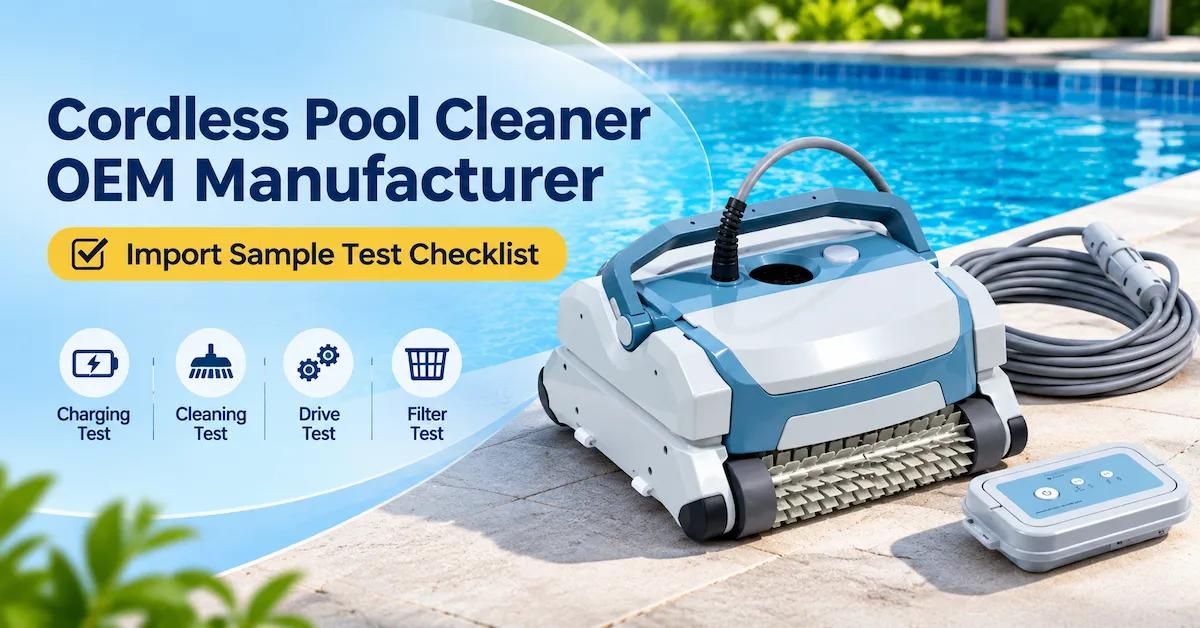

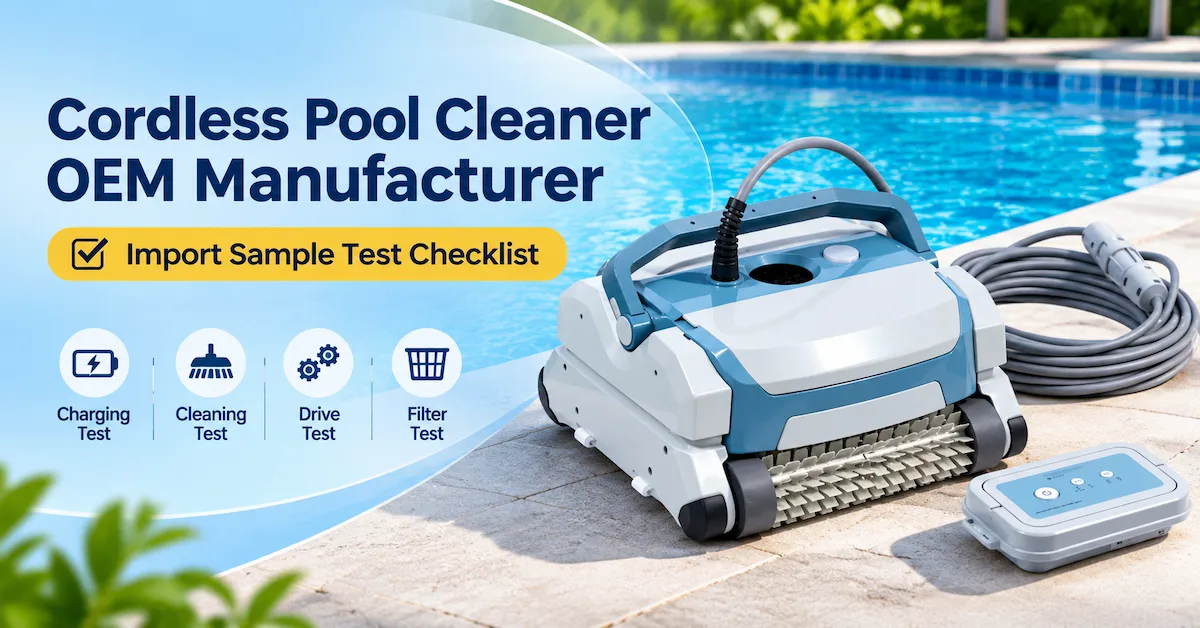
Quick Answer: A reliable cordless pool cleaner OEM manufacturer should provide model-specific specifications, representative samples, charging information, functional test procedures, and appropriate supporting documents. Before approving bulk production, importers should evaluate charging, runtime, drive behavior, debris collection, filter assembly, retrieval, and product identification. Sample approval should be followed by production-representative validation, controlled component revisions, and documented shipment acceptance requirements.
For pool equipment importers and private-label brands, sourcing cordless robotic pool cleaners introduces purchasing risks that differ from those associated with manual cleaning accessories.
A robot may operate satisfactorily during a short demonstration but develop problems during repeated charging, extended cleaning, obstacle encounters, or filter maintenance.
A visually attractive sample may also contain different components from the intended production version.
If these differences are not identified before bulk manufacturing, distributors may experience product returns, customer complaints, warranty expenses, and inventory replacement costs.
The objective of an OEM sample approval program is therefore to establish whether the selected cleaner meets agreed technical and commercial requirements before committing to production.
This guide focuses on functional sample testing, engineering records, production approval, and import purchasing decisions for cordless pool robots.
Key Takeaways for OEM Pool Robot Buyers
-
Approve the actual product configuration. Identify the robot model, battery pack, charger, drive system, filtration components, and firmware revision where applicable.
-
Separate cleaning performance from runtime. A longer operating period does not necessarily establish better debris collection or surface coverage.
-
Test the complete charging system. Verify charger compatibility, charging behavior, indicators, and relevant documentation.
-
Evaluate drive and filtration separately. Movement across the pool does not prove effective debris collection.
-
Use production-representative samples. Development prototypes may differ from mass-produced units.
-
Separate functional testing from regulatory compliance. Internal sample tests do not replace applicable product safety assessments.
-
Control repeat production. Battery, motor, charger, sealing, and firmware changes should receive appropriate technical review.
1. What Should Buyers Expect From a Cordless Pool Cleaner OEM Manufacturer?
A professional OEM supplier should support a purchasing process based on approved product specifications rather than catalogue descriptions alone.
For cordless pool cleaners, the importer needs to understand the complete electrical, mechanical, and cleaning system.
OEM Product Qualification Requirements
| Evaluation Area | Information to Request | Purchasing Risk |
|---|---|---|
| Product platform | Model, intended application and revision | Incorrect product selection |
| Battery system | Pack identification, chemistry, capacity and rated voltage | Inconsistent energy supply |
| Charger | Input, output, connector and market-specific plug | Charging incompatibility |
| Drive system | Motor and movement configuration | Poor movement or mechanical failure |
| Cleaning system | Intended surfaces and debris types | Unsupported performance claims |
| Filter assembly | Filter construction and collection method | Debris escape or poor maintenance |
| Housing | Materials, joints and sealing structure | Water ingress or structural damage |
| Control system | Operating modes and firmware, where applicable | Inconsistent behavior |
| Documentation | Instructions, test evidence and applicable market documents | Import and product compliance risks |
| OEM services | Branding, packaging and technical customization | Uncontrolled product changes |
Which Buyers Need This Qualification Process?
This approach is particularly relevant to pool robot brand owners, international importers, OEM purchasing teams, retail category managers, and quality engineers responsible for approving electronic pool cleaning equipment.
It is less relevant to individual consumers purchasing a single robot for household use.
Procurement recommendation: Request a complete model specification and sample identification record before beginning functional testing.
2. Which BONNY Cordless Pool Cleaners Should OEM Buyers Evaluate?
BONNY, operated by Ningbo Bonny E-Home Co., Ltd., develops and manufactures swimming pool cleaning equipment and accessories in Ningbo, China.
Its official robotic pool cleaner catalogue includes several product platforms that importers can evaluate for different applications.
BONNY Cordless Pool Cleaner Model Comparison
| Model | Published Product Positioning | Recommended Sample Evaluation |
|---|---|---|
| BN1020 | Cordless underwater cleaning robot | Runtime, drive operation and debris collection |
| BN-WS004 | Cordless pool surface cleaning robot | Surface movement, floating debris collection and recovery |
| BN-WS002 | Cordless underwater cleaning robot | Steering, obstacle response and cleaning behavior |
| BN0019 | Cordless automatic pool cleaning robot | Charger configuration, pool compatibility and cleaning operation |
These descriptions reflect BONNY's published product positioning. Actual performance and current product specifications should be confirmed through model-specific documentation and representative samples.
BN1020 — Cordless Underwater Cleaning Robot
The BN1020 provides a starting point for importers evaluating an underwater cleaning platform.
Buyers should request its current battery specification, approved operating conditions, cleaning functions, charging requirements, and relevant test records.
View BONNY BN1020 Cordless Pool Cleaning Robot
BN-WS004 — Cordless Pool Surface Cleaner
This model is presented as a swimming pool surface cleaner.
Its sample evaluation should focus on surface navigation, floating debris collection, filter or collection-container operation, and retrieval.
Surface-cleaning performance should not be treated as proof of floor or wall-cleaning capability.
View BONNY BN-WS004 Cordless Pool Surface Cleaner
BN-WS002 — Cordless Underwater Pool Robot
The BN-WS002 product description includes movement and steering features, modular construction, and end-of-cycle behavior.
Buyers should evaluate these functions against the approved model specification instead of relying solely on promotional descriptions.
View BONNY BN-WS002 Cordless Pool Robot
BN0019 — Cordless Automatic Pool Cleaner
The BN0019 listing identifies several regional plug configurations and potential swimming pool applications.
OEM importers should confirm the exact charging system supplied for their destination market and validate the intended pool compatibility.
View BONNY BN0019 Automatic Pool Cleaner
3. What Should Importers Verify Before Starting OEM Sample Tests?
A sample test is only meaningful when the tested product can be identified accurately.
Before operating the cleaner, create a sample configuration record.
OEM Sample Identification Checklist
| Record Item | Required Information |
|---|---|
| Product model | Confirmed manufacturer model |
| Sample ID | Unique identification number |
| Hardware revision | Approved configuration |
| Battery pack | Model, specification and supplier reference |
| Charger | Model, ratings and connector |
| Drive assembly | Identifiable component configuration |
| Filter assembly | Filter type and revision |
| Firmware | Version, where applicable |
| Intended pool application | Approved surfaces and operating conditions |
| Packaging | Sample packaging version |
| Product instructions | Approved document revision |
Why Battery Capacity Alone Is Insufficient
Battery capacity expressed in milliamp-hours does not independently establish useful runtime.
Battery voltage, available energy, motor consumption, control behavior, and operating conditions also influence performance.
Buyers should request the battery pack's rated voltage and energy specification where relevant.
Development Sample vs Production Sample
A development sample may be assembled using prototype components.
A production-representative sample should reflect the intended manufacturing configuration, materials, components, and processes.
If important components change after testing, the original results may no longer represent the final product.
4. How Should Buyers Test the Charging System?
Charging performance is one of the first functional checks for cordless pool cleaning equipment.
The test should evaluate the approved robot and charger as a matched system.
Charging Test Requirements
| Test Item | Verification Method | Acceptance Principle |
|---|---|---|
| Charger identification | Compare model and rating labels | Matches approved specification |
| Plug configuration | Check destination-market version | Correct supplied configuration |
| Charging connector | Inspect fit and condition | Connects as intended |
| Charging initiation | Observe normal charging operation | Starts according to instructions |
| Charging indicator | Observe display or indicator behavior | Matches documented behavior |
| Charging duration | Record actual charging time | Meets agreed requirement |
| Charging completion | Verify normal completion indication | Matches approved specification |
| External condition | Observe damage or abnormal behavior | No unacceptable abnormalities |
Important Charging Safety Conditions
Charging should take place in the dry location and environmental conditions specified by the manufacturer.
Use only the approved charger.
Do not charge a damaged, leaking, swollen, unusually hot, or potentially water-compromised unit. Stop the evaluation and arrange appropriate technical assessment if abnormal conditions arise.
Buyers should not open battery packs, bypass protective circuits, or deliberately create electrical faults during routine sample inspections.
Battery abuse tests and electrical safety evaluations require suitable laboratory procedures and competent personnel.
5. How Should Buyers Evaluate Drive Performance and Navigation?
A cordless pool robot must move appropriately within its intended operating environment.
Different platforms may use different drive mechanisms, steering methods, and operating logic.
The evaluation should reflect the selected product rather than assume every robot supports the same functions.
Drive System Functional Test Matrix
| Test Area | Suggested Evaluation | Acceptance Requirement |
|---|---|---|
| Start-up | Observe normal operation in the approved environment | Starts as specified |
| Forward movement | Record movement across the intended surface | Meets agreed behavior |
| Direction changes | Observe turning or reversing | Operates as documented |
| Obstacle response | Use approved representative obstacles | Responds within agreed requirements |
| Surface transitions | Evaluate only supported surfaces | No unacceptable malfunction |
| Drive stability | Observe repeated normal operation | Consistent functional behavior |
| Cycle completion | Check end-of-cycle response | Matches instructions |
| Retrieval | Evaluate approved removal method | Can be retrieved as intended |
How Should Navigation Claims Be Verified?
If a product is advertised with obstacle detection, automatic steering, parking, or other navigation features, the sample test should identify the exact behavior expected.
Record the test pool geometry, operating mode, relevant obstacles, and observed result.
A small number of successful movements should not be interpreted as proof of complete pool coverage.
Wall climbing, waterline cleaning, and step navigation should only be tested and marketed where the specific model supports those functions.
6. How Can Importers Test Cleaning Performance and Runtime?
Cleaning performance should be evaluated under documented and reasonably repeatable conditions.
A cleaner that operates for an extended period may still leave significant debris behind.
Runtime and cleaning effectiveness should therefore be recorded separately.
Recommended Cleaning Test Conditions
| Test Variable | Information to Record |
|---|---|
| Pool type | In-ground, above-ground or defined test environment |
| Cleaning zone | Water surface, floor or other supported area |
| Pool dimensions | Relevant test geometry |
| Surface material | Approved pool finish |
| Water conditions | Temperature and other relevant conditions |
| Debris type | Approved representative leaves, particles or other material |
| Debris quantity | Recorded starting quantity |
| Operating mode | Selected model setting |
| Starting battery condition | Defined charge status |
| Filter condition | Clean or specified starting condition |
| Operating duration | Actual observed time |
| End condition | Normal completion, low battery or other reason |
Measuring Debris Collection
A practical controlled test may introduce a known quantity of suitable debris into a defined test area.
After the cleaner completes the agreed test procedure, the collected and remaining material can be evaluated using an appropriate consistent measurement method.
Where reliable comparable mass measurements are possible:
Debris collection rate = Collected debris mass ÷ Initial debris mass × 100%
The measurement basis must account for moisture, debris lost outside the test area, and other factors affecting comparability.
This is a proposed testing metric, not a published BONNY performance result.
Measuring Runtime
Record the operating duration from the defined starting condition until the specified normal termination point.
The report should identify the operating mode, pool conditions, filter loading, and reason for termination.
Do not treat advertised runtime as a guaranteed result under every operating condition.
Testing Boundaries
Wet-operation tests should be performed without swimmers in the test pool and according to approved operating instructions.
Do not intentionally obstruct moving components or operate the cleaner outside its permitted conditions.
7. What Filter Box and Debris Collection Tests Should Buyers Perform?
The filter assembly directly affects debris retention and routine maintenance.
A robot can move correctly while still failing to retain collected debris or allowing undesirable bypass around its filter assembly.
Filter Assembly Inspection Matrix
| Test Item | Suggested Verification |
|---|---|
| Filter identification | Confirm approved type and specification |
| Installation | Check correct seating and orientation |
| Filter cover or latch | Verify intended engagement |
| Collection container | Inspect construction and condition |
| Debris retention | Evaluate using approved debris samples |
| Filter bypass | Assess according to the actual design |
| Removal | Confirm intended user access |
| Cleaning | Follow approved maintenance instructions |
| Reinstallation | Check correct assembly after maintenance |
| Repeated operation | Evaluate relevant wear and damage |
Why Filter Precision Requires Supporting Evidence
A numerical filtration claim should be supported by a defined test method and relevant evidence.
A mesh opening specification, nominal filtration rating, and measured particle-retention performance are not necessarily equivalent.
Before publishing micron-rating claims, importers should confirm the actual filter specification and supporting documentation.
Filter Maintenance and After-Sales Value
Buyers should also determine whether filter assemblies can be cleaned, replaced, or purchased separately.
Replacement filter availability and compatibility should be confirmed with the manufacturer rather than assumed from the product design.
8. Cordless Pool Cleaner OEM Sample Test Matrix
The following matrix provides a practical framework for import quality managers evaluating production candidates.
| Test ID | Functional Area | Test Focus | Required Record |
|---|---|---|---|
| CH-01 | Charging | Charger and connector compatibility | Model and inspection result |
| CH-02 | Charging | Charging initiation and completion | Indicator behavior and time |
| BT-01 | Battery | Normal operating duration | Measured runtime and conditions |
| DR-01 | Drive | Start-up and movement | Functional result |
| DR-02 | Drive | Turning and obstacle response | Observations and test video |
| CL-01 | Cleaning | Intended cleaning zone | Coverage observations |
| CL-02 | Cleaning | Representative debris collection | Starting and collected quantity |
| FT-01 | Filtration | Filter seating and retention | Inspection result |
| FT-02 | Filtration | Removal, cleaning and reassembly | Functional result |
| HS-01 | Housing | Visible joints and external condition | Inspection photographs |
| RC-01 | Retrieval | Normal end-of-cycle retrieval | Observed result |
| PK-01 | Packaging | Accessories, instructions and identification | Content checklist |
All test conditions, sample quantities, and acceptance limits should be agreed before testing.
Sample Test Record Template
| Sample ID | Model / Revision | Test ID | Measured Result | Criterion | Decision |
|---|---|---|---|---|---|
| Sample A | Record reference | CH-02 | Record actual time | Agreed limit | Pending |
| Sample A | Record reference | BT-01 | Record actual runtime | Agreed limit | Pending |
| Sample B | Record reference | DR-02 | Record observation | Approved behavior | Pending |
| Sample B | Record reference | CL-02 | Record collected quantity | Agreed requirement | Pending |
| Sample C | Record reference | FT-02 | Record functional result | Approved operation | Pending |
This is an illustrative OEM approval template, not a completed BONNY laboratory report.
How Should Failed Samples Be Handled?
Record the failure condition, sample reference, test environment, and relevant evidence.
The supplier should investigate the cause and propose corrective actions.
Retesting should use the revised configuration and documented acceptance criteria.
A failed safety-related requirement should prevent the affected configuration from being released.
9. What Import Compliance and Battery Documents Should Buyers Request?
Factory sample approval, product conformity, and transport documentation are separate requirements.
Passing an internal cleaning test does not establish that a cordless pool cleaner meets every requirement in its destination market.
Lithium Battery Transport Documentation
The US Department of Transportation's PHMSA guidance on lithium battery test summaries explains the test summary requirements associated with subsection 38.3 of the UN Manual of Tests and Criteria.
Importers should request the applicable documentation for the battery type actually supplied and confirm shipment requirements with qualified logistics providers.
A UN 38.3 test summary relates to battery transport qualification. It does not independently establish the electrical safety, waterproof performance, or cleaning effectiveness of the finished robot.
Import Documentation Checklist
| Document | Verification Purpose |
|---|---|
| Battery specification | Identify actual battery configuration |
| Applicable UN 38.3 test summary | Review battery transport evidence |
| Charger specification | Confirm electrical configuration |
| Product safety test evidence | Review applicable product requirements |
| Ingress protection report, if claimed | Verify the stated protection rating |
| Market-specific conformity documents | Establish applicable regulatory evidence |
| Product instructions | Verify correct operation and safety information |
| Product labels | Confirm model and identification details |
| Component traceability records | Support production consistency |
The applicable documents depend on the product construction, electrical system, battery chemistry, destination market, and shipment method.
Buyers should not accept generic certificates that cannot be linked to the exact product configuration.
10. How Should OEM Buyers Approve Bulk Production?
Once the technical sample has passed the agreed evaluation, the next objective is to establish consistency during production.
Recommended Production Release Checklist
| Approval Area | Required Evidence |
|---|---|
| Robot model | Approved commercial SKU |
| Product configuration | Controlled bill of materials |
| Battery and charger | Approved component references |
| Drive system | Accepted configuration and functional results |
| Filter assembly | Approved construction and performance |
| Firmware, if applicable | Approved version |
| Housing and sealing | Approved design and applicable test evidence |
| Golden sample | Identified production reference |
| Packaging | Approved artwork and contents |
| Market documentation | Applicable evidence reviewed |
| Inspection plan | Defined acceptance requirements |
| Production release | Authorized buyer and supplier approval |
Using ISO 2859-1 for Bulk Inspection
ISO 2859-1:2026 provides AQL-indexed sampling schemes for lot-by-lot inspection by attributes.
An agreed sampling plan may support inspection of defined defects such as damaged housings, missing accessories, incorrect labels, and failed routine functional checks.
However, statistical sampling does not replace appropriate product safety testing, design qualification, or necessary controls for critical characteristics.
Proposed Production Quality Plan
| Production Stage | Main Verification |
|---|---|
| Incoming components | Approved battery, charger, motor and materials |
| Assembly | Component identification and workmanship |
| First-piece inspection | Conformity to approved configuration |
| In-process inspection | Relevant mechanical and electrical checks |
| Functional testing | Defined routine operating checks |
| Final inspection | Product appearance, identification and accessories |
| Shipment release | Lot acceptance and required documentation |
These checks represent proposed procurement requirements, not a claim that every procedure is currently performed by BONNY.
Why Component Changes Require Review
Changes to batteries, chargers, motors, control boards, seals, or firmware may affect performance, safety, or previously reviewed documents.
The buyer and supplier should agree on change-notification and requalification requirements before bulk production.
11. What Can Buyers Customize in a Private Label Cordless Pool Cleaner?
BONNY offers OEM and ODM services through its Engineering & Design department.
Customization may range from branding and retail packaging to technically feasible product modifications.
| Customization | Commercial Purpose | Approval Requirement |
|---|---|---|
| Logo and branding | Private-label identity | Artwork and physical sample |
| Housing color | Product differentiation | Material and color approval |
| Retail packaging | Channel-specific presentation | Artwork and pack-out approval |
| Charger configuration | Destination-market compatibility | Electrical and documentation review |
| Filter assembly | Defined maintenance requirements | Functional validation |
| Battery configuration | Project-specific operating requirements | Engineering and safety reassessment |
| Control functions | Differentiated product features | Technical feasibility and functional testing |
| Housing modifications | Custom product development | Structural and relevant safety evaluation |
Not every customization is necessarily available for every BONNY model.
Branding an existing platform is different from modifying its electrical or mechanical design.
Structural and electrical changes may require additional tooling, engineering work, testing, and documentation.
12. What Determines Cordless Pool Robot Wholesale Cost and Lead Time?
A factory quotation should be evaluated alongside the cost of sample development, product validation, packaging, freight, and after-sales support.
Major OEM Cost Drivers
| Cost Factor | Procurement Impact |
|---|---|
| Battery and charger | Component cost and document requirements |
| Drive system | Motor and mechanical construction |
| Cleaning assembly | Product performance requirements |
| Filter system | Material and maintenance considerations |
| Housing | Structural design and tooling |
| OEM customization | Branding and development cost |
| Testing | Sample and product qualification |
| Packaging | Retail presentation and shipment protection |
| Freight | Product and battery transport arrangements |
| After-sales support | Spare parts, repairs and replacement expenses |
Total Landed Cost
Total landed cost = Product price + Customization + Tooling allocation + Testing + Inspection + Packaging + Freight + Insurance + Applicable import charges + Relevant replacement costs
This is a purchasing framework, not a published BONNY quotation.
MOQ, production capacity, sample costs, and manufacturing schedules should be confirmed for the actual selected model and OEM configuration.
13. Cordless Pool Cleaner OEM Project RFQ Checklist
A detailed request for quotation helps the manufacturer evaluate both the proposed product and the buyer's required approval process.
| RFQ Field | Information to Provide |
|---|---|
| Buyer type | Brand owner, importer or distributor |
| Reference model | BN1020, BN-WS004, BN-WS002, BN0019 or another confirmed platform |
| Intended application | Surface or underwater cleaning |
| Pool compatibility | Target pool types, finishes and geometry |
| Cleaning requirements | Intended debris types and performance expectations |
| Battery requirements | Requested configuration and operating expectations |
| Charger | Destination-market configuration |
| Drive functions | Required supported operating behavior |
| Filter assembly | Debris collection and maintenance requirements |
| Sample testing | Agreed functional test matrix |
| Compliance | Applicable destination-market requirements |
| OEM customization | Logo, color, packaging or design changes |
| Order quantity | Initial volume and expected reorders |
| After-sales needs | Requested spare parts and service arrangements |
| Commercial terms | Sample costs, MOQ, quotation and proposed schedule |
Request OEM Cordless Pool Cleaner Samples
For an efficient technical discussion, provide BONNY with the preferred product platform, intended application, destination market, expected order quantity, branding requirements, and sample acceptance criteria.
BONNY can review the available product options and discuss sample arrangements, technical feasibility, customization, and project-specific commercial terms.
Frequently Asked Questions
1. How do I choose a cordless pool cleaner OEM manufacturer?
Evaluate its relevant product platforms, engineering support, component controls, sample testing procedures, manufacturing consistency, and available product documentation. Approve representative samples before committing to bulk production.
2. What tests should importers perform on cordless pool robot samples?
Important checks include charging, runtime, drive operation, debris collection, filter assembly, normal retrieval, housing condition, packaging, and product identification.
3. Does higher battery capacity guarantee longer cleaning time?
No. Battery voltage, usable energy, motor consumption, operating mode, filter loading, and environmental conditions also affect runtime.
4. How should buyers verify robotic pool cleaner performance?
Use documented test conditions, approved pool surfaces, representative debris, and agreed acceptance criteria. Record operating duration, collection performance, and relevant movement behavior.
5. Can a surface-cleaning robot also clean the pool floor?
Not necessarily. Surface and underwater cleaning platforms may have different functions. Buyers should verify the exact model's supported cleaning zones.
6. Does UN 38.3 establish complete pool robot product safety?
No. UN 38.3 concerns lithium battery transport testing. Finished-product safety and market-specific conformity require separate evaluation.
7. Can BONNY provide private label cordless pool cleaners?
BONNY offers company-level OEM and ODM services. Available branding, packaging, product modifications, and electrical configurations should be confirmed for the selected robot.
8. How should buyers approve production samples?
Approve the actual model, component configuration, functional test results, applicable documents, packaging, and inspection requirements before authorizing bulk production.
9. What determines cordless pool cleaner MOQ and production lead time?
MOQ and lead time depend on the product platform, component availability, customization, testing, order volume, packaging, and production arrangements. Obtain a current project-specific quotation.
10. What information should an importer include in an OEM pool robot enquiry?
Provide the reference model, intended cleaning application, destination market, battery and charger requirements, estimated quantity, customization needs, sample tests, and applicable documentation requirements.
Conclusion
Choosing a reliable cordless pool cleaner OEM manufacturer requires more than comparing advertised runtime, cleaning functions, and wholesale prices.
For pool robot brands, importers, and quality managers, the most effective purchasing strategy is to establish a documented sample qualification process before approving mass production.
Charging performance, drive behavior, debris collection, filter functionality, housing construction, and product identification should be evaluated against model-specific requirements.
Functional sample approval should also be supported by relevant product safety evidence, applicable battery transport documentation, controlled component specifications, and suitable production inspection procedures.
BONNY, operated by Ningbo Bonny E-Home Co., Ltd., supplies robotic pool cleaners and offers OEM/ODM product development support for international B2B customers.
Whether you are evaluating an existing cordless cleaning platform, developing a private-label robot, or preparing a recurring wholesale purchasing program, BONNY can review your technical requirements and discuss suitable product and manufacturing options.