
Quick Answer: When sourcing aluminum back pool brush wholesale products, importers should verify the backing structure, bristle construction, connector dimensions, and export packaging before approving large orders. A suitable carton should protect the aluminum backing from bending, prevent sustained pressure on the bristles, and restrict movement during transportation. Buyers should approve a documented packing arrangement, evaluate representative shipping conditions, and inspect completed cartons before dispatch.
Aluminum-backed swimming pool brushes are an established product category for pool equipment distributors and professional cleaning-tool brands.
Their construction may combine a metal backing, polymer components, a pole connector, and rows of cleaning bristles.
However, a brush that performs satisfactorily during cleaning can still arrive damaged if its packaging is poorly designed.
Long brush heads may bend under concentrated loads. Bristles may deform when compressed against neighboring products. Pole connectors may strike carton walls, while polished or finished components can suffer abrasion during transportation.
For overseas buyers, these issues can result in inventory rework, customer returns, and additional replacement shipments.
The objective of a professional purchasing program is therefore to protect the complete product throughout its intended distribution route.
This article focuses on export carton design, aluminum-backing protection, bristle deformation prevention, transportation validation, and OEM shipment approval.
It does not repeat general explanations of pool brush material selection or bristle planting.

Key Takeaways for Wholesale Importers
-
Protect the aluminum backing from concentrated loads. Supporting the brush at appropriate structural points can help prevent unacceptable bending during transportation.
-
Avoid continuous pressure on bristles. Packaging should preserve the approved bristle geometry during storage and shipping.
-
Control movement inside cartons. Connectors, metal edges, and neighboring products should not create damaging contact.
-
Select packaging according to the distribution route. Parcel delivery, palletized wholesale shipments, and retailer distribution may require different validation approaches.
-
Approve a complete packed sample. Product approval alone does not establish packaging performance.
-
Compare total landed cost. Packaging material savings should be evaluated against transport damage, freight, handling, and potential replacement expenses.
-
Maintain OEM packing specifications. Carton construction, arrangement, quantities, labeling, and approved materials should be controlled across repeat orders.
1. Why Does Export Packaging Matter for Aluminum-Back Pool Brushes?
An aluminum-backed pool wall brush is different from a compact molded accessory.
Its elongated shape can make it vulnerable to loading and handling conditions that create bending moments.
The bristles also extend beyond the rigid backing and require their own protective space.
Common Transportation Risks
| Product Component | Possible Shipping Damage | Potential Commercial Consequence |
|---|---|---|
| Aluminum backing | Bending or deformation | Product no longer meets approved dimensions |
| Metal surface | Scratches or dents | Appearance complaints |
| Nylon or other bristles | Flattening or permanent deformation | Reduced product acceptability |
| Bristle attachment | Loosening or shedding | Product quality complaints |
| Pole connector | Cracking, bending, or breakage | Incompatible or unusable attachment |
| End sections | Damage from impact | Unacceptable product condition |
| Packaging | Crushed corners or torn cartons | Increased damage exposure |
| Product labels | Incorrect or damaged identification | Warehouse and retail errors |
Why Is the Complete Brush More Vulnerable Than Its Individual Components?
A metal backing may resist certain forces when tested alone.
However, the assembled brush includes bristles, connectors, fasteners, and other structures that can change how loads are transferred.
For example, stacking pressure applied through the bristles may deform them even if the backing remains undamaged.
Likewise, a projecting connector can receive impact loads when a package shifts.
Procurement takeaway: Packaging should protect the assembled product, not only its aluminum component.
2. Which BONNY Aluminum-Back Pool Brushes Should Importers Evaluate?
Ningbo Bonny E-Home Co., Ltd. supplies swimming pool cleaning equipment and accessories for international customers.
Its official catalogue includes wall brushes described with aluminum backing or aluminum-handle construction.
BONNY Product Comparison
| Product | Published Reference | Product Description | Packaging Verification |
|---|---|---|---|
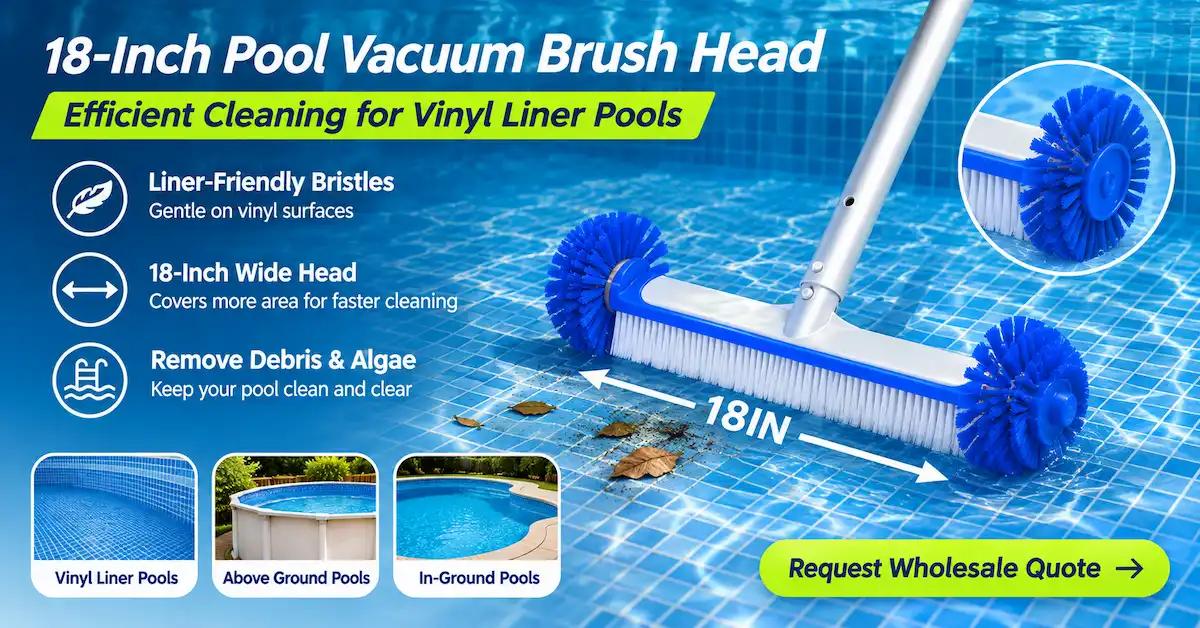
| 18-Inch Deluxe Pool Brush with Aluminium Back | T854A / T854 | 18-inch deluxe wall brush | Confirm backing construction, bristle clearance, and packing |
| 20-Inch Wall Brush with Aluminum Handle | T614D / T614 | 20-inch wall brush with aluminum-handle description | Confirm actual backing material and connector protection |
| 360-Degree Round Pool Wall Brush | WB081604 | Round-head brush with aluminum-back description | Confirm geometry and whether a different protective insert is needed |
18-Inch Deluxe Pool Brush
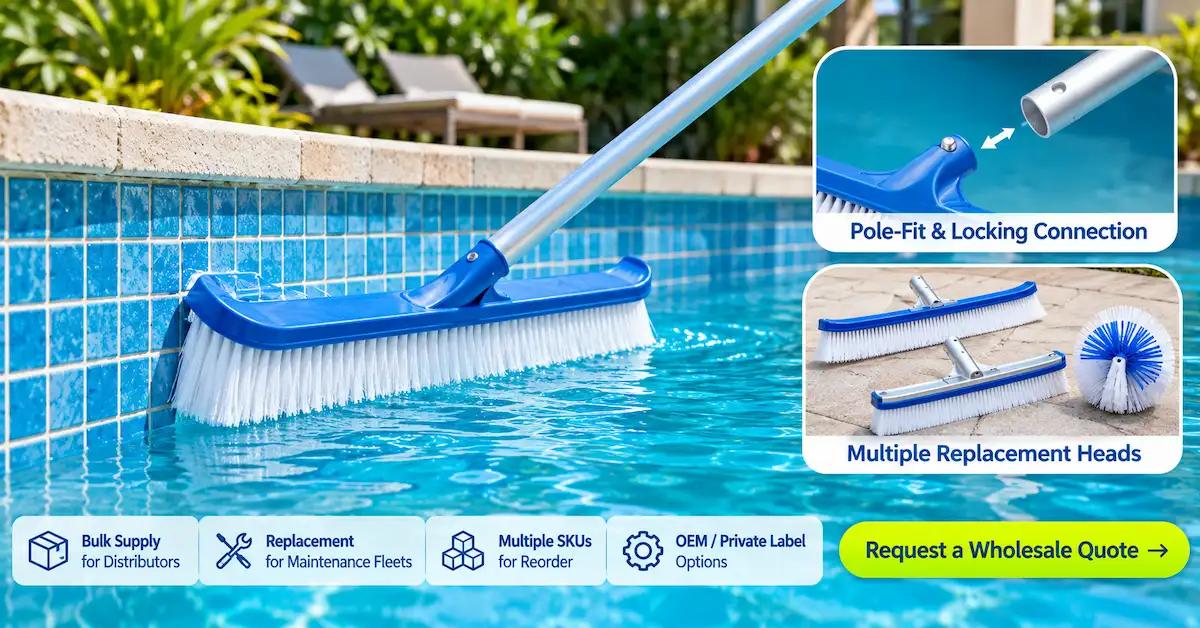
The official BONNY product page identifies an 18-inch deluxe swimming pool brush with an aluminum-back description.
View BONNY 18-Inch Deluxe Pool Brush
The page displays T854A as the product type and T854 in the detailed specifications.
It also lists plastic in the material field.
For procurement purposes, the buyer should clarify whether the backing is aluminum, which other components are plastic, and which exact product revision will be supplied.
The product page identifies a polybag package, but it does not provide enough information to establish the complete export master-carton protection design.
20-Inch Pool Wall Brush
BONNY also lists a 20-inch wall brush with an aluminum-handle description.
View BONNY 20-Inch Pool Wall Brush
Its product information includes T614D and T614 references.
The page also lists plastic as the material, so buyers should confirm whether the selected version has an aluminum backing, aluminum connector, or another construction.
The published product title alone should not be treated as a complete material specification.
Which Product Should Be the Main Reference?
For an article focused specifically on aluminum backing and export protection, the 18-inch deluxe brush is the stronger starting reference because the official product title explicitly identifies an aluminum back.
The 20-inch product can be included as a comparison after its exact construction is confirmed.
Explore BONNY Pool Cleaning Accessories
3. How Should Export Packaging Protect the Aluminum Backing?
An elongated metal backing should be evaluated for bending, localized impact, and unwanted contact with other products.
The packaging should help keep external handling loads away from vulnerable areas.
Support the Appropriate Structural Points
A protective insert can be designed to support selected areas of the rigid brush body.
The arrangement should be validated using the actual product.
Supporting only the ends may be unsuitable if the middle of the brush experiences excessive unsupported loading.
Conversely, supports placed incorrectly may press against the bristles or damage the frame.
Avoid Concentrated Connector Loads
The pole connector often projects away from the brush body.
If it contacts the carton wall or another brush, an impact may concentrate force at the connection.
A suitable protective space or insert can help prevent direct loading on the connector.
Protect Finished Metal Surfaces
Surface protection may be required to prevent metal-to-metal abrasion.
Potential solutions include appropriate separators, protective sleeves, or surface-compatible wrapping.
Any material in prolonged contact with the metal surface should be checked for unwanted marks, moisture retention, or residue.
Aluminum-Backing Protection Checklist
| Protection Area | Suggested Design Approach | Acceptance Focus |
|---|---|---|
| Backing length | Suitable structural support | No unacceptable bending |
| Backing edges | Protective separation | No damaging contact |
| Connector | Clearance or protective pocket | No connector damage |
| Metal finish | Compatible protective layer | No unacceptable scratches |
| Product movement | Suitable positioning inserts | No uncontrolled shifting |
| Stacking loads | Defined load path through packaging | No excessive product pressure |
Engineering takeaway: A carton should manage the path of external forces so that vulnerable product areas are not used as the primary support for stacking and handling loads.
4. How Can Buyers Prevent Bristle Crushing During Transportation?
Bristle deformation is a significant packaging concern for swimming pool brushes.
The risk depends on filament construction, applied pressure, exposure duration, temperature, and packing arrangement.
Why Bristles Become Deformed
Possible contributing factors include:
-
Excessive compression.
-
Direct contact with neighboring brush heads.
-
Incorrect product orientation.
-
Insufficient internal carton clearance.
-
Prolonged loading.
-
High-temperature storage conditions.
-
Packaging changes that alter the original load path.
Some temporary bristle displacement may recover after unpacking.
However, buyers should not assume every deformation is reversible.
Create a Protected Bristle Zone
A proposed packing design can keep the bristles in a region where external loads are not intentionally transferred through their tips.
The required clearance should be established using the actual bristle length and agreed product tolerances.
Use Appropriate Separators
Potential packaging components include:
-
Die-cut corrugated supports.
-
Protective sleeves.
-
Molded or formed inserts.
-
End supports.
-
Partition boards.
-
Suitable unit packaging.
The final design should be selected based on performance, cost, and distribution conditions.
Bristle Protection Evaluation
| Packaging Condition | Potential Risk | Suggested Verification |
|---|---|---|
| Bristles directly against carton wall | Compression | Inspect after storage and shipment simulation |
| Two brush heads pressed together | Interlocking or deformation | Evaluate packed-product arrangement |
| Heavy product resting on bristles | Sustained loading | Review load path |
| Insufficient separator height | Contact between layers | Check actual clearance |
| Excessive movement | Bristle abrasion | Perform representative handling evaluation |
| High-temperature exposure | Potential shape changes | Assess relevant storage conditions |
Buyer recommendation: Approve bristle protection by examining the product after simulated shipment and a defined recovery period, not by relying solely on a freshly packed photograph.
5. Recommended Aluminum-Back Pool Brush Export Carton Layout
A practical packaging drawing should identify the product orientation, supporting locations, separation materials, and areas that must remain free of damaging pressure.
The following is a conceptual packing diagram for an elongated aluminum-back pool brush.
It is not a confirmed BONNY factory packing design.
Proposed Carton Cross-Section
| Position From Top to Bottom | Packing Component | Intended Function |
|---|---|---|
| A — Outer top | Corrugated carton top | Protect the shipping unit |
| B — Upper protective layer | Cushion or approved support insert | Manage impact and stacking loads |
| C — Backing support zone | Supports contacting approved rigid areas | Protect metal backing geometry |
| D — Brush assembly | Aluminum backing, connector, bristles | Finished product |
| E — Bristle clearance zone | Protected space around filament tips | Prevent sustained compression |
| F — Lower support layer | Suitable support or separator | Stabilize the assembly |
| G — Outer bottom | Corrugated carton bottom | Complete the protective enclosure |
Side-View Packing Concept
Outer carton → protective support → aluminum backing → bristle clearance zone → lower support → outer carton
The supporting insert should contact only approved structural regions. The connector requires its own clearance, and the bristles should not carry carton stacking loads unless the actual design has been validated for that condition.
What Should the Final Packaging Drawing Show?
| Drawing Item | Required Information |
|---|---|
| Product orientation | Position of brush inside the carton |
| Overall carton dimensions | Length, width and height |
| Unit quantity | Number of brushes per carton |
| Layer quantity | Number of permitted layers |
| Backing support points | Approved contact locations |
| Connector protection | Clearance and insert geometry |
| Bristle protection | Required free space and separation |
| Insert materials | Material type and specification |
| Carton board | Approved board construction |
| Carton closure | Approved sealing method |
| Carton labels | SKU, quantity, destination and handling information |
| Drawing revision | Approved design version |
Should Brushes Be Packed Bristle-to-Bristle?
Not automatically.
Some configurations may allow efficient nesting, but direct bristle contact can also create deformation or entanglement.
The arrangement should be tested before adoption.
Should Aluminum Backings Face Each Other?
This depends on the proposed protective layers and overall geometry.
Direct metal contact may create scratches or unwanted movement.
Any facing arrangement should include appropriate separation and be validated using real products.
Packaging takeaway: The best layout is the one that provides adequate product protection at a commercially acceptable total cost—not necessarily the arrangement with the greatest number of units per carton.
6. Which Export Packaging Model Is Best for Wholesale Orders?
The correct packaging model depends on how the brush will be distributed.
A supplier shipping full cartons to a distributor may use a different system from a brand shipping individual brushes directly to consumers.
Packaging Model Comparison
| Packaging Model | Suitable Distribution Channel | Main Verification |
|---|---|---|
| Polybag plus protective master carton | Wholesale distribution | Bristle clearance and carton loading |
| Individual retail box | Retail display and distribution | Product protection and branding |
| Individual e-commerce shipper | Direct-to-consumer delivery | Parcel handling and impact resistance |
| Multi-unit partitioned carton | Distributor replenishment | Product separation and packing density |
| Palletized master cartons | Larger wholesale shipments | Stacking, pallet stability and handling |
A polybag can help keep a product organized and protected from some surface contamination.
However, a polybag alone does not establish adequate protection against bending, crushing, or impact.
How Should Buyers Compare Packaging Options?
Compare the complete cost and performance of each proposed system.
Important variables include packaging materials, packing labor, carton volume, freight, damaged products, warehouse handling, and disposal requirements.
The supplier should provide samples of the actual packed configuration.
7. Which Transportation Tests Should Importers Request?
Transportation validation helps determine whether a proposed package can protect its contents under defined distribution conditions.
The selected test procedure should reflect the actual shipping route and package type.
ISTA Packaging Tests
The International Safe Transit Association's official test procedure catalogue describes different protocols for packaged-product distribution.
For example, ISTA Procedure 3A addresses certain individually packaged products shipped through parcel delivery systems.
Other procedures apply to different distribution environments, including unitized loads or less-than-truckload transportation.
A test designed for individual parcel shipments should not automatically be treated as the correct procedure for a palletized ocean-freight shipment.
ASTM D4169
ASTM D4169 is a standard practice for performance testing of shipping containers and systems.
It provides a framework for evaluating shipping units using test methods and conditions representative of selected distribution environments.
The actual distribution cycle and test requirements should be established for the buyer's shipment.
Recommended Packaging Validation Process
Step 1 — Define the shipping route. Identify whether the product will travel as a retail parcel, master carton, palletized shipment, or another configuration.
Step 2 — Approve the packaging drawing. Confirm product positions, inserts, materials, carton dimensions, and closures.
Step 3 — Prepare representative packed samples. Use actual products and approved packing materials.
Step 4 — Select an appropriate test plan. Determine the relevant transportation hazards and testing procedure.
Step 5 — Conduct the agreed evaluation. Use suitable equipment and competent personnel or a qualified laboratory.
Step 6 — Inspect the products after testing. Check the backing, bristles, connectors, finish, and carton integrity.
Step 7 — Document results. Record the exact configuration tested and any necessary design changes.
Packaging Test Approval Checklist
| Test Item | Required Record |
|---|---|
| Product reference | Model and revision |
| Packaging reference | Drawing and revision |
| Carton construction | Board and closure specification |
| Internal protection | Insert material and arrangement |
| Packed quantity | Units per carton |
| Distribution route | Shipping mode and handling arrangement |
| Test procedure | Selected method and edition |
| Acceptance criteria | Defined before testing |
| Product inspection | Condition after testing |
| Final decision | Approved, revised or rejected |
Important: These standards provide testing frameworks. They do not demonstrate that BONNY has completed a specific packaging test unless product- and package-specific reports are supplied.
8. How Should Buyers Classify Export Shipping Damage?
A structured damage classification system helps importers evaluate complaints, production lots, and shipment acceptance.
The categories should be defined according to product function, appearance requirements, and potential safety consequences.
Pool Brush Export Damage Classification Table
| Damage Type | Example | Potential Classification | Inspection Decision |
|---|---|---|---|
| Bent aluminum backing | Brush exceeds approved straightness tolerance | Major | Reject or investigate |
| Broken connector | Pole cannot attach securely | Major or Critical, based on risk | Reject |
| Permanently flattened bristles | Product fails approved bristle geometry | Major | Reject |
| Excessive bristle shedding | Attachment fails agreed criteria | Major | Reject |
| Exposed sharp metal | Unacceptable injury or surface-damage risk | Critical | Reject |
| Deep finish damage | Fails agreed retail appearance criteria | Major | Reject |
| Light cosmetic mark | Within or outside approved appearance limits | Minor or Major | Evaluate against specification |
| Crushed outer carton | Packaging damaged but product condition unknown | Requires inspection | Inspect contents |
| Missing protective insert | Approved packing specification not followed | Major | Investigate lot |
| Incorrect SKU label | Product cannot be identified correctly | Major | Correct or reject |
The classifications are illustrative.
The buyer and supplier must agree on the actual defect definitions and acceptance criteria.
Why Distinguish Carton Damage From Product Damage?
An outer carton may show damage while the brush remains acceptable.
Conversely, a carton may appear intact even though prolonged internal pressure has deformed the bristles.
Therefore, damage evaluation should include both the package and its contents.
Incoming Damage Report
A useful report includes the product SKU, carton number, shipment reference, photographs, defect type, affected quantity, packaging condition, and recommended corrective action.
9. How Can ISO 2859-1 Support Pre-Shipment Inspection?
Bulk inspection should verify that production shipments match the approved product and packaging configuration.
ISO 2859-1:2026 provides acceptance sampling schemes for inspection by attributes.
Importers can use an agreed sampling plan for characteristics such as visible defects, missing inserts, incorrect labels, and defined dimensional pass/fail requirements.
However, acceptance sampling does not replace the engineering validation of the packaging design.
Recommended Pre-Shipment QC Matrix
| Inspection Area | Suggested Verification |
|---|---|
| Brush model | Match approved SKU |
| Aluminum backing | Check geometry and appearance |
| Bristle condition | Confirm acceptable shape and attachment |
| Connector | Check integrity and dimensions |
| Unit packaging | Match approved material and arrangement |
| Protective inserts | Check presence and placement |
| Carton quantity | Match purchase order |
| Carton dimensions | Check approved packing specification |
| Labels | Confirm SKU and shipment details |
| Finished packaging | Compare with approved packed sample |
For critical defects, additional controls may be necessary beyond ordinary sampling.
Golden Packed Sample
In addition to a product golden sample, buyers can retain an approved packed-carton sample or a documented packing reference.
This helps the supplier reproduce the same protection system during future orders.
10. How Does Export Packaging Affect Total Wholesale Cost?
A purchasing manager should compare the total economic impact of different packaging designs.
The cheapest carton is not necessarily the least expensive shipping solution.
Main Export Packaging Cost Drivers
| Cost Driver | Purchasing Impact |
|---|---|
| Carton board | Material cost and structural performance |
| Protective inserts | Additional material and packing labor |
| Unit packaging | Retail requirements and protection |
| Carton dimensions | Freight volume and warehouse storage |
| Packed quantity | Efficiency and product contact risk |
| Product damage | Rework, replacements and returns |
| Validation testing | Development and qualification expenses |
| OEM printing | Artwork and branding cost |
| Repacking | Additional destination handling |
| Packaging changes | Sample approval and revision costs |
Total Landed Cost Per Accepted Unit
A practical purchasing formula is:
Landed cost per accepted brush = Total product, packaging, inspection, freight, insurance, applicable import charges and replacement expenses ÷ Accepted brush quantity
This helps buyers compare different packaging proposals using actual data.
Example: Two Packaging Strategies
Option A — Compact bulk packing
Uses a higher number of brushes per carton with a comparatively compact arrangement.
The buyer must verify whether this creates unacceptable pressure or abrasion.
Option B — Protective partitioned packing
Uses separators or supports to reduce damaging contact.
It may require additional material or carton space.
Neither option should be declared superior without comparing actual landed costs and validation results.
What About MOQ and Lead Time?
Minimum order quantity and production lead time depend on the selected brush, customization, packaging requirements, order quantity, and manufacturing schedule.
Buyers should request updated, model-specific quotations.
A custom retail box or new protective insert may require additional development and approval.
11. OEM Aluminum Pool Wall Brush Packaging: What Can Be Customized?
OEM packaging allows distributors and retail brands to establish their own product presentation while meeting agreed protection requirements.
BONNY publicly describes OEM and ODM services covering private labeling, product customization, materials, colors, and packaging development.
Potential OEM Packaging Requirements
| Customization | Commercial Purpose | Required Verification |
|---|---|---|
| Printed retail box | Brand presentation | Product protection and correct information |
| Brand logo | Private-label identity | Approved artwork |
| Protective insert | Reduce shipping damage | Packaging validation |
| Custom carton quantity | Warehouse handling | Packing stability |
| Carton dimensions | Freight and storage planning | Complete pack-out evaluation |
| Product labels | SKU identification | Barcode and information accuracy |
| Product color | Brand differentiation | Actual product and material approval |
| Custom brush geometry | Product development | Engineering and packaging revalidation |
These are potential OEM project requirements rather than guarantees that every option is available for every existing BONNY product.
OEM vs ODM
OEM generally involves producing or customizing an existing design according to approved specifications.
ODM may involve a new product structure or packaging design requiring additional development.
Where a brush's backing, bristles, or connector changes, the existing packaging may need to be re-evaluated.
Explore BONNY Engineering and OEM/ODM Services
12. Why Consider BONNY for Aluminum-Back Pool Brush Wholesale?
Ningbo Bonny E-Home Co., Ltd., founded in 1998, manufactures and supplies swimming pool cleaning equipment and accessories for international customers.
BONNY's official catalogue includes pool wall brushes with aluminum-back or aluminum-handle descriptions, along with other cleaning accessories.
Relevant Product Options
The 18-inch deluxe pool brush provides a suitable starting point for aluminum-backing and export-packaging enquiries.
The 20-inch wall brush can be considered as a supplementary product once the exact construction is verified.
OEM and Packaging Support
BONNY describes company-level support for private-label branding, packaging customization, material selection, and product development.
These services make it relevant to importers planning branded wholesale pool accessories.
Manufacturing and Quality Coordination
The company identifies manufacturing capabilities including plastic molding, bristle planting, assembly, and product development.
Buyers should confirm the applicable production and packaging responsibilities for the selected brush.
What Should Importers Verify?
Before approving an aluminum-backed brush order, request confirmation of:
-
Exact commercial model and revision.
-
Aluminum-backing material and construction.
-
Bristle specification.
-
Connector dimensions.
-
Standard product packaging.
-
Proposed master-carton protection.
-
Sample and testing arrangements.
-
OEM packaging availability.
-
MOQ and production schedule.
-
Inspection and shipment documentation.
Explore BONNY Pool Accessories
13. Aluminum-Back Pool Brush Wholesale RFQ Checklist
A detailed request for quotation helps the manufacturer evaluate both the product and its required packaging.
| RFQ Item | Information to Provide |
|---|---|
| Buyer type | Importer, distributor, retail brand or OEM customer |
| Target product | Aluminum-backed pool wall brush |
| Reference model | T854A/T854 or another confirmed model |
| Brush dimensions | Required width and construction |
| Backing specification | Material and acceptable geometry |
| Bristle specification | Material, length and arrangement |
| Connector | Required interface and product contents |
| Packaging type | Bulk carton, retail box or individual shipper |
| Carton quantity | Preferred units per carton |
| Protective materials | Proposed or required inserts |
| Distribution route | Parcel, wholesale pallet or other route |
| Packaging test | Required procedure and acceptance criteria |
| OEM branding | Logo, colors and artwork |
| Inspection | Product and carton acceptance requirements |
| Estimated order | Quantity and expected repeat purchases |
| Destination | Country and receiving location |
| Commercial terms | MOQ, price, delivery terms and schedule |
Request OEM Packaging Samples and Wholesale Pricing
For an accurate quotation, provide BONNY with your preferred brush model, expected order quantity, destination market, and proposed distribution method.
If you already have a packaging drawing or a damaged-product example, include it with your enquiry.
BONNY can review the available brush configurations and discuss packaging customization, sample preparation, and commercial feasibility.
Frequently Asked Questions About Aluminum-Back Pool Brush Wholesale
1. What should I look for in an aluminum back pool brush manufacturer?
Verify the actual backing material, brush construction, bristle specifications, connector design, packaging capabilities, quality controls, and export documentation. Approve representative products and packaging before bulk purchasing.
2. Why do aluminum-backed pool brushes bend during shipping?
Possible causes include unsupported spans, concentrated loads, poor internal carton arrangements, impact, and inappropriate stacking. The failure mechanism should be investigated using the actual packed product.
3. How can manufacturers prevent crushed pool brush bristles?
A packaging design can include approved structural supports, bristle clearance, protective partitions, and controlled product orientation. The final configuration should be validated under suitable transport conditions.
4. Is a polybag enough for export packaging?
Not necessarily. A polybag may help organize the product, but the complete shipping system must provide adequate protection against the mechanical hazards of its distribution route.
5. Should aluminum-backed brushes be packed in retail boxes or bulk cartons?
Both models can be appropriate. The decision depends on the sales channel, shipping route, protection requirements, packaging cost, and distribution arrangements.
6. What transportation tests should importers request?
Select tests according to the actual distribution environment. ISTA protocols and ASTM D4169 provide recognized frameworks for evaluating packaging under defined transportation conditions.
7. Can BONNY provide OEM aluminum pool wall brushes?
BONNY offers pool brush products and company-level OEM/ODM services. The exact aluminum-back construction, available customizations, and packaging arrangements must be confirmed for the selected model.
8. What is the difference between product QC and carton QC?
Product QC evaluates the brush itself, including backing geometry, bristles, and connector integrity. Carton QC evaluates the packaging materials, arrangement, protection, labeling, and shipment configuration.
9. How do I compare packaging costs for wholesale pool brushes?
Compare total landed costs, including packaging materials, packing labor, freight, inspection, storage, and actual damage-related expenses. Do not compare carton price alone.
10. What should I send when requesting an aluminum-back pool brush wholesale quotation?
Provide the preferred product model, technical specifications, quantity, destination market, OEM requirements, proposed carton design, testing expectations, and delivery requirements.
Conclusion
Successful aluminum back pool brush wholesale procurement requires careful attention to both product construction and the packaging system used for international transportation.
For importers, distributors, and private-label brands, aluminum-backing deformation, crushed bristles, damaged connectors, and inconsistent cartons can create avoidable supply-chain problems.
The most effective purchasing process begins with a confirmed product specification and continues through packing-design approval, suitable transport validation, structured shipment inspection, and repeat-order control.
A well-designed export carton should protect the rigid backing without transferring damaging pressure to vulnerable bristles or connection components.
Packaging decisions should also consider freight volume, warehouse handling, retail requirements, and total landed cost.
BONNY, operated by Ningbo Bonny E-Home Co., Ltd., supplies swimming pool brushes and accessories and offers OEM/ODM support for international B2B customers.
Whether you are sourcing the 18-inch deluxe aluminum-back pool brush, evaluating a wider wall-brush configuration, or developing customized retail and export packaging, BONNY can review your specifications and discuss suitable manufacturing and packaging options.
Contact BONNY to Request Aluminum-Back Pool Brush Samples, Packaging Solutions and Wholesale Pricing