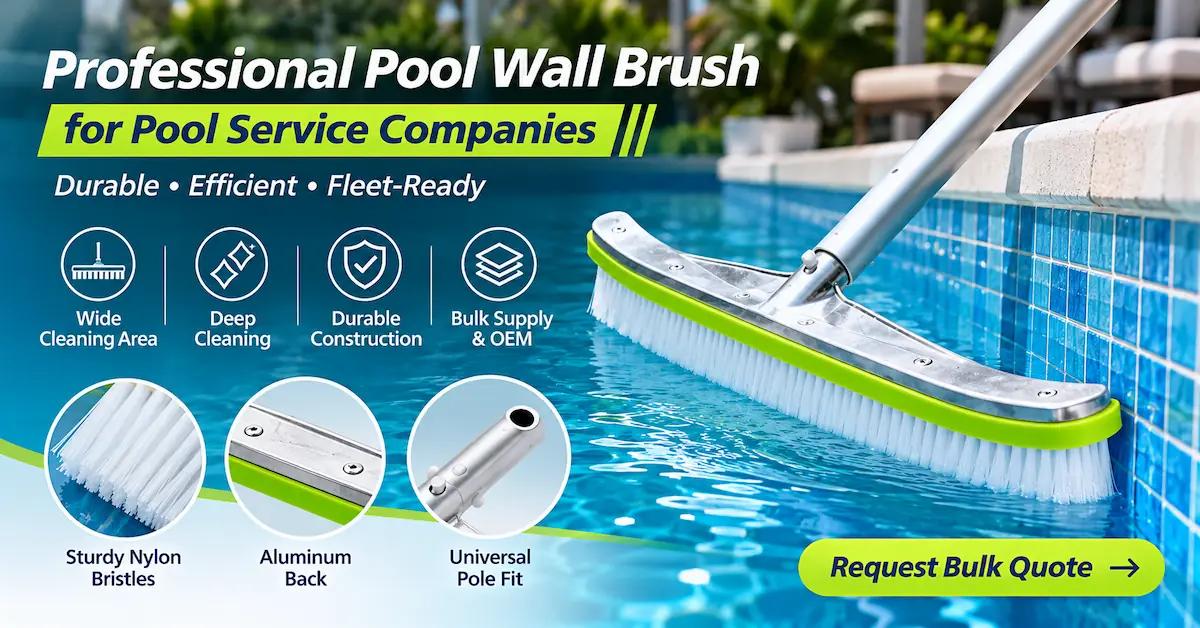

Quick Answer: A reliable round pool brush wholesale supplier should help buyers compare brush-head geometry, bristle coverage, corner access, pole compatibility, and batch consistency before placing orders. Round-head brushes can be evaluated for compact curved areas, while elongated brushes with rounded or curved ends may offer a different balance of access and cleaning coverage. The right SKU should be selected through representative cleaning trials, confirmed dimensions, and approved product specifications.
Pool equipment distributors and commercial maintenance contractors often need specialized brushes for locations that conventional straight wall brushes cannot reach effectively.
These locations may include pool steps, inside corners, curved wall transitions, recessed areas, and selected surfaces near fixed fittings.
However, not every specialized brush provides the same cleaning geometry.
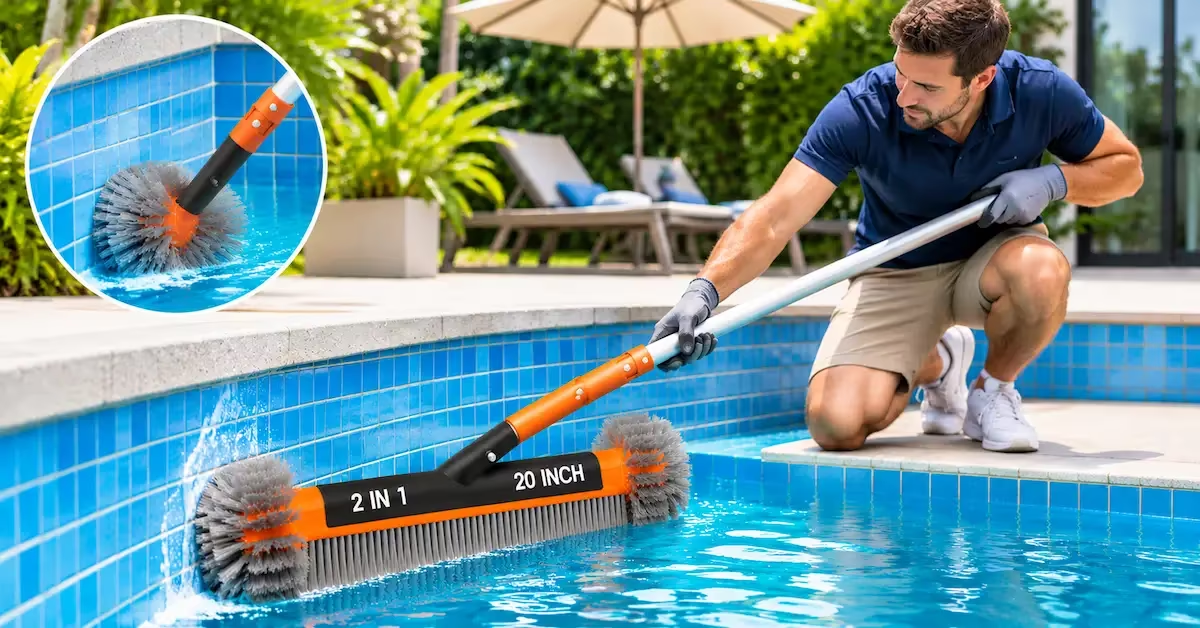
A compact round-head brush may offer maneuverability in restricted spaces, while a longer brush with rounded ends may provide additional contact coverage on a wall-to-floor transition.
For wholesale buyers, selecting the wrong product can create duplicated inventory, customer dissatisfaction, and unnecessary replacement orders.
The purchasing challenge is therefore to choose a practical assortment of brush-head configurations based on the actual applications served by the distributor.
This guide focuses on round-head versus curved-end brush procurement, product testing, SKU planning, and OEM sourcing.
For a general introduction to different pool brush categories, see BONNY's Guide to Pool Brush Types and Their Uses.
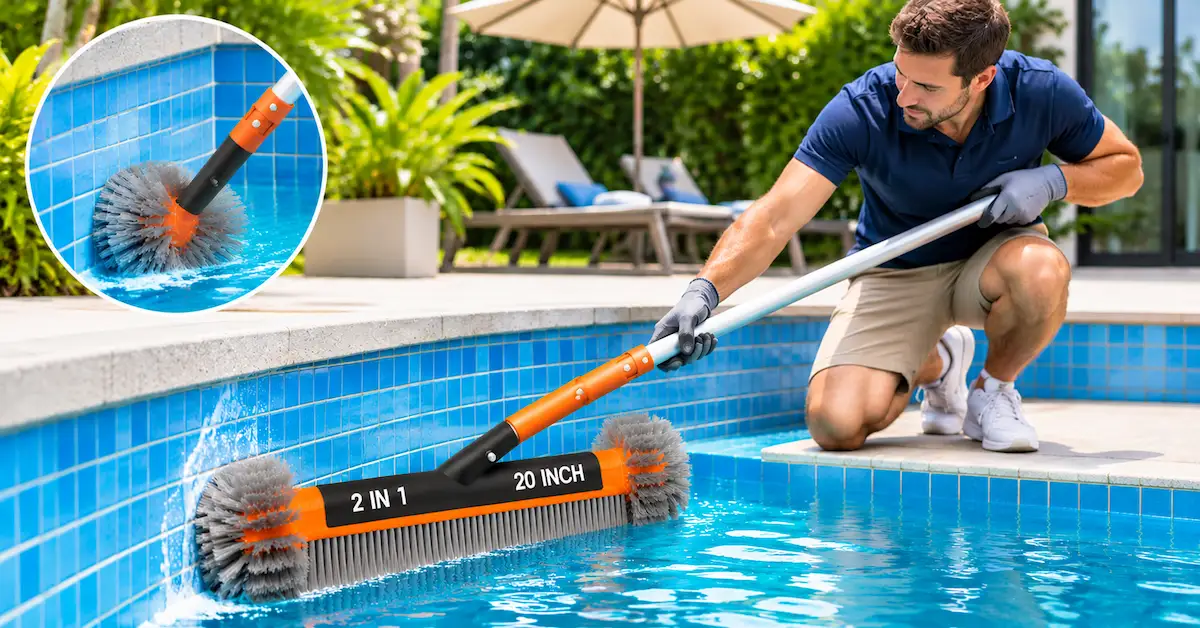
Key Takeaways for Wholesale Buyers
-
Compare actual brush geometry. Round heads, rounded-end wall brushes, and curved-edge brushes are not automatically interchangeable.
-
Test difficult cleaning areas. Use representative corners, step edges, and curved surfaces to evaluate contact coverage.
-
Verify bristle placement. A rounded frame does not guarantee that bristles reach every part of a corner.
-
Check pole compatibility. Brush-head shape and connector design should be evaluated separately.
-
Build a focused SKU assortment. Distributors may benefit from offering complementary specialty brushes rather than numerous overlapping products.
-
Confirm current availability. A product displayed in a supplier catalogue may not be available for immediate wholesale delivery.
-
Approve samples before bulk orders. Dimensions, materials, bristles, connectors, packaging, and quality requirements should be documented.
1. Why Do Distributors Source Round Pool Brushes in Bulk?
Specialized pool brushes serve a narrower purpose than standard wall brushes.
Their value lies in providing cleaning access or contact geometry suited to particular tasks.
For distributors, these products may complement an existing assortment of straight wall brushes, vacuum heads, and other pool maintenance accessories.
Target B2B Buyers
| Buyer Type | Purchasing Need | Important Evaluation |
|---|---|---|
| Pool equipment distributor | Build a specialty brush assortment | Product differentiation and SKU coverage |
| Commercial maintenance contractor | Equip technicians for curved or restricted areas | Handling and cleaning access |
| Pool service franchise | Standardize selected specialty brushes | Repeat-order consistency |
| Private-label brand | Introduce branded corner-cleaning products | OEM feasibility and packaging |
| Pool cleaning equipment wholesaler | Supply multiple brush designs | Model availability and inventory planning |
| Hotel maintenance supplier | Support specific facility layouts | Surface suitability and brush geometry |
Why Is a Specialty Brush Worth Considering?
A standard straight brush may be sufficient for broad pool walls.
However, irregular geometry can make it difficult to maintain appropriate bristle contact.
Different brush-head shapes may improve access in selected conditions.
The Pool & Hot Tub Alliance's pool maintenance guidance includes regular wall and floor brushing as part of pool care.
For professional buyers, specialized brushes should support the facility's maintenance requirements rather than replace the broader cleaning program.
Purchasing takeaway: Select specialty brushes to address specific access problems, not simply to increase the number of SKUs in a catalogue.
2. Round-Head vs Curved-End Pool Brushes: What Is the Difference?
Brush-head geometry determines where the bristles are positioned and how the tool can approach a surface.
Three designs are particularly relevant to wholesale assortment planning.
Round-Head Pool Brushes
Round-head brushes use a compact or rounded cleaning arrangement.
Depending on the construction, bristles may extend around different parts of the head.
This configuration can be evaluated for selected corners and curved areas where maneuverability matters.
However, the term "360-degree" does not automatically establish complete contact coverage in every direction.
The actual bristle arrangement must be inspected.
Elongated Brushes With Rounded Ends
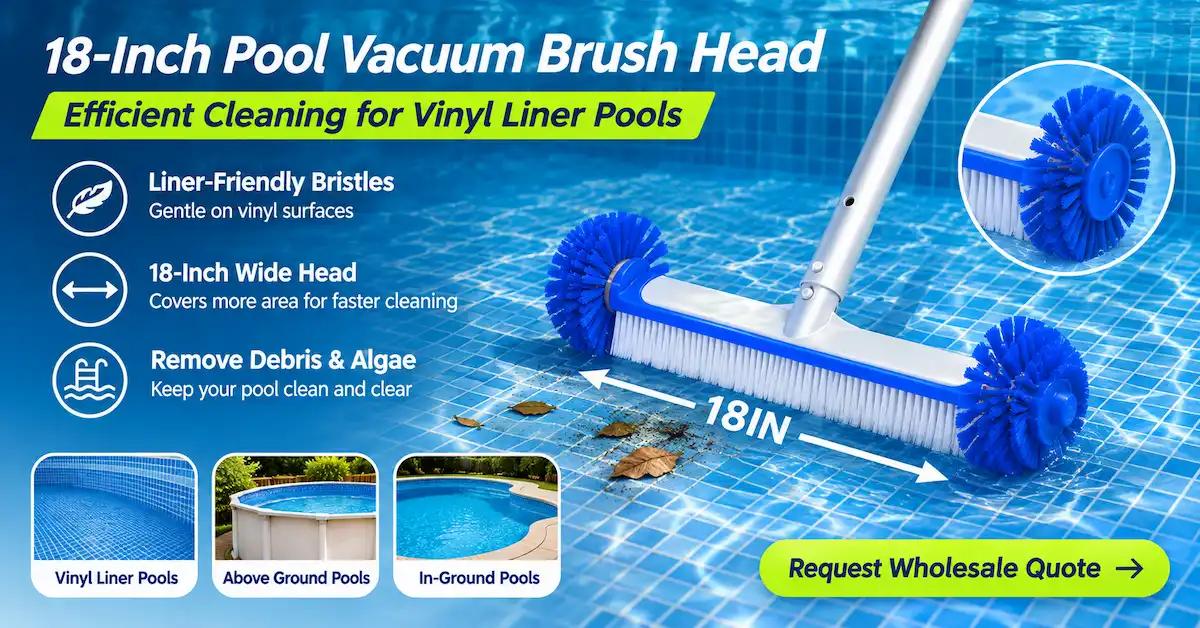
Some elongated pool brushes incorporate rounded brush sections at their ends.
This configuration may combine a relatively long cleaning section with additional bristles positioned around the ends.
The buyer should determine whether the end sections provide useful access to the intended pool geometry.
Curved-Edge Wall Brushes
A curved-edge brush uses a shaped head or bristle arrangement to accommodate selected transitions.
Depending on the design, it may be suitable for evaluating wall-to-floor junctions, steps, or curved walls.
However, a product should not be classified as equivalent to another merely because both marketing descriptions include the word "curved."
Product Geometry Comparison
| Brush Configuration | Potential Application | Main Advantage to Evaluate | Limitation |
|---|---|---|---|
| Compact round head | Restricted corners and curved areas | Maneuverability and directional contact | Smaller cleaning area |
| Elongated brush with rounded ends | Steps, walls and selected transitions | Combined straight and end-bristle contact | May be difficult in narrow spaces |
| Curved-edge wall brush | Wall-to-floor transitions | Contact along selected curves | Performance depends on actual curvature |
| Standard straight wall brush | Broad walls and open surfaces | Wide cleaning coverage | Limited access to some tight corners |
These are design categories for procurement comparison, not independently verified performance rankings.
3. How Should Buyers Test Corner-Cleaning Performance?
A supplier may describe its product as suitable for corners, steps, or difficult cleaning areas.
However, these claims become more useful when supported by a practical test.
For B2B sourcing, a controlled cleaning-access trial can help compare different brush geometries.
Step 1: Define Representative Test Areas
Choose surfaces that reflect the target customers' actual maintenance tasks.
Suggested evaluation locations include:
-
A 90-degree inside corner.
-
A wall-to-floor transition.
-
A curved pool wall.
-
A horizontal step adjoining a vertical riser.
-
A narrow area adjacent to a fixed fitting.
The selected materials and cleaning procedures must be suitable for the intended pool finish.
Step 2: Establish Comparable Test Conditions
Use an agreed telescopic pole, appropriate surface, defined brushing method, and consistent test conditions.
Record the brush model and operator.
Where feasible, multiple operators should repeat the evaluation to reduce the influence of individual technique.
Step 3: Evaluate Contact Coverage
A suitable demonstration may use an approved test panel or removable indicator that can show where bristles make contact.
Only use testing materials that are compatible with the test surface and do not create a contamination or damage risk.
Do not introduce unapproved pigments or abrasive materials into operating swimming pools.
Step 4: Record Handling and Coverage
Measure the practical outcomes rather than relying on product appearance.
Useful observations include:
-
Contact in the intended corner.
-
Areas that remain unreached.
-
Number of required brushing passes.
-
Ease of changing brush direction.
-
Connector stability.
-
Bristle deformation.
-
Operator handling feedback.
Round vs Curved-End Brush Test Matrix
| Test Area | Round-Head Brush | Rounded-End Brush | Curved-Edge Brush |
|---|---|---|---|
| 90-degree inside corner | Test contact coverage | Test end-bristle access | Test edge contact |
| Curved wall section | Test maneuverability | Test contact continuity | Test curvature matching |
| Step riser | Test restricted access | Test end and central bristles | Test edge reach |
| Wall-to-floor junction | Test bristle position | Test rounded-end behavior | Test transition contact |
| Area near fitting | Test head clearance | Test overall head length | Test shaped-edge clearance |
| Open pool wall | Establish cleaning baseline | Test coverage | Test coverage |
This is a proposed evaluation matrix. It does not contain measured BONNY product results.
Test Recording Template
| Test Parameter | Record |
|---|---|
| Product model | Actual SKU |
| Brush-head type | Round / rounded-end / curved-edge |
| Pool or test surface | Material and finish |
| Test geometry | Corner, step or wall transition |
| Pole model | Actual reference |
| Test method | Agreed procedure |
| Contact coverage | Observed result |
| Cleaning passes | Measured count |
| Handling | Operator observations |
| Brush condition | Before and after inspection |
| Final decision | Approve / revise / reject |
Can Suppliers Guarantee a Particular Cleaning Angle?
A brush does not have one universal effective cleaning angle.
Performance depends on head geometry, bristle orientation, pole position, operator technique, and the surface being cleaned.
Buyers should therefore request drawings and representative test results rather than assume a product described as "360-degree" reaches every corner equally.
Engineering takeaway: A repeatable cleaning-access test is more useful than an unsupported claim that one brush is always more efficient.
4. Which BONNY Round and Corner Pool Brushes Should Buyers Compare?
Ningbo Bonny E-Home Co., Ltd. supplies different pool cleaning brushes for international customers.
Its Pool Accessories Catalogue includes round-head and rounded-end brush configurations relevant to this sourcing topic.
BONNY Product Comparison
| Product | Published Model | Catalogue Description | Main Purchasing Consideration |
|---|---|---|---|
| 360-Degree Round Pool Wall Brush | WB081604 | Nylon round-head brush with aluminum-back description | Confirm head geometry, bristles and pole connection |
| Round-Ends Corner Brush | WB0070 | Round-ended brush with cobweb-duster description | Confirm availability, actual shape and intended use |
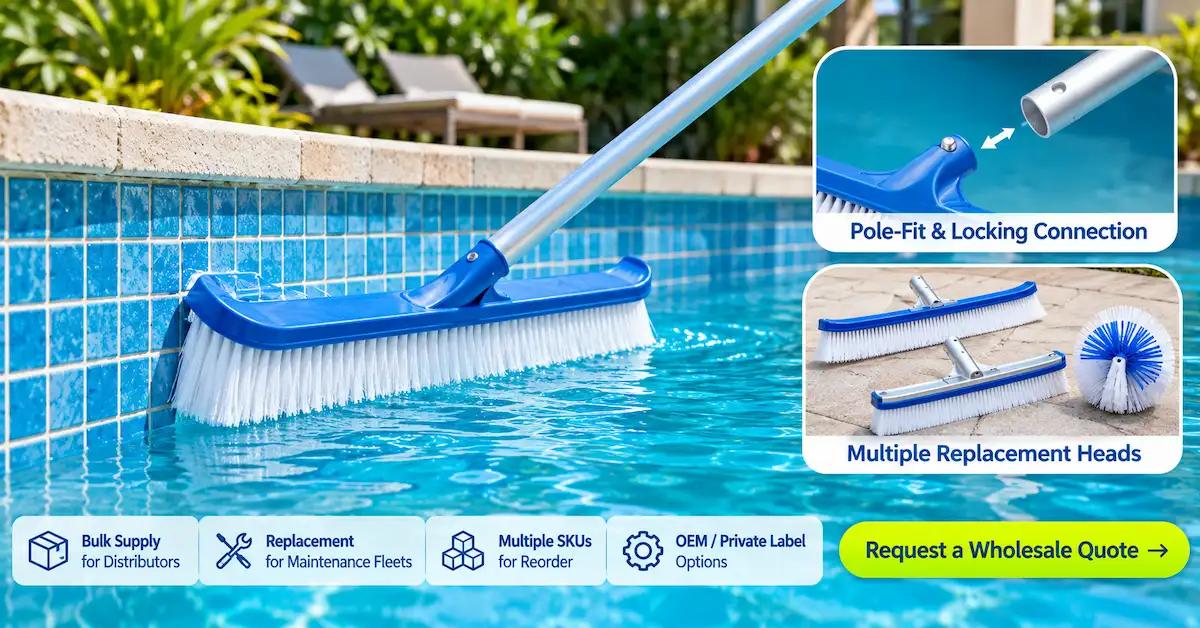
| 20-Inch Wall Brush | T614D / T614 references | Standard wall brush product | Use as a wide-brush comparison reference |
WB081604 — 360-Degree Round Pool Wall Brush
BONNY lists this product as a nylon pool cleaning brush with a round-head design.
It is a relevant candidate for buyers evaluating specialty cleaning access.
For an OEM project, request drawings showing the actual head dimensions, bristle distribution, backing structure, and pole connector.
View BONNY 360-Degree Round Pool Wall Brush
The product page contains different material and descriptive details. The final approved specification should be confirmed before purchasing.
WB0070 — Round-Ends Corner Brush
BONNY also lists a specialized brush with rounded ends and a cobweb-duster description under model WB0070.
This product can be evaluated as an alternative specialty brush configuration.
View BONNY WB0070 Round-Ends Corner Brush
Availability note: The product page currently displays Out of Stock. Buyers should confirm whether new production, samples, or alternative models can be supplied.
20-Inch Pool Wall Brush
The 20-inch wall brush provides a useful reference for comparing specialty cleaning heads with a more conventional wide-brush format.
View BONNY 20-Inch Pool Wall Brush
Its product page displays T614D and T614 references. Confirm the correct commercial model before including it in a comparison or RFQ.
Which Product Should Be the Main Wholesale SKU?
For distributors specifically targeting corner-cleaning products, WB081604 is the most relevant candidate to evaluate first.
WB0070 can be considered as a complementary option after confirming its availability and exact construction.
A standard wall brush should remain a separate product category rather than being marketed as an equivalent replacement for a specialty round-head design.
5. What Dimensions and Pole Interfaces Should Buyers Confirm?
A specialty brush must function with the equipment used by the intended customer.
Therefore, wholesale buyers should verify both the brush geometry and the telescopic pole interface.
Critical Technical Specifications
| Parameter | What Buyers Should Request |
|---|---|
| Overall head length | Actual dimensions |
| Head width or diameter | Actual dimensions |
| Head profile | Drawing of round or curved sections |
| Bristle material | Approved polymer or filament specification |
| Bristle length | Finished trim length |
| Bristle distribution | Coverage around head and ends |
| Backing material | Approved construction |
| Connector dimensions | Mating diameter and insertion length |
| Locking system | Hole and spring-button arrangement |
| Product weight | Model-specific specification |
| Package dimensions | Unit and carton measurements |
| Intended application | Supported pool finishes and cleaning tasks |
Why Pole Compatibility Matters
A round brush and a conventional wall brush may use different connector geometries.
Even if both appear to connect to a telescopic pole, their actual engagement and locking arrangements must be verified.
Buyers should conduct assembly tests using the intended pole.
What About Pool Surface Compatibility?
Round-head geometry does not establish that the brush is appropriate for every pool finish.
The bristle material, stiffness, head backing, and potential contact surfaces should be evaluated against the pool finish manufacturer's instructions.
A brush designed for a particular hard surface should not automatically be promoted for vinyl liners or delicate coatings.
6. How Do Materials and Manufacturing Quality Affect Specialty Brush Performance?
Round and curved-end brushes may contain molded plastic components, metal backing, bristles, and attachment hardware.
The actual construction varies by model.
For wholesale purchasing, the important objective is consistency with the approved specification.
Bristle Construction
Bristle stiffness, length, and placement influence contact with the intended cleaning surface.
In a round-head design, buyers should pay particular attention to bristles positioned around the perimeter or curved sections.
Tuft Attachment
Bristle bundles should remain securely attached during the intended service conditions.
An appropriate retention-testing method can be established according to the product construction.
No universal pull-force threshold should be assumed without a relevant design-specific requirement.
Backing and Frame Construction
The backing should provide sufficient integrity for the intended application.
Potential defects include cracking, unacceptable deformation, loose components, and protruding edges.
Manufacturing Consistency
BONNY describes company-level capabilities including injection molding, bristle planting, and assembly.
These processes are relevant to the production of selected pool cleaning brushes.
However, buyers should confirm the actual manufacturing and inspection arrangements for WB081604, WB0070, or any customized variant.
7. What Quality Tests Should Be Required for Bulk Round Pool Brushes?
A professional inspection plan should address both the finished brush and the features that differentiate specialty head designs.
Wholesale Quality Control Matrix
| Inspection Item | Suggested Check | Main Risk |
|---|---|---|
| Head geometry | Compare with approved drawing | Incorrect shape |
| Bristle arrangement | Check specified coverage | Inconsistent contact |
| Bristle retention | Agreed attachment test | Premature shedding |
| Head dimensions | Measurement | SKU mismatch |
| Connector dimensions | Fit test with approved pole | Attachment failure |
| Backing integrity | Visual and functional evaluation | Cracking or deformation |
| Assembly | Check joints and fasteners | Loose components |
| Surface condition | Inspect unacceptable sharp projections | Pool-surface damage |
| Packaging | Check protection and identification | Transit damage |
| Carton quantities | Compare with purchase order | Shipping errors |
Applying ISO 2859-1 to Bulk Orders
ISO 2859-1:2026 defines acceptance sampling schemes for inspection by attributes.
A buyer and supplier can agree on a suitable sampling plan for characteristics that can be evaluated using defined pass/fail criteria.
Examples may include incorrect product labels, visible damage, or dimensional features inspected against an agreed gauge.
However, this standard does not establish a specific corner-cleaning performance rating or universal brush bristle-retention requirement.
A product-specific functional trial remains necessary where cleaning geometry is critical.
Sample Approval Checklist
Before authorizing bulk production, confirm the approved model, dimensions, materials, bristle construction, pole interface, packaging, inspection criteria, and product revision.
Where a buyer requires a new curved-end geometry, the revised sample should be evaluated before ordering.
8. How Should Distributors Build a Round and Curved-End Brush SKU Assortment?
A distributor does not necessarily need several similar products that perform the same task.
A useful assortment should cover distinct applications.
Proposed Wholesale SKU Selection Matrix
| SKU Role | Brush Configuration | Target Buyer | Purchasing Decision |
|---|---|---|---|
| Specialty corner-cleaning SKU | Compact round-head brush | Maintenance contractors | Evaluate WB081604 |
| Rounded-end specialty SKU | Elongated head with rounded ends | Distributors with varied pool layouts | Evaluate WB0070 after availability confirmation |
| Primary wall-cleaning SKU | Conventional wide wall brush | General pool equipment retailers | Evaluate 20-inch wall brush |
| Custom application SKU | Buyer-defined geometry | OEM brand or project supplier | Engineering review required |
The above represents a proposed commercial assortment, not a confirmed BONNY multi-product kit.
How Many Specialty SKUs Should a Distributor Stock?
Start with the actual applications served by customers.
If most customers need a tool for occasional corner cleaning, a single approved round-head product may be sufficient.
If the distributor supplies professional crews working across multiple pool geometries, a complementary rounded-end option may justify a separate SKU.
The decision should be based on measured demand and actual product differentiation.
Why Avoid Duplicate SKUs?
Two brushes that appear different in a catalogue may provide similar functionality.
Duplicated inventory can increase storage requirements and complicate replenishment.
Buyers should establish a clear purpose for each SKU.
Replaceability and SKU Continuity
A specialty brush should have a consistent model identifier and controlled product specification.
Changes to dimensions, bristle construction, or connector design should be communicated where they affect customer expectations or compatibility.
9. What OEM Customization Can Buyers Request?
OEM and private-label projects can help distributors develop a recognizable pool cleaning product range.
BONNY describes OEM and ODM services including branding, packaging, material selection, and product development.
Potential Customization Requirements
| OEM Requirement | Commercial Purpose | Technical Verification |
|---|---|---|
| Brush color | Brand differentiation | Material and color approval |
| Logo | Private-label identification | Marking quality |
| Head shape | Specialized cleaning application | Geometry and functional trial |
| Bristle pattern | Different contact requirements | Performance and retention |
| Connector design | Pole compatibility | Assembly testing |
| Product dimensions | Target application | Drawing approval |
| Retail packaging | Channel presentation | Protection and accurate product information |
| Carton labeling | Wholesale inventory management | SKU and quantity accuracy |
Not every customization is automatically available for every existing product.
OEM vs ODM
OEM generally involves manufacturing according to an approved design or customizing an existing product.
ODM may involve a new head geometry, modified connection system, tooling, or development project.
A modified round-head structure should be evaluated for its intended cleaning task before production.
Explore BONNY Engineering and OEM Services
10. What Determines Wholesale Round Pool Brush Pricing?
Wholesale pricing depends on the complete product construction and purchasing requirements.
A specialty brush with additional bristle coverage or more complex geometry may involve different costs from a conventional wall brush.
Main Purchasing Cost Drivers
| Cost Factor | Purchasing Implication |
|---|---|
| Head dimensions | Material consumption |
| Head geometry | Tooling and manufacturing complexity |
| Bristle material | Material specification and cost |
| Bristle quantity | Filament consumption and processing |
| Backing material | Structural component cost |
| Connector design | Compatibility and assembly requirements |
| OEM customization | Branding, tooling and packaging |
| Order quantity | Production planning |
| Inspection | Testing and quality-control requirements |
| Freight | Carton volume, weight and destination |
Total Landed Cost
A practical cost framework is:
Total landed cost = Product price + Tooling allocation + Packaging + Inspection + Freight + Insurance + Applicable import charges + Expected replacement costs
This is a procurement calculation, not a published BONNY quotation.
MOQ and Production Lead Time
MOQ and lead time depend on the selected model, required customization, quantity, material availability, and production arrangements.
For WB0070, current availability requires particular attention because the product page displays an out-of-stock status.
Buyers should request an updated model-specific quotation rather than assume immediate shipment availability.
11. What Should Be Included in a Round Pool Brush Wholesale RFQ?
A detailed request for quotation helps manufacturers evaluate both the product requirements and the intended commercial assortment.
Recommended RFQ Checklist
| RFQ Field | Information to Provide |
|---|---|
| Buyer type | Distributor, contractor, retailer or OEM brand |
| Required configuration | Round-head, rounded-end or curved-edge |
| Reference model | WB081604, WB0070 or buyer-supplied reference |
| Intended application | Pool corners, steps, curves or other areas |
| Pool surface | Material and finish |
| Head dimensions | Preferred size and geometry |
| Bristle specification | Material, stiffness and arrangement |
| Pole interface | Connector dimensions and locking system |
| Sample test | Required cleaning-access evaluation |
| Order quantity | Initial quantity and expected reorders |
| SKU assortment | Number and type of products |
| OEM requirements | Color, logo, packaging or structural modification |
| Quality requirements | Inspection and acceptance criteria |
| Destination country | Import market |
| Commercial terms | MOQ, price, freight terms and delivery schedule |
Request Round Pool Brush Wholesale Pricing
For an efficient sourcing enquiry, send BONNY the brush configuration you need, target application, reference model, estimated purchasing quantity, destination market, and any OEM customization requirements.
If you already have an approved brush or telescopic pole, include photographs and relevant dimensions.
BONNY can review the available catalogue options, assess customization feasibility, and discuss samples and commercial terms.
Contact BONNY for Round Pool Brush Specifications, OEM Samples and Wholesale Quotations
Frequently Asked Questions About Round Pool Brush Wholesale Suppliers
1. How do I choose a reliable round pool brush wholesale supplier?
Evaluate the supplier's relevant product range, head geometry, bristle specifications, connector compatibility, sample availability, inspection procedures, and OEM capabilities. Approve representative samples before bulk purchasing.
2. What is the difference between a round-head pool brush and a curved-end brush?
A round-head brush typically uses a compact rounded cleaning structure, while a curved-end or rounded-end brush may combine a longer cleaning section with additional end coverage. Actual functionality depends on the individual design.
3. Are round pool brushes suitable for all swimming pool corners?
Not necessarily. Corner geometry, bristle placement, head dimensions, pole angle, and pool finish affect suitability. Evaluate the selected brush under representative conditions.
4. Can BONNY supply round pool brushes wholesale?
BONNY lists the WB081604 round-head pool brush and other specialty brush products. Wholesale pricing, quantities, samples, and current availability should be confirmed directly.
5. Is the BONNY WB0070 round-ended pool brush currently available?
Its official product page currently displays an out-of-stock status. Buyers should ask BONNY whether new production, samples, or an alternative product can be arranged.
6. What technical specifications should I request for a round pool brush?
Request overall dimensions, head geometry, bristle material and layout, backing construction, connector dimensions, product weight where relevant, and packaging specifications.
7. How should a distributor compare corner-cleaning performance?
Use representative corners and curved surfaces, consistent cleaning conditions, and an approved evaluation method. Record contact coverage, handling, required passes, and product condition.
8. Can BONNY provide OEM round pool cleaning brushes?
BONNY offers company-level OEM and ODM services. Available customizations, such as branding, materials, colors, packaging, or head geometry, should be confirmed for the selected project.
9. What determines round pool brush MOQ and delivery time?
MOQ and lead time depend on the selected model, customization, order volume, materials, packaging, and production arrangements. Current commercial terms should be requested from the supplier.
10. What should I send when requesting a wholesale round pool brush quotation?
Provide the preferred head design, application, pool finish, technical specifications, quantity, destination, sample requirements, and OEM needs. Model references or product photographs can help clarify the enquiry.
Conclusion
Choosing a reliable round pool brush wholesale supplier requires more than comparing catalogue photographs and unit prices.
For distributors, maintenance contractors, and OEM brands, the most important purchasing decision is selecting a brush-head geometry that serves a defined cleaning application.
Round-head brushes, rounded-end designs, and curved-edge wall brushes may provide different advantages depending on the pool layout.
Practical cleaning-access trials, clear technical specifications, connector verification, and structured sample approval help buyers compare products more effectively.
A focused SKU assortment can also support more consistent inventory management and repeat purchasing.
BONNY, operated by Ningbo Bonny E-Home Co., Ltd., supplies swimming pool cleaning brushes and offers OEM/ODM services for international B2B customers.
Whether you are evaluating the WB081604 round-head brush, enquiring about the WB0070 round-ended configuration, or developing a customized specialty pool brush, BONNY can review your requirements and discuss appropriate manufacturing options.
Contact BONNY to Request Round Pool Brush Product Specifications, OEM Samples and Wholesale Pricing