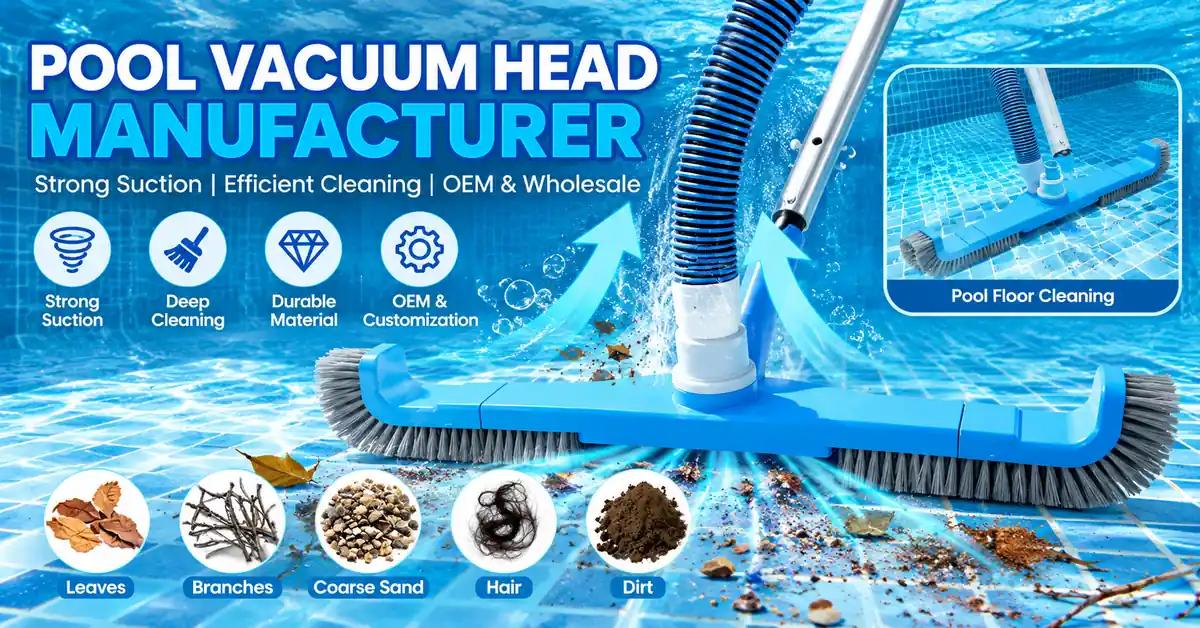

Choosing a reliable pool vacuum head manufacturer requires evaluating more than product appearance, cleaning width, or wholesale pricing. For pool equipment importers, distributors, and private-label brands, the biggest purchasing risks often involve incompatible hose connections, weak pole attachments, unsuitable cleaning surfaces, inconsistent suction performance, and product variations between bulk shipments.
Quick Answer: A qualified pool vacuum head manufacturer should provide clearly defined hose and telescopic pole connections, suitable head construction, representative samples, documented quality checks, and OEM customization options where available. Buyers should verify the complete cleaning system—including the vacuum head, hose, pole, and suction source—before approving wholesale production.
This guide explains how B2B buyers can compare vacuum head designs, evaluate technical specifications, reduce sourcing risks, and develop a more reliable procurement strategy.
1. What Should Buyers Expect From a Pool Vacuum Head Manufacturer?
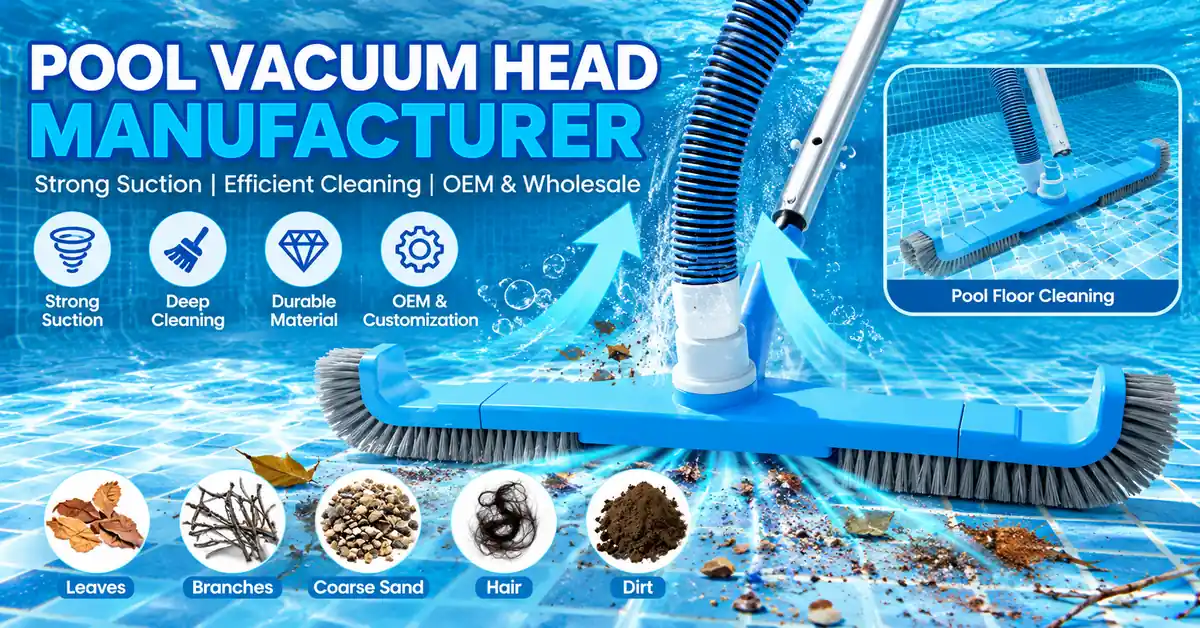
A manual pool vacuum head is a cleaning attachment that connects to a telescopic pole and a compatible suction hose. Water and debris pass through the vacuum head into the connected filtration or vacuum system.
Unlike a robotic pool cleaner, a conventional manual vacuum head does not normally contain its own propulsion motor or independent cleaning system.
For wholesalers and equipment distributors, selecting the right product involves compatibility with existing pool maintenance equipment and suitability for the intended cleaning environment.
A professional supplier should help buyers assess five essential areas:
-
Technical compatibility: Hose connection dimensions, pole attachment, head geometry, and suitable suction systems.
-
Product construction: Body materials, wheels or brushes where applicable, reinforcing features, and assembly quality.
-
Cleaning application: Residential pools, inground pools, vinyl-lined surfaces, and professional maintenance environments.
-
Manufacturing quality: Dimensional consistency, component security, and agreed inspection requirements.
-
Commercial support: Wholesale quotations, OEM branding, packaging customization, sample approval, and order planning.
Which Buyers Benefit Most?
| Buyer Type | Main Requirement | Purchasing Priority |
|---|---|---|
| Pool equipment importer | Reliable products for regional distribution | Compatibility and consistent specifications |
| Wholesale distributor | Multiple products for different applications | Product assortment and replenishment |
| Private-label brand | Customized product identity | Branding, packaging, and repeatable quality |
| Professional pool maintenance company | Tools suitable for recurring cleaning work | Handling, functionality, and durability |
| Hotel or resort equipment buyer | Equipment suited to facility maintenance | Cleaning application and maintenance requirements |
| Pool equipment retailer | Consumer-ready products | Clear instructions, packaging, and product fit |
For buyers primarily seeking autonomous cleaning equipment, BONNY's robotic pool cleaner range is a separate product category that requires different technical evaluation criteria.
2. Why Hose and Telescopic Pole Compatibility Matters
Hose and pole compatibility is one of the most important technical considerations when purchasing wholesale pool vacuum heads.
A product may look suitable in photographs but fail to connect correctly with hoses or poles already sold in the buyer's market.
This can result in unwanted movement, connection failures, reduced cleaning effectiveness, or customer returns.
Vacuum Hose Connection
The vacuum hose transfers water and debris from the cleaning head to the connected suction system.
Before approving a product, buyers should confirm:
-
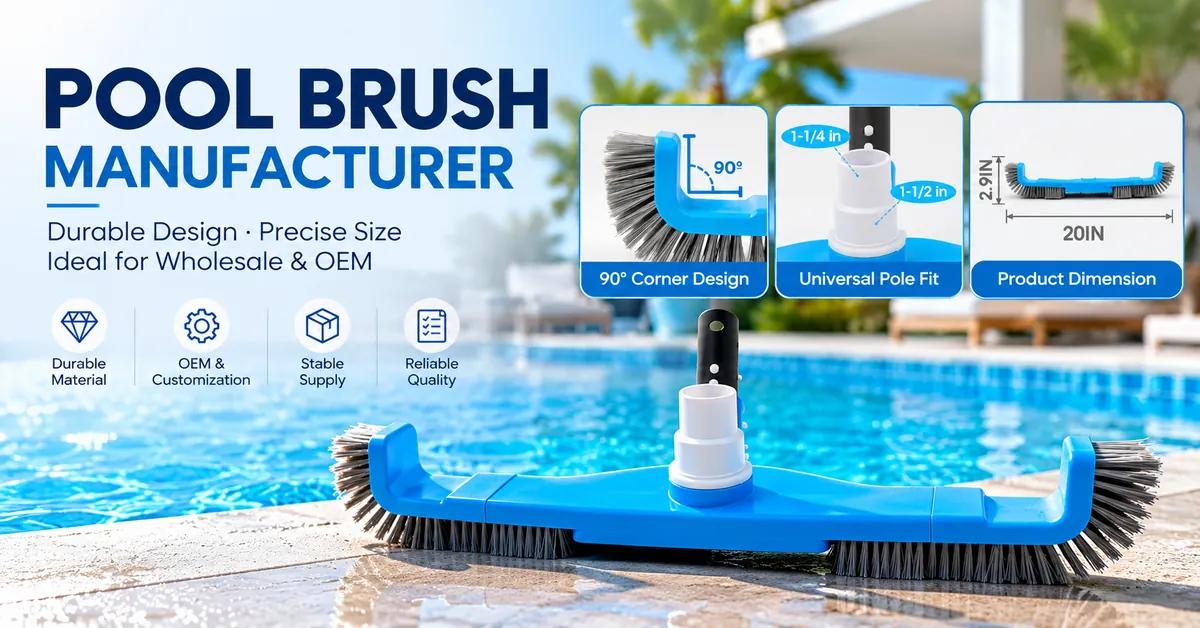
The actual outside diameter and connection geometry of the vacuum head's hose port.
-
The required mating hose dimensions and connection method.
-
The insertion or engagement depth.
-
Whether the connection is fixed or incorporates a swivel mechanism.
-
Whether the assembled connection remains secure during normal movement.
Pool vacuum hoses and fittings are not universally interchangeable. Even products described as compatible with common hose sizes may differ in actual dimensions and tolerances.
B2B Recommendation: Request a dimensioned drawing or representative sample and test it using the specific hose types sold in your target market.
Telescopic Pole Attachment
A pool vacuum head normally connects to a telescopic pole so the operator can guide the head across the pool floor.
Depending on the design, attachment systems may use clips, locking buttons, or other mechanical connections.
Important questions include:
-
Does the attachment fit the buyer's existing poles?
-
Does the locking mechanism engage securely?
-
Can the attachment withstand normal cleaning movements?
-
Is the connection easy to assemble and remove?
-
Can components be replaced if they become damaged?
For professional maintenance operations, repeatable connection dimensions are especially important because service teams may use multiple poles and vacuum heads.
Technical Compatibility Checklist
| Component | What to Verify | Why It Matters |
|---|---|---|
| Hose port | Actual diameter and mating dimensions | Helps prevent incompatible connections |
| Hose connection | Engagement depth and retention | Supports secure assembly |
| Pole connector | Dimensions, clip type, locking method | Ensures compatibility with specified poles |
| Swivel mechanism | Rotation and connection security, if equipped | May improve hose handling |
| Suction opening | Geometry and obstruction clearance | Influences debris entry and flow resistance |
| Head width | Cleaning coverage | Affects maneuverability and application suitability |
| Contact components | Brush, wheel, or base design | Determines interaction with the pool surface |
| Product weight | Overall mass and weight distribution | Influences handling and surface contact |
The manufacturer and buyer should agree on these specifications before production.
3. How Does Pool Vacuum Head Design Affect Cleaning Performance?
The vacuum head determines how the cleaning system interacts with debris and the pool surface.
However, cleaning performance is not determined by the head alone. It also depends on available suction, hose condition, filtration equipment, debris characteristics, and operator technique.
Suction Opening and Flow Path
A well-designed vacuum head should provide a suitable route for water and debris to enter the connected suction system.
Important design considerations include the size and location of the suction opening, internal restrictions, and how the head contacts the pool floor.
A larger opening is not automatically better.
If the opening geometry is poorly matched to the available suction, debris may not be collected effectively. Conversely, excessive restriction can increase resistance and interfere with normal operation.
Buyers should evaluate the head under representative working conditions rather than relying solely on claims such as "powerful suction."
Contact With the Pool Floor
The relationship between the vacuum head and the pool surface can influence cleaning effectiveness.
For example:
-
Flexible designs may help accommodate certain floor contours.
-
Wheeled designs can support controlled movement when appropriately configured.
-
Brush-equipped designs can help loosen suitable deposits.
-
Different head shapes may provide different access to corners and edges.
The actual benefits depend on the specific model and its intended application.
Debris Types
Fine sand, settled dirt, leaves, and larger debris create different cleaning requirements.
A suction opening suitable for fine particles may not handle larger debris in the same way.
For distributors developing a product line, separating vacuum heads by application may be more practical than presenting one model as suitable for every situation.
4. Comparing BONNY Pool Vacuum Head Product Options
Ningbo Bonny E-Home Co., Ltd. offers pool cleaning accessories that include flexible vacuum heads, suction brush heads, and combination cleaning tools.
Buyers can explore these products through the BONNY Pool Accessories catalogue.
The following comparison focuses on product types displayed in the catalogue. Exact construction, materials, dimensions, and configuration should be confirmed for each quoted product.
| Product Type | Published Catalogue Feature | Potential Application | Main Procurement Check |
|---|---|---|---|
| 14-inch flexible pool vacuum head | 14-inch flexible cleaning head design | Manual pool-floor vacuuming | Hose connection, flexibility, head dimensions |
| Curved suction vacuum brush head | Curved brush and suction-head design | Selected floor and edge cleaning tasks | Brush construction and suction interface |
| 2-in-1 pool wall cleaning and vacuum brush head | Combined brushing and suction concept | Applications requiring brushing with vacuum assistance | Bristles, connection geometry, and cleaning compatibility |
| Standard manual vacuum head | Conventional suction cleaning arrangement | General pool maintenance | Pool surface, hose fit, and cleaning system |
Note: This is a product-design comparison, not a verified performance ranking. Confirm actual model numbers, materials, connection dimensions, and operating limitations with BONNY before ordering.
How Should Distributors Build Their Product Range?
For general pool equipment distribution, a flexible vacuum head may be a useful product category to evaluate.
For customers requiring combined brushing and debris collection, a suction brush configuration may provide an additional product option.
For professional maintenance markets, buyers should consider factors such as cleaning frequency, compatibility with existing tools, and ease of replacing worn components.
A well-structured product assortment should offer meaningful differences in application instead of several nearly identical products with unclear positioning.
5. Choosing Vacuum Head Materials for Different Pool Environments
Material selection influences product weight, structural performance, surface interaction, and long-term maintenance.
Common materials used in pool cleaning equipment include ABS, polypropylene, PVC, aluminum, and nylon.
However, not every material is used in every vacuum head, and actual performance depends on its grade and finished design.
ABS Plastic
ABS is used in various molded equipment components.
It can provide suitable structural properties for selected cleaning-tool designs, depending on grade and wall thickness.
Buyers should consider impact resistance, surface finish, and environmental exposure.
Polypropylene
Polypropylene is commonly used in molded plastic products and may be suitable for certain equipment bodies or components.
Its suitability depends on the selected formulation, operating temperature, product geometry, and environmental conditions.
Aluminum Components
Some pool cleaning head designs use aluminum components for structural support or connections.
Corrosion resistance depends on alloy selection, surface finishing, and actual water conditions.
Nylon Bristles
Brush-equipped vacuum heads may incorporate nylon bristles for mechanical cleaning assistance.
Bristle stiffness and surface compatibility require careful evaluation.
Application and Material Considerations
| Pool Environment | Main Concern | Recommended Evaluation |
|---|---|---|
| Vinyl-lined pool | Liner scratching or damage | Smooth edges and finish-compatible contact components |
| Fiberglass pool | Surface abrasion | Suitable brushes, wheels, and contact pressure |
| Concrete or plaster pool | Rough surfaces and debris deposits | Wear resistance and appropriate cleaning action |
| Tiled pool | Surface and grout protection | Edge design and compatible contact materials |
| Outdoor residential pool | Sunlight and seasonal use | Material weathering and storage conditions |
| Commercial aquatic facility | Frequent maintenance | Component durability and ease of inspection |
Important: A pool vacuum head should not be advertised as suitable for all pool finishes without appropriate product-specific evidence.
6. How Manufacturing Processes Influence Product Consistency
A professional pool vacuum head manufacturer should be able to explain which production and inspection processes apply to the specific product being purchased.
BONNY's About Us page identifies manufacturing capabilities including injection molding, bristle planting, blow molding, and extrusion.
For pool vacuum heads, the relevant manufacturing and assembly considerations depend on the product design.
Injection Molding
Injection molding is commonly used to produce suitable plastic bodies and components.
Important quality considerations include:
-
Dimensional stability.
-
Consistent material selection.
-
Uniform molded structure.
-
Appropriate surface finishing.
-
Avoidance of significant molding defects.
Brush Component Manufacturing
For vacuum heads incorporating bristles, bristle attachment and arrangement are important.
The brush should be evaluated for appropriate filament retention, placement, and compatibility with the intended surface.
Mechanical Assembly
Depending on the product, assembly may involve connectors, wheels, brushes, or additional fasteners.
Critical components should remain secure during intended use.
Final Product Verification
Finished products should be checked against agreed drawings, reference samples, and inspection criteria.
For bulk procurement, buyers should request information about the actual inspection arrangements for their order rather than assuming that all product models undergo identical testing.
7. What Quality Tests Should Wholesale Buyers Require?
The purpose of quality control is to verify that manufactured products meet agreed requirements.
A clear inspection plan is particularly valuable for importers and private-label brands because defects may not become obvious until products reach their customers.
Recommended Inspection Framework
| Inspection Item | Suggested Test or Check | Purchasing Risk Addressed |
|---|---|---|
| Hose port dimensions | Measure against approved drawing | Incorrect hose fit |
| Pole attachment | Fit and retention check | Loose or incompatible connections |
| Suction opening | Visual and dimensional inspection | Blockages or inconsistent geometry |
| Body integrity | Inspect molded components and joins | Cracking or structural defects |
| Brush retention | Agreed retention test, if applicable | Bristle shedding |
| Wheel movement | Rotation and security check, if equipped | Uneven movement |
| Functional performance | Trial using a defined pool and suction setup | Unsuitable cleaning behavior |
| Packaging | Label, barcode, protection, and carton inspection | Distribution and identification errors |
Sample Approval Before Bulk Production
A practical approval process should include:
Step 1: Confirm the product drawing, materials, and intended application.
Step 2: Obtain representative samples.
Step 3: Check hose and pole compatibility.
Step 4: Evaluate movement and cleaning function using a defined test setup.
Step 5: Record any defects or necessary design modifications.
Step 6: Approve the final reference sample and inspection requirements.
For shipment inspection, buyers may consider an acceptance sampling approach based on ISO 2859-1:2026, which provides procedures for inspection by attributes.
The standard is a general quality-control framework, not a certification of any specific pool vacuum head or manufacturer.
For commercial pool operations, the CDC's 2024 Model Aquatic Health Code also provides relevant guidance concerning aquatic facility operation and cleaning systems. Local requirements and the facility's operating procedures should be followed where applicable.
8. OEM Pool Vacuum Head Manufacturing and Private Label Options
Private-label products allow wholesalers and retailers to build a differentiated brand identity.
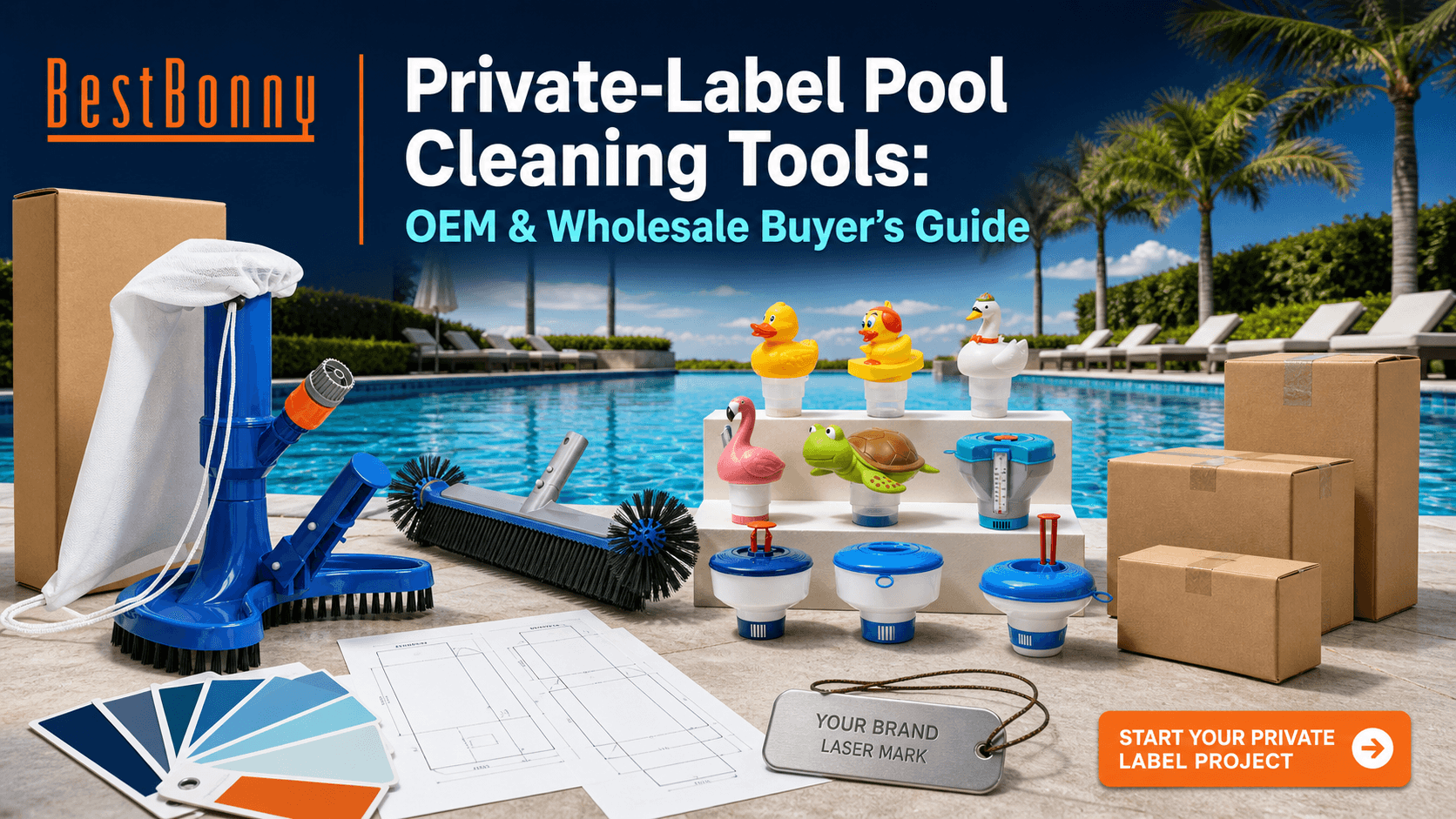
BONNY provides OEM and ODM services for pool cleaning equipment and accessories.
According to the company's Engineering & Design page, its services cover product design, prototype development, private labeling, customized packaging, and material or color customization.
Common OEM Project Requirements
| Customization | Business Value | What Buyers Should Confirm |
|---|---|---|
| Custom logo | Brand recognition | Application method and artwork approval |
| Product color | Product differentiation | Material and color consistency |
| Private-label packaging | Retail presentation | Carton, label, barcode and language requirements |
| Material selection | Application-specific product design | Grade, performance requirements, feasibility |
| Hose connection design | Compatibility with target-market equipment | Dimensions, tooling and testing |
| New product structure | Differentiated product development | Engineering scope, prototypes and tooling |
OEM vs ODM
OEM generally involves manufacturing a product according to the buyer's defined specifications or adapting an existing product for branding and packaging.
ODM involves additional product development, which may include concept evaluation, structural engineering, prototyping, and design validation.
A simple color or logo change is different from developing a new suction-head structure.
For successful cooperation, the buyer should define the customization scope before requesting final pricing.
9. Pool Vacuum Head Wholesale Pricing, MOQ and Lead Time
When comparing manufacturers, the quoted unit price should not be the only purchasing criterion.
Two products with similar dimensions may differ in their materials, connection components, assembly methods, and packaging requirements.
Main Factors Affecting Price
-
Body material and weight.
-
Head size and structural complexity.
-
Number and type of additional components.
-
Brush, wheel, or connector design.
-
Production quantity.
-
OEM branding and packaging.
-
Tooling or development costs.
-
Inspection and testing requirements.
-
Freight and delivery conditions.
A useful purchasing comparison considers the total landed cost, including product price, customization, packaging, inspection, freight, and applicable import charges.
Minimum Order Quantity
MOQ varies according to the product, packaging, materials, and customization requirements.
Standard products and newly developed OEM designs may have different minimum production quantities.
Buyers should request a model-specific quotation rather than assume one MOQ applies to every product.
Production Lead Time
Lead time depends on order quantity, production scheduling, material availability, sample approval, and customization.
For new product development, tooling and prototyping may add additional stages.
Ask the supplier to confirm these arrangements in writing before finalizing the order.
10. Common Procurement Risks and How to Avoid Them
Selecting the wrong pool vacuum head manufacturer can lead to product incompatibility, returns, delays, and avoidable expenses.
The following risks deserve special attention.
Risk 1: Incorrect Hose Dimensions
Problem: Vacuum heads do not connect securely to the hoses sold in the target market.
Solution: Confirm actual dimensions and approve physical samples.
Risk 2: Inconsistent Suction Performance
Problem: A product works poorly because the head geometry and suction system are not appropriately matched.
Solution: Perform functional trials using a defined cleaning system and representative debris.
Risk 3: Surface Damage
Problem: Contact materials or edges are inappropriate for the customer's pool finish.
Solution: Verify intended surface compatibility and follow the pool finish manufacturer's guidance.
Risk 4: Component Failure
Problem: Connectors, brushes, or wheels become loose during normal operation.
Solution: Establish agreed component retention and functional inspection requirements.
Risk 5: Uncontrolled OEM Changes
Problem: Bulk products differ from approved samples in color, material, connections, or packaging.
Solution: Use controlled specifications and require approval of relevant product changes.
Risk 6: Unclear Commercial Terms
Problem: Buyers discover unexpected tooling charges, packaging requirements, or delivery limitations.
Solution: Confirm MOQ, quotation scope, Incoterms, sample charges, and lead time before placing an order.
11. Why Consider BONNY as a Pool Vacuum Head Manufacturing Partner?
Ningbo Bonny E-Home Co., Ltd., founded in 1998 and based in Ningbo, China, manufactures swimming pool cleaning equipment and accessories for international markets.
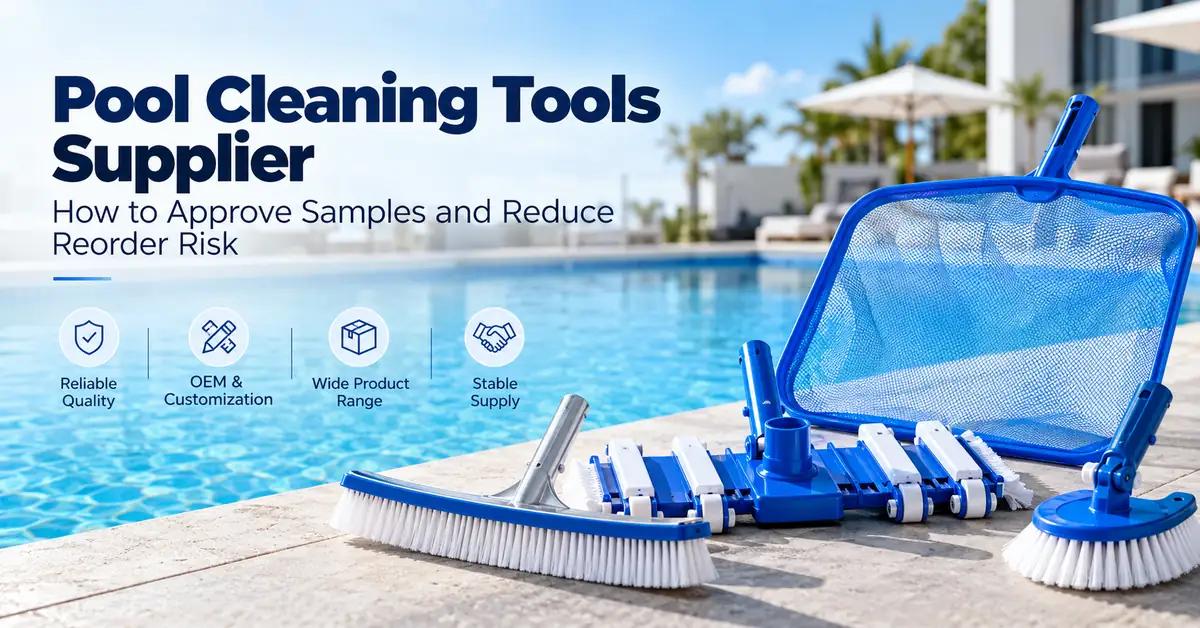
The company's product range includes manual pool vacuum heads, pool wall brushes, skimmer nets, and other maintenance products.
Its engineering and manufacturing information also describes product development, injection molding, bristle planting, OEM/ODM customization, and export-oriented cooperation.
What Makes BONNY Relevant to B2B Buyers?
Product range: Buyers can evaluate different pool cleaning accessories within a single catalogue.
Manufacturing expertise: The company identifies production processes relevant to plastic cleaning equipment and related components.
OEM/ODM support: International customers can discuss branding, packaging, materials, and product development requirements.
Engineering communication: Buyers can submit technical drawings, reference products, and application information for project evaluation.
Wholesale sourcing: Importers and distributors can enquire about product selection, quantities, samples, and export arrangements.
These capabilities make BONNY a potential supplier for wholesale and customized pool vacuum head projects. Final supplier approval should still depend on confirmed specifications, representative samples, commercial terms, and applicable quality documentation.
Explore BONNY Pool Cleaning Products
Learn About BONNY Manufacturing and Engineering
12. How to Request a Pool Vacuum Head Manufacturing Quotation
An accurate RFQ helps the manufacturer understand your actual purchasing requirements.
For wholesale or OEM orders, provide the following information.
| RFQ Field | Information to Provide |
|---|---|
| Product type | Flexible vacuum head, suction brush head, or other design |
| Application | Residential, commercial, above-ground, or inground pool |
| Pool surface | Vinyl, fiberglass, concrete, plaster, or tile |
| Head dimensions | Preferred cleaning width and overall dimensions |
| Hose connection | Required dimensions and connection style |
| Pole connection | Existing pole dimensions and locking mechanism |
| Materials | Preferred body, brush, and other component materials |
| Order quantity | Estimated quantity per SKU |
| Branding | Standard product, private label, or new OEM/ODM design |
| Packaging | Retail box, bulk carton, barcode and language requirements |
| Destination | Country, delivery conditions, preferred schedule |
| Testing requirements | Inspection criteria and required technical documentation |
If you are developing a new product, drawings, reference samples, or clear photographs can help explain your requirements.
If you are sourcing existing products, specify your target market and the equipment your customers already use.
Ready to Develop Your Wholesale Pool Vacuum Head Range?
BONNY can discuss product options, OEM requirements, sample arrangements, and quotation details for your project.
Contact BONNY for Pool Vacuum Head Samples and Wholesale Pricing
Frequently Asked Questions About Pool Vacuum Head Manufacturers
1. What does a pool vacuum head manufacturer produce?
A pool vacuum head manufacturer produces cleaning attachments used with suitable pool vacuum systems. Products may include flexible vacuum heads, brush-equipped suction heads, and other manual cleaning designs.
2. How do I choose a reliable pool vacuum head manufacturer in China?
Compare product specifications, hose and pole compatibility, sample quality, engineering support, inspection arrangements, and commercial terms. Request evidence for the actual product you intend to purchase.
3. Are all pool vacuum heads compatible with standard pool hoses?
No. Connection dimensions and fittings may vary. Buyers should confirm actual measurements and test the vacuum head with the hoses sold in their target market.
4. What is the difference between a flexible vacuum head and a brush vacuum head?
A flexible vacuum head is designed around head movement or flexibility, depending on its construction. A brush-equipped vacuum head also incorporates brushing components. The better choice depends on the pool surface and cleaning requirements.
5. Can pool vacuum heads be used on vinyl-lined pools?
Some designs may be suitable for vinyl-lined pools, but compatibility depends on the specific head, contact components, and liner requirements. Verify suitability before use.
6. Can BONNY provide private-label pool vacuum heads?
BONNY offers OEM/ODM and private-label services for pool cleaning equipment. Specific product branding, color, material, packaging, and design options must be confirmed for the selected model.
7. What is the MOQ for wholesale pool vacuum heads?
MOQ varies by model, order quantity, packaging, and customization requirements. Buyers should request a quotation based on their selected products and expected purchasing volume.
8. How can I evaluate pool vacuum head quality before bulk orders?
Check the approved specifications, hose and pole connections, body integrity, component attachment, functional performance, and packaging. Request representative samples and agree on inspection criteria.
9. What factors affect pool vacuum head wholesale pricing?
Price depends on materials, product dimensions, component complexity, customization, quantity, packaging, tooling, and shipping requirements. Compare suppliers using the same specifications.
10. What should I send when requesting OEM pool vacuum head samples?
Provide the intended application, preferred design, connection dimensions, materials, branding requirements, estimated order quantity, destination country, and any available drawings or reference samples.
Conclusion
Choosing a reliable pool vacuum head manufacturer requires a detailed understanding of hose compatibility, telescopic pole connections, suction-head construction, pool surface requirements, manufacturing processes, and wholesale purchasing conditions.
For importers, distributors, and private-label brands, successful procurement begins with clearly defined technical specifications and representative sample testing. Consistent quality, suitable product design, and documented OEM requirements help reduce compatibility problems and improve long-term supply planning.
BONNY provides pool cleaning accessories and OEM/ODM manufacturing support for international B2B customers seeking standard or customized swimming pool maintenance products.
Whether you are introducing a new private-label vacuum head range, expanding your wholesale catalogue, or evaluating alternative manufacturers, BONNY can discuss product options based on your application and purchasing requirements.
Contact BONNY to Request Pool Vacuum Head Specifications, OEM Samples, and a Wholesale Quotation