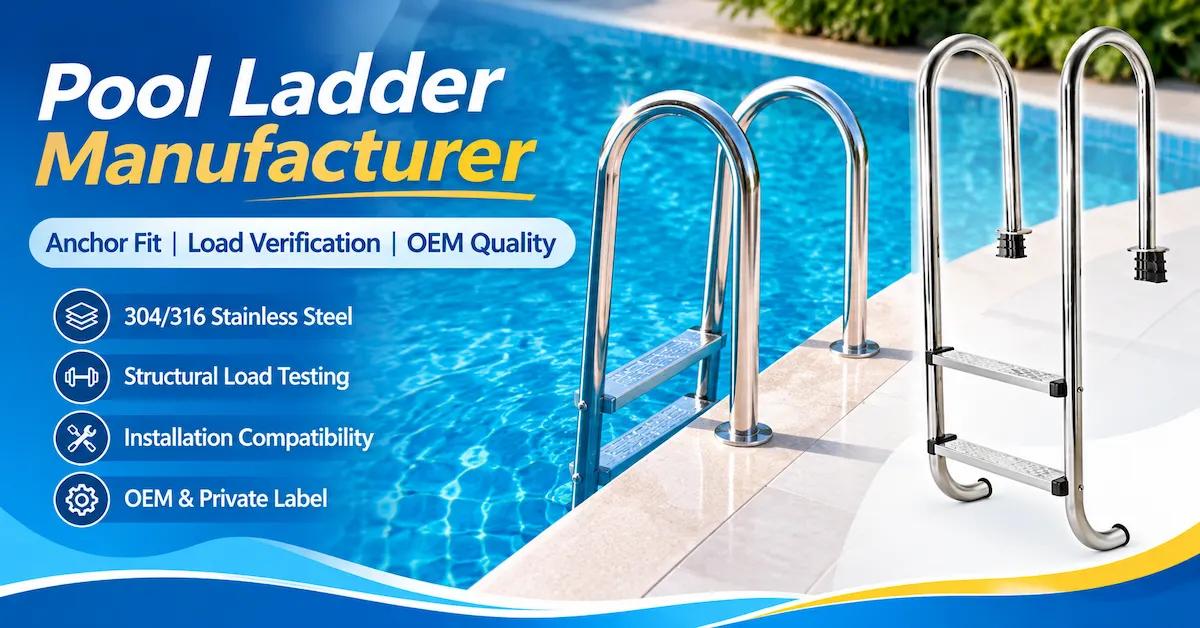

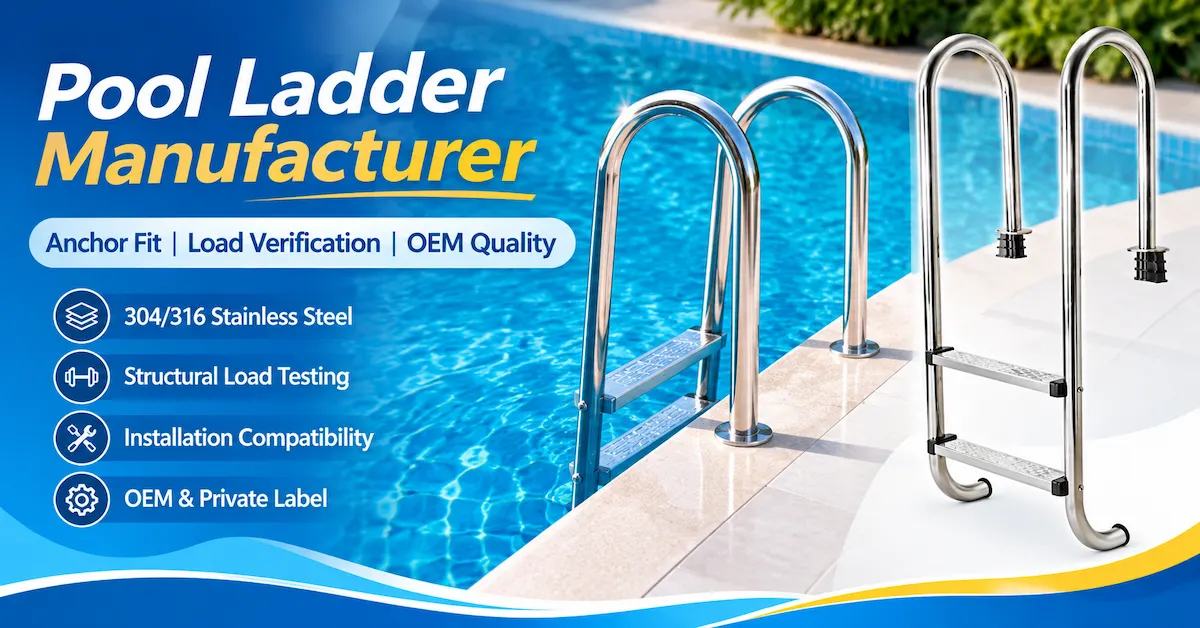
Quick Answer: A reliable pool ladder manufacturer should provide model-specific drawings, material specifications, anchoring details, step and handrail dimensions, appropriate load-test evidence, and documented quality requirements. For wholesale buyers, the critical checks are installation compatibility, structural integrity, corrosion resistance, slip-resistant step design, and repeat-order consistency—not simply the number of steps or the lowest factory price.
Swimming pool ladders are essential access components for residential pools, hotels, resorts, aquatic facilities, and swimming pool construction projects.
Although they appear relatively simple, their safety and performance depend on multiple interacting factors.
A ladder may use a suitable stainless steel grade but fail to fit the intended deck anchors. Another product may have attractive handrails but lack documented evidence of its structural performance. Incorrect mounting accessories can also delay installation or create unsafe conditions.
For overseas importers and distributors, these problems can result in product returns, delayed construction projects, warranty disputes, and additional installation costs.
This technical sourcing guide explains how to evaluate pool ladder manufacturers based on engineering requirements, material selection, installation interfaces, inspection procedures, and OEM supply capabilities.
It is designed for buyers seeking dependable, repeatable wholesale purchasing decisions.
Key Takeaways for Pool Ladder Buyers
-
Installation compatibility comes first. Pool type, wall geometry, deck construction, anchor arrangement, and ladder dimensions must be established before ordering.
-
304 and 316 stainless steel are not interchangeable in every environment. Material selection depends on water chemistry, chloride exposure, maintenance, and structural conditions.
-
Structural claims require model-specific evidence. Confirm applicable load-testing methods, acceptance criteria, and supporting documents.
-
Anti-slip step design requires evaluation. Textured treads, secure attachments, drainage, and safe edges should be reviewed for the intended application.
-
OEM customization must preserve engineering performance. Changes to dimensions, steps, handrails, materials, or anchoring can require additional testing.
-
Repeat orders need controlled specifications. Approved drawings, materials, samples, inspection criteria, and component revisions help prevent unwanted substitutions.
1. What Should a Professional Pool Ladder Manufacturer Provide?
A professional pool ladder manufacturer should be able to discuss the selected product in terms of its actual application, structure, materials, and installation requirements.
For B2B buyers, purchasing should begin with a technical specification rather than a catalogue photograph.
Pool Ladder Supplier Qualification Checklist
| Evaluation Area | What Buyers Should Confirm | Main Purchasing Risk |
|---|---|---|
| Pool application | In-ground, above-ground, residential, or commercial use | Incorrect product selection |
| Ladder geometry | Overall height, width, step positions, and rail spacing | Installation mismatch |
| Mounting system | Anchor socket, base plate, support feet, or A-frame construction | Incompatible installation |
| Material specification | Stainless steel grade, polymer components, and fasteners | Corrosion or deterioration |
| Structural performance | Applicable rated load and test evidence | Unsupported load claims |
| Step design | Tread dimensions, surface texture, and attachment | Slipping or component movement |
| Surface finishing | Polishing, weld finishing, and treatment requirements | Surface defects and corrosion |
| Product documentation | Drawings, installation instructions, test records | Incorrect installation |
| OEM requirements | Branding, packaging, dimensions, and design modifications | Inconsistent production |
| Quality control | Approved samples and inspection criteria | Defective or inconsistent shipments |
Procurement takeaway: The manufacturer should support evaluation of the complete ladder assembly, including mounting components and installation requirements.
A product photograph alone cannot establish whether a ladder is suitable for a particular pool.
2. Which Pool Ladder Types Are Suitable for Wholesale Distribution?
The correct ladder configuration depends on how users enter and exit the pool, the installation structure, and the intended operating environment.
BONNY's published Pool Ladder Product Category includes several ladder and handrail configurations.
These provide a useful starting point for product comparisons.
In-Ground Pool Ladders
In-ground pool ladders commonly use handrails and submerged steps.
Depending on the design, they may connect to suitable deck anchors or other approved mounting arrangements.
Buyers should verify the intended deck structure, dimensions, pool-wall clearance, and required installation hardware.
A ladder developed for one pool layout should not automatically be considered suitable for every concrete, tiled, or liner-finished pool.
Above-Ground Pool Ladders
Above-ground pool ladders may use A-frame or other supported structures.
Their suitability depends on the pool height, wall construction, support arrangement, and intended user access.
Some designs incorporate barriers or other access-management features.
Such features should not be described as childproof or as independently preventing unauthorized entry without appropriate validation.
Folding Pool Ladders
Folding or removable configurations may offer storage and handling advantages for suitable applications.
However, folding mechanisms introduce additional joints and moving components that require mechanical verification.
Pool Handrails
Standalone handrails can support specific pool-entry arrangements.
They should not be treated as equivalent to a complete ladder with steps.
The mounting system, intended load conditions, and installation requirements must be evaluated separately.
Pool Ladder Type Comparison
| Product Configuration | Typical Purchasing Application | Critical Verification |
|---|---|---|
| In-ground stainless steel ladder | Permanent pool access | Anchoring, rail spacing, wall clearance |
| Above-ground A-frame ladder | Compatible above-ground pool structures | Pool height, support points, stability |
| Folding pool ladder | Suitable removable or seasonal arrangements | Joint security and deployment mechanism |
| Multi-step pool ladder | Defined access height and user requirements | Step geometry and structural performance |
| Standalone pool handrail | Supplemental support at designated access points | Base plate and substrate anchoring |
| OEM customized ladder | Buyer-specific pool project or retail range | Drawing approval and design validation |
These are product categories, not confirmation that every option is available with all materials, step counts, or mounting systems.
For a broader introduction to product configurations, see BONNY's Pool Ladder Selection Guide.
3. Why Is Anchor Compatibility Critical When Sourcing Pool Ladders?
Anchor compatibility is one of the most important technical factors in pool ladder procurement.
A ladder can be manufactured correctly yet remain unsuitable for installation if its mounting dimensions do not match the receiving structure.
Common Mounting Arrangements
Depending on the ladder design, installation may involve:
Deck-mounted anchor sockets: Ladder rails engage with compatible anchors installed in an appropriate deck structure.
Surface-mounted base plates: Rails or handrails connect through approved flanges and specified fasteners.
Supported ladder frames: Certain above-ground products use structural feet or complete frame systems rather than permanent deck anchors.
These mounting arrangements are not interchangeable.
What Measurements Should Buyers Request?
A technical drawing should identify the relevant dimensions for the selected design.
| Measurement | Why It Matters |
|---|---|
| Overall ladder height | Confirms suitability for the intended installation |
| Rail center-to-center distance | Determines alignment with mounting positions |
| Tube outside diameter | Affects compatibility with sockets and accessories |
| Step width and position | Influences access geometry |
| Vertical step spacing | Affects safe and practical use |
| Deck-to-pool geometry | Determines whether the ladder reaches the intended position |
| Wall clearance | Helps prevent unsuitable contact with the pool structure |
| Anchor dimensions | Defines the required mounting interface |
| Support foot location | Influences load transfer and contact with the pool surface |
The required tolerances should be agreed with the manufacturer before production.
Why Anchor Dimensions Must Be Verified
Even small differences between the supplied rail spacing and the installed anchors can prevent correct assembly.
Attempting to force components into position may damage the ladder, mounting system, or surrounding construction.
Importers supplying replacement ladders should therefore obtain measurements from the intended installation rather than rely on general descriptions such as "universal replacement."
Who Is Responsible for Installation Design?
The pool contractor, project engineer, or qualified installer should verify the suitability of the installation substrate and anchoring system.
A manufacturer can provide product drawings and installation requirements, but these documents do not automatically establish that a particular existing deck or pool structure can support the ladder.
Engineering takeaway: Approve the ladder and its mounting system as a complete installation interface.
4. 304 vs 316 Stainless Steel: Which Material Should Buyers Specify?
Material selection is a major consideration when evaluating a stainless steel pool ladder manufacturer.
Pool ladders are exposed to treated water, splashing, cleaning products, and environmental conditions that can contribute to corrosion.
304 Stainless Steel
Grade 304 is used in many swimming pool applications.
It can provide suitable performance when the environment, design, fabrication, and maintenance conditions are appropriate.
However, it is not immune to staining, pitting, crevice corrosion, or other forms of degradation.
316 Stainless Steel
Grade 316 contains molybdenum, which generally improves resistance to chloride-related pitting and crevice corrosion compared with 304.
It may be preferable for demanding pool environments.
However, 316 stainless steel is not universally corrosion-proof.
Higher chloride exposure, unfavorable water chemistry, deposits, inadequate cleaning, and unsuitable design can still lead to corrosion.
Material Comparison
| Selection Factor | 304 Stainless Steel | 316 Stainless Steel |
|---|---|---|
| General corrosion resistance | Suitable for selected pool conditions | Generally stronger resistance to chloride-related localized corrosion |
| Material cost | Typically lower | Typically higher |
| Pitting resistance | Lower than 316 | Generally improved |
| Chlorinated pool applications | Requires application assessment | Often preferred, depending on conditions |
| Saltwater pool applications | Requires careful review | Requires careful review; not automatically suitable |
| Fabrication | Established manufacturing processes | Established manufacturing processes |
| Maintenance | Necessary | Necessary |
| Buyer documentation | Confirm grade and material evidence | Confirm grade and material evidence |
The British Stainless Steel Association identifies 304 and 316 as established materials for appropriately designed and maintained swimming pool equipment, while generally favoring 316 for improved resistance to staining and localized corrosion.
The same guidance also distinguishes immersed components from certain safety-critical, load-bearing components exposed to aggressive indoor pool atmospheres, where stress corrosion cracking can create additional concerns.
What About Saltwater Pools?
A saltwater chlorination system does not eliminate chloride-related corrosion risks.
Buyers should provide the intended water-treatment method, expected chloride exposure, operating temperature, and maintenance conditions.
Material selection should be evaluated for the specific project.
Do not treat descriptions such as "marine grade," "saltwater safe," or "rust-proof" as substitutes for material specifications and appropriate evidence.
What Material Documentation Should Buyers Request?
Relevant documentation may include the specified stainless steel grade, material certificate or supplier declaration, component material information, and traceability arrangements.
Documentation should correspond to the actual product or production batch where required.
5. How Do Ladder Tube Geometry and Step Design Affect Performance?
A pool ladder's structural behavior depends on the complete assembly.
Material grade alone does not determine its strength.
Tube dimensions, wall thickness, bending geometry, step connections, mounting arrangements, and manufacturing quality all influence performance.
Stainless Steel Tube Design
The tube outside diameter and wall thickness are important engineering variables.
However, a larger tube or thicker wall is not automatically evidence that the finished ladder meets a specific load requirement.
The overall design and mounting conditions must be evaluated.
Tube Bending and Welds
Manufacturing processes can influence dimensional consistency and finished appearance.
Buyers should review:
-
Correct bending geometry.
-
Absence of unacceptable cracks or deformation.
-
Appropriate welded-joint quality.
-
Smooth and accessible surfaces.
-
Proper finishing of relevant welded areas.
-
Alignment between the rails and step connections.
The inspection method should reflect the selected design and its applicable requirements.
Anti-Slip Pool Ladder Steps
Pool ladder treads should provide an appropriate walking or stepping surface for wet conditions.
Depending on the model, steps may include textured polymer surfaces, molded features, or other specified treatments.
However, a visually textured surface is not automatically proof of compliance with a particular slip-resistance requirement.
Buyers should evaluate the applicable test method and intended conditions.
Step Design Inspection
| Component | What to Examine | Potential Risk |
|---|---|---|
| Step surface | Appropriate texture and wet-use performance | Slip hazard |
| Step geometry | Dimensions and positioning | Unsuitable access |
| Step attachment | Mechanical security | Loose or moving tread |
| Step edges | Suitable finishing | Injury or snagging |
| Connection hardware | Material and fastening specification | Loosening or corrosion |
| Handrails | Geometry and secure assembly | Inadequate support |
For hotel, public pool, or other projects with specific accessibility requirements, the complete access design should be assessed against the applicable local rules.
A standard pool ladder should not automatically be described as universally accessible.
6. What Manufacturing Processes Should Pool Ladder Buyers Evaluate?
Manufacturing quality affects dimensions, appearance, structural consistency, and assembly reliability.
The relevant production processes depend on the actual ladder model.
Material Preparation
Metal tubes, fasteners, and plastic step components should correspond to approved specifications.
Material substitutions should not occur without the buyer's approval where they affect relevant requirements.
Tube Forming
For metal ladder designs, tube bending and forming influence the final rail geometry.
Important dimensions should be measured against approved drawings.
Welding and Joining
Where welded components are used, suitable joining processes and inspection procedures should be established.
Weld appearance alone is not enough to confirm structural performance.
Surface Finishing
Polishing and appropriate post-fabrication treatment may support appearance, cleaning, and corrosion performance.
Poor finishing can leave defects or contamination that contribute to later problems.
Step and Hardware Assembly
Steps, brackets, fasteners, and other components should be assembled according to approved requirements.
Critical joints should remain secure during intended use.
Packaging
The packaging should protect finished rails, polished surfaces, steps, and mounting accessories during transport.
The final packing arrangement should match the commercial order and approved product configuration.
What Does BONNY Manufacture?
According to its Company Information, Ningbo Bonny E-Home Co., Ltd. has manufacturing capabilities including injection molding, blow molding, extrusion, and bristle planting.
These capabilities are relevant to its broader pool equipment and accessory business.
For an individual metal ladder project, buyers should specifically confirm which processes, including any tube fabrication, welding, finishing, testing, and final assembly, are performed in-house or by qualified partners.
Buyer recommendation: Evaluate the production and inspection responsibilities for the selected ladder rather than assume the same manufacturing arrangement applies to every product category.
7. What Load Tests and Safety Documents Should Buyers Request?
Pool ladders are load-bearing access products.
Consequently, unsupported statements such as "heavy duty," "high strength," or "commercial grade" are insufficient for technical procurement.
A manufacturer should provide the appropriate load rating and evidence required for the selected model and intended market.
Static Load Verification
Static testing may be used to evaluate structural behavior under defined loading conditions.
The applied load, loading position, mounting arrangement, duration, and acceptance criteria must be specified by the applicable test method or agreed engineering plan.
Repeated or Dynamic Loading
Where required, testing may evaluate how a ladder responds to repeated or changing loads.
The appropriate procedures depend on the design and applicable standards.
Step Attachment Verification
Buyers should also consider whether the steps remain securely attached under the relevant conditions.
A complete ladder may need separate evaluations of its rails, treads, connections, and mounting system.
Why Installation Conditions Matter
Testing a ladder with one mounting arrangement does not automatically validate every alternative installation.
Anchor geometry, substrate, and fixing method can influence performance.
Documentation should identify the tested configuration.
Understanding EN 13451-2
EN 13451-2:2015+A1:2020 specifies additional safety requirements and test methods for ladders, stepladders, and handle bends used for pool access and egress within its defined scope.
It is part of the EN 13451 swimming pool equipment standards series.
For a project involving classified swimming pools covered by the standard, buyers should confirm the applicable requirements, edition, and supporting test evidence.
The standard should not be presented as automatically applicable to every domestic above-ground ladder or every international market.
Safety and Quality Documentation Checklist
| Document or Evidence | Purpose | Important Qualification |
|---|---|---|
| Technical drawing | Confirms product dimensions and geometry | Must match the selected model |
| Material specification | Identifies relevant materials | Must reflect actual components |
| Load-test record | Supports structural claims | Test configuration and acceptance criteria must be clear |
| Step or tread evaluation | Supports required step performance | Must use an appropriate method |
| Installation instructions | Defines correct assembly and mounting | Must suit the product and market |
| Inspection records | Supports manufacturing consistency | Must correspond to agreed requirements |
| Applicable standard evidence | Supports market-specific requirements | Scope and edition must be verified |
| Packaging specification | Controls shipment completeness | Must match the approved configuration |
Do not assume that CE marking, RoHS, ISO 9001 certification, or other documents automatically establish the structural safety of every pool ladder model.
Any claim of compliance should be supported by evidence applicable to that particular product and intended market.
8. How Can Buyers Establish an Effective Pool Ladder Quality Control Plan?
An effective inspection plan should cover materials, dimensions, structure, assembly, and packaging.
Recommended Pool Ladder QC Matrix
| Inspection Stage | Suggested Check | Main Risk Controlled |
|---|---|---|
| Incoming materials | Verify approved material specifications | Incorrect material substitution |
| Tube forming | Check critical rail dimensions | Anchor mismatch |
| Welding or joining | Inspect relevant joints | Structural defects |
| Step assembly | Check position and attachment | Loose or incorrectly placed steps |
| Surface finishing | Inspect defects and contamination | Appearance and corrosion problems |
| Mounting hardware | Verify type and dimensions | Installation incompatibility |
| Functional assembly | Assemble using approved components | Fit and stability problems |
| Product identification | Check SKU, revision, and labels | Wrong product shipment |
| Packing | Confirm hardware, instructions, and protection | Missing parts or transit damage |
Sample Approval
Before bulk production, buyers should review representative samples against the approved drawings.
Where relevant, sample approval should include a complete trial assembly with the intended mounting hardware.
Critical, Major, and Minor Defects
A quality agreement can distinguish defects according to their potential consequences.
For example:
Critical defects may involve conditions that create unacceptable safety risks.
Major defects may prevent correct installation or intended use.
Minor defects may involve cosmetic deviations within agreed limits.
The actual classification and acceptance criteria must be defined before production.
How Can ISO 2859-1 Support Inspection?
ISO 2859-1:2026 provides sampling procedures for inspection by attributes.
An agreed sampling plan can support evaluation of certain measurable or observable product characteristics during lot inspection.
However, sampling inspection does not replace suitable design verification, structural testing, or critical safety controls.
A statistical sampling plan also does not guarantee that every individual ladder is defect-free.
Quality takeaway: Structural verification, dimension control, assembly inspection, and shipment sampling serve different purposes. They should be coordinated rather than treated as interchangeable.
9. OEM and Private-Label Pool Ladder Manufacturing
OEM pool ladder manufacturing can support importers, distributors, retail brands, and project suppliers seeking products with defined technical and commercial specifications.
BONNY describes OEM and ODM support through its Engineering & Design Services.
Typical OEM Requirements
| Customization Requirement | Commercial Purpose | Technical Consideration |
|---|---|---|
| Product branding | Private-label identity | Approved marking and placement |
| Stainless steel grade | Suitability for target application | Material and corrosion requirements |
| Handrail dimensions | Installation compatibility | Geometry and structural verification |
| Step configuration | Project-specific access requirements | Step layout and structural performance |
| Tread appearance | Product differentiation | Wet-use suitability and attachment |
| Mounting hardware | Compatibility with the intended installation | Anchor and fixing verification |
| Surface finish | Appearance and maintenance | Finishing and corrosion considerations |
| Packaging | Retail or export requirements | Protection and shipment dimensions |
These are examples of potential customization requirements, not confirmation that every change is available for every BONNY product.
OEM vs ODM Pool Ladders
OEM: Manufacturing to an approved design or customizing an existing product within agreed technical boundaries.
ODM: Developing a new or modified product concept, potentially requiring engineering, prototyping, tooling, and testing.
A change to package artwork is not equivalent to redesigning the handrails or modifying the number of steps.
Changes affecting structural performance or installation should receive appropriate engineering review.
Recommended OEM Development Workflow
Step 1 — Define the application. Provide pool type, destination market, user environment, and installation conditions.
Step 2 — Review available products. Select a suitable catalogue model or describe the required custom design.
Step 3 — Confirm technical drawings. Approve geometry, materials, steps, mounting interfaces, and hardware.
Step 4 — Establish testing requirements. Identify applicable standards and verification methods.
Step 5 — Approve the sample. Assess dimensions, assembly, finish, and required performance evidence.
Step 6 — Finalize OEM packaging. Confirm branding, instructions, labels, and protection.
Step 7 — Agree on production controls. Define inspection criteria, product identification, and change management.
Step 8 — Confirm the commercial order. Approve MOQ, price, lead time, delivery terms, and relevant documentation.
10. How Do Different Pool Ladder Configurations Affect Wholesale Costs?
Wholesale ladder pricing depends on the complete product structure.
Material choice is only one factor.
The number of steps, handrail design, mounting components, finishing requirements, assembly complexity, and packaging may all affect cost.
Cost Comparison by Product Configuration
| Product Type | Important Cost Drivers | Main Buyer Consideration |
|---|---|---|
| Stainless steel in-ground ladder | Tube grade, length, steps, finishing, hardware | Installation compatibility |
| Above-ground A-frame ladder | Frame construction, steps, supports, assembly | Pool height and stability |
| Folding ladder | Joints, locking components, structure | Mechanism reliability |
| Plastic or resin ladder | Material, molding and structural design | Application and durability requirements |
| Standalone handrail | Tube geometry, base plate, fasteners | Mounting design |
| Customized OEM ladder | Engineering, tooling, materials and packaging | Development and validation cost |
Total Landed Cost
A purchasing comparison should include:
Total landed cost = Product price + Tooling allocation + Customization + Inspection + Packaging + Freight + Insurance + Applicable import charges + Expected replacement costs.
This formula is a procurement framework rather than a published BONNY quotation.
Packaging and Freight Considerations
Pool ladders can be relatively bulky compared with many small pool accessories.
Shipping cost may depend heavily on carton dimensions and packing configuration.
Buyers should confirm whether the product is shipped assembled, partially assembled, or disassembled.
Disassembled products may offer packaging advantages but require suitable installation instructions and component verification.
MOQ and Lead Time
Minimum order quantity depends on the product, customization requirements, packaging, and production arrangements.
Lead time can be influenced by material availability, manufacturing scheduling, engineering changes, and sample approval.
Obtain updated commercial terms for the specific model rather than relying on general estimates.
11. What Are the Most Common Pool Ladder Procurement Mistakes?
Mistake 1: Selecting by Step Count Alone
Risk: The ladder may be incompatible with the intended pool height or mounting geometry.
Solution: Confirm the complete installation drawing and application requirements.
Mistake 2: Assuming 316 Stainless Steel Cannot Corrode
Risk: Chloride exposure, deposits, unsuitable fabrication, and inadequate maintenance may still cause corrosion.
Solution: Evaluate the operating environment, material specification, design, and maintenance requirements.
Mistake 3: Trusting an Unverified Load Rating
Risk: A marketing claim may not correspond to the selected product.
Solution: Request model-specific load-test evidence and clarify the tested mounting arrangement.
Mistake 4: Ignoring Anchor Interfaces
Risk: The product cannot be installed with the available mounting system.
Solution: Verify rail spacing, tube dimensions, anchor components, and installation conditions.
Mistake 5: Assuming Textured Steps Guarantee Compliance
Risk: A tread may look slip-resistant without supporting test evidence.
Solution: Define the relevant wet-use performance requirements and verification method.
Mistake 6: Treating Every Pool Ladder as Suitable for Commercial Facilities
Risk: The product may not satisfy the applicable project requirements.
Solution: Confirm facility classification, use conditions, and relevant standards before ordering.
Mistake 7: Changing Materials or Dimensions Without Revalidation
Risk: Modified components may affect structural or installation performance.
Solution: Use controlled drawings, approved material specifications, and change-approval procedures.
Mistake 8: Ignoring Packaging and Installation Hardware
Risk: Shipments arrive with damaged finishes, missing hardware, or incomplete instructions.
Solution: Inspect the complete shipment configuration, not only the primary ladder structure.
12. Why Consider BONNY as a Pool Ladder Manufacturing Partner?
Ningbo Bonny E-Home Co., Ltd., founded in 1998, develops and manufactures swimming pool cleaning equipment and accessories for international customers.
BONNY's official product catalogue includes several pool ladder and handrail categories.
These include above-ground ladders, stainless steel ladder configurations, folding designs, and standalone pool handrails.
Product Range
The company provides a starting point for importers and distributors evaluating different ladder configurations.
Product availability and current specifications should be confirmed through the official catalogue or a direct enquiry.
OEM and ODM Services
BONNY describes support for customized products, branding, materials, colors, and packaging.
For pool ladder projects, structural modifications and material choices should receive model-specific engineering review.
View BONNY Engineering & Design
Export-Oriented Cooperation
BONNY works with overseas business customers on product requirements, sampling, customization, and export orders.
Buyers can submit technical drawings, required quantities, destination markets, and documentation needs for evaluation.
What Buyers Should Confirm Before Ordering
The following items should be established directly with BONNY for the selected ladder:
-
Exact material grades and component specifications.
-
Approved product drawings.
-
Mounting hardware and installation requirements.
-
Intended use and applicable standards.
-
Available structural or other test reports.
-
OEM development and packaging options.
-
MOQ, quotation, and lead time.
This approach helps align the final product with the buyer's purchasing and project requirements.
13. Pool Ladder Manufacturer RFQ Checklist for Importers
A complete request for quotation helps manufacturers identify suitable products and clarify technical requirements.
Recommended RFQ Information
| RFQ Item | Details to Provide |
|---|---|
| Product type | In-ground, above-ground, folding, or standalone handrail |
| Intended use | Residential, hotel, resort, or other defined facility |
| Installation environment | Pool construction and relevant water conditions |
| Material requirement | Specified grade or request for material evaluation |
| Ladder dimensions | Height, width, rail spacing, and step layout |
| Mounting system | Anchor socket, base plate, or specified frame |
| Structural requirements | Required rating and applicable verification method |
| Step requirements | Geometry, tread material, and wet-use performance |
| Surface finish | Approved finish and appearance requirements |
| Hardware | Fasteners, anchors, protective pads, and other items |
| OEM requirements | Logo, materials, design changes, or packaging |
| Documentation | Drawings, test reports, inspection records, instructions |
| Estimated quantity | Initial volume and anticipated repeat orders |
| Destination | Country and target sales channel |
| Commercial terms | MOQ, unit price, delivery terms, and schedule |
Request a Pool Ladder Manufacturing Quotation
For an efficient technical discussion, provide a reference product, intended pool type, installation dimensions, expected order volume, destination market, and any specific testing requirements.
BONNY can review available ladder configurations and discuss OEM or ODM feasibility before confirming specifications and commercial terms.
Contact BONNY for Pool Ladder Specifications, OEM Development and Wholesale Pricing
Frequently Asked Questions About Pool Ladder Manufacturers
1. How do I choose a reliable pool ladder manufacturer in China?
Evaluate the manufacturer's relevant product range, technical drawings, material documentation, mounting compatibility, structural test evidence, quality controls, and OEM services. Approve a representative sample and commercial specifications before placing a bulk order.
2. Is 316 stainless steel better than 304 for swimming pool ladders?
316 generally offers better resistance to chloride-related pitting and crevice corrosion. However, neither grade is universally corrosion-proof. The correct choice depends on the pool environment, product design, maintenance, and applicable requirements.
3. Are stainless steel pool ladders suitable for saltwater swimming pools?
Suitability must be evaluated for the specific product and water conditions. Saltwater exposure can contribute to corrosion, and material selection should consider the chloride environment, component construction, and required maintenance.
4. What dimensions should I confirm before ordering an in-ground pool ladder?
Important dimensions include rail spacing, tube diameter, ladder height, step layout, wall clearance, and anchor geometry. A complete installation drawing should be approved before ordering.
5. What load testing should a pool ladder manufacturer provide?
Request the applicable load rating and evidence of testing appropriate to the product's intended use. The report should identify the tested configuration, loading method, mounting conditions, and acceptance criteria.
6. Do pool ladders need to comply with EN 13451-2?
EN 13451-2 provides requirements for ladders, stepladders, and handle bends within its defined swimming pool scope. Whether it applies to a particular product depends on the facility, intended use, destination market, and applicable requirements.
7. Can BONNY provide OEM or private-label pool ladders?
BONNY publicly offers OEM and ODM services for pool equipment. Specific ladder customization options, including branding, dimensions, materials, and packaging, should be confirmed for the selected product and project.
8. What is the difference between an in-ground pool ladder and an above-ground pool ladder?
In-ground ladders commonly use rail structures intended for compatible permanent pool installations. Above-ground ladders may use A-frame or other supported arrangements designed around the above-ground pool structure. Their mounting systems and applications are not interchangeable.
9. What determines wholesale pool ladder MOQ and production lead time?
MOQ and lead time depend on the ladder model, materials, order quantity, OEM requirements, packaging, tooling, and production scheduling. Buyers should obtain current quotations and schedules for the actual order.
10. What documents should I request when sourcing commercial pool ladders?
Request product-specific drawings, material specifications, mounting instructions, load-test evidence where applicable, relevant market compliance documentation, and agreed quality inspection requirements. Confirm that the documents match the exact model being purchased.
Conclusion
Choosing a reliable pool ladder manufacturer requires careful evaluation of installation geometry, material suitability, structural performance, step design, and manufacturing consistency.
For pool equipment importers, distributors, and project contractors, anchor compatibility and model-specific verification are especially important.
A ladder manufactured from a suitable material can still create installation and performance problems if the mounting system, structural requirements, or component specifications are incorrect.
Likewise, claims about corrosion resistance, load capacity, or international standards should be supported by appropriate evidence rather than promotional descriptions alone.
The most effective sourcing process begins with an approved technical specification, followed by representative sample evaluation, suitable testing, controlled manufacturing, and clear commercial agreements.
BONNY, operated by Ningbo Bonny E-Home Co., Ltd., offers a range of swimming pool ladder and handrail products alongside OEM/ODM services for international business customers.
Whether you are sourcing stainless steel pool ladders, evaluating above-ground ladder configurations, or developing a customized private-label product, BONNY can review your requirements and discuss suitable manufacturing options.
Contact BONNY to Request Pool Ladder Specifications, OEM Samples and Wholesale Quotations