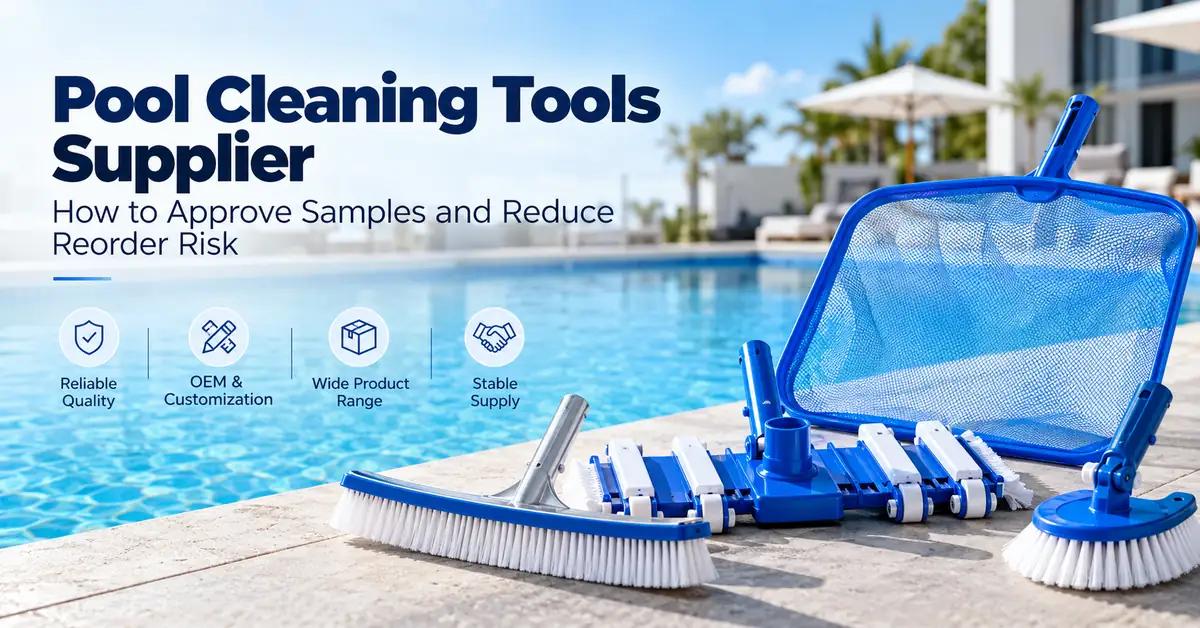

A dependable pool cleaning tools supplier should help you verify product fit, approve representative samples, and maintain specifications across repeat orders—not simply offer the lowest unit price. For importers, distributors, pool service companies, and private-label brands, the main purchasing risks are incompatible fittings, unsuitable brush materials, weak net construction, inconsistent packaging, and changes between sample and bulk production.
The most effective approach is to define the end-use first, request measurable specifications, test samples with your existing equipment, and agree on inspection and reorder requirements before committing to volume. This article provides a practical qualification framework using the types of products in BONNY’s pool accessories range.
1. What Should You Expect From a Pool Cleaning Tools Supplier?
A qualified supplier should support a documented decision across five areas: product suitability, manufacturing or sourcing capability, sample verification, order economics, and ongoing supply consistency.
Different buyers have different priorities:
| Buyer | Main Purchasing Requirement | Typical Risk |
|---|---|---|
| Pool equipment importer | Consistent specifications across several SKUs | Costly returns from incompatible components |
| Wholesale distributor | Clear product assortment and predictable replenishment | Unplanned substitutions or inconsistent cartons |
| Private-label brand | Approved appearance, branding, packaging, and quality | Bulk products differing from approved samples |
| Pool maintenance contractor | Fit-for-purpose tools that withstand its cleaning routines | Premature breakage or slow tool changes |
| Hotel or facility buyer | Products suited to defined pool surfaces and staff workflows | Buying tools that do not match operational needs |
Manual brushes, nets, and vacuum heads are useful for targeted maintenance, but they are not substitutes for water treatment, filtration systems, or all forms of automatic cleaning. Buyers seeking automation as their primary product category should assess robotic pool cleaner options separately.
2. Match Cleaning Tools to Pool Surfaces and Debris
The correct purchasing specification starts with the pool—not with a catalogue photograph. Before sending an RFQ, describe pool construction, likely debris, cleaning frequency, and the poles or hoses already used by your customers.
| Application | Suitable Tool Category to Evaluate | Critical Buying Check |
|---|---|---|
| Vinyl-lined or delicate surfaces | Surface-appropriate, non-abrasive brushes and vacuum heads | Confirm finish compatibility through supplier guidance and sample testing |
| Concrete or plaster pools | Wall brushes and vacuum heads selected for that finish | Check bristle stiffness and cleaning contact |
| Tiled pools and stepped corners | Round-ended or multi-angle brushes | Check edge access without scratching grout or surfaces |
| Outdoor pools with leaves | Skimmer nets and deeper leaf-rake designs | Confirm net depth, frame strength, and mesh size |
| Pools with settled sand or dirt | Manual vacuum heads | Verify hose connection, pole fitting, and operation with the intended suction system |
| Hotels and routine service routes | Practical combinations of brushes, nets, and vacuum heads | Evaluate handling, replacement frequency, and standardization |
A brush appropriate for one finish can damage another. Similarly, a vacuum head that appears to fit a pole may not fit the buyer’s hose or suction connection. Never assume a product is universally compatible without a fit check.
For a separate guide to choosing items for a maintenance kit, see BONNY’s existing article, How to Build the Ideal Pool Cleaning Kit for Commercial Buyers.
3. Compare Real Product Options, Not Generic Descriptions
BONNY, operated by Ningbo Bonny E-Home Co., Ltd., displays multiple manual cleaning products for wholesale and customization enquiries. The following is a buying comparison based on product types and specifications presented in its catalogue; details and availability should be reconfirmed for the exact quoted SKU.
| BONNY Catalogue Example | Published Detail | Likely Buyer Use | Confirm Before Ordering |
|---|---|---|---|
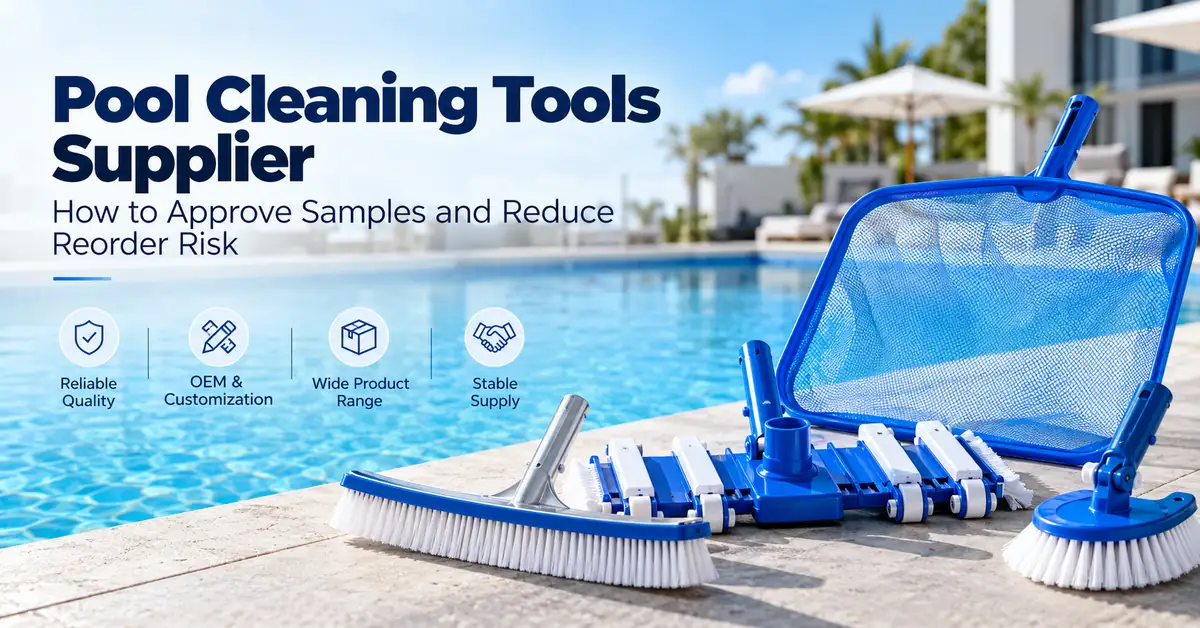
| 20-inch pool wall brush | 20-inch cleaning width; aluminum-related construction described in listing | Broad walls and floors | Bristle grade, backplate/handle material, pole fitting |
| 18-inch deluxe pool brush | 18-inch format; aluminum-back design described | Alternative brush width for retail or service ranges | Exact model, bristle stiffness, packing |
| 360-degree round pool brush | Round/multi-angle brush design | Corners, curved edges, and difficult-to-reach surfaces | Intended finish, dimensions, connector |
| 17-inch pool skimmer net | 17-inch listing; shallow nylon mesh | Routine collection of surface debris | Mesh aperture, seam strength, net depth |
| 14-inch flexible vacuum head | 14-inch format; flexible head design | Manual cleaning of pool floors | Hose port, pole clip, flexibility, finish compatibility |
| WB0110 vacuum brush head | 20-inch head; PP, nylon, and plastic listed | Combined brush and vacuum-head selection | Suction interface, sample performance, packing details |
The WB0110 vacuum brush head product page provides a useful example of a model-specific specification. However, no table can replace confirming the current drawing and approved sample.
Sourcing principle: Select the smallest set of clearly differentiated products that covers your buyers’ applications, rather than purchasing many overlapping SKUs with unclear benefits.
4. What Specifications Belong in a Wholesale RFQ?
A professional RFQ should allow suppliers to quote the same product requirements. Without this, low prices may reflect different materials, lighter construction, simpler packaging, or missing accessories.
| Specification Field | What the Buyer Should Request |
|---|---|
| Product identification | Product name, manufacturer's model, buyer SKU, drawing revision |
| Dimensions | Brush width, head dimensions, net opening, applicable tolerances |
| Materials | Housing, bristle, frame, net, fastener, and fitting materials |
| Connection details | Pole interface, clip arrangement, vacuum hose port dimensions |
| Performance/fit | Intended surface, debris type, operating method, sample acceptance criteria |
| Appearance | Color reference, logo location, surface finish, acceptable cosmetic defects |
| Packaging | Polybag or retail box, barcode, label languages, carton quantity and measurements |
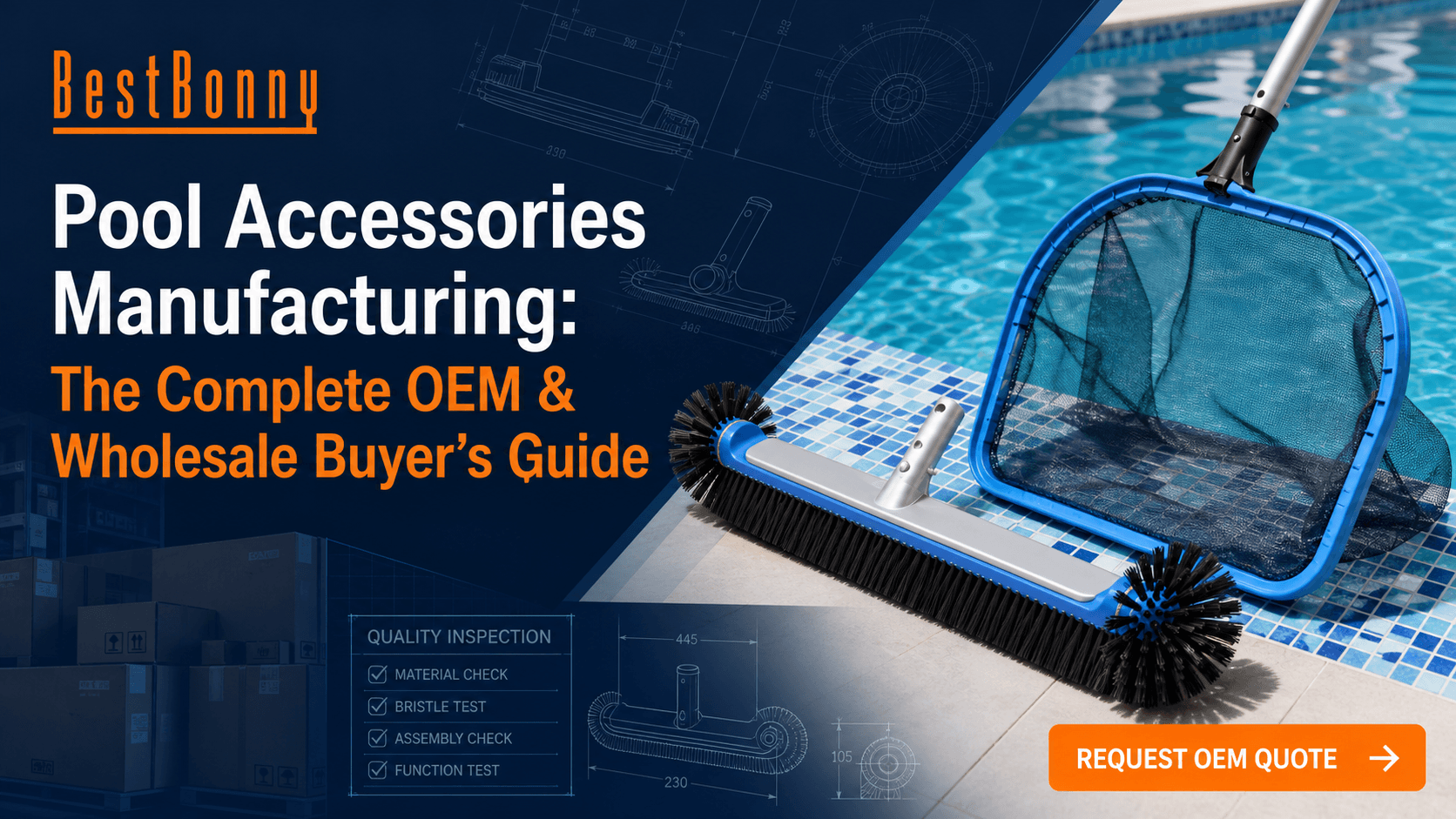
| Quality documentation | Inspection checklist, relevant test reports, lot identification, sample records |
| Commercial terms | Quantity by SKU, MOQ, pricing basis, tooling, payment, Incoterms, delivery destination |
Ask for a dimensioned drawing or controlled specification sheet where available. If a supplier cannot confirm critical fitting dimensions, treat that as an open technical question rather than assuming compatibility.
5. Use a Golden-Sample Approval Process
For a first order, sample verification should be a formal purchasing gate. The objective is not to prove that one attractive sample looks good; it is to create an agreed reference for production.
-
Define the application. List target pool finishes, cleaning conditions, existing pole and hose systems, and retail-market requirements.
-
Request representative samples. Ask for the actual construction and materials that will be used in the proposed bulk order, not an unspecified promotional example.
-
Check dimensions and interfaces. Measure brush width, hose ports, pole clips, and net-frame geometry. Test fittings on the equipment your customers use.
-
Evaluate construction. Examine bristle retention, frame rigidity, net stitching, sharp edges, moving joints, and visible molding defects.
-
Trial the tools. Test the brush on a representative approved surface, the net with typical debris, and the vacuum head with the intended cleaning system.
-
Approve the packaging. Confirm artwork, model labels, barcode placement, instructions, unit protection, and export-carton markings.
-
Record the result. Sign off the sample, specification revision, photographs, and agreed inspection criteria before mass production.
The acceptance criteria should be measurable and agreed by both parties. A signed sample alone is less useful if its materials, dimensions, and components were never documented.
6. Quality Control: What Evidence Should a Buyer Request?
A reliable pool cleaning tools supplier should be willing to discuss how product quality will be checked. The buyer can organize the conversation around three stages:
-
Incoming materials: Agreed plastic and bristle grades, net material, and critical purchased components.
-
In-process checks: Molded dimensions, bristle insertion quality, assembled fittings, edges, and product appearance.
-
Final inspection: Functionality, quantity, approved artwork, barcode readability, carton markings, and consistency with the signed sample.
For volume orders, define what counts as a critical, major, or minor defect and agree on a sampling and acceptance plan. ISO 2859-1:2026 provides an international framework for attribute-based acceptance sampling, but a standard reference is not proof that a particular supplier or shipment has passed inspection.
For public aquatic facilities, the CDC’s 2024 Model Aquatic Health Code also provides operational context for cleaning and preventive maintenance. Local regulations and facility procedures—not a tool supplier's marketing text—determine applicable operating requirements.
Request any product-specific certificates or test reports needed for your target market, and check their scope, date, issuing organization, and exact model coverage. Do not assume that a factory-level certificate automatically applies to every individual cleaning accessory.
7. Can the Supplier Support Private-Label and OEM Orders?
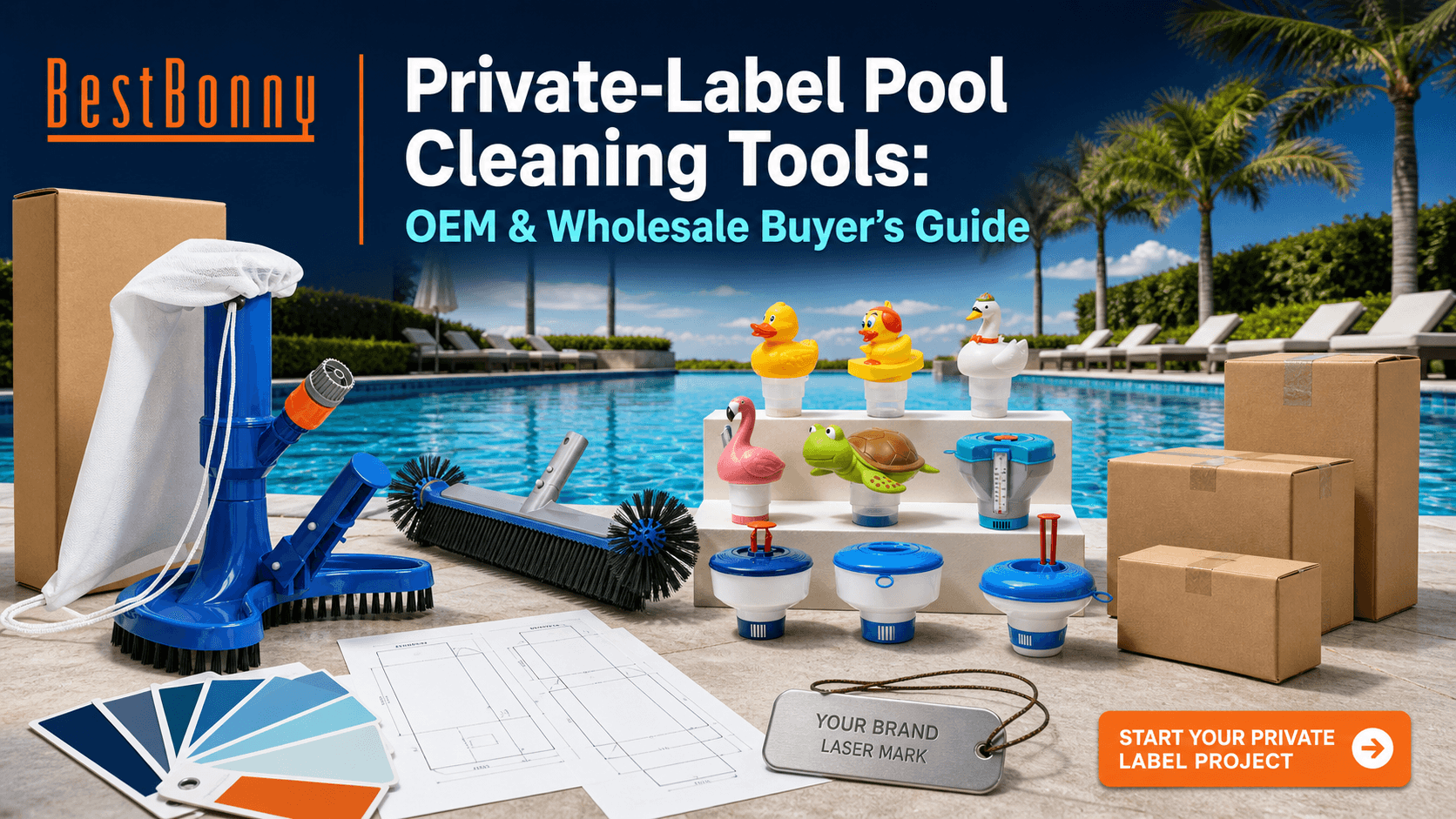
For a brand owner, consistent identity is part of product quality. BONNY’s Engineering & Design page describes OEM manufacturing, private labeling, customized packaging, material and color options, and ODM product engineering and prototypes.
Useful questions include:
-
Can the existing product be customized without new tooling?
-
Which modifications require molds, testing, or design approval?
-
Is the logo applied to the product, packaging, or both?
-
Who approves artwork and keeps the master version?
-
How are changes to materials or accessories communicated before repeat orders?
-
What intellectual-property and tooling arrangements will apply?
The appropriate customization scope, minimum volume, tooling charge, and development schedule must be agreed for the individual project. Avoid ordering printed packaging before the product sample and SKU naming are approved.
8. Compare Total Landed Cost and Reorder Risk
The lowest quoted unit price may not be the lowest cost after shipping, inspection, warehousing, and customer returns.
Indicative landed-cost framework:
Product price + tooling/branding allocation + packaging + inspection + freight + insurance + import duties/taxes + expected warranty or replacement costs.
For a meaningful comparison, ask every shortlisted supplier to quote against the same quantity, packaging, delivery term, and destination. Review carton dimensions and weights: bulky, low-value items can have disproportionately high freight costs.
Before paying for a large order, confirm how discontinued components, product revisions, defects, shortages, and future replenishment will be handled. A good sample is the beginning of supplier qualification, not the end.
9. A Practical 100-Point Supplier Qualification Scorecard
Use an evidence-based scorecard rather than selecting on price alone. The weights below are a suggested buyer framework, not an official industry certification or BONNY performance score.
| Evaluation Area | Weight | Evidence to Collect |
|---|---|---|
| Product fit and technical clarity | 30 | Drawings, measurements, surface and connector trials |
| Sample quality and repeatability | 25 | Approved sample, inspection records, defect definitions |
| OEM/private-label execution | 15 | Artwork process, prototype, tooling and change control |
| Total landed-cost transparency | 15 | Comparable quotation, packaging and shipping data |
| Supply continuity | 15 | Reorder terms, production plan, change notifications |
| Total | 100 | Approve based on documented results, not claims |
Set a minimum passing score according to your risk tolerance. More importantly, keep mandatory requirements—such as safe edges, material compatibility, and correct fittings—as pass/fail conditions. A strong commercial score cannot compensate for a critical product failure.
10. Move From Pilot Order to Repeat Supply
A controlled rollout helps reduce the consequences of a mistaken specification.
Stage 1 — Technical approval: Agree on the SKU list, drawings, material details, approved samples, and inspection plan.
Stage 2 — Pilot purchase: Begin with an order size appropriate for testing packaging, receiving procedures, field use, and customer feedback. MOQ and order size must be negotiated by product.
Stage 3 — Performance review: Record returns, fitting problems, appearance issues, and recurring customer questions. Separate actual product defects from incorrect application or installation.
Stage 4 — Repeat order: Issue a new purchase order against the approved revision, requesting advance notice of any component, process, or packaging change.
Also agree on order milestones, pre-shipment inspection timing, and freight documentation. Published lead times should not be treated as firm commitments for a customized or multi-SKU order.
11. Why Include BONNY on Your Supplier Shortlist?
Ningbo Bonny E-Home Co., Ltd. presents itself as a Chinese manufacturer of pool cleaning equipment and accessories, with a product catalogue covering wall brushes, skimmer nets, vacuum heads, and related products. Its engineering information describes product design, sampling, private-label customization, and manufacturing support.
For an importer or distributor, this makes BONNY a relevant candidate to evaluate when developing wholesale pool cleaning tools or an OEM accessory range. The commercially responsible next step is to request a model-specific quotation and verify the exact specifications, sample results, order requirements, and supporting documentation.
Explore BONNY’s full product catalogue or discuss customization with its team.
Frequently Asked Questions
1. How do I choose a pool cleaning tools supplier for wholesale orders?
Compare actual product specifications, sample results, connector compatibility, packaging requirements, QC evidence, and replenishment terms. Do not base approval solely on the lowest unit price.
2. What pool cleaning tools should an importer source first?
Start with the product categories your customers already purchase—commonly wall brushes, skimmer nets, and vacuum heads—then add specialized sizes or corner-cleaning designs where demand justifies them.
3. Are all pool brushes safe for vinyl-lined pools?
No. Brush material, stiffness, edges, and design must suit the finish. Confirm supplier guidance and validate a sample before making compatibility claims.
4. Do vacuum heads and skimmer nets fit universal telescopic poles?
Not necessarily. Pole clips, interfaces, and vacuum hose ports vary. Request dimensions and perform physical fit checks with the systems sold in your market.
5. Can I order pool cleaning tools with a private label?
BONNY describes private-label, packaging, color, and material customization services. Confirm availability, branding methods, minimum quantities, and costs for each proposed SKU.
6. What is the usual MOQ for bulk pool cleaning accessories?
There is no reliable single MOQ across product types, customization levels, and packaging options. Ask for a model-specific quotation with the required quantity and branding details.
7. How can I verify quality before a large wholesale order?
Approve representative samples, document dimensions and materials, test use and fit, define defect categories, and agree on a pre-shipment inspection plan.
8. What influences the final wholesale price?
Material grade, product size, tooling, customization, order volume, packaging, inspection, shipping method, and destination all affect the total cost.
9. How should buyers manage changes between repeat orders?
Keep a controlled product specification and golden sample. Require written approval for changes to dimensions, materials, critical components, logos, or packaging.
10. What information should I send to request a quotation?
Include target SKUs or product links, application and pool surface, expected quantity, destination country, branding requirements, packaging preferences, and any drawings or fitting dimensions.
Conclusion
Selecting a pool cleaning tools supplier is a process of reducing uncertainty before you scale. Buyers who verify product fit, document specifications, approve samples, and establish inspection and replenishment rules are better positioned to avoid mismatched products, unnecessary returns, and repeat-order disputes.
BONNY offers a catalogue of manual pool cleaning accessories alongside OEM/ODM engineering and branding services. If you are sourcing pool brushes, skimmer nets, vacuum heads, or a private-label range, contact BONNY for a wholesale quotation. Share your target products, estimated quantities, market, and customization requirements so the team can review the right options for your project.